Vision Pt 2
 Call Kai
 Learn
 Practice Test
 Spaced Repetition
 Match
 Flashcards
 Knowt Play
1/31

There's no tags or description
Looks like no tags are added yet.
32 Terms
opsin
GPCR
rod opsin
rhodopsin
cone opsins
S, M, L opsins
light on
photon is absorbed by rhodopsin which changes 11 cis retinal to all trans retinal. Causes a g protein cause transducin to undergo conformational change to activate PDE
scoptic visions
rods nightime vision
mesoptic
daylight and nighttime vision
rods and cones
photoptic
cones
daylight vision
testing signal transduction in a photoreceptor
did an inside out clamp and measured the conductance with increasing amount of cGMP and saww that conductance increased
dark conditions
photo receptors contain guanyl cyclase which converts GTP to cGMP. cGMP opens a nonselective cation channel which cause depolarization in the dark
light conditions
light actives rhodospin, which activates transducting and cGMP PDE. PDE hydrolyzes cGMP to GMP. overall decrease in cGMP. Closure of channels which causes the photoreceptor to hyperpolarize
sensitivity of a single rod
put rod in saline and pipetite it out and then measure the current. you would see in the dark there is a high inward current but in the light there is no current.
light adaption
less bright to more bright room
adaptation
occurs within photoreceptors
same cell should be able to with some tweaking adjust to low light then medium light then high light
ca2+ is crucial to the three adaptation mechanisms with its impact on guanyl cyclase.
GC needs
GCAP to function
GCAP
gunayl cyclase activating protein
in the dark gcap
Ca2+ binds to GCAP inhibiting it so less cGMP synthesis
in the light gcap
activation of light decreases cGMP which decreases Ca in
adaptation to light
low ca2+ in causes GCAP to be activated because the calcium break is released causing an increases in cGMP production. CNG channels open even in the presence of light

low intensity of light
increase cGMP causes CNG channels to open even in the presence of light.
high intensity of light
more light is now requried to close the channels
vertical pathway
photoreceptor—> bipolar—> retinal ganglion cell
receptive field
region of visual space where a stimulus can increase or decrease the excitability of a neuron
pathway general
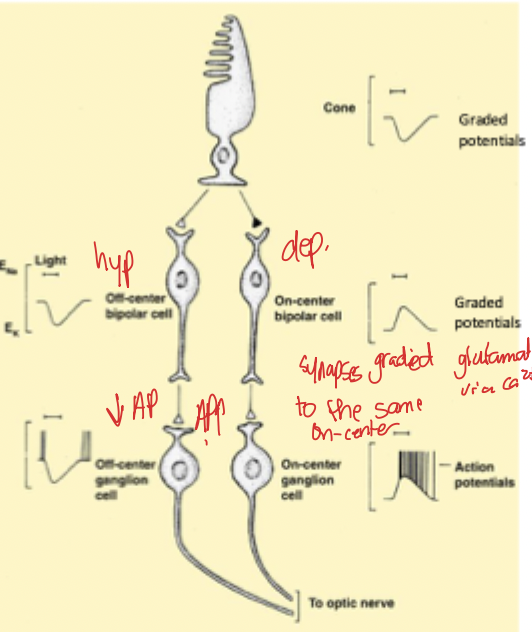
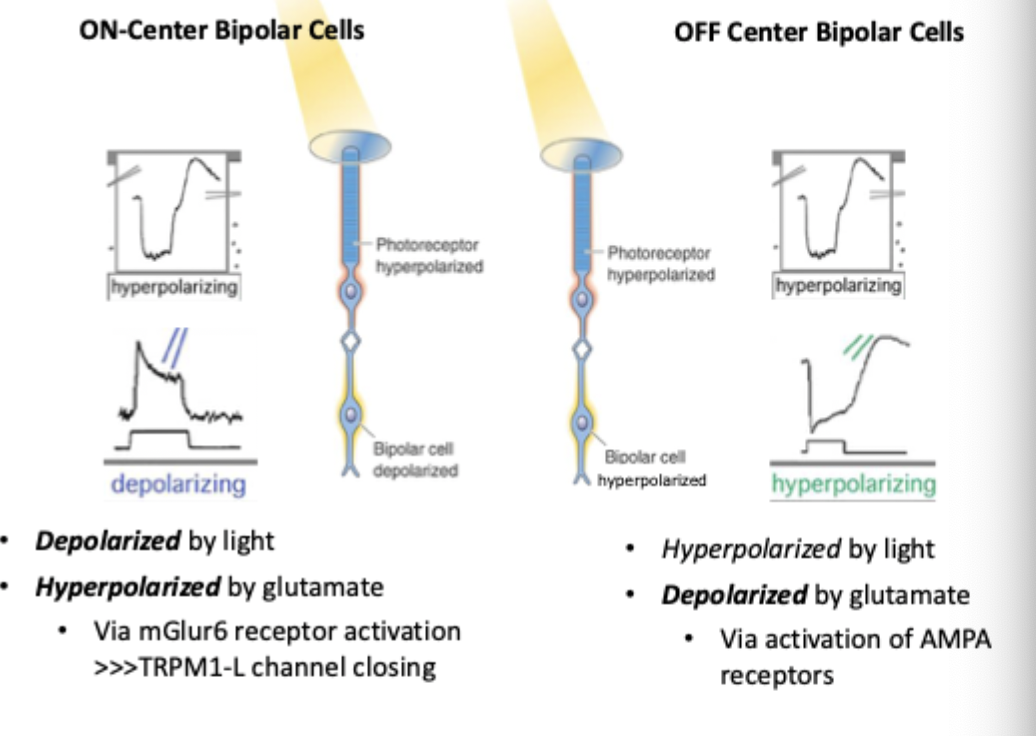
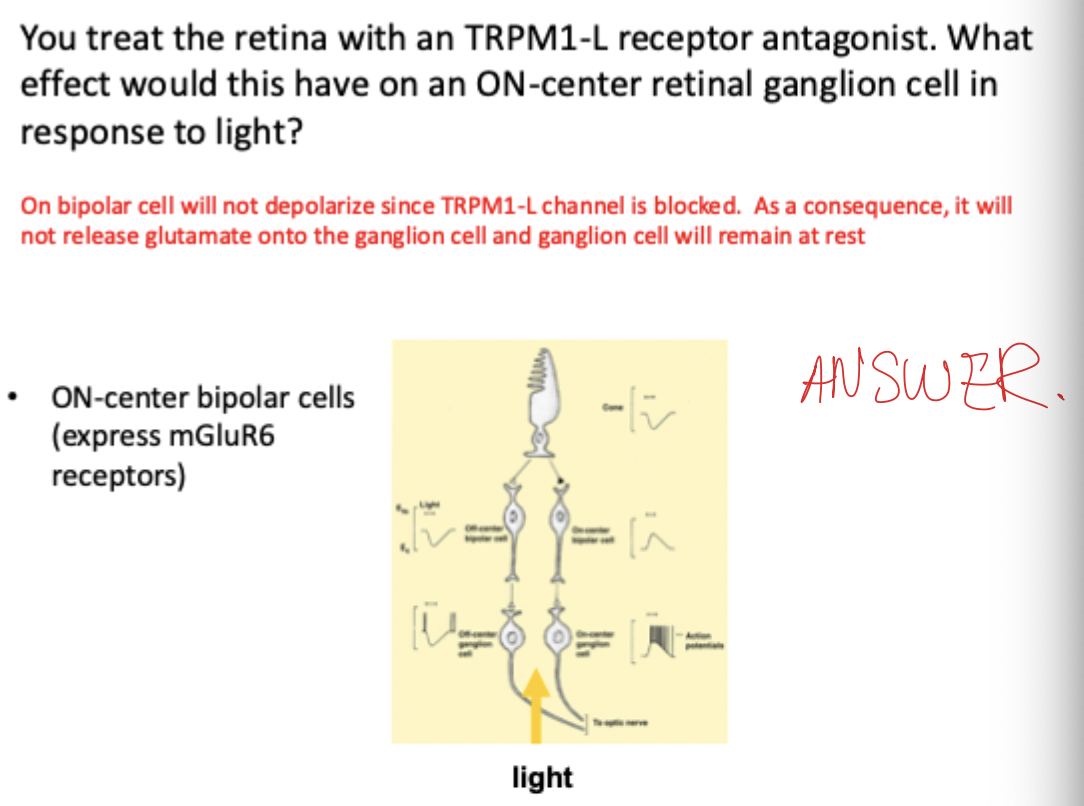
on center bipolar
= off center surround
expressed mGlur6
depolarize and increase firing rate of on center ganglion cells
off center bipolar cells
= on center surround
expressed AMPA receptors
hyperpolarize and decrease in firing of off center ganglion cells.
activation of mGLur6
close channels on on bipolar cells
dark and glutamate on center
more glutamate is released from the photoreceptor and the channels are closed
light and glutamate on center
less glutamate is released into bipolar cells from input photoreceptors and channels are open
TRM1
important channel important for on bipolar cells. when it was knockout there was no current in the onbipolar neurons which are mediated by mGlur6
mechanism of trip 1

summary