BIOL 172 Exam 1
 Call Kai
 Learn
Learn Practice Test
 Spaced Repetition
 Match
Match Flashcards
 Knowt Play
1/252

Earn XP
Description and Tags
Protists, 4 Supergroups,
Name | Mastery | Learn | Test | Matching | Spaced | Call with Kai | Chat |
|---|
No analytics yet
Send a link to your students to track their progress
253 Terms
What are the levels of Organizations in Biology?
Biosphere, Ecosystems, Communities, Populations, ORGANISMS, Organs/Organ Systems
Evolution =
changes in organisms’ DNA over time
The goals of every organisms are _________+________
survival;reproduction
Taxonomy = ?
classification method
Phylogeny
'“tribe-making”
There is an estimated ____ _______ extant species
8.7 MILLION
The Taxa (DKPCOFGS)
Domain, Kingsdom, Phylum, Class, Order, Family, Genus, Species
How many domains are in the Modern ToL (Tree of Life)?
3 domains
Where are the Eukarya Supergroups in The Taxa?
Between Domain and Kingdom
The ToL is built using _______
Phylogenies
What is a Protist?
Any eukaryote that is NOT a fungus, plant, or animal
What was a protist once classified as?
The Kingdom Protista
A protist is no longer classified together as Kingdom Protista because …..
paraphyletic
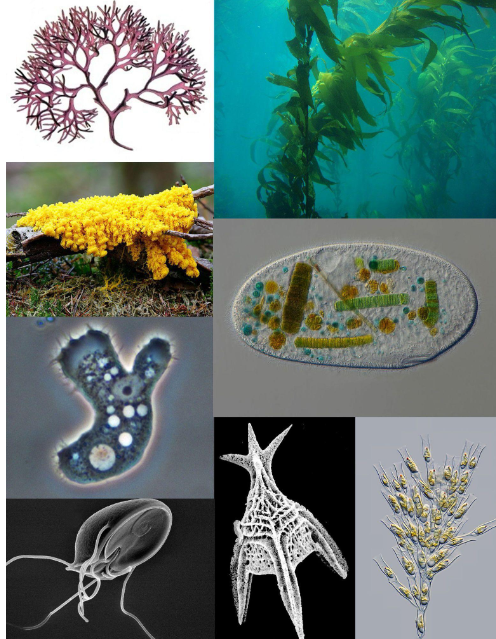
Protists are mostly …..
unicellular, NO tissues
What are Protists NOT?
Plants, Animals, or Fungi
“Protist” is paraphyletic, not _______
monophyletic
Protists evolved across all three feeding types which are….
Producers(Autotrophs), Consumers (Heterotrophs), and Mixotrophs
Producers (Autotrophs)
“Self feeding” They make organic molecules(biomolecules) from scratch (CO2 and inorganic reactants)
Consumers (Heterotrophs)
“different feeding” They must consume pre-made organic molecules
Mixotrophs
“Mixed feeding” Can produce AND consume other organisms
Almost all Autotrophs are _____________, using solar energy to make GLUCOSE through photosynthesis.
photoautotrophs
The rest of Autotrophs (Producers) are ________ that are in places like deep-sea hydrothermal vents, geysers, caves, and deep in rock
chemoautotrophs
__________ occurs in some prokaryotes and all plants, but also algae and certain other protists.
Photosynthesis
Almost all ________, including humans, depend on photoautotrophs for food and oxygen.
heterotrophs
Endosymbiosis
one cell engulfs another cell, which becomes an endosymbiont and then in the host cell
________ evolved through 1st Degree endosymbiosis of an aerobic heterotrophic bacterium —- happened ONCE!
Mitochondria
Each type of ____ evolved through endosymbiosis events
Plastid
________ is how PROTISTS evolved from PROKARYOTE ancestor(s). (e.g. Chloroplasts vie 1st Degree endosymbiosis of cyanobacterium → green algae)
Endosymbiosis
Endosymbiosis occurred repeatedly in the evolution of ______
Eukaryotes
In Domain ________, One phylogeny splits all eukaryotes into 4 “supergroups”
Eukarya
The four supergroups of Domain Eukarya
Excavata, SAR clade, Archaeplastida, Unikonta
The 3 members in the Excavata supergroup.
Key characteristics: PROTISTS, UNICELLULAR, “excavated” feeding groove, mostly anaerobic environments with reduced mitochondria
Diplomonads, Parabasalids, Euglenozoans

Diplomonads have a _____-______ _______!
(e.g. Genus species =Human diarrhea parasite from infected freshwater sources)
Non-functional mitochondria ; Giardia lamblia
Parabasalids have reduced mitochondria called __________ → produce H adn ATP anaerobically. Genus species- common STI that infects urinary& reproductive tracts
hydrogenosomes ; Trichomonas vaginalis

Euglenozoans have which unique features? (Excavata supergroup)
spiral or crystalline rod inside their flagella
The Euglenozoans includes ______ and ______
kinetoplastids ; euglenids
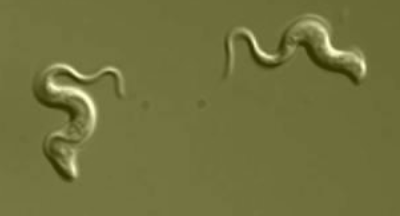
The kinetoplastid _______ _____ infects humans and cattle → African sleeping sickness from Tsetse flies (vectors)
Trypanosoma brucei
Trypanosoma brucei evades immune system of host using millions of _____ ____ ____ (VSG’s) expressed sequentially
variable surface glycoproteins
The “___” clade was established entirely by DNA homologies
SAR
The SAR Clade contains 3 related clades which are
Stramenopiles, Alveolates, Rhizarians

This clade includes important autotrophs and some heterotrophs (diatoms, golden algae, brown algae) → uni- & multicellular
hint: part of SAR’s clade
Stramenopiles
Important Unicellular Stramenopiles like _______ are unicellular algae with a unique 2-part glass-like cell wall
Diatoms
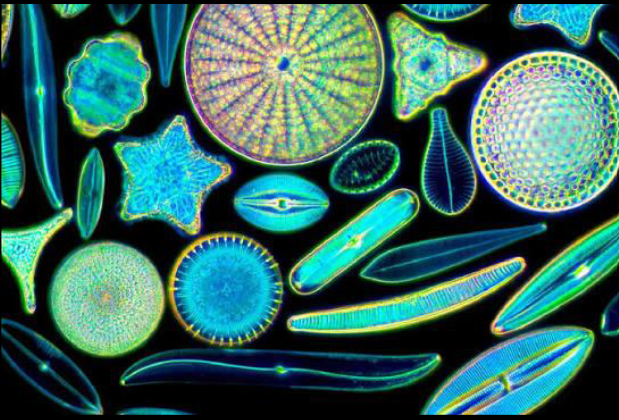
Stramenopiles like Diatoms produce _____ of all O2 on Earth
20%
Important multicellular Stramenopiles include ____ ____ (aka “seaweeds” or macroalgae) largest;marine most complex algae
Brown algae
This SAR’s clade includes dinoflagellates, apicomplexans, and ciliates and is named for membrane bound sacs (cortical alveoli) just under the cell membrane
Alveolates

These IMPORTANT Alveolates could be autotrophs, heterotrophs or mixotrophs.
**Some could release toxins in the presence of large fish that cause the “red tide”
Dinoflagellates
__________ are ALL unicellular and are specialized parasites of animals
e.g. Plasmodium → malaria
Toxoplasma → toxoplasmosis
Apicomplexans
Apicomplexans spread through their host as infectious cells called _______
sporozoites
One end of an Apicomplexan cell, the apex contains a _____ __ _________ specialized for attaching to and penetrating host cells and tissues
complex of organelles

4 species of ________ cause malaria in humans'
e.g. Insect vecot = Anopheles mosquitoes
Plasmodium
Toxoplasma induces _________ ___________ in hosts
behaviorial changes
(e.g. A rat willingly shows itself to a cat so cat can eat it and then cat poops and contaminates its next victim)
A large varied group pf mostly living protists are named for their use of cilia to move and feed.
Most well known Paramecium
Ciliates
Ciliates have large macronuclei and small micronuclei, and has Genetic variation (recombination) via ________
conjugation
Conjugation in ciliates is a ..
sexual process, but not sexual reproduction.
two individuals exchange haploid micronuclei
Ciliate reproduction via separate asexual process of ________ ________:
one cell splits into two (mitosis)
binary fission
The supergroup _________ is divided into clades Amoebozoa & Opisthokonta
Unikonta
The Supergroup Unikonta include many protists like ____ _____ and the Kingdom ______ and Kingdom _______
Slime molds
_________ are amoebas that move with lobe- or tube-shaped pseudopodia (foot-like extensions) and include slime molds
Amoebozoans

____________ _____ _____ are amoeba “supercells containing many nuclei that inhabit moist soil or decaying vegetation and feed by phagocytosis (Cell-feeding, engulfing)
Plasmodial slime molds

__________ ________ ______ are microscopic amoeba that feed individual cells but can form multicellular aggregated to migrate as a visible mass and disperse reproductive spores.
Cellular slime molds
Fungi
Single celled or multicellular heterotrophic eukaryotes (most have flagellum)
Fungi’s similarities with plants:
cell walls, non-motile, growth from tips
Fungi’s similarities with animals:
chitin as structural material, and use melanin for skin protection, and heterotrophic
_____ are more closely related to animals than to plants
Fungi
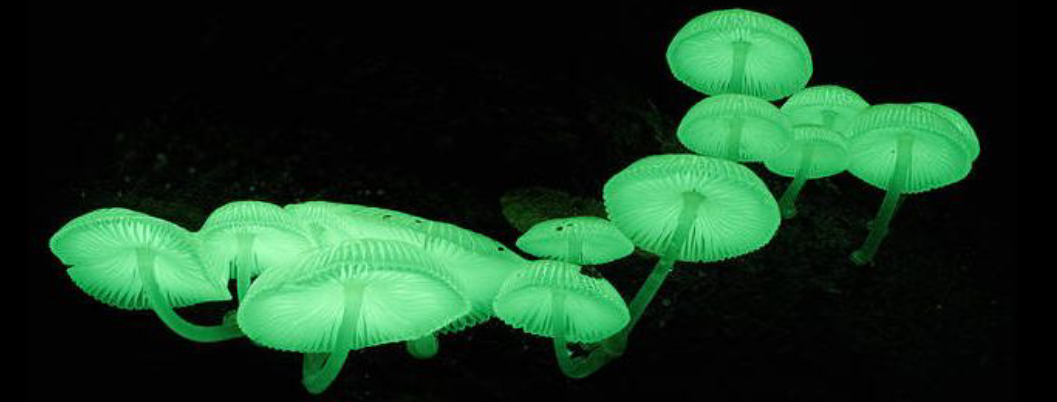
Over 70 species of fungus are _______
bioluminescent
The biggest organism ever is the “______ _______” Armillaria can cover more than 1800 football fields
honey mushroom
The main “body” of the fungus is made up of thin, thread-like filaments that are called ____
hyphae
A mass of hyphae is called a _______
mycelium
__________ fungi lack septa= continuous cytoplasmic mass with hundreds or thousands of nuclei.
Most fungi have hyphae divided into cells by septa with pores allowing for movement of organelles.
Coenocytic
Fungi obtain food by _______ __________ and _________
extracellular digestion ; absorption
Fungi secrete digetsive enxymes into the environment, then absorn the nutrients released; called “_________”
saprotrophic
Most fungi are _______ : live on decaying organisms
decomposers
Some fungi are _______: extract food from living organisms
parasites
A few fungi are _____: paralyze prey
** some unique predatory fungi have specialized hyphae for capturing prey
predators
Fungi can extract or exchange nutrients with plants with specialized hyphae called ______ that penetrate the tissues of their host
haustoria

___________ are mutually beneficial relationships between fungi and plant roots
Micorrhizae
Mycorrhizae are mutually beneficial symbioses between fungi and _______ ______
plant roots
______ are a mutualistic symbioses of fungi+ algae or cyanobacteria
Lichens
The Fungi of a Lichen provides attachment, structure, nutrients, and help anchor soil physically and uses _______
glomalin
Fungi reproduce using sexual or asexual ________
spores
(Almost all) fungi spend most of their lives as ______, becoming ______ only for the purpose of meiosis & sexual reproduction
haploids ; diploid
In Fungal reproduction, asexual reproduction is done by ______ most of the time
haploids
In stressful conditions for Fungal reproduction, they switch to sexual reproduction:
_________ (fusion of +/- cytoplasm) and is followed by _______ (fusion of +/- nuclei → _______ _____)
Plasmogamy ; Karyogamy ; diploid cells
Spores are ____ haploid reproductive cells that are produced sexually (meiosis) or asexually (mitosis)
genderless
______ are widespread in lakes and soils and include decomposers and parasites.
Chytrids
Ergot of rye is caused by an _______ and produces toxins
(think: LSD, gangrene, hallucinations, Most fungi are _____)
ascomycete
Genus species is an ascomyte used to make beer, bread, champagne
Saccharomyces cerevisiae
The 2nd biggest group of fungi
Basidiomycetes
Basidiomycetes include _____, puffballs, and shelf fungi, mycorrhizae, and plant (decomposers of wood)
mushrooms
Chytrids =
MOST DEADLY wildlife pathogen! and are deadly to amphibians
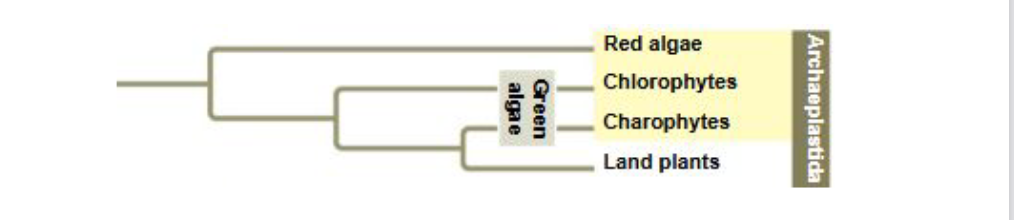
Supergroup ______ includes green algae, red algae, and land plants
Archaeplastida
Green algae is a Paraphyletic group of >7000 species including _______ and _____
chlorophytes and charophytes
Green algae includes ________ + _______ species and require aquatic or damp habitats
unicellular+multicellular
“Most primitive” (simplest) chlorophyte sexual and asexual stages have primitive traits: (motile)
unicellular with flagella
Green algae involved in 3 ways:
Formation of colonies, true multicellular bodies, and repeats division of nuclei coencytic organism (ONE BIG CELL)
In the Kingdom Plantae —Land plants share many traits with green algae but terrestrial (land) plants share 3 key traits ONLY with charophytes:
Rings of cellulose-synthesizing complexes
Structure of flagellated sperm
Formation of phragmoplast
The long-chain structural carbohydrate, cellulose, is synthesized by _____ of protein in the cell membranes of both charophytes and plants
rings
Charophytes and plants use a group of microtubules called a _____ (“fence builder”) to organize the cell plate during cell division (cytokinesis)
phragmoplast
The Pros of Moving onto Land
unfiltered sunlight
more CO2
nutrient-rich soil
escape from aquatic herbivores and pathogens
The Cons of moving onto land
water scarcity: need desiccation protection
full brunt of gravity: needs structural support