PCB 3043 Exam 3
 Call Kai
 Learn
 Practice Test
 Spaced Repetition
 Match
 Flashcards
 Knowt Play
1/137

Earn XP
Description and Tags
Clickers, Practice Exam, required material
138 Terms
According to the article on the mycorrhizal marketplace that you were invited to read, the fungus rewarded the root that gave it more phosphorus by giving that root more carbohydrate.
False.
According to the studies discussed in class, a zebra’s bold stripes are adaptive because they disrupt a lion’s search image for prey.
False.
Competition between two species of microbe growing together (compared to each growing separately) results in reduction of the population of only the poorer competition.
False.
According to the article “What is biodiversity and why does it matter to us?” that you were invited to read, tropical tortoises and monkeys help fight global warming by dispersing the seeds of forest trees.
True.
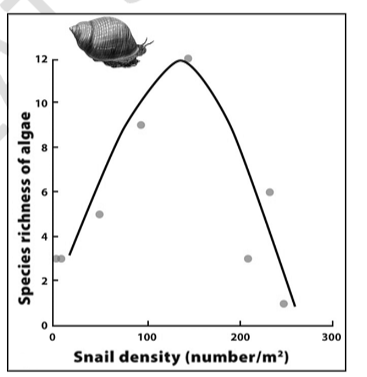
In the study of the tidepool communities shown by the graph, low grazing pressure (intensity of herbivory) on algae by snails enabled the highest algal diversity.
False.
Passionflowers are evolving more variation in leaf shapes while their butterfly herbivores are evolving new search images for passionflower leaves—-this is an example of coevolution.
True.
A common way that predators avoid eating all their prey is that they decide to eat less, to save some prey for later.
False.
A paloverde tree shades a young saguaro cactus, thus allowing it to establish. There is enough water for both tree and cactus at this point, so the cactus does not effect the tree.
Commensalism.
Deer eat the acorns (seeds) of oaks, but the deer don’t disperse or bury any of the acorns.
Predation/herbivory.
A female fly pollinates a Stapelia flower, which smells like a dead animal, and lays its eggs on the flower. There is nothing for the young maggots to eat, however.
Parasitism.
Bromeliads (tank plants) growing on branches of a rainforest tree collect falling dead leaves and dead insects in a central “cup”. The leaves and bugs decompose, releasing nitrogen. When it rains, some of the N splashes down to the roots of the tree and is used by the tree.
Mutualism.
Cockroaches, pigeons, cats, and rats evolved in different biomes, but today they live together in cities because they are all adapted to the human-made environment.
Ecological fitting.
Pigeons and sparrows both live in cities. Pigeons feed on large food items such as human leftovers, while sparrows feed on small crumbs, seeds, and even insects. Pigeons nest on ledges of buildings, while sparrows nest in crevices and holes in buildings.
Niche partitioning.
Decomposing Eucalyptus leaves prevent seeds of other tree species from growing.
Allelopathy.
On the South FL coast, red mangroves grow closest to the ocean (in salt water), with black mangroves farther inland, and buttonwoods the farthest inland (in mostly freshwater).
Zonation.
In coastal British Columbia (BC), salmon are major prey of killer whales and seals. Those that survive to adulthood leave the ocean to swim up rivers to spawn. After they spawn, bears and wolves catch the exhausted salmon, go into the forest, and eat, discarding the carcasses. Then, birds small mammals, and insects scavenge the remains. Thus, the salmon are a major food source for forest animals, as well as marine mammals. In addition, after hatching in the stream, young salmon feed on aquatic insects and regulate their population.
Answer from the perspective of the role of salmon.
Keystone species.
In the BC forests described in the preceding question, the remains of the salmon that are not eaten by animals are consumed by decomposers, increasing the N and P content of the soil. Understory plants are more diverse in habitat where the bears consume the salmon, than in similar habitat where bears have been overhunted.
Answer from the perspective of the added soil N and P.
Resources.
A community of microorganisms and tiny plants live on leaves of tropical rainforest plants and are called the phyllosphere or “leaf world”. Leaves that don’t dry quickly after a rain support liverworts, which in turn shelter tiny nematodes, mites, and insects. Leaves that dry more quickly are richer in lichens. The undersides of leaves have a different microbial community than the top surfaces do.
Habitat complexity.
In coastal SW Australia, macroalgae are extremely diverse. Macroalgal diversity is highest where wave action “prunes” individuals of the most common and fastest growing species, opening up space for slower growers to establish. Algal diversity is not as high at microsites where exposure to rough surf is extreme, or at sites sheltered from wave action.
Intermediate disturbance.
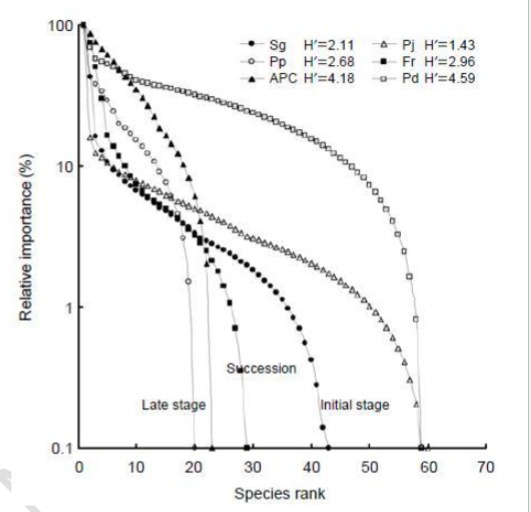
Which community has the lowest species richness?
Pp

Which community has the highest species evenness, for the 20 most common species?
Pd

These communities are:
At the edge of a stream.

The days to maturity for a crop of spinach grown hydroponically under various treatments are as follows (note: fewer days to maturity = faster growth).
Under these conditions, the limiting resource(s) for spinach growth was/were:
N only.
When Irish people starved during the Famine of 1847 while food was being exported to England, that was ___; when police (supporting British interests) suppressed an Irish rebellion the following year, that was ____.
Direct (interference) competition; direct (interference) competition.

The omnivores eat recently-drowned insects that are potential food items for the Nepenthes, but then excrete nitrogenous (N) wastes that are more available to the leaf. The relationship of the omnivores to Nepenthes is:
Mutualism.
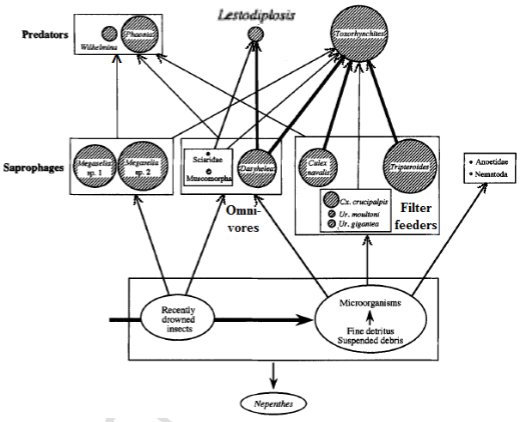
After a virus kills Lestodiplosis, and thus fewer omnivores are eaten, there would then probably be ___ microorganism and ___ filter feeders.
Fewer; fewer.
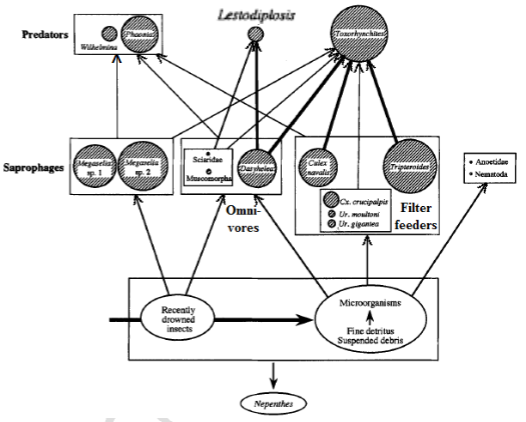
The effect of microorganisms and filter feeders in the previous question is an example of:
Trophic cascade: indirect effects.
Studies of mutualism we discussed in class showed all of the following except:
Loss of forest elephants increases dispersal of rainforest canopy trees.
When sea otters were removed by human activities from some marine kelp forest communities, sea urchin grazing on kelps increased, and most of the kelps were lost, creating an urchin barren community dominated by smaller algae and sea urchins. When the otters returned, the kelps grew back and resumed their role in the community. This is an example of community:
Resilience.
In predator prey dynamics (from actual results studied in class),
Predator populations lag in response behind prey populations.
The Lotka-Volterra model would be the most realistic if what else were considered?
Multiple predator species, prey food availability, and multiple prey species.

In the data for prey populations, at mainland (high predator density, open circles) and island (low predator density, closed circles) sites, the prey populations have a ___ cycle frequency, and ___ prey density is lower on the mainland.
Similar; minimum.
Competition between populations of different species is
Interspecific.
Plasmodium cells live inside human red blood cells (RBCs) and eat hemoglobin. When the RBCs burst, releasing the Plasmodium, a malarial fever results, but killing the human host is not a necessary part of the Plasmodium life cycle. Plasmodium is thus
An endoparasite.

The study compared the diets of rodents and ants in the desert. When rodents were excluded, large seeded plants did ___ than small seeded plants, resulting in ___ food for the ants.
Better; less.

These results show that competition can be affected by
Trade-offs, for example of foraging vs. defense ability.

Comparing the error bars, it is probable that with 8 newts present, survival of spadefoot toads was ___ survival of spring peepers.
Not different from.

Which statement below is a valid part of the closed hypothesis of community assembly?
Removal of several species would have more of an effect than in the open community.
According to the movie “The Queen of Trees”
Ficus trees in a population flower and fruit at various times throughout the year.

A yucca moth that lays 4 eggs in a yucca flower would have ___ probability of producing offspring than/as a moth that lays 12 eggs in the flower.
Much higher.
Mycorrhizal fungi
Allow the plant to obtain nutrient from beyond the root depletion zone.
According to Ricklefs & Relyea, the most important in-host parasite population dynamics is the parasite’s
Ability to infect new hosts.

At the stage of the cycle shown, the predator population is ___ and the prey population is ___.
Increasing; decreasing.
The larva of the Aphidius wasp consumes the internal organs of its aphid host, eventually killing it. This trophic strategy makes the wasp larva a(n)
Parasitoid.

After resident rabbit mortality from myxomatosis declined, newly-imported rabbits (from a population never exposed to the virus) were now exposed to the resident virus. They encountered 30% mortality. This is most clearly evidence that
The virus had evolved lower virulence.

Which species does/do better when grown alone, compared to when they are coexisting?
Both species.

According to these results, it is most reasonable to infer that between the two diatoms, ___ has a greater need for P, and ___ has a greater need for Si.
Cyclotella; Asterionella.

The realized niche of Balanus is ___ its fundamental niche because it is the ___ competitor.
The same as; better.
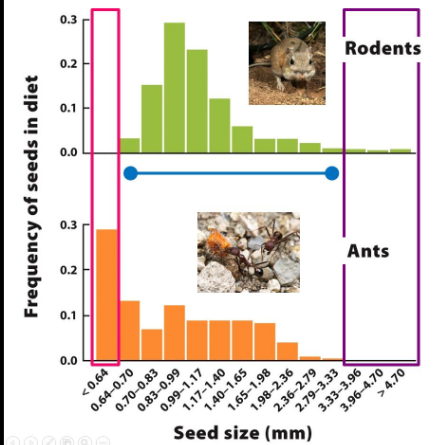
If rodents and ants have the seed diets shown, when both are present ___ benefit. If rodents are excluded and large-seeded (faster growing) plants now outcompete the small-to-medium-seeded plants, then ants will eventually do ___.
Neither; worse.
In the AM mutualism, the fungus might least benefit the plant when
On a farm, soil is tilled and fertilized.

The dispersion of the youngest megafauna-dispersed trees is ___ compared to the adults, suggesting the young trees; dispersal is ___.
More clustered; less effective.

When a yucca moth lays more than 6 eggs in a flower, there is a ___ probability that the developing fruit will be aborted, and thus a ___ probability that the moth’s offspring will survive.
Higher; lower.
If pine rockland (R) occurs only where there is fire and hardwood hammock (L) only where there is not fire, you would expect the structure of these S FL upland communities to be
Closed

These results suggest that at low elevations, the tundra community structure is ____, and at high elevation, it is ____.
Independent; interdependent.

The biota with many abundant (>1% relative abundance) species but few rare one is
Forest birds.

People in New England collect edible periwinkles from tide pools. To maximize algal diversity, one should collect 50 snails/m² from pools with a snail density of
200 snails/m²
Sharks are being severely overfished. With fewer sharks, there will be ___ sea turtles, and ___ seagrass for (commercial) fish and invertebrates.
More; less.

In the heavily fertilized plots, over time, species richness ___ and species evenness ___.
Decreased; decreased.
What type of ecological relationship exists between plants and mycorrhizal fungi?
Mutualism
What do plants primarily provide to mycorrhizal fungi?
Carbohydrates (carbon)
What do mycorrhizal fungi provide to plants?
Phosphorus, nitrogen, and other benefits.
What is the main finding of Fair Trade at Plant Roots?
Plants and fungi reward partners that provide more resources.
What does reciprocal control mean in mycorrhizal mutualism?
Both organisms adjust exchanges based on partner contributions.
How do plants reward fungi that provide more phosphorus?
They supply more carbon.
What happens to fungi that contribute fewer nutrients?
They receive less carbon from the plant.
What did scientists previously believe about the control of mycorrhizal symbiosis?
Plants controlled the symbiosis.
Which plant was used in the experiment involving three fungal species?
Medicago truncatula.
What happened when different fungal species provided different levels of phosphorus?
Fungi supplying more phosphorus received more carbon.
What was varied in the experiment involving carrot roots and one fungal species?
Phosphorus availabilty.
What did the carrot-root experiment demonstrate?
Fungi with more phosphorus available received more carbon.
How did researchers test whether fungi could reward plants?
They grew one fungus with roots offering different carbon levels.
Which roots received more phosphorus from the fungus?
Roots with higher carbon availability.
How do reciprocal rewards help maintain mutualism?
By favoring cooperative partners and discouraging cheating.
In Fair Trade at Plant Roots, what does ‘cheating’ refer to?
A fungus contributing fewer nutrients while benefiting from the exchange.
Which nutrient was the primary focus of the resource-exchange experiments?
Phosphorus
Which additional factors might influence resource exhange?
Nitrogen contributions, soil improvements, and environmental conditions.
What nutrient transport did reasearchers plan to investigate next?
Nitrogen.
What is the overall conclusion of the study in Fair Trade at Plant Roots?
Plants and fungi both regulate resource exchange through reciprocal rewards.
What is biodiversity?
The variety of life, including its forms and interactions
What are the major levels of biodiversity described in the What Is Biodiversity and Why Does It Matter to Us?
Genes, species, communities, and ecosystems.
Why is biodiversity essential to humans?
It supports food, clean water. oxygen, and ecosystem stability.
Which ecosystem is provided by bees?
Pollination of crops and wild plants.
How do coral reefs and mangroves benefit coastal communities?
By protecting coastlines from storms and tsunamis.
Why are seed-dispersing animals important for climate regulation?
They help regenerate trees that absorb carbon dioxide.
Where is biodiversity generally highest?
Tropical regions.
Approximately how many species of animals, plants, and fungi had been formally recorded in What Is Biodiversity and Why Does It Matter to Us?
1.7 million
According to What Is Biodiversity and Why Does It Matter to Us, how much higher is the current extinction rate than the prehuman baseline?
About 1000 times.
What is the main cause of the biodiversity crisis described in What Is Biodiversity and Why Does It Matter to Us?
Human activities.
Which human activity is a major driver of habitat loss?
Clearing land for agriculture and development.
What is meant by the sixth mass extinction?
A period of rapid biodiversity loss largely driven by humans.
What percentage of assessed amphibian species was reported as threatened?
41%
According to What Is Biodiversity and Why Does It Matter to Us, how much had freshwater animal populations declined since 1970?
81%
Why are insects essential to ecosystems?
They pollinate, decompose waste, control pests, and support food chains.
Which combination describes major threats to biodiversity?
Habitat destruction, overpopulation, pollution, and invasive species.
Why are invasive species dangerous to native ecosystems?
They can disrupt communities lacking defenses against them.
What is natural capital?
The value of nature and the ecosystem services it provides.
Why is preserving wild relatives of crops important?
They provide genetic traits for drought, disease, and environmental resistance.
Which conservation approach is emphasized in the article?
Expanding protected habitats, encouraging sustainable consumption, and supporting local communities.
What ancient organisms does Obama's Secret Weapon in the South: Small, Dead, But Still Kickin' identify as an indirect influence on Southern voting patterns?
Plankton
During which geological period was much of the Deep South covered by shallow seas?
Cretaceous