Chapter 7 - Plasma Membrane
 Call Kai
 Learn
Learn Practice Test
 Spaced Repetition
 Match
Match Flashcards
 Knowt Play
1/31

There's no tags or description
Looks like no tags are added yet.
Name | Mastery | Learn | Test | Matching | Spaced | Call with Kai | Chat |
|---|
No analytics yet
Send a link to your students to track their progress
32 Terms
Plasma membrane
• Found in ALL cells (including plant, animal, and bacterial cells)
• Mediates transport of moleculesinto/out of the cell
• Maintains homeostasis within the cell
• Organized as a "Fluid-Mosaic Model"
• Flexible, fluid membrane where components can move and flow throughout
(3 main components: lipids, proteins, carbohydrates)

Fluid Mosaic Model
Mosaic refers to thevarious substancesthat are associated with the lipid bilayer
• phospholipids
• proteins
• carbohydrate chains
• cholesterol

Phospholipids
• Similar to a fat molecule, but only two fatty acids attached to glycerol
• The 3rd hydroxyl group of the glycerol is attached to a phosphate group
• Additional small molecules that are usually charged/polar can be linked to the phosphate group for variety

__________ molecule - has both a polar and a nonpolar end(hydrophilic & hydrophobic)
• Forms a bilayer
Amphipathic
Plasma membrane components: Membrane proteins
• Interspersed throughout the membrane
• Serve various functions
• Can be:
• integral - span the membrane
• peripheral - found on one side of the membrane (inside)

Integral proteins
• Integral proteins usually span the whole width of the bilayer
• Part of the protein sticks out (the extracellular side) and part sticks in (the cytoplasmic side)
• Usually, the region spanning the membrane contains α-helice
Plasma membrane components
Carbohydrates: Short chains of carbohydrates (sugars)attach to the lipids and proteins on the outside of the
(• Glycolipids - sugar chains attached to a lipid• Glycoproteins - sugar chains attached to a protein)
Membrane fluidity
• Membranes are fluid• the phospholipids within one plane of the bilayer can move and exchange places (lateral movement)
• Phospholipids occasionally (rare) flip-flop from one side of the bilayer to the other on their own
• Fluidity decreases as the temperature drops• phospholipids pack more tightly together until they solidify
• Temperature sensitivity depends on the type of lipids that make up the membrane

Lipid bilayer sidedness
•Each side of the lipid bilayer has a unique lipid, protein, and carbohydrate composition
•The membrane on the inside of the ER, Golgi, and vesicles is equivalent to the membrane on the outside of the cell
Selective permeability
Plasmamembranes allow some substancesto cross more easily than others
Concentration gradient
Movement relies greatly on a concentration gradient
• Concentration difference of solute across a barrier (plasma membrane)
• Each solute (or substance) has its OWN concentration gradient
Types of transport
Passive and Active
Passive transport:
Molecules diffuse across the membrane without energy input
1. Diffusion
2. Osmosis
3. Facilitated diffusion
• Small molecules move DOWN (with) theirconcentration gradientfrom [HIGH] to [LOW]
• NO ENERGY NEEDED!
![<p>Molecules diffuse across the membrane without energy input</p><p>1. Diffusion </p><p>2. Osmosis</p><p>3. Facilitated diffusion</p><p>• Small molecules move DOWN (with) theirconcentration gradientfrom [HIGH] to [LOW]</p><p>• NO ENERGY NEEDED!</p>](https://assets.knowt.com/user-attachments/afd59483-76e1-4a60-abab-bf1c1a8ee104.jpg)
Diffusion
1. molecule movesAGAINST gradient(secrete, stockpile, etc.)from [Low] to [HIGH]2. Bulk transport of BIG molecules
• Requires cellular energy→ ATP
Active Transpot
1. molecule movesAGAINST gradient(secrete, stockpile, etc.)from [Low] to [HIGH]2. Bulk transport of BIG molecules
• Requires cellular energy→ ATP
Osmosis
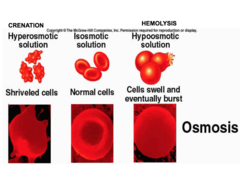
Movementof water (solvent)across a selectivelypermeable membrane (Water will balance itself oneither side of the membrane,even if the solutes can notmove across the membrane)
Tonicity
the concentration of a solution surrounding a cell (Hypertonic, Hypotonic and Isotonic)
Hypertonic
higher solute concentration than inside the cell
Hypotonic
lower solute concentration thaninside the cell
Isotonic
equal concentration inside and outside the cell
Hypertonic solution
• Higher solute concentration outside the cell
• WATER DIFFUSES OUT!
• CELL SHRIVELS!
Isotonic solution
solution:
•Equal soluteconcentration insideand outside the cell
•What does water do?
•What happens to the cell?
Effects of tonicity
Osmoregulation
Regulation of solute concentrations and water balance by a cell or organism: extreme example:
• Paramecium inhabits pond water (hypotonic)
• Water enters the cell
• The plasma membrane of Paramecium is less permeable to water, which slows the intake of water... but water still continuously enters
Contractile vacuole:
Organelle that functions asa pump to force water out of the cell as fast as itenters by osmosis
Facilitated diffusion
Passage ofmolecules/ions down their concentration gradient across a membrane with the assistance oftransmembrane transportproteins
• NO ENERGY NEEDED
Electrochemical gradient:
diffusion gradient of an ion,which is affected by both:• its concentration gradient acrossa membrane (chemical force)and• the membrane potential(electrical force)
Exocytosis:
Cellular secretion of biological molecules by the fusion of vesicles containing them with the plasma membrane
• Mediated by transport vesicles moving from theGolgi along microtubules
3 types:
• Phagocytosis
• Pinocytosis
• Receptor-mediated endocytosis
Phagocytosis:
Whenlarge particulatesubstances or small organisms are taken up by a cell
• Cell uses ____________ toengulf the food
• "Cell eating"
pseudopodia
Pinocytosis
when acell ingestsextracellular fluid and its dissolved solutes• Nonspecific uptake of fluid and solutes • "Cell drinking
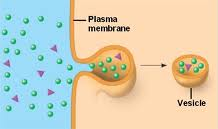
Receptor-mediatedendocytosis:
Movementof specific molecules into acell by the inward buddingof vesicles containingproteins with receptor sitesspecific to the moleculesbeing taken in
