Topic 1:
 Call Kai
 Learn
 Practice Test
 Spaced Repetition
 Match
 Flashcards
 Knowt Play
1/62

There's no tags or description
Looks like no tags are added yet.
63 Terms
atrophy
X. Cellular Adaptations
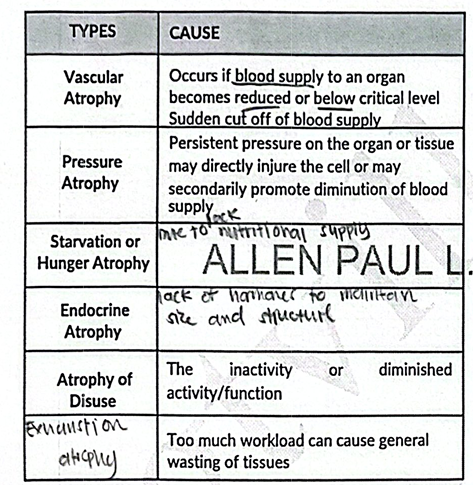
Acquired decrease in tissue or organ size
Could be physiologic/pathologic
physiologic atrophy
X. Cellular Adaptations : Atrophy
Normal
Happens as a consequence of Maturation
i.e. atrophy of thymus during puberty & atrophy of brain and sex organs
Notes:
As the Person ages, the size of thymus gets smaller
At the age 50, brain and sex organs undergoes atrophy
Decrease in uterus and breast size, after childbirth is normal
Note: Pathologic atrophy = Due to disease
hypertrophy
X. Cellular Adaptations
Increase in tissue and organ size due to increase in individual cells comprising an organ
NO new cells are produced

hyperplasia
X. Cellular Adaptations
Increase in tissue and organ size due to increase in number of cells comprising an organ
New cells are produced

metaplasia
X. Cellular Adaptations
A reversible process
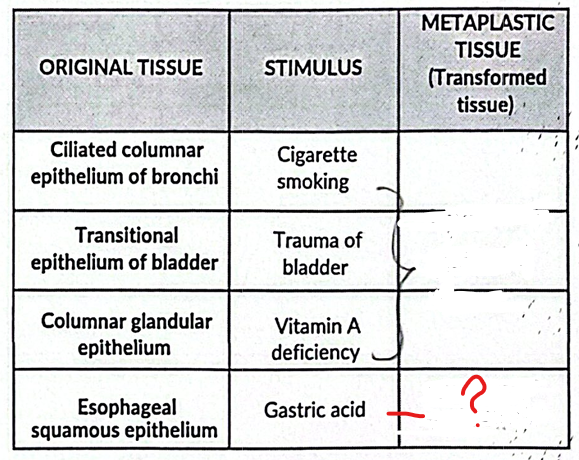
Involves transformation of adult cell to another adult cell
Epithelial metaplasia - involves epithelial cells
Mesenchymal Metaplasia- involves connective tissue cells
squamous epithelial tissue
X. Cellular Adaptations: Metaplasia

columnar epithelium
X. Cellular Adaptations: Metaplasia
dysplasia
X. Cellular Adaptations
Also called as pre-neoplastic lesion or atypical metaplasia
A reversible process
Compared to metaplasia,_______ has to cell transformation
The affected cells shows a change / variation in size. shape, cell orientation (cellular arrangement)
Abnormal growth and differentiation
A pre-neoplastic lesion - a stage in the cellular evolution to cancer
May lead to cancer but not necessarily
I.e cervical intraepithelial neoplasia
anaplasia
X. Cellular Adaptations
Compared to metaplasia and dysplasia,______ is considered an irreversible process
Transformation of adult cell to primitive / embryonic cell type.
Often used as a criterion for malignancy
“De-differentiation”
neoplasia
X. Cellular Adaptations
Process of tumor formation
Characterized by continuous proliferation of abnormal cells (cells that serves no purpose / function)
Can lead to formation of tumor
Tumor is aka neoplasm - new growth
parenchyma
2 Parts of Tumor
neoplastic cells
stroma
2 Parts of Tumor
connective tissue framework (vascular)
supplies food for the parenchyma to continue to proliferate
benign
2 Types of Tumor
will not immediately lead to death
+oma
Regular surface “localized”
Non-invasive
Well differentiated
(-) Bleeding @ the site of injury
malignant
2 Types of Tumor
no matter how small or where it is located, it can often lead to death
+carcinoma or +sarcoma
Irregular surface “scattered”
Invasive
Poorly differentated
(+) Bleeding
carcinoma
2 Types of Tumor : Malignant tumors
Cells involved are Epithelial tissue
*See page 1

sarcoma
2 Types of Tumor : Malignant tumors
Cells involved are Connective tissue
*See page 1

reporting of tumors
Gross Description
Microscopic Evaluation
Diagnosis/Remarks
grading of tumors

grade 1
Broader’s Classification
Differentiated Cells: 100%-75%
Undifferentiated Cells : 0%-25%
grade 2
Broader’s Classification
Differentiated Cells: 75%-50%
Undifferentiated Cells : 50%-25%
grade 3
Broader’s Classification
Differentiated Cells: 50%-25%
Undifferentiated Cells : 75%-50%
grade 4
Broader’s Classification
Differentiated Cells: 0%-25%
Undifferentiated Cells : 100%-75%
TNM
In staging tumors, based on the size of primary lesion, extent of spread to regional lymph nodes, presence or absence of metastases uses ____ classification?

somatic death
Refers to the death of the entire body

algor mortis
XI. Somatic Death : Secondary changes

livor mortis
XI. Somatic Death : Secondary changes
(+) Purplish discoloration
Also called as : “Lividity” “Post mortem hemolysis”
rigor mortis
XI. Somatic Death : Secondary changes
Stiffening of the muscle starts at 2-3 hrs after death
Stiffness can remain until 36 hrs max
post mortem clotting
XI. Somatic Death : Secondary changes
Clotting of the blood
desiccation
XI. Somatic Death : Secondary changes
Drying and wrinkling of the anterior chamber of the eye and cornea
putrefaction
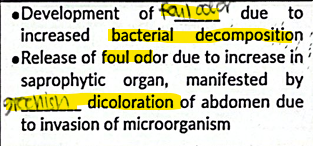
XI. Somatic Death : Secondary changes
autolysis
XI. Somatic Death : Secondary changes
Self digestion of tissues by its own enzymes
Not required
XII. Autopsy/Necroscopy
Autopsy is ________.
Other documents: Death certificate and medicolegal clearance.
Note: Most important requirement of autopsy
Content from the nearest kin
XII. Autopsy/Necroscopy : Types of