Schizophrenia
 Call Kai
 Learn
 Practice Test
 Spaced Repetition
 Match
 Flashcards
 Knowt Play
1/39

There's no tags or description
Looks like no tags are added yet.
40 Terms
What are the 3 main categories of schizophrenia symptoms?
positive
hallucinations
delusions
negative
blunted emotional expression
social withdrawal
lack of motivation
cognitive
impairment in working memory
impairment in attention and executive functions
What is working memory?
ability to temporarily hold and manipulate info
What are positive symptoms of schizophrenia?
experiences added to normal functioning e.g. hallucinations, delusions
What are negative symptoms of schizophrenia?
reduced normal functioning e.g. blunted emotional expression, social withdrawal, lack of motivation
What are cognitive symptoms of schizophrenia?
impairments in working memory, attention and executive functions
What is the difference between hallucinations and delusions?
hallucination = a perception without appropriate external stimulus
e.g. hearing voices, seeing things that aren’t there
delusions = belief not supported by evidence or context
At what age does schizophrenia typically first become apparent?
late adolescence or early adulthood
How can schizophrenia symptoms develop overtime?
early negative or cognitive difficulties (e.g. social withdrawal, behaving eccentrically)
followed by psychotic episodes
with residual symptoms persisting between psychotic episodes
Which schizophrenia symptoms respond best to antipsychotics?
positive symptoms
What is a major limitation of current antipsychotic treatment for schizophrenia?
doesnt really treat cognitive symptoms and effects on negative symptoms are limited
What are executive functions?
higher-level cognitive processes involved in planning, organising, decision-making and behavioural control
Does schizophrenia have a genetic component?
Is it fully a genetic condition?
yes - runs in families
no, also environmental and chance-related factors as well
Why is schizophrenia genetically heterogenous?
not caused by a singular gene, multiple genetic variants contribute to risk of developing
What chromosome deletion heavily associated with increased schizophrenia risk?
deletion of chromosome 22q11.2
What is DISC1?
What is it involved in?
What happens to DISC1 in schizophrenia?
disrupted in schizophrenia 1
gene involved in brain development
impaired in schizophrenia as well as other psychiatric disorders (so not only for schizophrenia)
Why is schizophrenia considered a neurodevelopmental disorder?
many associated genes influence brain development
and circuit abnormalities often emerge before clinical symptoms shown
What is an intermediate phenotype?
Give examples in relation to schizophrenia?
a measurable biological abnormality between genetic risk and clinical symptoms
altered brain structure, activity or synapse connectivity
What cortical regions show structural abnormalities in schizophrenia?
prefrontal, temporal and parietal cortex show thinning or reduced grey matter
Which prefrontal region is important in schizophrenia?
What is this region involved in?
dorsolateral prefrontal cortex (DLPFC)
working memory and executive functions
How are DLPFC abnormalities related to schizophrenia symptoms?
altered DLPFC structure relates to reduced working memory and executive functions (cognitive symptoms)
What causes cortical grey matter reduction?
primarily reduced dendritic, axonal and synaptic processes
What is the relationship between the mediodorsal thalamus and DLPFC (schizophrenia)?
neurons in MD thalamus send their axons to DLPFC
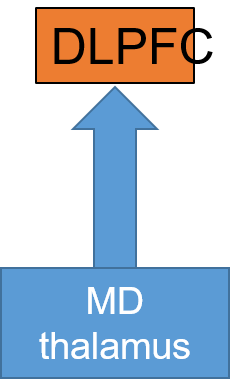
abnormalities may disrupt prefrontal connectivity and cognitive function
What is synaptic pruning?
How might abnormal synaptic pruning contribute to schizophrenia?
Why might schizophrenia first become apparent in adolescence/ early adulthood?
process of eliminating or weakening some synapses to refine neural circuits
excessive excitatory pruning may reduce connectivity and impair brain-circuit function
adolescence is when pruning occurs as well as cortical maturation and dopaminergic changes
so in schizophrenia, lots of possible areas where problems can occur
What happens to GABAergic interneurons in schizophrenia?
What does this cause?
reduced GABAergic interneuron function
can disrupt coordinated cortical activity and cognition
What is proposed role of microglia in schizophrenia?
abnormal microglia involvement in synaptic pruning
may contribute to altered neural connectivity
What receptors belong to the D1-like receptor family?
What is their action with adenylyl cyclate?
D1 and D5
stimulate adenylyl cyclase → increase cAMP
What receptors belong to the D2 like receptor family?
What action do these have on adenylyl cyclase?
D2, D3 and D4
inhibit adenylyl cyclase → reduce cAMP
Why is D2 antagonism good for schizophrenia?
helps with positive symptoms
What are examples of SGAs?
clozapine (ring fused), olanzapine (ring fused), risperidone, quetiapine
Why is clozapine clinically important for schizophrenia treatment?
particularly effective in treatment resistant schizophrenia
What is dopamine hypothesis of schizophrenia?
abnormal dopamine signalling → contributes to psychotic symptoms
What drugs produce psychotic symptoms?
dopamine enhancing drugs e.g. cocaine, amphetamines
What kind of signalling is associated with positive schizophrenia symptoms?
What kind of signalling is associated with cognitive symptoms?
increased subcortical dopamine signalling (D2 is subcortical)
reduced/altered prefrontal signalling (D1 is prefrontal (so less D1 enhances schizophrenia) )
What is proposed role of prefrontal D1 receptors in schizophrenia?
D1 signalling contributes to working memory and executive functions
so abnormalities in D1 signalling can contribute to cognitive symptoms
What is glutamate hypothesis of schizophrenia?
reduced NMDA receptor function may contribute to psychotic and cognitive symptoms
What are the 4 stages of schizophrenia?
stage 1 = pre-symptomatic
stage 2 = pre-psychotic but starting to show symptoms
stage 3 = acute psychosis
stage 4 = chronic illness
What characterises stage 1 of schizophrenia?
genetic vulnerability and environmental exposure
possible mild cognitive symptoms
no psychotic symptoms at this stage
What is stage 2 of schizophrenia?
Is psychosis at this stage?
early cognitive and behavioural difficulties
e.g. poor attention, social withdrawal etc.
not yet
What characterises stage 3 of schizophrenia?
acute psychotic symptoms
e.g. hallucinations, delusions
accompanied by a decline in functioning
What characterises stage 4 of schizophrenia?
persistent illness and chronic functional impairment