Art History Midterm Guide
 Call Kai
 Learn
Learn Practice Test
 Spaced Repetition
 Match
Match Flashcards
 Knowt Play
1/70

There's no tags or description
Looks like no tags are added yet.
Name | Mastery | Learn | Test | Matching | Spaced | Call with Kai | Chat |
|---|
No analytics yet
Send a link to your students to track their progress
71 Terms

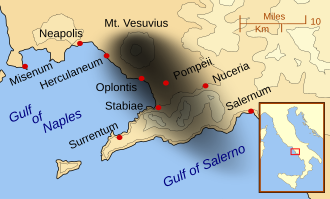
Pompeii is located on coastal southern Italy. The region of Pompeii is ______ and it’s geographical location is ____ __ ____. (List two)
Campania; Bay of Naples

_______ was a coastal promontory and major Roman naval base situated on the northern side of the Bay of Naples. Pliny the Elder was commanding in person at the time of MT. Vesuvius’ eruption.
Misenum

The location where Pliny the Younger first observed the massive umbrella-pine-shaped cloud rising over Vesuvius. Pliny the Elder also dispatched warships directly from this location across the Bay of Naples to evacuate coastal residents fleeing the volcano.
Misenum

This location suffered violent earth tremors, receding shorelines, heavy ashfall, and was eventually shrouded in total darkness by a giant volcanic cloud. During the eruption, Pliny the Younger and his mother evacuated on foot with a crowd.
Misenum
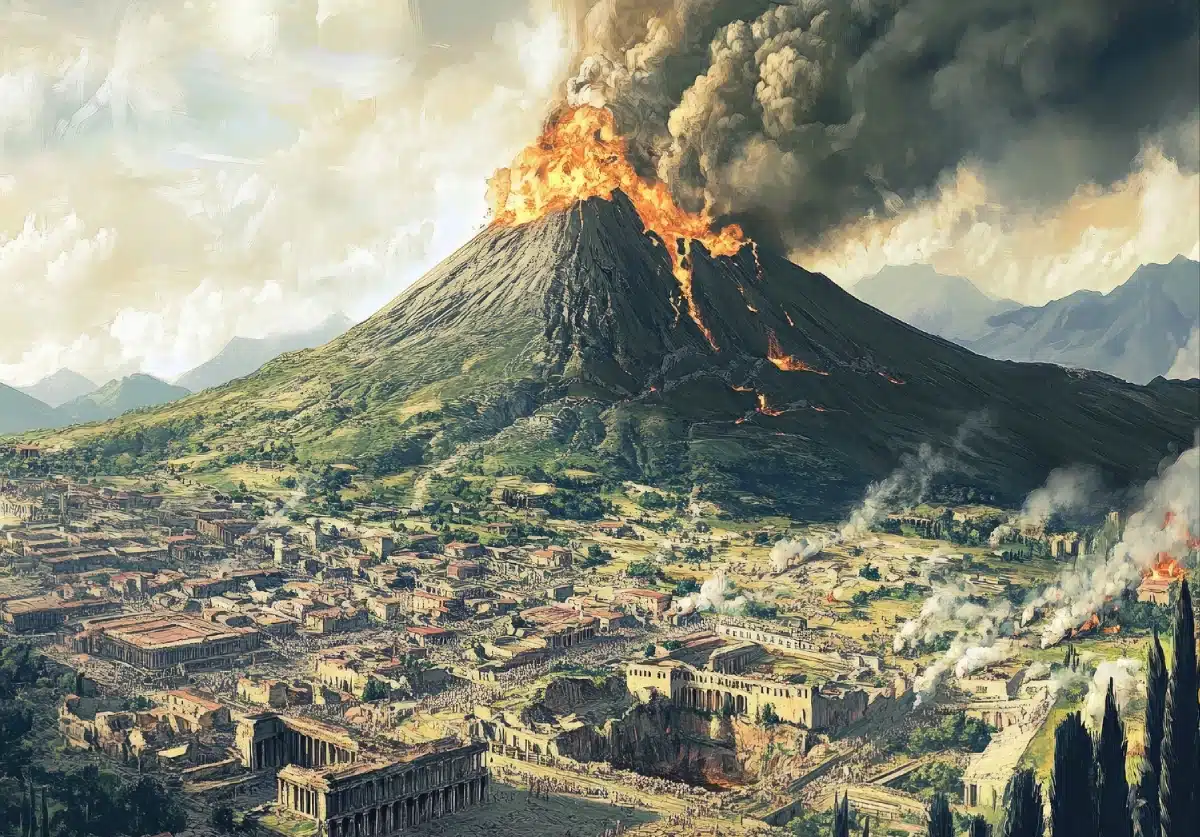
When did Mt. Vesuvius erupt?
79 AD

_____ are small pumice stones that fell from the sky, along with ash, according to Pliny.
lapilli

The ____ is the household alter in the atrium of thehouse of Lucius Caecilius Iucundus.
Lararium

Who was Titus?
A Roman emperor who ruled from 79 CE - 81 CE).

When was Titus’ lifespan?
39 CE - 81 CE
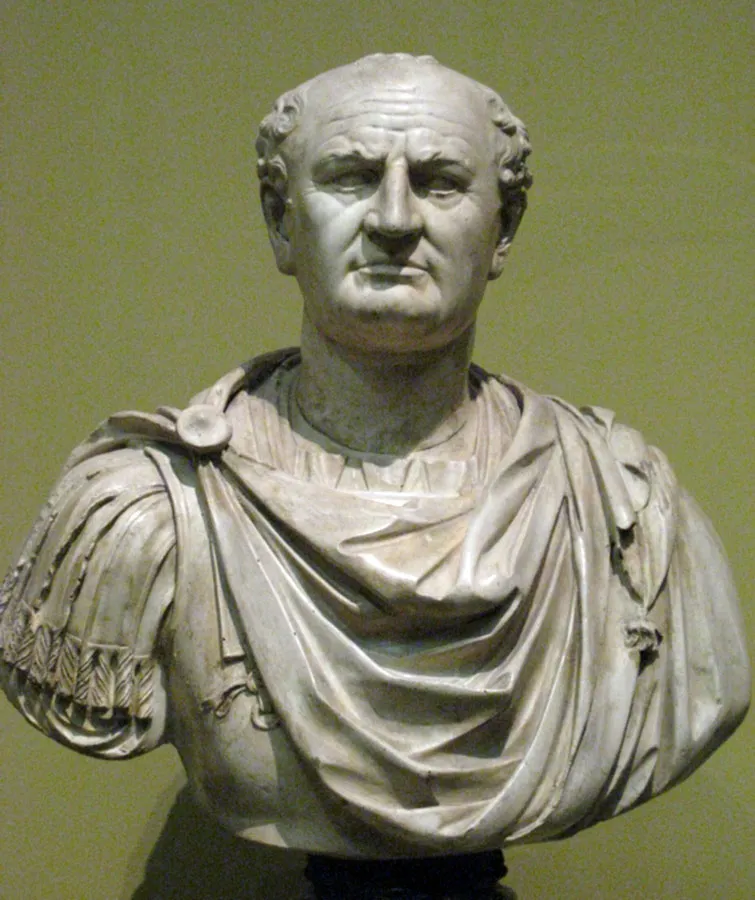
Titus of was the son of Emperor ____ who ruled from 69 CE - 79 CE.
Vespasian

Whose major “accomplishment” was the siege of Jerusalem in 70 CE & sacking of the Jewish Temple?
Titus
The dynasty that consists of Vespasian, Titus, and Domitian is typically called _______?
the Flavians
Many events happened during Titus’ reign. Which did NOT happen in 80 CE?
Vesuivus

Which emperor died in 81 CE of a mysterious illness?
Titus
_____ ___ _____ was a distinguished Roman scholar, author, and naval commander. He served as a commander of a Roman fleet stationed at Misenum on the Bay of Naples during the eruption of Mt. Vesuvius (AD 79). He was also the uncle of Pliny the Younger and had recently completed writing his extensive work, the Natural History.
Pliny the Elder

_____ ___ _______ was considered a key, primary witness of the eruption. He wrote two famous letters detailing his uncle's final hours and his own harrowing escape from Misenum to the historian Tacitus, upon request. (around AD 106–107)
Pliny the Younger

TRUE OR FALSE: THis quote (see image) was spoken by Pliny the Elder
True

_____ ___ _______ was the nephew of Pliny the Elder. He was documented as 17 years old, living at the Misenum naval base at the time of Mt. Vesuvius’ eruption in AD 79. He decided to stay behind and pursue his studies when his uncle set out in the Bay of Naples to provide aid during the eruption.
Pliny the Younger

TRUE OR FALSE: Pliny the Younger describes the appearance of the rising eruption cloud as being "sometimes white, sometimes dirty and speckled, according to how much soil and ash it carried.”
True

________ ______, also called Sponge, serves as evidence that ncient Roman writers were aware of Vesuvius's dormant volcanic character long before its catastrophic eruption in AD 79. It was observed to have been melted down from another time of stone and converted into this current rock-like state.
They are also described as light and porous by Pliny the Younger.
Pompeiian Pumice
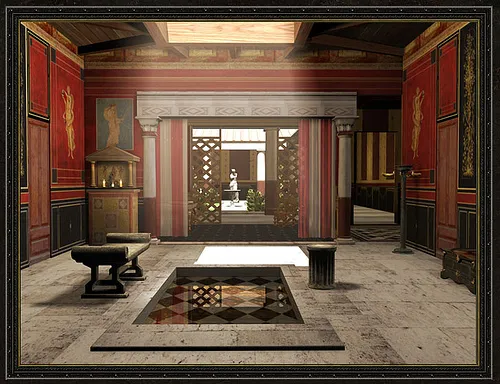
The ______ was the central open reception hall or courtyard of a traditional Roman house (domus). It served as the primary hub of domestic life and was often where the family kept its household shrine (lararium).
Atrium

What is the title of this image?
Bacchus and Mount Vesuvius Fresco

Where is this image located?
House of the Centenary (Regio IX), Pompeii

A famous wall painting located in a household shrine (lararium) within the House of the Centenary in Pompeii.
Bacchus and Mount Vesuvius Fresco

This painting depicts Baccus standing alongside Mount Vesuvius. It provides a rare look at Mt. Vesuvius pre-eruption, showcasing vast, fertile vineyards covering the mountain.
It is also frequently cited by historians as evidence that some Pompeians at least understood that the richness of their lands was due to Vesuvius.
Bacchus and Mount Vesuvius Fresco

Who is the Roman god of wine and fertility?
Bacchus
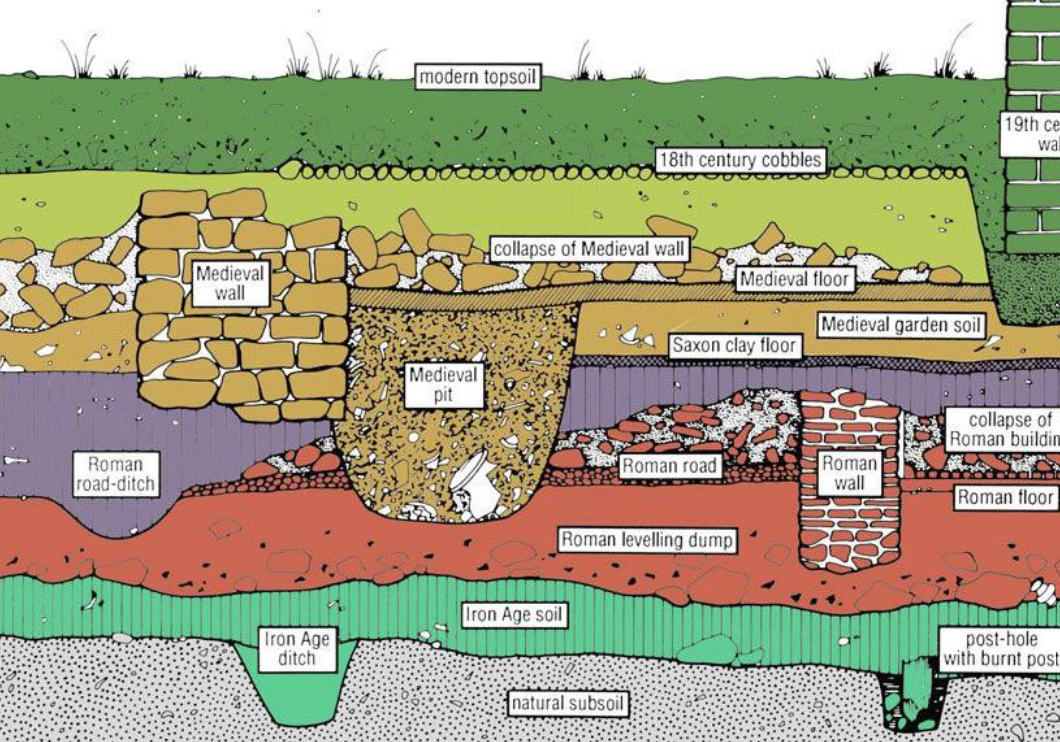
The Basic idea is that the oldest material is at the bottom and the youngest at the top.
Stratigraphy

Rules of __________ are based on the law of superposition
Stratigraphy
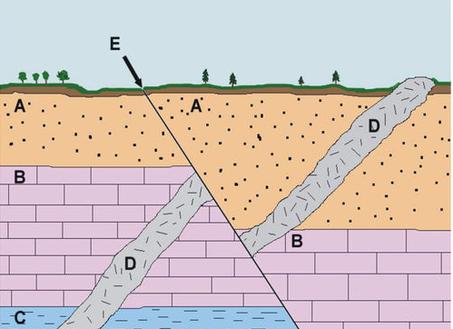
The geologic principle that states that in horizontal layers of sedimentary rock, each layer is older than the layer above it and younger than the layer below it. It also helps scientists determine the age of a rock.
The law of Superposition

This person:
Began working in Pompeii in 1872
Is considered one of the “fathers” of Roman art history
Created the “Four Styles” of Pompeian wall painting
Increased focus on daily life
August Mau

This person:
Worked in Pompeii from 1924 – 1961
Focused on restoration and conservation
Crucial in identifying various chronological phases, including pre-Roman Pompeii
Amedeo Maiuri
This person:
was a Swiss engineer & military expert
ran excavations at Herculaneum (1750 – 1764)
“scientific” – paid close attention to detail; had the ability to manage large-scale excavations, manpower, and material
one of the “fathers” of modern archaeology
Karl Weber

This person:
Worked at Pompeii intermittently from 1843 –1863
Oversaw the transfer of Pompeii and other local sites from royal property to be run by the Italian state
Created the identification and labeling system (still in use today)
Began excavating from the top down
Introduced plaster casts for body forms
Giuseppe Fiorelli

The process of pouring plaster into the crevices of dead bodies. This process has helped archaeologists make deductions about health, clothing, and position at death.
They are also argued to be the most significant tourist attraction of the eruption site. If removed, both public and government funds may be removed as well.
Fiorelli method

___ ____ __ ______ was an extraordinarily luxurious Roman suburban estate located along the ancient coastline just outside Herculaneum. It is widely considered one of the grandest and most lavishly decorated private residences known from the ancient Roman world.
The Villa of the Papyri

The Villa of the Papyri is traditionally attributed to ______ Calpurnius Piso Caesoninus, the father-in-law of Julius Caesar.
Lucius

The Villa of the ______ derives its name from the discovery of a vast private library containing hundreds of carbonized papyrus scrolls. An uncovered network of underground mining tunnels led by Karl Weber revealed a collection of bronze and marble statues, elaborate fresco wall paintings, and intricate geometric mosaic floors in 1974.
It is one of the only intact libraries to survive from classical antiquity.
Papyri

_______ was the primary writing material of classical antiquity, made from the pith of the papyrus reed and rolled into long scrolls (*papyri*)
Papyrus

_______ scrolls: Carbonized ancient texts (Texts are mostly philosophy Epicurus, Philodemus)
Papyrus

TRUE OR FALSE: Detailed architectural plans of the Villa of Papyri, by Karl Weber, inspired the replica, The Getty Villa, in in Malibu, California.
True
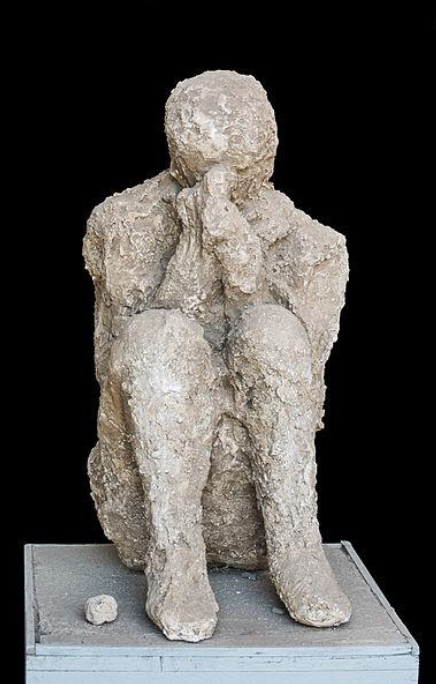
Who said this quote?:
“They have been dead for eighteen centuries, but they are human creatures seen in their death struggle. This is not art, this is not imitation, these are their bones, the relics of their flesh and their clothing mixed with plaster, and the pain of death that regains substance and form.”
Fiorelli
Who ascribed changes in building style and technique to different groups in 1873?
Fiorelli
Who added wall painting styles to the chronology?
August Mau
Who identified the Altstadt – the SW corner as the original nucleus of the city in 1913?
Francis Haverfield
Who began excavations underneath 79 AD layers in both public and private spaces, additionally finding evidence for 6th century BCE occupation at Doric Temple and Temple of
Apollo?
This person also studied the wall circuit, assigning various phases by construction technique in 1926.
Amedeo Maiuri

This artwork depicts the scene of an earthquake, likely resulting from Mount Vesuvius. It presents identifiable areas of Pompeii, namely the Forum and the area outside the Vesuvian Gate. What is its name?
Note: It also depicts the northern side of the Forum, with the Temple of Jupiter, flanked by two equestrian statues and a monumental arch, and an altar flanked by sacrificial implements and a bull sacrifice.
Relief panel depicting an earthquake

Scientists believe that these reliefs were set up as a thank-offering to the household gods for protecting life and/or property during an earthquake. What is the name of this relief?
Relief panel depicting an earthquake

Where is this painting located?
House of Caecilius Iucundus, Pompeii

This artwork belongs to the household shrine (lararium) of Caecilius Iucundus.
Relief panel depicting an earthquake

The term ______ (German for "Old Town") refers to the oldest, less regular urban core located in the southwestern section of Pompeii, covering about 14 hectares around the Forum area
Altstadt

This plan indicates where archaic structures and objects have been found in Pompeii, demonstrating that they are not restricted to Altstadt

What is the object?
Antefixes with heads of Hercules and Athena from the temple of the Triangle Forum, Pompeii

The ______ were the native Italic inhabitants of Campania. Their language was an Italic tongue written right-to-left using its own distinct alphabet and became the official written and spoken language of Pompeii throughout the Samnite period.
Inscriptions from this group revealed how pre-Roman Pompeii was governed by local chief magistrates (meddix tuticus), aediles, and quaestors.
Oscans

This group originated from the mountainous region of Samnium and took control of Pompeii and Herculaneum in the 5th/4th centuries BC.
Under their rule, Pompeii underwent massive urban growth (Neustadt), rebuilt its defensive stone walls, and constructed monumental public facilities—including the Stabian Baths.
Their dominance ended when Rome besieged Pompeii during the Social War (89 BC) and replaced Oscan with Latin as the official language.
Samnites
_________ were among the early regional powers occupying Herculaneum and Pompeii before the Samnite takeover.
Etruscans

The Temple of Apollo features the earliest decipherable writing found at Pompeii on pottery fragments within a votive deposit. These were dated between c. 600 and c. 475 BC and are called the ________ inscriptions.
Etruscan

________ became uneasy “allies” (socius) with the Roman in the 3rd c. BCE. While cities maintained autonomy, they were required to provide annual soldiers and military aid to Rome.
In 2nd Punic War (218-201), many Italian cities defected; Pompeii remained loyal to Rome.
Samnites

The _____ ______ was an archaic sacred building in the Triangular Forum. Built in the 6th century BC, it is one of Pompeii's oldest public and religious monuments.
Terracotta rosettes also depict Hercules alongside Athena, proving the sanctuary honored both deities.
Doric Temple

The _______ were one of Pompeii's oldest and most influential local families, whose public contributions span both the Samnite and Roman eras:
Popidii

TRUE OR FALSE: Vibius Popidius served as meddix tuticus (chief magistrate) and quaestor, overseeing major civic projects.
During the Roman Period, the collapsed Temple of Isis was rebuilt under a Popidius. Another family member preserved wall graffiti, marking post-eruption salvaging tunnels.
True
TRUE OR FALSE: One of the earliest monumental structures is the Temple of Apollo (Etruscan Inscriptions). It is dated between c. 600 and c. 575 BC based on architectural terracottas and votive deposits.
Records of pottery ownership and Deposits containing pottery fragments with Etruscan dedications provide evidence of Etruscan presence in the region.
True
What two materials represent two key categories of material evidence used by scholars to reconstruct the religious life, artistic influences, and early cultural history of the city?
Architectural terracottas and votive deposits
_______ ________ are decorative or protective molded clay elements used on the roofs and upper structures of temples, public buildings, and residences
Architectural terracottas
_______ _______ are buried caches or pits containing ritual offerings (votives) presented by worshippers to gods or domestic spirits as acts of devotion, prayer, or thanksgiving
Votive deposits
_______ is a Greek term for a sacred precinct or enclosed plot of land set aside for a deity. It enclosed the walls of the Temple of Apollo
Temenos
the ______ was the magistrate in charge of financial management and public funds
quaestor
______ were civic magistrates responsible for municipal maintenance, road construction, and local sanctuaries
aediles
Early construction of the First fortification wall (600 – 550 BCE) used _________ tuff.
pappamonte
____ ________ was an ancient masonry technique using large, squared rectangular blocks of stone laid in regular, horizontal courses without mortar. It was also used for urban fortifications.
Opus Quadratum
The Temple of Apollo was constructed from ________, a soft, porous volcanic tufa (consolidated volcanic ash) quarried locally in Campania. This material was the earliest stone building material used in archaic Pompeii (6th century BC)
Pappamonte
Bay of Naples (location on map)