Biology - A2.3 Viruses HL
 Call Kai
 Learn
Learn Practice Test
 Spaced Repetition
 Match
Match Flashcards
 Knowt Play
1/23

There's no tags or description
Looks like no tags are added yet.
Name | Mastery | Learn | Test | Matching | Spaced | Call with Kai | Chat |
|---|
No analytics yet
Send a link to your students to track their progress
24 Terms
What are the common features of viruses?
Small size
No gradual growth of viruses
Have nucleic acids as genetic material
Have a protein capsid (genetic material enclosed in a protein coat)
Have no cytoplasm and no (or few) enzymes, they rely on metabolism of host cells
What is the size of viruses?
20-300 nanometres very small, they need to be smaller than host cell to enter
What genetic material do viruses have?
DNA and RNA, which adhere to the universal code
How is symmetry of viruses introduced?
The protein capsid with one (or several) type(s) of repeating protein subunit(s). The self assembly of these proteins gives viruses a symmetrical structure.
How do viruses reproduce if they have little cytoplasm?
Rely on host cell for viral reproduction, and for metabolism
What are aspects of viruses that vary?
Genetic material
The way in which they replicate their genetic material and make proteins
Membrane enveloping
How does the genetic material vary per virus?
Viruses have genes made from DNA or RNA, single stranded or double stranded, also varying in length, can be circular or linear
What are the different ways in which viruses replicate DNA and do protein synthesis?
Single stranded RNA:
1) Positive sense - have hosts use viral RNA directly as mRNA, having them make the proteins and then packaging the proteins up for lysis
2) Negative sense (dif bc virus makes mRNA) - transcribe viral RNA into mRNA for use by host, then host makes the proteins and releases them
3) Retrovirus - make DNA from the viral RNA they have and transcribe it into mRNA
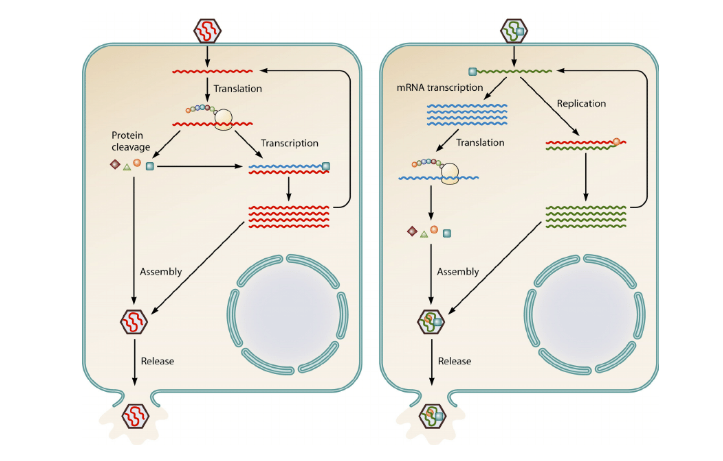
How does membrane enveloping happen and what are the dif types?
Membrane enveloping: when viruses are released from host cell (lysis), some become enveloped in membrane of host cell
Enveloped viruses: become covered in host’s plasma membrane with glycoproteins from virus embedded in it, common in viruses infecting animal cells for contact
Non-enveloped viruses: Viruses not contained within membrane during lysis, common in viruses infecting plants or bacteria

Bacteriophage lambda (type of virus, enveloped?, genetic material, distinctive feature, host cell)
bacteriophage (type that uses bacteria as host)
non-enveloped
1 molecule of 2 stranded DNA and can do both negative and positive sense strands for protein synthesis
lytic cycle (reproduces then kills host) and lysogenic cycle
E. coli

COVID-19 (type of virus, enveloped?, genetic material, distinctive feature, host cell)
coronavirus (RNA as genetic material and crown like shape)
Enveloped
1 molecule of 1 stranded RNA
Known for causing a pandemic and e.g. of zoonosis
Human and animal cells

HIV (type of virus, enveloped?, genetic material, distinctive feature, host cell)
Retrovirus
enveloped
2 molecules of single stranded positive sense RNA
Has enzyme reverse transcriptase (to make DNA from RNA)
T-helper cell in immune system

What are the dif viral reproductive cycles?
The lytic cycle and the lysogenic cycle
Steps of lytic cycle with bacteriophage as example
1) Virus attaches to host cell and injects its DNA
2) DNA circularises by linear DNA joining to form circle, this is replicated many times
3) DNA transcribed and translated to make viral proteins
4) Proteins formed self-assemble to form capsids, with copy of viral DNA inside
5) New infectious viruses (virions) cause host cell to burst (lysis)

Steps of lysogenic cycle with bacteriophage as example
1) Virus injects DNA into host cell
2) Circularisation of DNA
3) DNA from virus integrates with host cell chromosomes, the viral DNA is in stage called prophage
4) Host cell reproduces normally, no harm done, but viral DNA in all daughter cells
5) A particular trigger and the prophage separates from hosts DNA and enters lytic cycle

Is evolution of viruses clear cut?
Nope, viruses don’t fossilize so can’t rly study history or evolution
When did viruses evolve?
Viruses share the same genetic code as living organisms (universal code), therefore common ancestor, but don’t know if before or after development of cells
Argument for before cells: viruses are simpler than cells, so simple to more complex
Argument after cells: viruses have obligate parasitism and must have host cell to survive
What are the 2 theories for how viruses have evolved, based on evolving after cells?
Progressive
Regressive
Progressive (or escape) hypothesis with evidence
The portions of genetic material escaped from organisms and became surrounded by protein coat, dif parts of cells slowly building up viruses
Evidence: retroviruses (HIV) have reverse transcriptase to make DNA from RNA and then DNA is injected into host cell. Similarly, humans also have reverse transcription and the copied DNA is injected into random locations in og DNA. Therefore, part of the human retrotransposons is used to form virus

Regressive (or reduction) hypothesis with evidence
Viruses are remnants of cells that gradually remove structures that are no longer needed, whole cells simplifying down to become viruses
Evidence: bc viruses vary so much in complexity some are almost simple bacteria (e.g. mimivirus), while some simple bacteria seem like viruses (e.g. chlamydia)
Convergent evolution and obligate parasitism
The similarities between all viruses (nucleic acids, protein capsid) could be evidence of common ancestor, but think its bc of convergent evolution
Convergent evolution: particular characteristics favoured and so evolve similarly in unrelated organisms
Reasons for rapid evolution of viruses
Short generation time, of 1 hr
High mutation rates - replication of viral DNA or RNA has no checks so many mutations so lots of genetic variation and structural changes
High selection pressure - host defences push virus to change bc then they’re less identifiable
Examples of rapidly evolving viruses
HIV - doesn’t proofread so high mutation rate
Influenza - doesn’t proofread so high mutation rate and changing proteins on exterior of membrane
Consequences for treating diseases caused by rapidly evolving viruses
Rapid evolving viruses =
Many changes in vaccine
Infectious individuals might need to be isolated to prevent spread
Viral propagation reduced by targeting areas where viruses spread, e.g. water or fumes
Disease resistant host cells may be introduced
Education programmes used to inform public that minimal exposure is best
Laws passed to ensure public compliance for vaccinations etc.