OBLI CON MIDTERM(no cases)
 Call Kai
 Learn
 Practice Test
 Spaced Repetition
 Match
 Flashcards
 Knowt Play
1/181

There's no tags or description
Looks like no tags are added yet.
182 Terms
OBLIGATIONS AND CONTRACTS
• Governs how individuals, entities, and the
State interact in everyday transactions and
commitments
• Primarily codified in the New Civil Code of
the Philippines (R.A. No. 386), Book IV
OBLIGATIONS
"An obligation is a juridical necessity to give, to do, or not to do." Article 1156, New Civil Code
-Articles 1156 to 1304 of the New Civil Code
CONTRACTS
"A contract is a meeting of minds between two persons whereby one binds himself, with respect to other, to give something or to render some service." Article 1305, New Civil Code
-Articles 1305 to 1422 of the New Civil Code
OBLIGATIONS
”An ___ is a juridical necessity to give, to
do, or not to do.” Article 1156, New Civil Code
• Derived from the Latin word “obligatio” which
means tying or binding.
• When there is a right, there is a corresponding obligation. Right is the active aspect while obligation is the passive aspect.
Natural Obligations
-Based on equity and natural justice
-Enforced by good conscience and not by court actions
Civil Obligations
Arise from positive law such as laws, contracts, quasi-contracts, delicts, and quasi-delicts.
Enforced through court actions or the coercive power of public authority
Moral Obligations
Arise from moral law developed by the church - deals with the spiritual obligation of a person in relation to his God or Church.
Enforced by religious beliefs and moral conscience
Essential Requisites
1. Passive Subject (debtor/obligor)
2. Active Subject (creditor/obligee)
3. Object or Prestation
4. Juridical or Legal Tie
Example:
B granted a Php10,000 loan to A, where A agrees to
pay B within ten days from receipt thereof.
A – Passive Subject / Debtor
B – Active Subject / Creditor
Php10,000 – Object/Prestation
Loan – Juridical Tie
Different Kinds of Prestation
To give
To do
Not to do
To Give
Delivery of a thing to the creditor
Sale, deposit, pledge, donation
To Do
Rendering of works or services, whether physical or mental
Contract for professional services like painting, singing, writing
Not to Do
Refraining from doing certain acts
Restraining orders, negative easements, injunction
Obligations arise from:
1. Law
2. Contracts
3. Quasi-contracts
4. Acts or omissions punished by law (delicts)
5. Quasi-delicts
Legal Obligations
• Obligations Ex Lege
• Obligations derived from law are NOT
presumed
Contractual Obligations
• Obligations Ex Contractu
• Must contain all the essential
requisites of a valid contract
• Must not be contrary to law, morals,
good customs, public order, and
public policy
Quasi-Contractual Obligations
• A juridical relation arising from
lawful, voluntary, and unilateral acts
based on the principle that no one shall
be unjustly enriched or benefited at the
expense of another.
Obligations Ex Delicto
• Delict is an act or omission punishable
under the law
• Based on Art. 100 or Revised Penal
Code: “Every person criminally liable for
a felony is also civilly liable."
Delict
___ is an act or omission punishable
under the law
Obligations Ex Quasi-Delicto
• Quasi-delict is an act or omission
arising from fault or negligence which
causes damage to another, there being
no pre-existing contractual relations
between the parties
Quasi-delict
is an act or omission
arising from fault or negligence which
causes damage to another, there being
no pre-existing contractual relations
between the parties
Article 1163
OBLIGATION TO GIVE
Degree of care: Diligence of a good father of a family
___. Every person obliged to give something is also obliged to take care of it with the proper diligence of a good father of a family, unless the law or the stipulation of the parties require another standard of care.
Article 1164
OBLIGATION TO GIVE
Fruits of the Thing
___. The creditor has a right to the fruits of the thing from the time the obligation to deliver it arises. However, he shall acquire no real right over it until the same has been delivered to him.
Fruits of the Thing

OBLIGATION TO DO
• If the obligor fails to do it – the same shall be
executed at his cost, plus damages
• If done in contravention of the tenor of the obligation – the same shall be executed at his cost
• If poorly done – the same shall be undone, plus damages
Article 1170
FRAUD
___. Those who in the performance of their obligations are guilty of fraud, negligence, or delay, and those who in any manner contravene the tenor thereof, are liable for damages.
Two Kinds of Fraud:
1. Fraud in obtaining consent
2. Fraud in fulfillment of the obligation
NEGLIGENCE
The omission of that diligence which is required by the nature of the obligation and corresponds with the circumstances of the person, of the time, and of the place.
Test of Negligence:
Whether the defendant used the reasonable care and caution that an ordinarily prudent person would have used in the same situation. If they did not, they are guilty of negligence.
Kinds of Negligence
Culpa Contractual
Culpa Aquiliana
Culpa Criminal
Culpa Contractual
– negligence in the
performance of a contract
Culpa Aquiliana
Culpa Aquiliana – acts or omissions that cause
damage to another, there being no contractual
relation between the parties
Culpa Criminal
– negligence that results in the
commission of a crime
DELAY / DEFAULT
Non-fulfillment of an obligation on time
Kinds of Delay:
Mora Solvendi
Mora Accipendi
Compensatio Morae
Mora Solvendi
– delay on the part of the debtor
Mora Solvendi
- delay on the part of the creditor
Compensatio Morae
-- both parties are in default
When is a debtor considered in delay?
Those obliged to deliver or to do something incur in delay from the time the obligee judicially or extrajudicially demands from them the fulfillment of their obligation
“No demand, no delay”
Exceptions:
When the law provides otherwise
When there is an express stipulation
When time is of the essence
When the demand would be useless
In reciprocal obligations, where the obligations arise out of the same cause and must be fulfilled at the same time, from the moment one of the parties fulfills his obligation, delay by the other party begins notwithstanding absence of demand
FORTUITOUS EVENTS
Those events that could not be foreseen, or which, though foreseen, are inevitable.
General Rule:
No person shall be liable for fortuitous event
Except:
1. When the law expressly provides
2. Express stipulation
3. Nature of the obligation requires the assumption of risk
FORTUITOUS EVENTS
Elements:
The cause must be independent of debtor’s will
There must be impossibility of foreseeing the event or of avoiding it even if it can be foreseen
The occurrence of the event must be of suchcharacter as to render it impossible for the debtorto perform his obligation in a normal manner
The debtor did not contribute or had no participation in the aggravation of the damage
FORTUITOUS EVENTS
Exceptions:
1. When the loss is partly due to the fault of the
debtor
2. When the debtor promised the same thing to
people who does not have the same interest
When the thing delivered is generic
When the debtor is in delay
When the liability proceeds from a criminal loss
RESOLUTION
The power to rescind obligations is implied in reciprocal ones, in case one of the obligors should not comply with what is incumbent of him.
The injured party may choose between the fulfillment and the rescission of the obligation, with the payment of damages in either case. He may also seem rescission, even after he has chosen fulfillment, if the latter should become impossible.
The court shall decree the rescission claimed, unless there by just cause authorizing the fixing of a period.
Article 1176
Presumption on Receipt of Interest or of Later Installment
____. The receipt of the principal by the creditor without reservation with respect to the Interest, shall give rise to the presumption that said Interest has been paid.
The receipt of a later installment of a debt without reservation as to prior installments, shall likewise raise the presumption that such installments have been paid.
Remedies of a Creditor to Enforce Payment of His Claims Against the Debtor
1. Exact performance
2. Exhaust assets in possession of the debtor, except those exempt by law
3. Accion subrogatoria
4. Accion pauliana
Transmissibility of Rights
General Rule:
All rights are transmissible
Exceptions:
1. If the law prohibits the transmission of rights
2. If there is an express stipulation prohibiting
transmission
If the right is by nature not transmissible
Kinds of Obligations

Pure Obligations
An obligation whose performance does not depend upon a future or uncertain event, or upon a past event or upon a past event unknown to the parties, demandable at once. (Art. 1179, NCC)
*The most distinctive characteristic of a pure obligation is its immediate demandability. This quality, however, must not be understood in such a way as to lead to absurd interpretations which would literally require the obligor or debtor to comply immediately with his obligation.
Conditional Obligations
An obligation subject to a condition and the effectivity of which is subordinated to the fulfillment or non-fulfillment of a future and uncertain event or a past event unknown to the parties.
Condition = Futurity + Uncertainty
SUSPENSIVE
The happening of which
gives rise to the obligation
RESOLUTORY
Demandable at once but
the happening of an event
extinguishes the obligation
POTESTATIVE
A condition that depends
upon the will of one of the
contracting parties:
→ On the part of the DEBTOR:
Suspensive = VOID
Resolutory = Valid
Casual
- Depends upon chance
or will of a third person
Mixed
- Depends partly upon
will of one of the parties and
partly upon chance or will of a
third person
Period vs Condition

Suspensive vs Resolutory

Void Conditional Obligation
-Where the potestative condition
depends solely upon the will of the
debtor, the conditional obligation
shall be void because its validity and
compliance are left to the will of the
debtor (Art. 1308, NCC)
-Both the conditions and the
obligations are void
Example:
“I will pay you if I feel like it.”
“I will pay you when I decide to sell my car.”
“I will pay you after I recover what my friend owes.”
Only the Condition is Void
-If the obligation is pre-existing and
does not depend for its existence
upon the fulfillment by the debtor of
the potestative condition
-Leaves the obligation valid
-The condition is imposed not on the
birth of the obligation but on its
fulfillment
Example:
D borrowed P10,000 from C, payable within two months.
Subsequently, D promised to pay C “after D sells his car,”
to which C agreed.
Here, only the condition is void, but not the pre-existing
obligation of D to pay C.
Casual Condition
If the suspensive
condition depends on
chance or the will of a
third person
Mixed Condition
If the suspensive
condition depends partly
on chance and partly
upon the will of a third
person
Impossible Conditions
GR: Impossible conditions annul the
obligation which depends upon the
parties but not of a third person.
-The obligations remain valid; only
the condition is void and deemed to
have not been imposed. It is
applicable only to obligations not to
do, and gratuitous obligations
Exceptions:
1. Pre-existing obligations
2. Obligation is divisible
3. In simple or remuneratory
donations
4. In case of conditions not to do
an impossible thing
5. In testamentary dispositions
Void Conditional Obligation
-Impossible conditions annul the
obligation which depends on them.
Both the obligation and the
condition are void.
-The reason is that the obligor knows
his obligation cannot be fulfilled.
-He has no intention to comply with
his obligation.
Valid Conditional Obligation
If the condition is negative, that is, not to do an impossible thing, it is disregarded, and the obligation is rendered pure and valid.
The obligations are pure and demandable at once.
Example:
" will give you my house if you do not become a flying pig."
"I will sell you my land if you do not give me a dog that talks."
"I will sell you my land if you do not carry 20 cavans of rice on your shoulder."
Only the affected obligation is void
-If the obligation is divisible, the part not affected by the impossible condition shall be valid.
Example:
"I will give you P10,000 if you sell my land; and a car, and if you kill Pedro."
The obligation to give P10,000 is valid, but the obligation to give a car is void because it depends on an impossible condition.
Only the condition is void
-If the obligation is pre-existing and
does not depend on the fulfillment
of a condition which is impossible,
for its existence, only the condition is
void.
Example:
D borrowed P10,000 from C.
If C later agreed to kill X before D paid him, the condition
“to kill X” is void but not the pre-existing obligation of D “to
pay C.”
Positive Conditions
Involves the doing of an
act.
A condition that an event
will happen at a
determinate time.
Negative Conditions
Involves the omission of an act.
A condition that an event will not happen at a determinate time.
Divisible Conditions
Susceptible of partial performance.
Indivisible Conditions
Not susceptible of partial performance.
Alternative Conditions
There are several conditions in an obligation but only one must be performed.
Express Conditions
The condition is clearly stated.
Implied conditions
The condition is merely inferred.
Rights of the Parties Before Fulfillment
of Condition
The creditor may, before the fulfillment of the
condition, bring the appropriate actions for the
preservation of his right.
The debtor may recover what, during the same
time, he has paid by mistake in case of a
suspensive condition.
The condition shall be deemed fulfilled when
the obligor voluntarily prevents its fulfillment.
Effect of Fulfillment of Condition
GR: The effects of a conditional obligation to give, once the condition has been fulfilled, shall retroact to the day of the constitution of the obligation.
Except:
There shall be no retroactive effect with respect to the fruits
and interests as follows:
In reciprocal obligations, the fruits and interest during the pendency of the condition shall be deemed to have been mutually compensated.
In unilateral obligations, the debtor keeps the fruits and interests received before the fulfillment of the condition.
Loss of the thing:
a. Without debtor’s fault - Obligation is extinguished
b. Through debtor’s fault - Debtor is obliged to pay damages
Deterioration of the thing:
a. Without debtor’s fault - The impairment shall be borne by the creditor
b. Through debtor’s fault - The creditor may choose between:
1. Rescission, plus damages
2. Fulfillment, plus damages
Improvement of the thing:
a. By nature or time - The improvement shall inure to the benefit of the creditor
b. At the expense of the debtor - He shall have no other right than that granted to the usufructuary (right to use and to the fruits of the thing)
Rules in Case of Fulfillment of Resolutory
Condition
Upon the fulfillment of the resolutory condition, the obligation is extinguished
The parties shall return to each other what they have received.
In case of loss, deterioration or improvement of the thing, the provisions in the above rule, which pertain to the debtor shall be applied to the party who is bound to return.
Obligation with a Period (Term)
Obligations for whose fulfillment a day certain has been fixed are demandable only when that day comes (Art. 1193, NCC).
“Term” or “Period”
___ is a length of time that determines the effectivity or extinguishment of an obligation. It must be future, certain, and possible — legally and physically (Paras, 2008).
Kinds of Terms or Periods
Ex die
In diem
Legal
Conventional or voluntary
Judicial
Definite
Indefinite
Ex die
– a term with suspensive effect; the
obligation begins only from the day certain, i.e., upon the arrival of the period.
In diem
– a term with resolutory effect; the
obligation remains valid until the arrival of the
period, when it terminates.
Legal
– a period granted under the provisions of The law.
Conventional or voluntary
– the period agreed upon or stipulated by the parties.
Judicial
– the period fixed by the courts for the
performance of an obligation or its termination.
Definite
– the exact date or time is known and
given.
Indefinite
– something that will surely happen, but the date of happening is unknown (e.g., “I will pay when my means permit me to do so.”).
Benefit of the Creditor
BENEFIT OF THE PERIOD
_____
Creditor may demand
performance at any time,
but cannot compel early
acceptance of payment
(e.g., “on demand”).
Benefit of the Debtor
BENEFIT OF THE PERIOD
____
Debtor may oppose a
premature demand, or
may renounce the benefit
by paying in advance.
Effect of a Fortuitous Event to an Obligation with a Period
It only relieves the contracting parties from the fulfillment of their respective obligations during the term or period.
-Even a promise to pay “when able” is an
obligation with a period (Art. 1180, NCC); once
fixed by the courts, the period cannot be
changed by the parties (Art. 1197, NCC).
The Court May Fix the Period When:
A period was clearly intended by
the parties, though not expressly fixed
The duration of the period depends upon the will of the debtor
There is just cause for fixing the period in reciprocal obligations
Instances Where the Debtor Loses the Right to Use the Period
When, after the obligation has been contracted, he becomes insolvent, unless he gives a guaranty or security for the debt.
When he does not furnish the creditor the guaranties or securities which he has promised.
When by his own acts he has impaired said guaranties or securities after their establishment.
When through a fortuitous event the guaranties or securities disappear, unless he immediately gives new ones equally satisfactory.
When the debtor violates any undertaking, in consideration of which the creditor agreed to the period.
When the debtor attempts to abscond (Art.
1198, NCC).
Alternative Obligation
Debtor is alternatively bound by different prestations; complete performance of one extinguishes the obligation.
Facultative Obligation
Debtor has a reserved right to substitute another prestation for the one principally due.
Conjunctive Obligation
Debtor must perform several prestations; extinguished only by performance of all of them.
quick distinction of alternative, facultative and conjunctive
ONE prestation performed = Alternative/Facultative.
ALL prestations performed
= Conjunctive.
Facultative vs alternative obligations
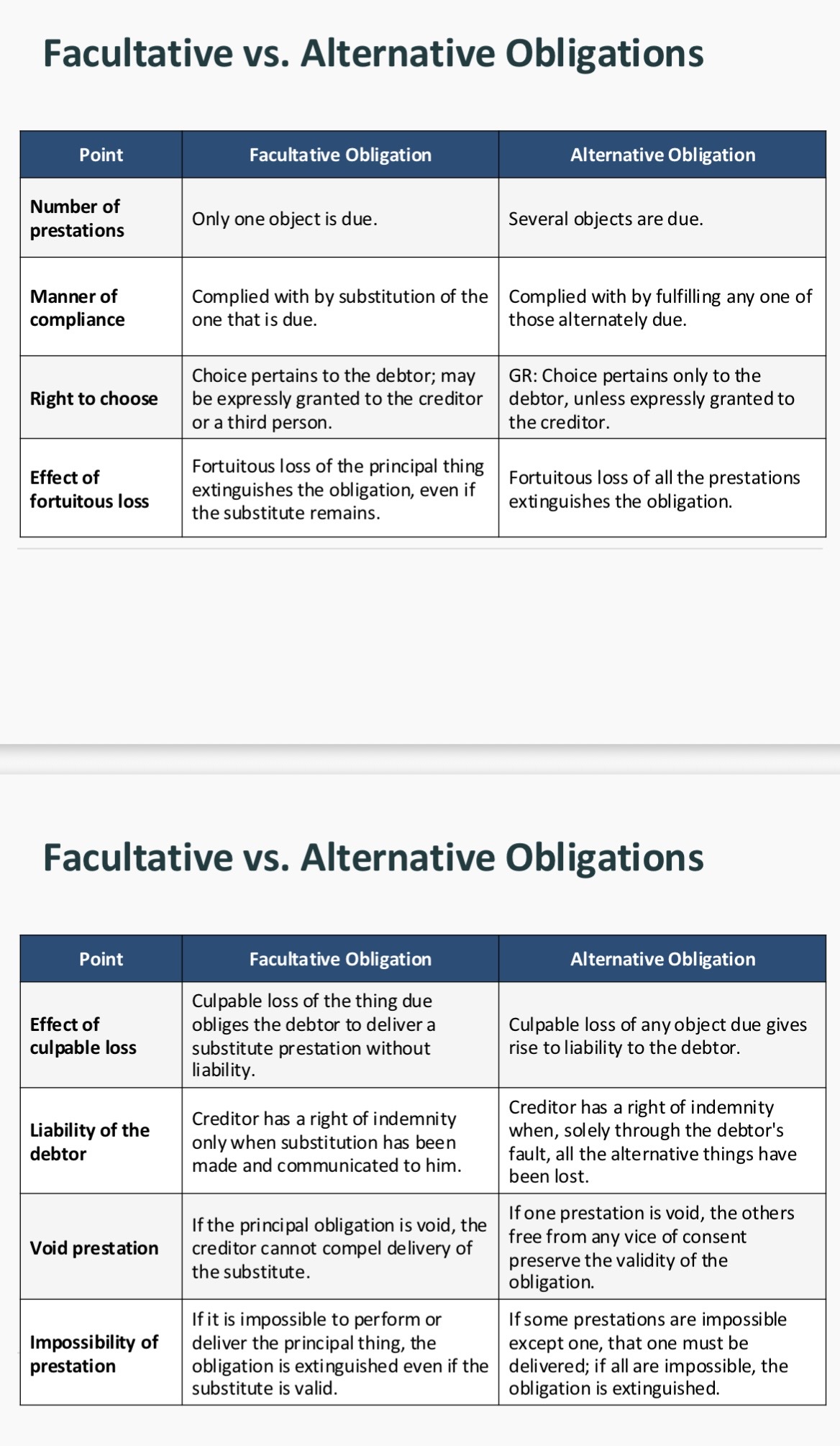
Limitations on the Debtor's Right to Choose
The debtor must absolutely perform the chosen prestation; he cannot compel the creditor to receive part of one and part of another undertaking.
The debtor has no right to choose prestations which are impossible, unlawful, or which could not have been the object of the obligation (Art. 1200, NCC).
The debtor loses the right of choice when, among the prestations whereby he is alternatively bound, only one is practicable (Art. 1202, NCC).
The selection made cannot be subjected to a condition or a term unless the other party consents thereto (Tolentino, 2002).
Effectivity of the Choice in Alternative Obligations
The choice made takes effect only upon its communication to the other party, and from such time, the obligation ceases to be alternative (Arts. 1201 & 1205, NCC).
-If the choice is rendered impossible through the creditor's fault, the debtor may rescind the contract with damages (Art. 1203, NCC).
An Alternative Obligation Becomes
Simple When:
1. The debtor has communicated
the choice to the creditor
2. The debtor loses the right of
choice because only one
prestation is practicable (Art.
1202, NCC)
Effects of Loss of Objects — Choice Belongs to the Debtor Or Creditor

Plurality of Parties in Alternative Obligations
When the obligation is joint, the consent of all
the joint debtors or creditors is necessary to
make the selection effective, since none of
them can extinguish the entire obligation
alone.
When the obligation is solidary and there is no
stipulation to the contrary, the choice made by
one solidary debtor, once communicated, binds
him personally — but not the others (Tolentino,
2002).
Joint Obligation
Credit or debt is presumed divided into equal shares among the creditors or debtors (Art. 1208, NCC).