VSEPR Theory, Molecular Geometries, and Hybridization

0.0(0)
Studied by 1 person
call kaiCall Kai
learnLearn
examPractice Test
spaced repetitionSpaced Repetition
heart puzzleMatch
flashcardsFlashcards
GameKnowt Play
Card Sorting

1/12

flashcard set

Earn XP

Description and Tags

Comprehensive vocabulary flashcards covering electronic geometries, molecular geometries, bond angles, hybridization types, and polarity rules.

13 Terms

1
New cards

Linear (22 Electron Groups)

- 22 electron groups and no lone pairs,

-featuring bond angles of 180∘180^\circ

-spsp hybridization.

-non-polar if both peripheral atoms are identical


<p>- $$2$$ electron groups and no lone pairs, </p><p>-featuring bond angles of $$180^\circ$$</p><p>-$$sp$$ hybridization. </p><p>-non-polar if both peripheral atoms are identical</p><p></p>
2
New cards

Trigonal Planar

- 33 electron groups with no lone pairs

-bond angles of 120∘120^\circ

- sp2sp^2 hybridization

-non-polar if all peripheral atoms are identical,
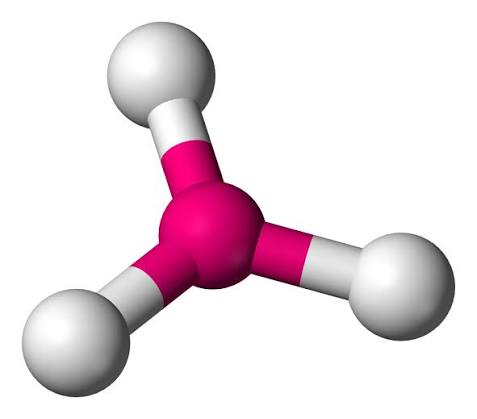
<p>- $$3$$ electron groups with no lone pairs</p><p>-bond angles of $$120^\circ$$ </p><p>- $$sp^2$$ hybridization</p><p> -non-polar if all peripheral atoms are identical, </p>
3
New cards

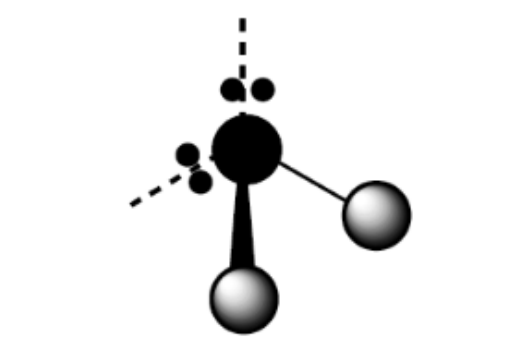
Bent (3 electron groups)_

  • Electronic geometry) derived from a trigonal planar w/ 22 bonding pairs and 11 lone pair

  • bond angles of <120∘< 120^\circ

  • sp2sp^2 hybridization,

  • polar


<ul><li><p>Electronic geometry) derived from a trigonal planar w/ $$2$$ bonding pairs and $$1$$ lone pair </p></li><li><p>bond angles of $$&lt; 120^\circ$$</p></li><li><p> $$sp^2$$ hybridization, </p></li><li><p>polar</p></li></ul><p></p>
4
New cards
<p>Tetrahedral Molecular Geometry</p>

Tetrahedral Molecular Geometry

  • 44 bonding electron groups and no lone pairs

  • bond angles of 109.5∘109.5^\circ

  • sp3sp^3 hybridization.

  • It is non-polar if all peripheral atoms are identical,


5
New cards

Trigonal Pyramidal

  • Electronic Geometry) derived from tetrahedral, w/ 33 bonding pairs and 11 lone pair,

  • bond angles of <109.5∘< 109.5^\circ

  • sp3sp^3 hybridization

  • polar


<ul><li><p>Electronic Geometry) derived from tetrahedral, w/ $$3$$ bonding pairs and $$1$$ lone pair,</p></li><li><p> bond angles of $$&lt; 109.5^\circ$$</p></li><li><p>$$sp^3$$ hybridization </p></li><li><p>polar</p></li></ul><p></p>
6
New cards

Bent (44 Electron Groups)

  • derived from a tetrahedral w/ 22 bonding pairs and 22 lone pairs

  • bond angles of <109.5∘< 109.5^\circ

  • sp3sp^3 hybridization

  • polar character


<ul><li><p>derived from a tetrahedral w/ $$2$$ bonding pairs and $$2$$ lone pairs</p></li><li><p>bond angles of $$&lt; 109.5^\circ$$</p></li><li><p> $$sp^3$$ hybridization</p></li><li><p>polar character</p></li></ul><p></p>
7
New cards
<p>Trigonal Bipyramidal </p>

Trigonal Bipyramidal

  • 55 bonding electron groups and no lone pairs

  • bond angles of 120∘120^\circ, 90∘90^\circ, and 180∘180^\circ

  • dsp3dsp^3 (sp3dsp^3d) hybridization

  • It is non-polar if all peripheral atoms are identical, or if the 22 axial atoms are identical and the 33 equatorial atoms are identical.


8
New cards

See-saw

  • derived from a trigonal bipyramidal w/ 44 bonding pairs and 11 lone pair

  • bond angles of <120∘< 120^\circ, <90∘< 90^\circ, and <180∘< 180^\circ,

  • polar


<ul><li><p>derived from a trigonal bipyramidal w/ $$4$$ bonding pairs and $$1$$ lone pair</p></li><li><p>bond angles of $$&lt; 120^\circ$$, $$&lt; 90^\circ$$, and $$&lt; 180^\circ$$,</p></li><li><p>polar </p></li></ul><p></p>
9
New cards

T-shaped

  • derived from a trigonal bipyramidal electronic geometry containing 33 bonding pairs and 22 lone pairs

  • bond angles of <90∘< 90^\circ and <180∘< 180^\circ

  • polar


<ul><li><p>derived from a trigonal bipyramidal electronic geometry containing $$3$$ bonding pairs and $$2$$ lone pairs</p></li><li><p>bond angles of $$&lt; 90^\circ$$ and $$&lt; 180^\circ$$</p></li><li><p>polar</p></li></ul><p></p>
10
New cards

Linear (55 Electron Groups)

  • derived from a trigonal bipyramidal electronic geometry with 22 bonding pairs and 33 lone pairs in equatorial positions

  • bond angle of 180∘180^\circ

  • dsp3dsp^3 (sp3dsp^3d) hybridization

  • non-polar if both peripheral atoms are identical.
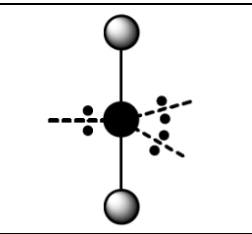

<ul><li><p>derived from a trigonal bipyramidal electronic geometry with $$2$$ bonding pairs and $$3$$ lone pairs in equatorial positions</p></li><li><p>bond angle of $$180^\circ$$ </p></li><li><p> $$dsp^3$$ ($$sp^3d$$) hybridization</p></li><li><p>non-polar if both peripheral atoms are identical.</p></li></ul><p></p>
11
New cards

Octahedral

  • formed by a central atom with 66 bonding electron groups and no lone pairs,

  • bond angles of 90∘90^\circ and 180∘180^\circ (distorted if polar),

  • d2sp3d^2sp^3 (sp3d2sp^3d^2) hybridization.

  • It is non-polar if all peripheral atoms are identical or if identical atoms are positioned in opposite directions.
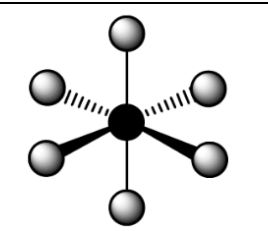

<ul><li><p>formed by a central atom with $$6$$ bonding electron groups and no lone pairs, </p></li><li><p>bond angles of $$90^\circ$$ and $$180^\circ$$ (distorted if polar), </p></li><li><p> $$d^2sp^3$$ ($$sp^3d^2$$) hybridization. </p></li><li><p>It is non-polar if all peripheral atoms are identical or if identical atoms are positioned in opposite directions.</p></li></ul><p></p>
12
New cards
<p>Square Pyramidal </p>

Square Pyramidal

  • derived from an octahedral electronic geometry containing 55 bonding pairs and 11 lone pair,

  • bond angles of <90∘< 90^\circ and <180∘< 180^\circ

    sp3d2 hybridization

  • polar


13
New cards

Square Planar

  • derived from an octahedral electronic geometry containing 44 bonding pairs and 22 lone pairs on opposite sides

  • bond angles of 90∘90^\circ and 180∘180^\circ (distorted if polar).

  • sp3d2 hybridization

  • It is non-polar if all peripheral atoms are identical or if identical atoms are paired across the central atom.


<ul><li><p>derived from an octahedral electronic geometry containing $$4$$ bonding pairs and $$2$$ lone pairs on opposite sides</p></li><li><p>bond angles of $$90^\circ$$ and $$180^\circ$$ (distorted if polar).</p></li><li><p>sp3d2 hybridization</p></li><li><p>It is non-polar if all peripheral atoms are identical or if identical atoms are paired across the central atom.</p></li></ul><p></p>