ARTH 2400 Quiz #3
 Call Kai
 Learn
 Practice Test
 Spaced Repetition
 Match
 Flashcards
 Knowt Play
1/38

There's no tags or description
Looks like no tags are added yet.
39 Terms
Burgher
A member of the wealthy, Dutch mercantile middle class.
Idolantry
The worship of a physical object as a god.
Iconoclasm
The rejection or destruction of religious images as heretical.

Identify
Rembrandt van Rijn, Portraits of Maerten Soolmans and Oopjen Coopit, 1634, oil on canvas
Pendant portraits
Portraits that were conceived or commissioned as a pair. Often made to commemorate a marriage.
Tronie
A painting that is a head study of a “typical” human character. They are often characterized by exaggerated or characteristic facial expression.

Identify
Rembrandt van Rijn, Captain Frans Banning Cocq Mustering His Company (The Night Watch), 1642, oil on canvas
Genre painting
Scenes of everyday life.

Identify
Johannes Vermeer, The Milkmaid, 1658, oil on canvas
Hierarchy of the arts
History painting
Portraiture
Still life, landscapes, genre

Identify
Jacob van Ruisdael, The Windmill at Wijk, 1670, oil on canvas
Leifhebber
Amateur, devotee, lover, connoisseur.
Camera obscura
A darkened box with a convex lens or aperture for projecting the image of an external object onto a screen inside.

Identify
Johannes Vermeer, Officer with a Laughing Girl, 1657, oil on canvas
Circles of confusion
Optical effect seen when bright highlights are viewed through an imperfect or unfocused very high quality.
Still life painting
Paintings that depict mostly inanimate subject matter, including natural and man-made objects.
Tulipmania
A period during the Dutch Golden Age when contract prices for some bulbs of the recently introduced and fashionable tulip reached extraordinarily high levels. Lasting from 1634 to 1637, it is generally considered to have been the first recorded speculative bubble in history.

Identify
Jan Davidsz de Heem, Vase of Flowers, 1660, oil on canvas

Identify
Adrienne Coorte, Shells on a Ledge, 1698, oil on paper on panel

Identify
Daniel Vertangen, Portrait of Jan Valckenburgh and an Enslaved Servant, 1660, oil on canvas

Identify
Daniel Vertangen, Portrait of Dina Lems, 1660, oil on canvas

Identify
Rembrandt van Rijn, Portrait of Maerten Soolmans and Portrait of Oppjen Coppit, 1634, oil on canvas

Identify
Albert Eckhout, Series of eight figures, 1641, oil on canvas
Repoussoir
An object along the right or left foreground that directs the viewer's eye into the composition by bracketing the edge.

Identify
Andries Beeckman, The Castle of Batavia, 1661, oil on canvas
Pronkstilleven
Ornate still lives depicting luxurious foreign goods.
Peristyle
A row of columns surrounding a space within a building, such as a court or internal garden or edging a veranda or porch.
Enfilade
An interconnected group of rooms arranged usually in a row with each room opening into the next.

Identify
Jules Hardouin- Mansart (architecture) and Charles Le Brun (decoration), The Hall of Mirrors, 1678-84
Parterre
Ornamental, designed flowerbeds.
Bosquet
A grove, wood, or other formal plantation of trees.

Identify
André Le Nôtre, Grand Canal, 1667-79, earth, stone and water
Bodogones
paintings of daily life, often with food or drink as still-life elements. The term comes from the Spanish word bodega, which means tavern or storeroom.
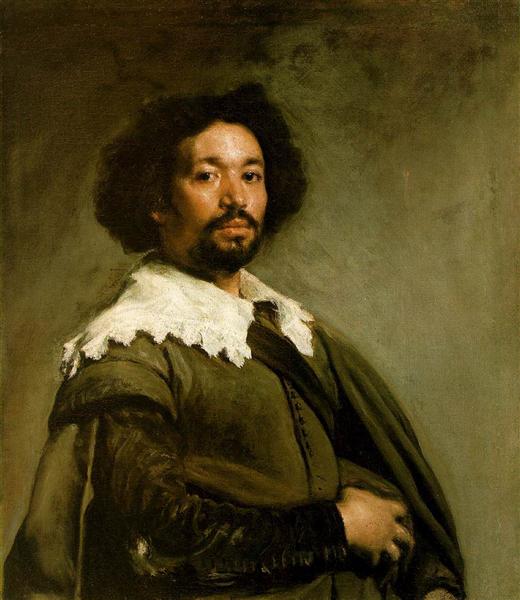
Identify
Diego Velázquez, Portrait of Juan de Pareja, 1650, oil on canvas

Identify
Diego Velázquez, Las Meninas, 1656, oil on canvas

Identify
Diego Velázquez, Philip IV in Brown and Silver, 1632, oil on canvas

Identify
Antonio Rodríguez Beltrán, María Luisa de Toledo with an indigenous companion, 1670, oil on canvas
Casta painting
Paintings of human lineage mainly in 18th-century Mexico that show race mixture as a hierarchy.