BIO 141 - ch 7 - Membranes
 Call Kai
 Learn
 Practice Test
 Spaced Repetition
 Match
 Flashcards
 Knowt Play
1/18

There's no tags or description
Looks like no tags are added yet.
19 Terms
semi permeable, some things get through some don’t, it protects the cell because of its control. allows for the storage of energy by moving things from one side to the other - transfer of energy
allows for molecules [enzymes, cytochromes] to be close to each other
phospholipids - polar and non polar
membrane
function
importance of location
what’s it made of
have a hydrophilic head [outside] and hydro phobic tail [inside]
they are arranged in a bilayer with the phillic heads facing out and the phobic heads on the inside
Describe the properties of phospholipids and their arrangement in cellular membranes.
they split the membrane down the middle of the phospholipid bilayer and are proteins embedded directly within the core of the membrane rather than just sitting of the surface
Explain what freeze-fracture techniques reveal about the involvement of proteins in membranes.
fluid properties have more spacing between the hydrophilic heads
they have unsaturated hydrocarbon tails -double bonds
this makes it easier for things to pass through the membrane
Describe the fluid properties of the cell membrane and explain how membrane fluidity is influenced by membrane composition.
carbohydrates are located exclusively on the extracellular side
Describe how proteins and carbohydrates are spatially arranged in cell membranes and how they contribute to membrane function.
concentration gradients - molecules want to move from high to low concentrations
ex. more Na is outside the cell so they will go in and more K is in the cell so they will go out
transport proteins regulate what can go in and out of the cell
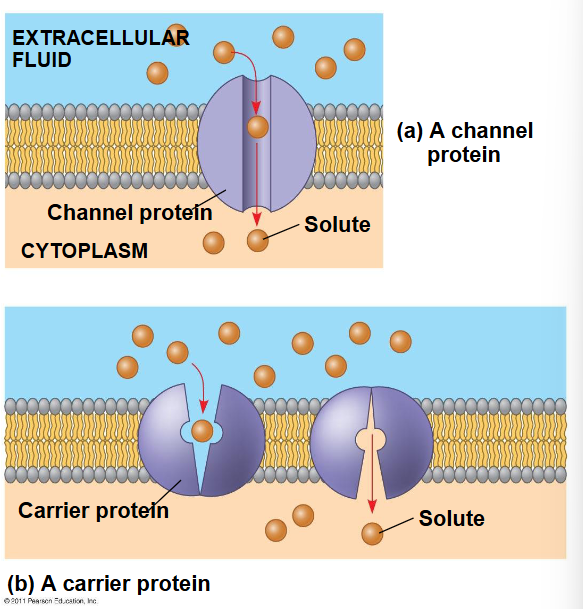
protein channels are specific to what ions can pass through
Describe factors that affect the selective permeability of membranes.
they are located spanning across the membrane
integral proteins span across the membrane or peripheral proteins attach to the surface
they function as channels or carriers to help specific molecules, ions, and water cross the hydrophobic barrier
Describe the locations and functions of transport proteins.
it is the movement of particles from a high concentration to low
takes no energy
the driving force is the concentration gradient
Define diffusion. Explain what is the driving force behind diffusion.
it is regulated by the concentration gradient
have channels specific to what can pass through
it is basically diffusion with some help
no energy
Explain what regulates the rate of passive transport.
molecules naturally store energy when moved by a concentration, which is released as they flow down their gradient to perform work
Explain why a concentration gradient across a membrane represents potential energy.
hypotonic
animal = lysed - over filled
plant = turgid - normal
more water less solute inside cell
isotonic
animal = normal
plant = flaccid - under filled
hypertonic
animal = shriveled
plant - plasmolyzed
more solute less water inside cell
Distinguish between hypertonic, hypotonic, and isotonic solutions.
its the diffusion of water across a selectively permiable membrane
water moves from an area of lower solute concentration [higher water] to an area of higher solute concentration [ lower water ]
Define osmosis and predict the direction of water movement based on differences in solute concentrations.
They go across the membrane
take a certain amount of proteins across and need ATP to be phosphorylated in order to change cell shape and move contents across membrane.
Explain how transport proteins are structurally organized.

facilitated is like diffusion with some help
the ions are still moving with their concentration gradient - so its passive
the channel is specific to what can pass through
some are carrier proteins that change their shape to help the movement of a solute
[there are two types a channel type and a switch type]
Explain how transport proteins facilitate diffusion.
it requires energy because it moves substances against their concentration gradient
when ATP comes along it phosphorylates the protein - allowing it to shift
when K comes the protein dephosphorylates
for example the Na/K pump when Na attaches to the protein ATP phosphorylates, attaching a P to the protein and giving it the energy to shift and release the Na to the other side.
then K comes and attached to the pump, it can use the P again to drive the K into the cell then
Explain how active transport differs from diffusion
ion pumps [like the Na / K pump or proton pump] use ATP to actively transport ions across the membrane against their gradient, creating unequal distribution of charge and concentration
Explain what mechanism can generate a membrane potential or electrochemical gradient
in a proton pump energy is needed to get H from inside the cell [in tje cytoplasm] to outside the cell [extracellular]
once the H build up it can diffuse back into the cell and sucruse can use the H to move with it
it is using an exergonic motion to drive and endergonic
Describe the process of co-transport
dont
diffusion
facilitated diffusion
do
active transport
endo/exocytosis
what membrane processes need energy vs which dont
facilitated diffusion
diffusion
.
diffusion
aquaporins
facilitated diffusion
how do each of these move through proteins - what method of travel
carb
lipid
protein
gasses
water
ions