Anti-Infectives Pharmacology
 Call Kai
 Learn
Learn Practice Test
 Spaced Repetition
 Match
Match Flashcards
 Knowt Play
1/62

There's no tags or description
Looks like no tags are added yet.
Name | Mastery | Learn | Test | Matching | Spaced | Call with Kai | Chat |
|---|
No analytics yet
Send a link to your students to track their progress
63 Terms
What is the strategy for curing most infections?
Minimal effects on host cells
What are the 3 classes of biochemical reactions?
Class 1 - ATP production
Class 2 - small biomolecules
Class 3 - macromolecules
What are some cell wall targets in pathogens?
Terminal 2 amino acids - D-Alanine can be inhibited
Peptidoglycan subunit passes through cell membrane and polymerises when reaches cell wall and antibiotics can prevent dephosphorylaiton
Cross-linking of peptide portion can be inhibited

What is the action of penicillins?
Prevent bacteria from using a substance necessary for maintaining outer cell wall - inhibits transpeptidase, can be bactericidal or bacteristatic
What type of bacteria is mycobacterium tuberculosis?
Weakly gram positive, aerobic
What is the structure like of mycobacterium TB?
Lipid-rich cell wall

What is the primary infection that TB causes?
Pulmonary
Where does TB then disseminate to after the primary infection which is usually pulmonary?
Any body system!
What is TB resistant to?
Disinfectants, detergents, common antibiotics and traditional stains
What patient groups is TB most common in?
Immunocompromised or untreated patients
What is the treatment of TB generally?
Multi-drug regimen and prolonged treatment to prevent development of resistance
What is the prevention of TB in endemic countries?
Immunoprophylaxis with BCG
How is TB preventable?
Active surveillance, prophylaxis and therapeutic intervention and careful case monitoring
What is ALWAYS necessary when treating TB?
Polytherapy
What does antibiotic drug treatment depend on for TB?
Site of infection, susceptibility testing, multi-drug resistant (MDR) strains and renal impairment
What body system involvement requires prolonged TB treatment?
CNS
What is needed to treat MDR TB?
Prolonged treatment for 18-24 months with at least 6 drugs which specific bacterium is likely to be sensitive
What drugs are usually first line for TB?
Isoniazid with pyridoxine, rifampicin, ethambutol, pyrazinamide
How are ethambutol and pyrazinamide excreted?
Renally
What may need to be added to first line treatment for CNS TB?
Dexamethasone or Prednisolone
What is second line treatment for TB?
Cycloserine, streptomycin, capreomycin potentially
What is the term used to describe an infected but asymptomatic patient with TB who has immune system stimulation due to TB antigens and are at risk of developing active disease?
Latent infection
What is the regimen based on for TB?
Age, HIV status, liver function and susceptibility testing
What type of drug is isoniazid?
Prodrug activated by bacterial enzymes
How does isoniazid work?
Exerts inhibitory activity on synthesis of mycolic acids - unique to cell wall of mycobacteria and is bacteriostatic at low concs, bacteriocidal at high concs
What are potential ADRs from isoniazid that can be affected by genetics?
All ADRs - peripheral/optic neuritis, hepatitis, gastric upset, haemolytic anaemia, enzyme inhibitor, CNS toxicity
How does rifampicin work?
Inhibits subunit of bacterial DNA-dependant RNA polymerase and inhibits transcription - bactericidal
What are some ADRs of rifampicin?
Harmless red/orange colour to urine, sweat and tears, rashes, thrombocytopenia, nephritis, cholestatic jaundice/hepatitis, flu-like syndrome and induces CYP450s
When is 2nd line treatment indicated for TB?
Resistance to 1st line drugs, failure of clinical response and increase of risky effects/pt not tolerating 1st line
What does isoniazid metabolism depend on?
Acetylation profile of an individual - can have different CYP enzyme variants
What transmits malaria?
Female anopheles mosquito from 16 degrees clips up to 30 degrees Celsius
What causes malaria?
Plasmodium Protozoa
How many hosts does the life cycle of malaria require?
2
What is the life cycle of malaria?
Infected mosquitos inject sporozoites into human host
Sporozoites infect liver cells and mature - asymptomatic
Cells rupture when mature, ruptures into merozoites
These invade erythrocytes - symptomatic stage
What is the malarial paroxysm?
Cycling pattern of illness following by fever-free period
What are the symptoms during the malarial paroxysm?
Headache, lack of energy, muscle aches and chills and fever up to 41 degrees, sweating occurs and rapid reduction in fever
What is the periodic febrile response caused by in malaria?
Rupture of mature schizonts
What are some sites of drug action for malaria?
Non-dormant liver stages - 8aminoquinolines e.g., primaquine, atovaquone-proguanil
Blood stages - ACTs, chloroquine, mefloquine, doxycycline, clindamycin
Gametocyte stages - ACTs, quinine, chloroquine, mefloquine
Liver dormant stages - 8aminoquinolines e.g., primaquine
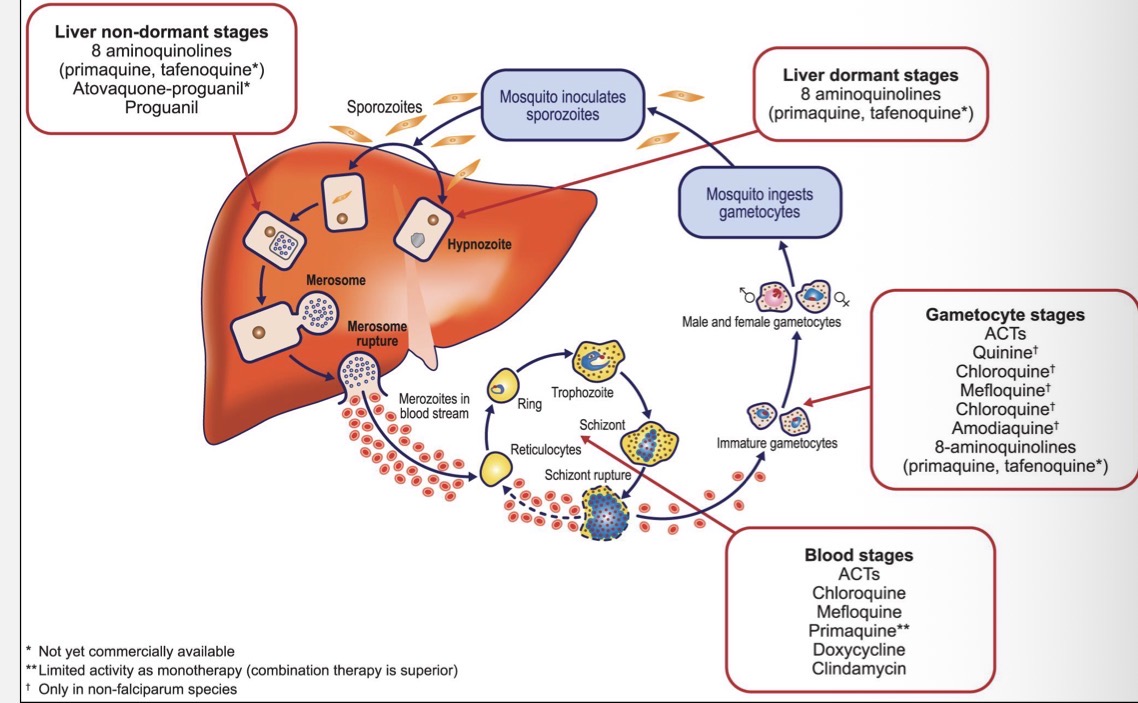
What are the therapeutic options for uncomplicated malaria where patients are symptomatic but no vital organ disturbance?
Artemisinin combination therapy (ACT), Atovaquone-proguanil or quinine + doxycycline, chloroquine
What are the therapeutic options for severe/complicated malaria?
Artesunate, quinine, chloroquine, primaquine
What is the only drug currently effective for eradicating hypnozoites?
Primaquine
What is the term to describe dormant parasites which persist in the liver after treatment of P.vivax and P,ovale?
Hypnozoites
What is the MOA of quinine and related agents?
Haem toxic - polymerised to haemozoin by the parasite and inhibits haem polymerase, resulting in Haem toxic
What are the ADRS of quinine?
Cinchonism e.g., tinnitus, deafness, headache, nausea, visual effects
What is cinchosim?
cluster of dose-related and reversible side effects of quinine
What is the contraindications of chloroquine?
Teratogenic!
What are the cautions/interactions of quinine and related agents?
Reduce in liver/kidney disease
Glucose 6 phosphate deficiency - acute haemolytic anaemia risk
Chloroquine - risk of retinopathy
Quinine - inhibits tubular secretion of digoxin, potentiates warfarin effects and prolongs QT interval
How do anti-folates e.g., proguanil work for malaria as prophylaxis or treatment?
Inhibits dihydrofolate reductase (DHFR)
What is the MOA of atovacuone-proguanil?
Active metabolite of proguanil that inhibits DHFR in pre and erythrocytic parasites and also inhibits mitochondrial ETC
What are the ADRs of atovacuone-proguanil?
Mouth ulcers, epigastric discomfort, diarrhoea
How fast does artemisinin work?
Very rapid acting but short half life - unsuitable for chemoprophylaxis
What is the MOA of Artemesinin?
Depends on production of free radicals - exact mechanism unknown
What can be used in ACT to treat uncomplicated malaria?
Artemethere + lumefantrine, derivative with 2nd unrelated antimalarial compound that is highly potent
How does lumafantrine work?
Eliminates residual parasites, active against human malarial parasites
What are the ADRs of ACT?
Abdominal pain, nausea, anorexia, diarrhoea, dizziness, headache, sleep disturbance, fatigue
What can be done to prevent malaria?
Educate about malaria, avoid mosquito bites, chemoprophylaxis, compliance, diagnosis of febrile illness until 1 year after travel
What must choice of drug for prophylaxis of malaria consider?
risk of exposure to malaria
Extent of drug resistance, efficacy of recommended drugs
Side effects of drugs
Patient-related factors e.g., age, pregnancy, renal
What forms of malaria cause hypnozoite formation?
P.vivax and p.ovale
When should chemoprophylaxis for malaria start?
Before travel and continued after leaving the area - schedule length is drug dependent
What is the issue with using chloroquine to treat malaria?
Widespread resistant
What drugs can be used for chemoprophylaxis?
Doxycycline, mefloquine, atovaquone with proguanil
What quinine is preferred in pregnancy as we know more about it?
Quinine
What chemoprophylactic drug is used when travellers are going to areas where resistance to other antimalarial drugs is suspected?
Atovaquone with proguanil