Exam 2 Ecology and Evolution Terms
 Call Kai
 Learn
Learn Practice Test
 Spaced Repetition
 Match
Match Flashcards
 Knowt Play
1/38

There's no tags or description
Looks like no tags are added yet.
Name | Mastery | Learn | Test | Matching | Spaced | Call with Kai | Chat |
|---|
No analytics yet
Send a link to your students to track their progress
39 Terms
Explotative Competition
INDIRECT competition through depletion of resources
(ex. two bugs species feeding not the same plant)
Interference Competition
DIRECT competition that reduces another organism’s ability to acquire resources
(ex. two males fighting over a mate)
Pre-emptive Competition
competition for space when early occupants prevent later establishment
(ex. birds claiming a tree cavity, so no other birds can)
Intraspecific Competition
competition among members of the same species for a shared resource
(ex. deer fighting over a mate)
Interspecific competition
competition between different species for a common resource
(ex. birds fighting over seeds in a feeder)
Allelopathy
a plant releases a chemical interference that suppresses a competitors growth
(ex. buckthorn releases a chemical compound called emotion into the soil through roots and leaves)
Describe Joseph Connel’s experiment with barnacles. What did this experiment reveal about fundamental and realized niches?
Two Barnacle species, Cthamalus (top section) and Balanus(bottom section). Joseph Connel removes the bottom layer and observed that Cthamalus took over the bottom section of the rock. The whole rock was Cthamalus fundamental niche, because without having to compete with Balanus it took over the whole rock. The two species living on the same rock was the realized niche because it is actually how they live.
Fundamental Niche
where species could live if there was no competition or limiting factors
Realized Niche
where species actually live because of competition and limiting factors
Competitive Exclusion
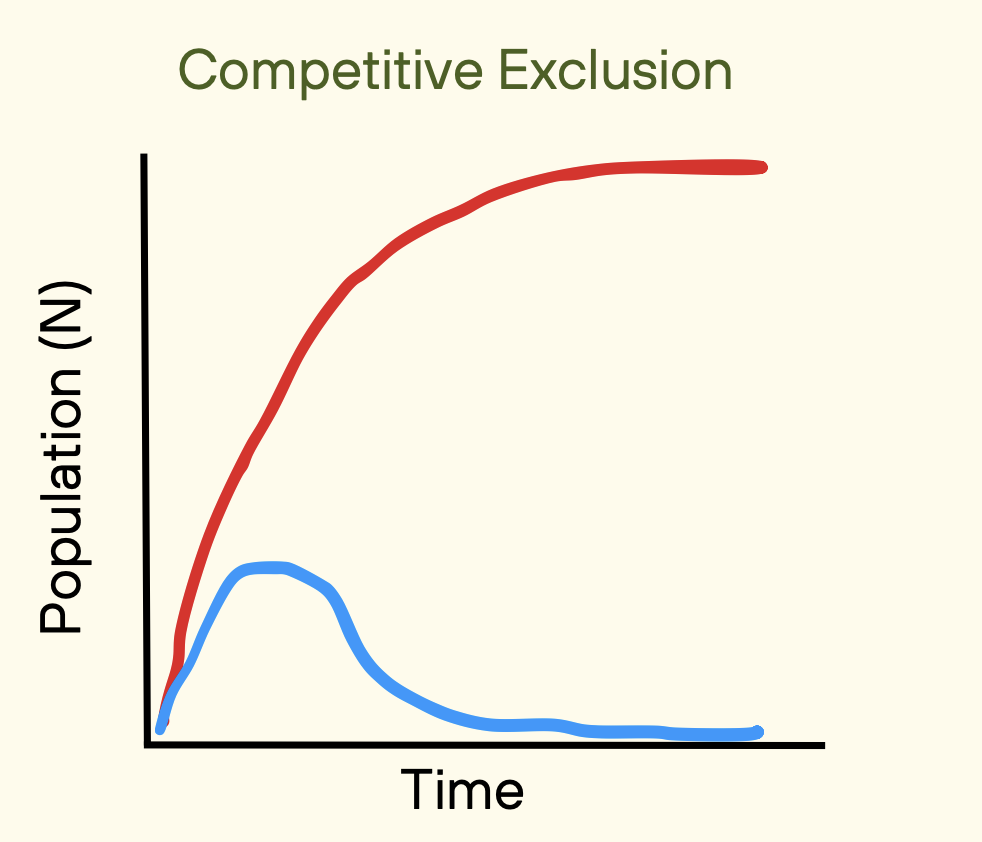
Competitive Coexistence

What are the four strategies that can lead to competitive coexistence?
Spatial niche partitioning
Temporal niche partitioning
Behavioral niche partitioning
Character Displacement
Spatial Niche Partitioning
when different species use different areas or locations to access resources, reducing competition with each other
ex: two bird species live in the same tree, but one searches for food near the top branches while the other searches near the bottom branches
Temporal Niche Partitioning
when different species use the same resources at different times to reduce competition
ex. mammals foraging at different times of day
Behavioral Niche Partitioning
when different species behave differently to access resources, reducing competition with each other
ex. two bird species eat insects from the same tree, but one searches for insects on the leaves while the other searches under the bark
Character Displacement
species living in the same area develop traits to reduce competition
ex. Darwin’x finches evolving diffrent beak types to eat different foods in the same area
r
intrinsic growth rate
K
carrying capacity when N is 0
N
intraspecific crowding (N = 5 rabbits, not very crowded), (N = 100 rabbits, fairly crowded)
aN2
the total competitive effect that species 2 has on the population growth of species 1
Imagine:
species 1 = rabbits
species 2 = deer
one deer needs four times the food that 1 rabbit needs
a = 4
in the context of the equation, aN2 is how much crowding species 2 causes species 1m
a < 1
One N2 counts as less than one N1. Species 2 has a weaker effect on species 1 than species 1 has on itself
a = 1
One N2 counts as exactly one N1. The two individuals create equal crowding effects on species 1.
a > 1
One N2 counts as more than one N1. Species 2 has a stronger effect on species 1 than self-crowding.
What were some key-takeaways from the Snowshoe Hare study, Krebs et al. 1955?
The Snowshoe Hare cycle is a three level trophic interaction between food supplies and predators, not either one alone
Top-down (predators) and borrow-up(atrophic/plants) forces act together, rather than either one of them acting in a vacuum
“alpha”
the effect of N2 on population growth rate of N1, measured in units of N1
“beta” (predator-prey model)
Conversion efficiency — measures the ability of the predator population to convert captured victims into new predator offspring
Hutchinson’s niche
an n-dimensional hyper volume that defines a set of conditions of which dN/dt is greater than zero
K-selection
the type of selection that acts upon individuals born into a crowded environment
neutral equilibrium
the system rests at a state (or within a cycle), until some outside force pushes the system to a new point
isocline
the line in a state space graph that represents combinations of abundances of N1 and N2, such that dN/dt = 0
bet-hedging
a reproductive strategy that reduces the risk of total reproductive failure when environmental conditions are unpredictable. Instead of putting all their reproductive effort into one outcome, organisms spread their risk
ex: a plant produces seeds that remain dominant for different lengths of time, so not all seeds try to grow in the same year
paradox of the plankton
the observation that many plankton species coexist in the same environment even though they appear to compete for a limited number of resources
rescue effect
when individuals immigrate into small or declining population and help prevent it from going extinct
ex: birds from a nearby population move into a small population where the number of birds is falling
sink population
a population in a habitat where local reproduction and survival are not enough to replace deaths. The population persists because individuals immigrate from other populations
ex: a sink depends on immigration to survive
Type III survivorship curve
a survivorship pattern in which many individuals die when they are young, but those that survive early in life may live much longer
ex: many fish, insects and plants produce large numbers of offspring, but only a small fraction survive to adulthood
sympatry
when two species or populations live in the same geographic area and have the opportunity to encounter one another
ex: two closely related bird species living in the same forest
5 assumptions of Lotka-Volterra Predator-Prey Model
No migration, age or size structure, genetic structure, time lags
No carrying capacity for V
P is a specialist on V
P and V encounter each other randomly in a homogeneous environment
Individual predators are insatiable
Predator-Prey Model Equations
Prey: rV - aVP
Predator: BVP - qP
Competition
an interaction between two species that negatively affect each other