Rectification-Karteikarten | Quizlet
 Call Kai
 Learn
 Practice Test
 Spaced Repetition
 Match
 Flashcards
 Knowt Play
1/57

Earn XP
Description and Tags
Cards that discuss concepts within the Rectification topic in Food Engineering course.
58 Terms
Formula for heat required for heating of mixture to Tb from T
ΔH = m_mixture c_p (T_b - T)
Key idea behind the thermal separation
Separation of the components by exploiting their physical properties: vapour pressure, solubility, or density.
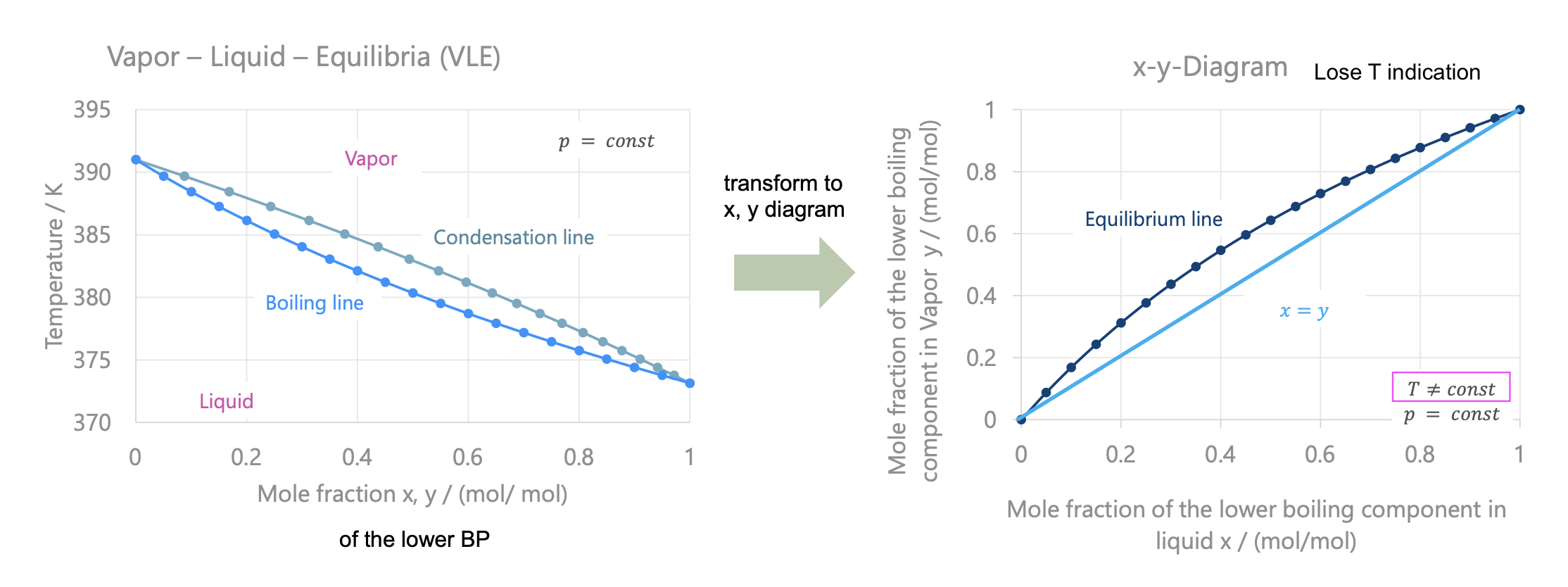
How is equilibrium line constructed and what info is lost?
Using vapor-liquid equilibrium (VLE) data, which shows the relationship between the compositions of components in the vapor and liquid phases at equilibrium. On x axis it has mole fraction of the lower BP compound in the mixture, and T on the y axis.
Information about T is lost.
Name separation techniques for:
1) Gas liquid
2) Gas solid
3) Liquid liquid
4) Liquid solid
1) Gas liquid: absorption, desorption, evaporation, distillation, rectification, condensing
2) Gas solid: adsorption, drying, sublimation
3) Liquid liquid: solvent extraction
4) Liquid solid: extraction, precipitation
From what is the x-y line for LB (lower boiling) compound achieved and what are the criteria for T and p?
What is on the axis of the graph for x-y line?
From vapour - liquid equilibria. Equilibrium space - btwn boiling and condensation lines.
p = const, T ≠ const
x axis - mol fraction of LB in the liquid
y axis - mol fraction of LB in the vapour
Steps for McCabe Thiele diagram
1) Place xH, xB, xF - fraction of target compound in the head, in the bottom, and in the feed.
2) Draw the feed line from the x=y, depending on the state of feed. E.g., boiling liquid - straight line.
3) Identify b: xH / (r+1). Draw a helping operating line: b to xH.
4) Find a cross section (X) between the feed line and a helping operating line.
5) xB - X = stripping line, X - xH = rectifying line.
6) Draw the stages between the equilibrium line and the operating lines.
What can one adjust to separate an azeotropic system?
1) Change the pressure → shift of the equilibrium line;
2) Use absorbent or adsorbent to remove one of the compounds;
3) Introduce a third component (an auxillary medium) for it to interact with one of the components to change its properties → change relative volatility;
4) Use membrane
What are two extreme scenarios for column operation? What do they lead to?
1) Infinite reflux ratio > minimum number of stages. Leads to a higher energy costs, because a lot of recondensation and reboiling should happen. Minimal investment costs (little amount of trays is needed).
2) Infinite number of stages > minimum reflux ratio. Minimum energy consumption.
Column operates btwn these two scenarios. Rule of thumb: r = 1.2 ... 1.5 * r_min
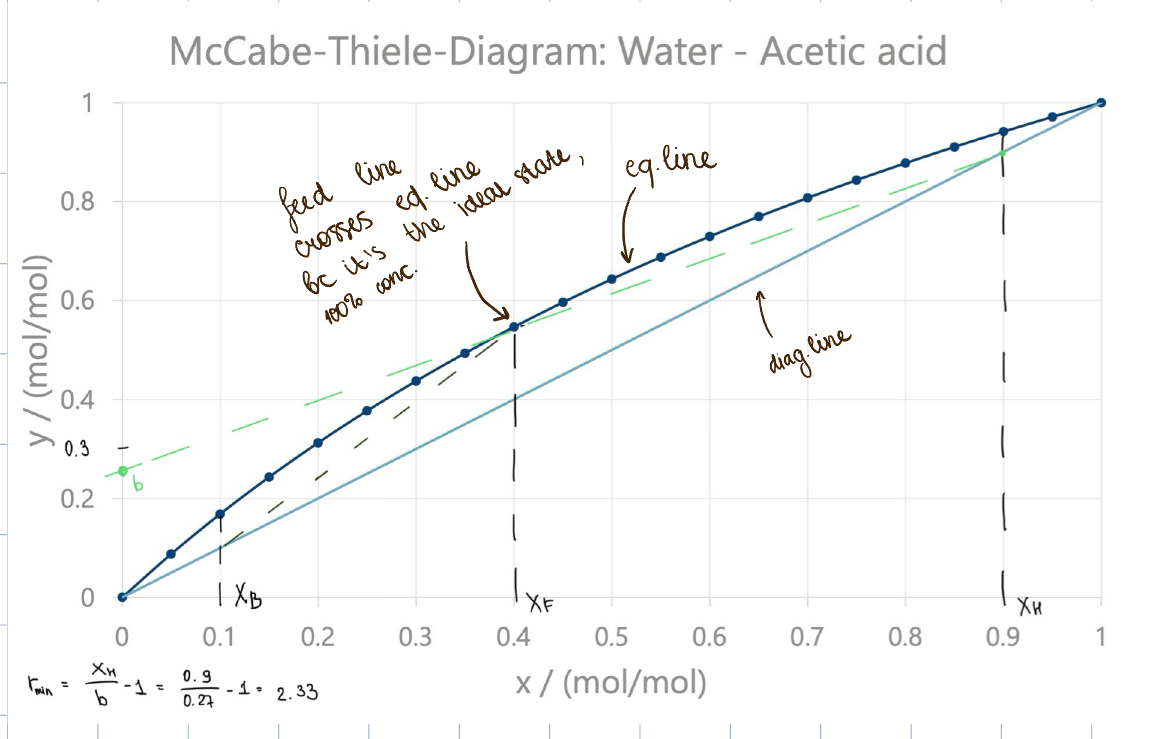
How to obtain r_min from the diagram?
Find the intersection btwn the equilibrium and feed line.
Find the intersection btwn X-Y and Xh.
Make a line through these two points until y-axis is reached (b point).
b = xH/(r+1).
Rectifying line equation
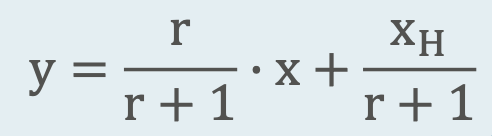
It reflects the relationship between the composition of the vapor phase (y) and the liquid phase (x) in the rectifying section of a distillation column.
Intersection with y-axis equals to b, x_H/(r+1)
How does reflux ratio affect the rectifying line position?
As reflux ratio (r = R/H, reflux / distillate enriched in the volatile compound) decreases, b becomes bigger, so the rectifying line moves closer to the equilibrium line.
The process becomes less efficient, as there’s less driving force for the separation, because less reflux is returned.
With a low reflux ratio, more stages are required to achieve the same separation because the operating lines are closer to the equilibrium curve, requiring more steps to reach the desired distillate composition.
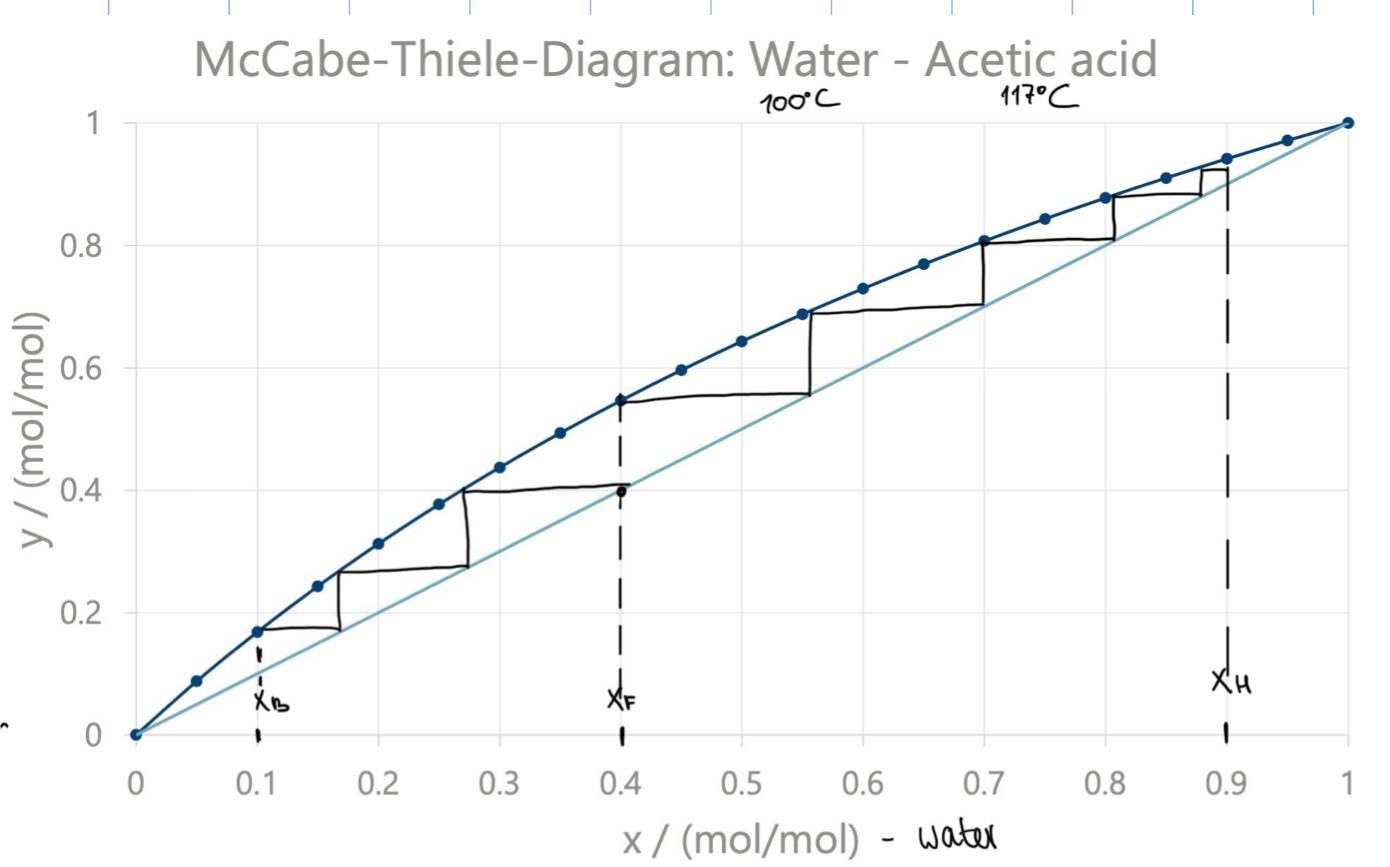
How to obtain number of stages for an infinite reflux situation from the diagram?
Just make a step drawing from the intersection of XY and Xb to the intersection of XY and Xh.
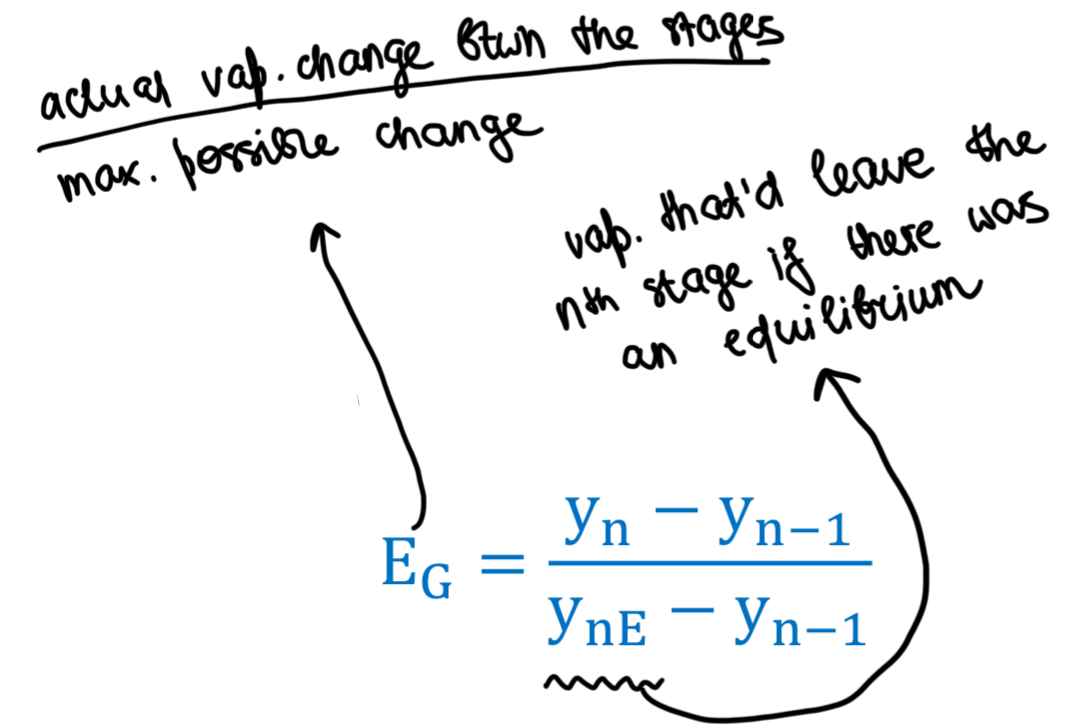
What is Murphee tray efficiency?
Factor that should be defined for each stage. Ratio of actually reached enhancement of concentration of lighter component within a tray to a theoretical value.
Usually, 0.7 for sieve and bubble, and 0.8 for valve.
What is the relative volatility? Is it constant?
Relative volatility (α) is a measure of the ease of separating two components in a binary mixture.
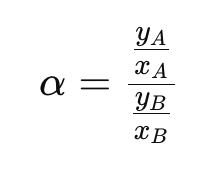
y - mole fraction of the component in the vapour,
x - mole fraction of the component in the liquid
α > 1 indicates that the component A is much more likely to enter the volatile phase, leading to an easy separation.
It’s not constant, because it changes with T, pressure (affects the vapor-liquid equilibrium), non-ideal behaviour (interaction btwn the molecules with the change in concentration, as they don’t follow Raoult’s Law) and activity coefficients.
Difference between ideal and non ideal systems
In ideal systems, phase behavior is governed by simple relationships that assume no interactions between components. However, in nonideal systems, molecular interactions can significantly deviate from ideal behavior.
How does one determine min number of stages with an inf reflux ratio?
Just calculate the number of stages btwn x=y and equilibrium line from xB to xH.
How does one determine min reflux ratio with an inf number of stages?
Inf number of stages > feed line crosses equilibria line. Plot a line through this point from xH and find a dot (b) on y axis.
b = xH/(r+1)
Relation between the water concentration in the vapour phase and its mole fraction in the liquid phase + activity coeff
y = (x_w*a_12) / [(a_12 - 1)x_w + 1]
a_12 = p_w/p_aa
Activity coeff represents the volatility of water relative to another compound in the system
How can be visible from the McCabe-Thiele, that mixture is separated easily?
If equilibrium line is really far from x=y, because then the difference in concentration is high and good mass transfer occurs.
Why is vapour compression efficient?
When condensing it, it's going to give out more heat.
On T-xy Diagram, what does the proximity of dew and bubble lines indicate? What compound is placed on x axis?
It indicates that mixture's components have similar boiling points. This makes it difficult to separate the components through simple distillation.
LB compound is on the x axis.
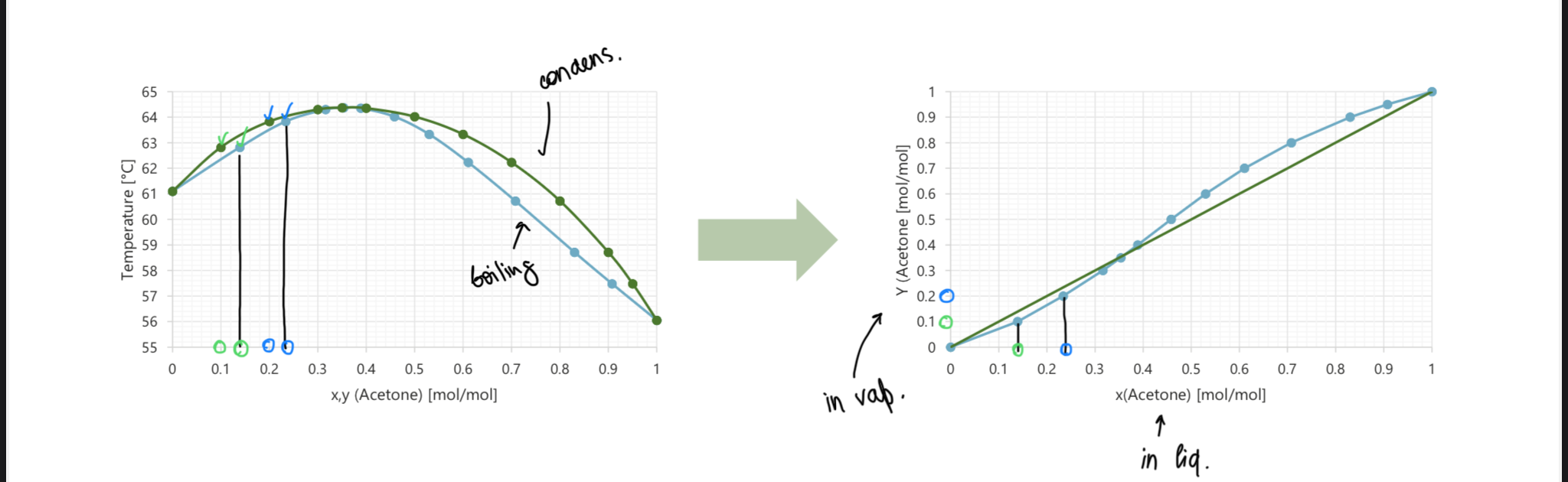
How to transfer VLE diagram to a xy diagram?
Values of the upper condensation curve go to the vapour value (y axis), according points values of the lower boiling curve go to the liquid value (x axis)
What is non azeotropic system?
Mixture of compounds that have different boiling temperature
Principle of rectification
Feed is entering the column in the feed zone (middle).
Liquid goes down to the stripping section that is rich in HB compound, while vapour is in LBC and goes up in the rectifying section.
A part of vapour is refluxed and re-condensed back for the re-boiling. When it comes in contact with the rising vapour in the upper part, more LB goes into the vapour, due to its high vapour pressure and chemical potential.
In the lower part, when liquid comes in contact with the rising vapour, it also loses LB to the latter.
Reboiler at the bottom gives back the vapour.
Define head flux (H) without using bottom flux (B)
H = F * (xF - xB)/(xH - xB)
Obtained from the total mass balances for a LBC.
Study and explain this
Alrighty
How do balances in a rectifying section look?
1) G = L + H, where L - liquid flow, G - gas flow, H - distillate
2) G h_mG = L h_mL + H * h_mH + Q_H, where Q_H is a latent vaporization heat that comes from condenser that creates a reflux
What is Trouton's rule?
Molar evaporation energy (energy needed to make liq > vap) is directly proportional to the T boiling. It works well for liquids with low intermolecular forces and bonds.
h_mV = c_T * T_B [J/kmol]
For water, proportionality factor, c_T = 1.410^5 [J/(kmol K)]
Define h_mV
h_mV = h_mG - h_mL
Molar evaporation enthalpy
How can (h_mH - h_mL) be approximated? Why is this equation needed?
h_mH = enthalpy of the more volatile compound
h_LH = enthalpy of the less volatile compound
c_mp * (T_H - T_L), difference between the boiling points
c_mp - energy to raise T of 1 mole for 1 K, molar heat capacity of liquid
Equation helps to approximate how much energy is needed to vaporize the heavier component compared to the lighter one.
How do c_mp and c_T relate?
c_mp - molar heat capacity of the liquid phase. Energy needed to raise liquid’s T for 1 K.
c_T - molar heat capacity of the vapour.
They are of similar order at boiling point. However, their energies are relatively small compared to the one required for the phase transition.
Why is boiling T of liquid phase (T_L or T_B) is much higher than T_H - T_B?
Because it's enriched with HBC.
How can one simplify G with Q_H, c_T, and T_B?
G = Q_H / (c_T * T_B)
What assumption is made for the feed zone?
Neglection of separation effect
No concentration change
Total mass balance between feed section
F + G_S + L_R = G_R + L_S
How is the feed heated?
???
Why do operating lines for stripping and rectifying sections match the feed line on a McCabe Thiele diagram?
Because both phases should have the same composition as the feed
What does reduced reflux ratio lead to?
1) Reduced energy consumption (less liquid is reboiled and less vap is condensed)
2) Shift of the operating line in the direction of the equilibrium > less efficient separation
3) Increase in the required column height due to an increase in the number of theoretical stages
Reflux ratio formula
r = R/H
Difference between trays and packing columns (two insert types)
1) Tray columns: horizontal plated placed at a given distance above each other
2) Packed columns: random packings or structured with defined geometry
Explain a working principle of trays
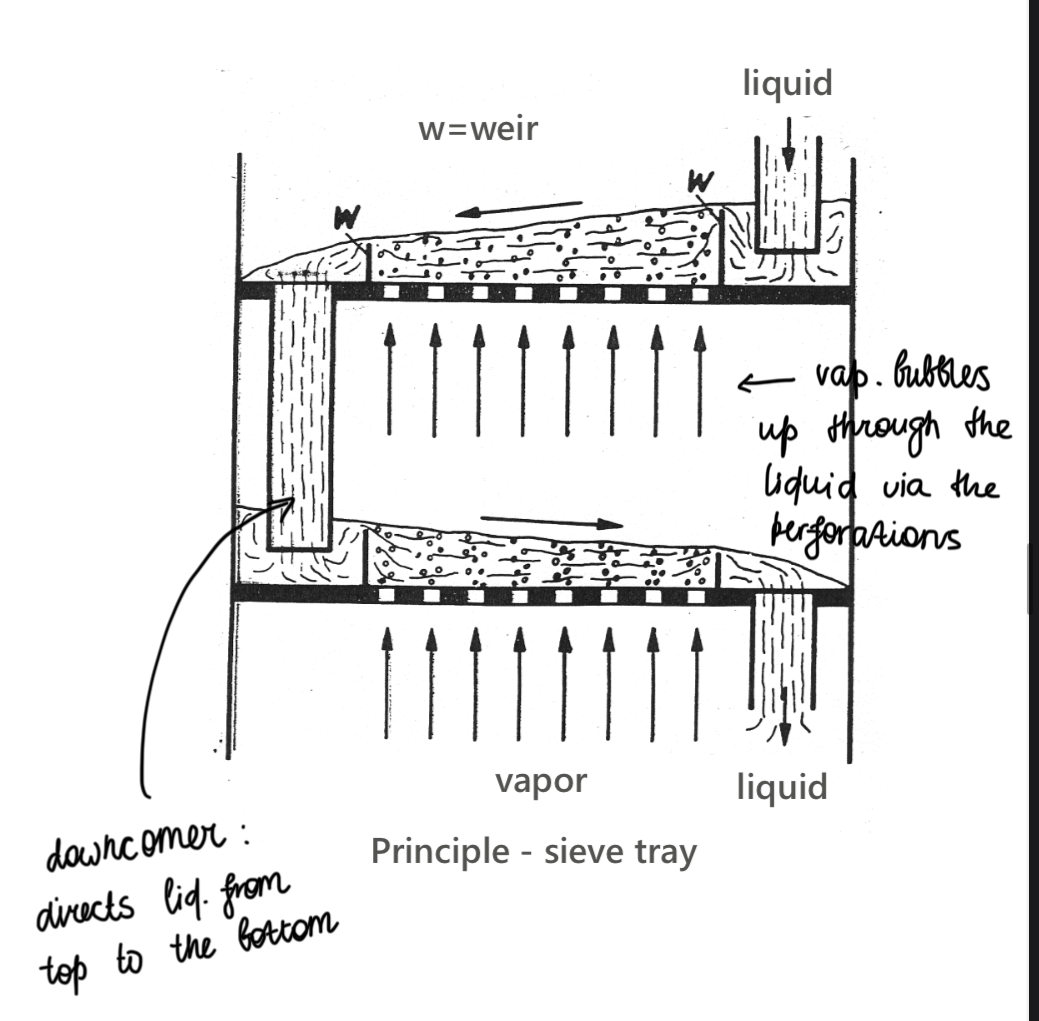
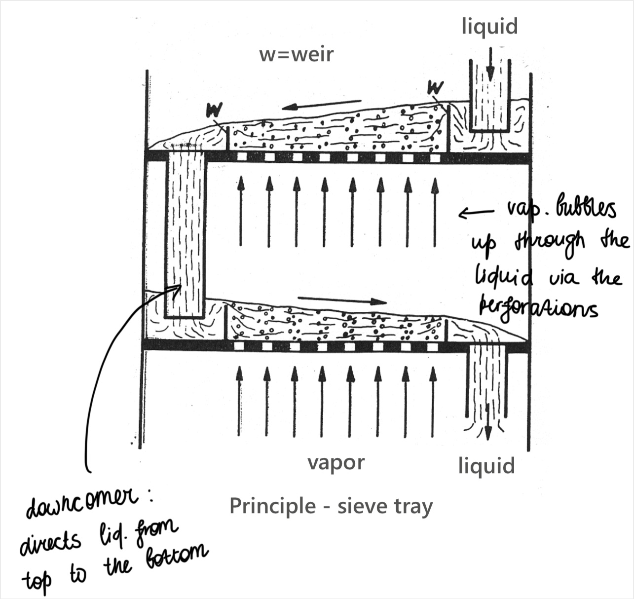
1) Tray has holes and weirs as liquid level holders
2) On the sides, there are downcomers that direct liquid from top to the bottom
3) Vapour rises through the holes and prevents liquid from going downward
4) The reduction of cross-sections keeps liquid level high enough to inhibit vapour break through for a proper contact of both phases
Name 4 types of trays
1) Sieve
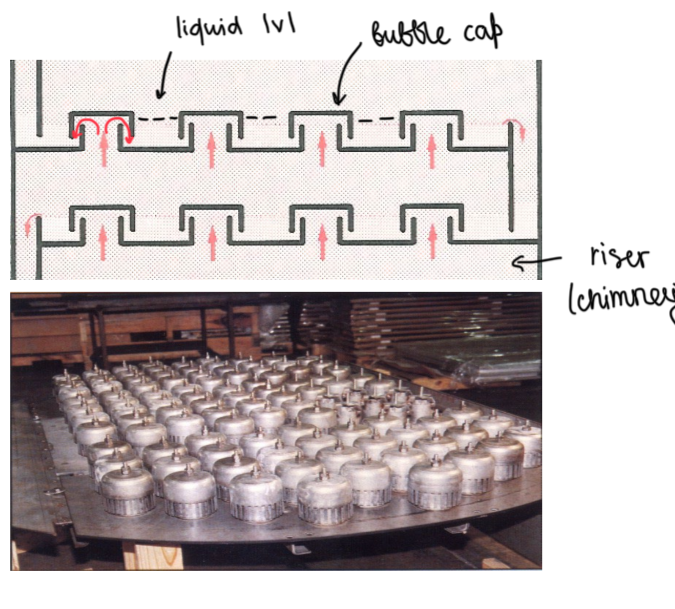
2) Bubble cap
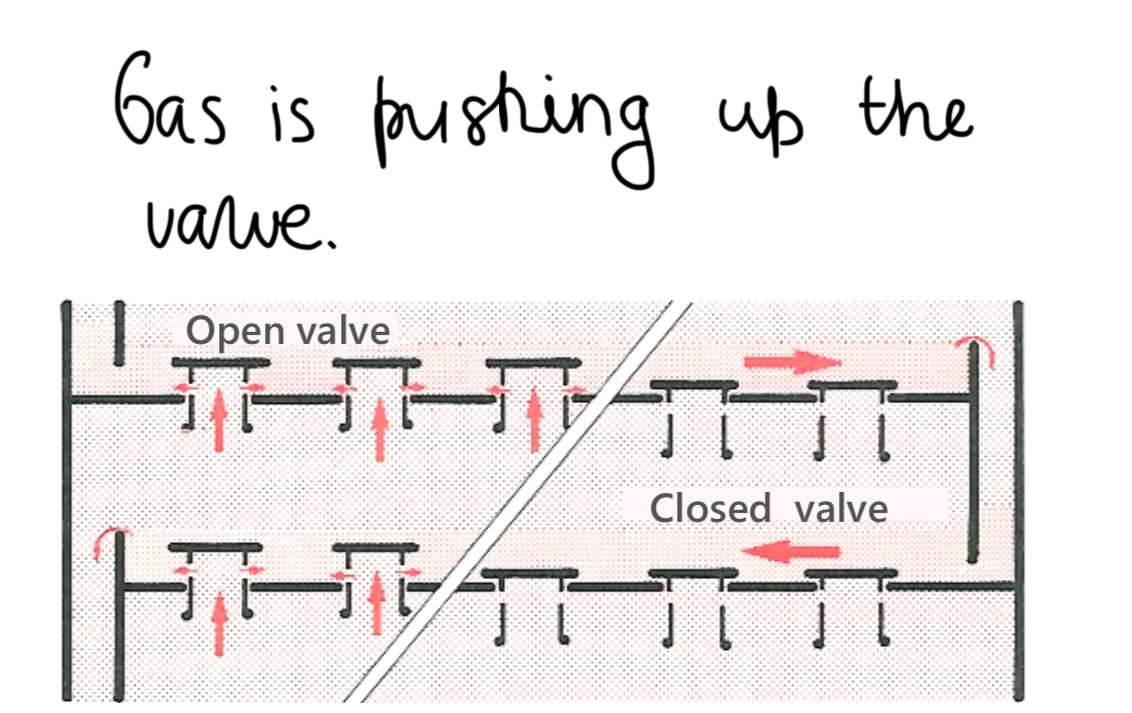
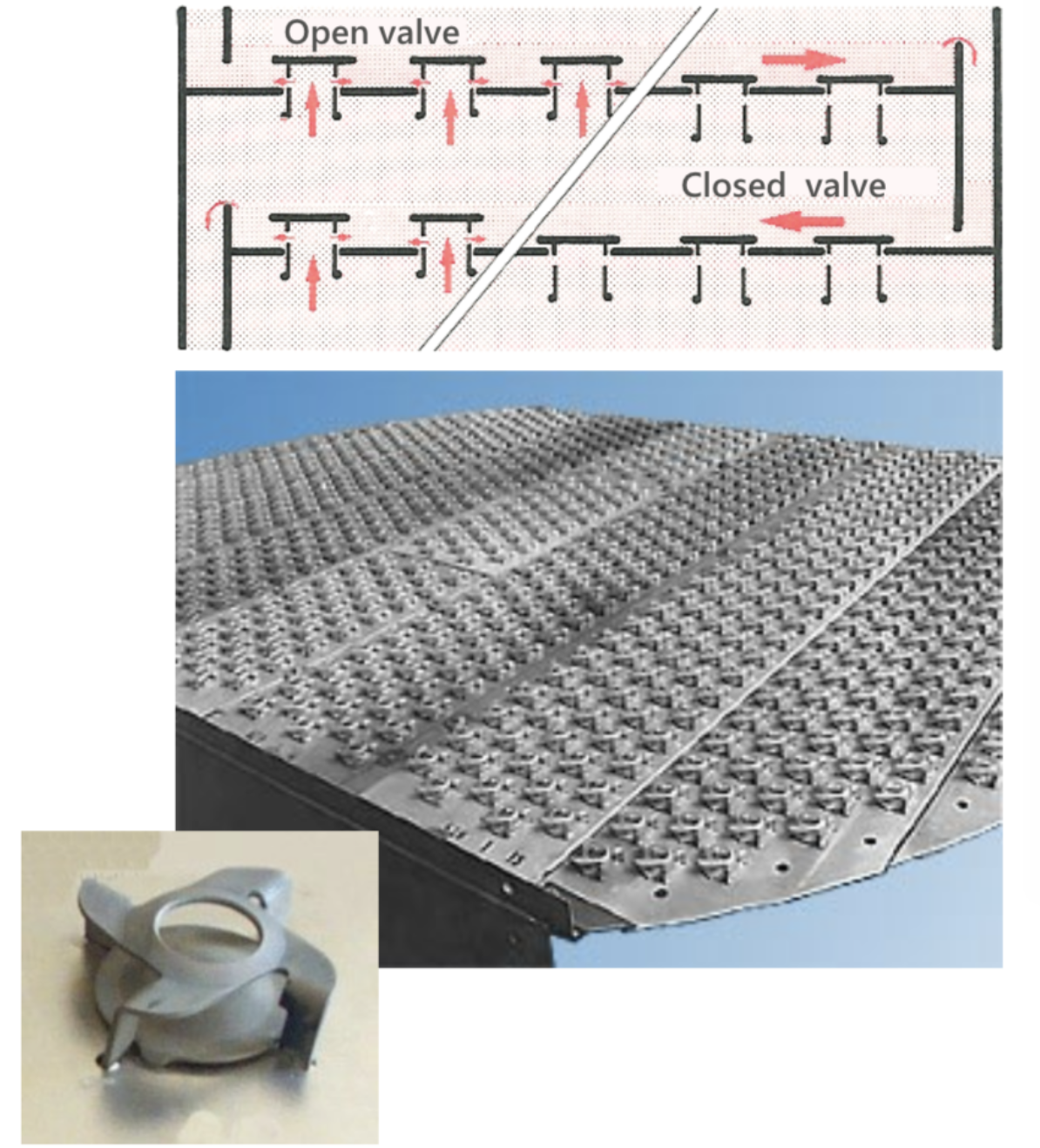
3) Valve
4) Dual flow
Advantages and disadvantages of sieve trays
Advantages:
1) Low cost
2) Possibility of vacuum
3) Almost as good in separation as other options
4) Empties completely
Disadvantages:
1) Weeping might occur
2) Not suitable for strong changes in operating conditions
3) Flooding might occur
4) Susceptible to fouling
Advantages and disadvantages of bubble caps
Advantages:
1) Suitable for different operating conditions (e.g., diff flow rates)
2) No entrainment of the liquid
3) No weeping
Disadvantages:
1) Expensive
2) Susceptible to fouling because of the cap "teeth"
3) Can't run w/o liquid, because vapour will blow through
4) Not suitable for vacuum because of the high pressure drop
Advantages and disadvantages of valve trays
Advantages:
1) Suitable for different operating conditions
2) Self cleaning because of the up/down movement of the valves > dislodging of fouling
Disadvantage:
1) Expensive
Advantages and disadvantages of dual flow trays
Don’t have downcomers. Dual flow = counter current flow of vapour and liquid through the perforations.
Advantages:
1) Best suited for liquids with moderate to high solid content
2) Higher capacity and lower pressure drop
Disadvantages:
1) Narrow operating range
2) Sensitive to leveling
3) Efficient when used in smaller tower diameters
Why is foaming important in tray columns?
By foaming, the surface area becomes sufficient for mass transfer
What are the most efficient trays out of all?
Sieve and valve
What are usually open parameters for the column design?
Column diameter
Tray distance
Number of trays
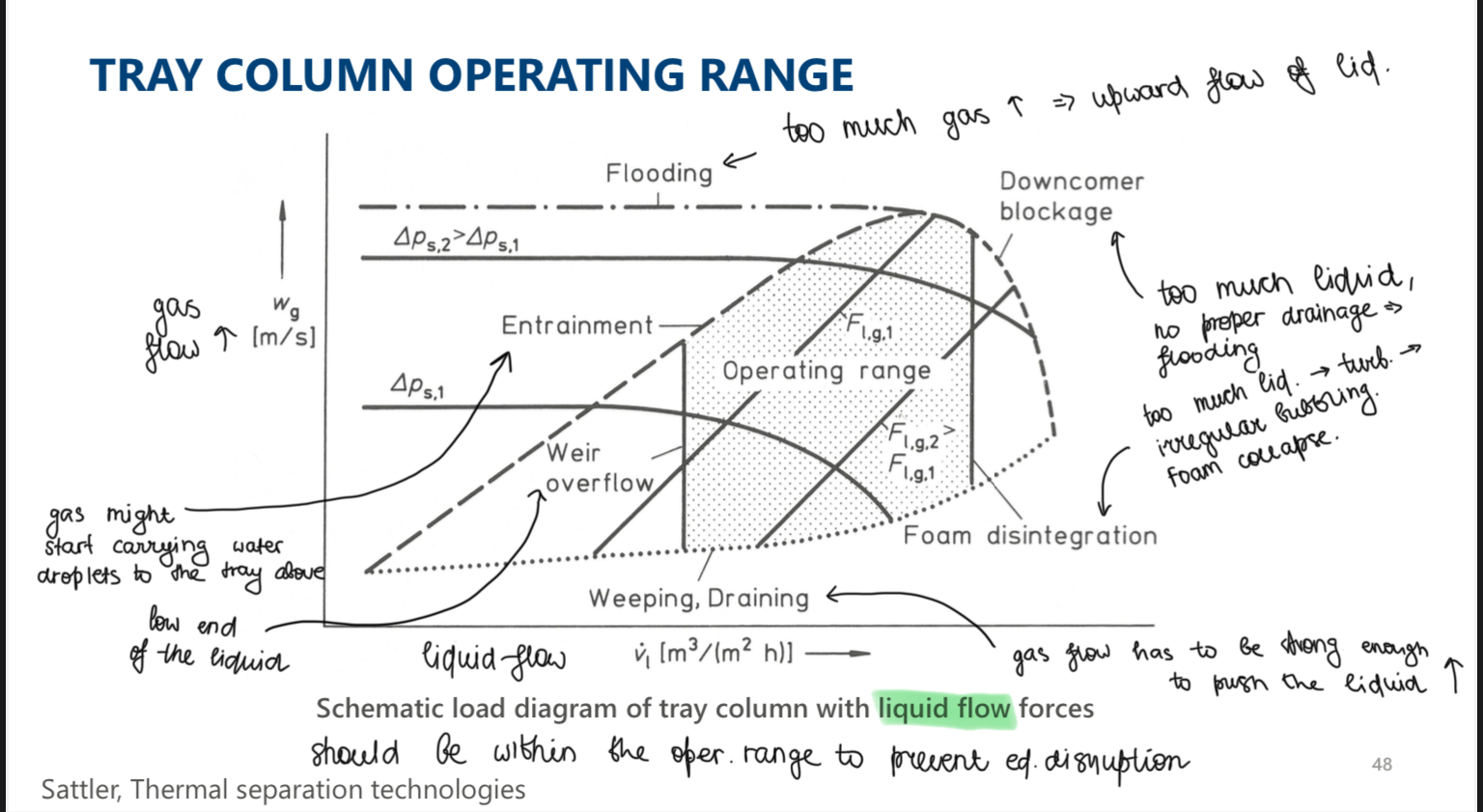
What are upper operating ranges of tray column?
1) Max vapour 💨💨:
1.1 Flooding: if too much gas is added, liquid will overflow the weirs
1.2 Entrainment: gas might start carrying water to the tray above
2) Max liquid 💦💦:
2.1 Downcomer blockage: not enough residence time won't allow to have a full separation
2.2 Foam disintegration: too much turbulence and irregular bubbling
What are lower operating ranges of tray column?
1) Min vapour 💨💨:
1.1 Weeping: if the gas flow isn't sufficient, the liquid will weep down
2) Min liquid 💦💦:
2.1 Weir overflow: no guarantee in a consistent weir overflow for the passage to the downcomer, if the liquid flow is too low
What are parameters important to analyse when assessing small and big hole diameters?
Small holes 🐭: surface tension is important to consider. If diameter becomes too big, inertia (gas velocity) might outpace the surface tension, leading to a droplet burst.
Weber number = gas velocity/surface tension = 2
Big holes 🐘: inertia (gas velocity) VS gravity force is important.
Modified Froude number = gas velocity/gravity.
If it's too high, entrainment happens. If it's too low, gravitational forces dominate and weeping happens.
What does F-Factor indicate?
It indicates an upper load limit with respect to the gas flow.
F-factor = sqrt(2p_dynamic) = sqrt(ρ_G)w_G
What is an active tray area?
Section of tray available for gas liquid interaction.
A_active = V_G / w_G, where V_G - gas/vapour volume flow in the column
What is column cross section?
A_active + 2*A_s, where A_s is a downcomer
What is the minimum recommended tray distance, z_p,min?
1.3 - times the height of the froth layer for a proper foam formation
What are two types of packing? What are disadvantages of each?
Random and structured
Random:
1) Random orientation > difference btwn the set ups > inconsistent performance;
2) Maldistribution, as some areas have either larger voids or smoother paths;
3) No parallel flow of gas and liquid, so the pressure drop is high;
4) Liquid at column wall goes there > more liquid is needed to be redistributed;
5) Inhomogeneous gas velocity
Structured:
1) High costs, other than that they overcome disadvantages of the random packing: maldistribution and high pressure drop. Structured trays generate a very homogeneous film and velocity varies only a little.
What is HETS? What does it depend on? Is capacity affected by it?
Height Equivalent on one Theoretical Stage, required to achieve a proper separation.
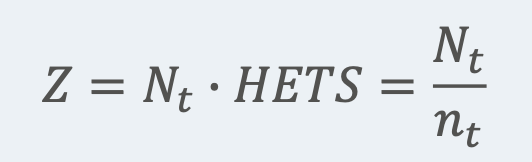
where Z - total column height [m], Nt - number of theoretical stages, HETS - height of one stage, nt - number of real transfer units per unit of height = mass transfer efficiency.
The higher nt, the smaller height is needed for a proper separation.
HETS depends on:
type and size of surface and packing material.
properties of the countercurrent flowing phases (e.g., gas and liquid densities, viscosity etc)
process conditions (e.g., pressure, liquid load)
degree of liquid maldistribution.
HETS is usually determined experimentally and given at a dependency of F Factor. So, HETS is influenced by the gas flow conditions.
The F-Factor (also known as the Capacity Factor) is a measure of the gas velocity and density in a packed column. It is used to evaluate the capacity of the column before flooding occurs. So, capacity isn’t affecting the mass transfer efficiency, which is indicated by HETS.