Properties and Behaviors of CE Materials (MIDTERM 2)
 Call Kai
 Learn
 Practice Test
 Spaced Repetition
 Match
 Flashcards
 Knowt Play
1/109

There's no tags or description
Looks like no tags are added yet.
110 Terms
Components of Concrete (4)
1. Cement
2. Water
3. Aggregates
4. Admixture (to enhance certain properties)
Concrete is a man-made composite!
Unique Properties of Concrete (2)
1. Plastic stage: concrete can be molded into any shape
2. Usually manufactured/cast at the site and CANNOT be tested and approved in advance
Terminology (3)
1. Cement + Water = Cement Paste
2. Paste + Sand = Mortar
3. Mortar + Coarse Aggregate/rock = Concrete
Hardened Concrete (5, %)
6% Air
11% Portland Cement
41% Coarse Aggregates (Gravel or Crushed Stone)
26% Fine Aggregates (Sand)
16% Water
Uses of Portland Cement Concrete (6)
-Foundations
-Columns
-Beams
-Slabs
-Roads
-Cooling towers
Key Ingredients and Oxide Composition in Portland Cement (6)
*CSFAGM
1. C = Calcium Oxide ('lime"), 63%
2. S = Silicon Dioxide ("Silica"), 21%
3. F = Iron Oxide, 3%
4. A = Aluminum Dioxide ("Alumina"), 6%
5. Gypsum, 7%
6. MgO = Magnesia, trace
Where do Oxide Composition come from?
C = "Lime" (Limestone, Shale)
S = "Silica" (Clay, Sand, Shale)
F = Iron Oxide (Clay, Iron ore)
A = "Alumina" (Clay, Fly ash, Shale)
Calcareous (CaCO3 > 75%)
Argillaceous (CaCO3 < 40%)
Manufacturing Process of Portland Cement
1. Dry: Raw materials (Limestone and Shale)
2. Wet: Raw materials (chalk and clay)
3. Rotary Kiln
-Temps up to 1650C or 3000F
-Inclined a few degrees
-Slowly rotating
-approx. 250ft long
-feed residence time 30mins
-grinding with 1-5% gypsum
Wet vs. Dry Method
Dry method: raw materials and proportioned, ground into powder, blended, fed into kiln in dry state
Wet Method: slurry is formed by adding water to proportioned raw materials
Why is gypsum added to Portland Cement?
retard early setting and hardening
Compound Composition of Portland Cement (4)
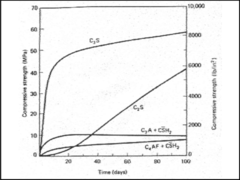
C3S- TriCalcium Silicate, High early strength
C2S- DiCalcium Silicate, long term strength
C3A- TriCalcium Aluminate, Slight Early Strength
C4AF- TetraCalcium AluminoFerrite, "Flux" reduces clinkering temperature
Fluxing Agents
-Added to lower the formation of C3S
-Agents include: Aluminum Oxide (Alumina, Al2O3, "A"),
Iron Oxide (Fe2O3, "F")
Types of Portland Cement (5)
Type I- Normal
Type II- Moderate Sulfate Resistance
Type III- High Early Strength
Type IV- Low Heat of Hydration
Type V- High Sulfate Resistance
Reasons for Varying Cement Type (3)
1. Rate of Strength gain (faster growth= convenient, slower strength gain= better longevity)
2. Heat of hydration (reaction between cement and water that generates heat)
3. Sulfate Resistance (sulfates cause deterioration of cement)
Other Types of Cement Types (5)
-White Portland Cement
-Blended Hydraulic Cement
-Masonry Cement
-Expansive Cement (Type K)
-Specialty Cement
Blended Hydraulic Cements (5)
IS- Portland Blast-Furnace slag cement
IP/P- Portland pozzolan cement
I(PM)- Pozzolan-modified portland cement
I(SM)- Slag-modified portland cement
S- Slag cement
Vicat Test
-1mm needle is lowered on the surface of cement with normal consistency
-Penetration is measured every 15 minutes until penetration of 25mm is obtained (initial set time)
-Final set time is when the needle is not penetrating the surface
-test used to measure the setting time of cement
Gilmore Test
-needles are lowered on surface of cement paste with normal consistency until cement holds needles.
-test used to measure the initial and final setting time of cement
Blain Specific Surface
Determines fineness of cement using air permeability measurements
Wagner Tubidimeter
Determines fineness of cement using photo electric cell to measure light passing through material
Mechanical Properties Tests (4) CEMENT
1. Vicat Test
2. Gilmore Test
3. Blain Specific Surface
4. Wagener Turbidimeter
Soundness
-ability to retain its volume after setting
-cement paste bards are subjected to heat and high pressure and expansion is measured
Hydration
Chemical and physical process between Portland cement and water resulting in setting and hardening of cement
Hydration Features (2)
1. Fineness- reaction occurs at surface, finer the cement, higher reaction
2. Moisture- continued presence of water is required. (ex. curing is necessary for strength gain of concrete)
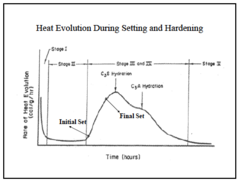
Heat Evolution During Setting and Hardening
-Stage 1: initial Peak-wetting and mixing
-Stage 2: induction-initial setting time
-Stage 3: Acceleration Phase- final setting time (strength development)
-Stage 4: deceleration phase - cooling down
-Stage 5: Long-term hardening

Effects of Carbonation
Fresh Concrete: surface durability
Hardened Concrete: Carbonation (shrinkage, corrosion of steel) (lowers alkalinity)
Hardened Concrete Carbonation Factors (5) and Prevention (1)
Carbonation Increases with:
-high water cement ratio
-low cement content
-short curing period
-low strength
-highly permeable paste
Proctection: adequate concrete cover
Maturity Concept
-estimate strength of concrete based on temperature history
-only works for first 72 hrs
Maturity Index
Relationship between temperature history of concrete and its strength
Benefits of Maturity Testing (5)
-Early application of prestress
-Early opening of the facility to the traffic
-Early form removal
-curing times are usually cut dramatically (especially during winter)
-Non destructive and inexpensive
Mixing Water Criteria
1. Water fit for drinking is good for concrete
2. 7 day compressive strength for mortar cubes made with questionable water should be 90% or more strength of cubes made with potable water
3. Neither setting time should be adversely affected.
Effects of Impurities in Mix Water (4)
-Efflorescence
-Corrosion
-Volume Instability
-Reduced Durability
Concrete Wash Water (3)
-Various sources
-Hazardous according to Water Quality Act
-Disposal regulated by EPA
Sulfate Resistance (2)
-Sulfates in soil, air, water, salt used to remove ice react with C3A to form expansive mineral
-Decompose CSH (calcium-silicate-hydrate) to gypsum
Flash Setting (4)
concrete sets too quickly
-Too little gypsum
-Too much C3A
-Too much surface area
-Condition irrecoverable
False Setting (3)
-Gypsum conversion to plaster (hot cement)
-Hot cement desiccates gypsum (removes moisture)
-can mix through false set
Reasons for using admixtures (4)
-to enhance concrete properties
-to modify fresh concrete behaviour
-to compensate for cement characteristics
-to make concrete economic
Types of Admixtures (9)
1. Air entraining
2. Water reducing
3. Set retarding
4. Set accelerating
5. Water reducing and retarding
6. Water reducing and accelerating
7. Water reducing, high range
8. Water reducing, high range, and retarding
9. Finely divided mineral admixtures
What is created after raw materials are fed into a kiln during Portland cement production?
Clinker - clinker is then ground to make Portland cement.
Factors Affecting Admixture Behaviour (6)
1. Cement Characteristics (type, chemistry, fineness, impurities)
2. Mix Water (chemistry, impurity, hardness, water content)
3. Aggregate Characteristics (type, chemistry, gradation)
4. Temperature
5. Mix Characteristics (proportions, water-cement ratio, slump)
6. Mixing procedure (equipment, how, when, sequence of admixture is added, concentration of admixture)
Air Entraining Admixture Uses
purposefully entrain microscopic air bubbles in concrete to improve freeze-thaw resistance and resist scaling due to salts
Water Reducing Admixture Uses
reduces mixing water for the same slump, increases strength, reduces cost
Water Reduction Admixture Ranges
Normal Range - 5-8%
Mid Range - 8-15%
High Range (Superplasticizer, make more flexible) - 5-30%
Water Reduction Admixture Mode (medium) (2)
-reduce mix water only (reduces water/cement)
-Increase workability
Water Reduction Admixture Concerns (4)
-temporary effect
-retardation
-stickiness/elasticity
-air bubble stability
What are superplasticizers?
-high range plasticizer that are used when concrete slump is needed to be extremely high-used for items such as pumping concrete and underwater concrete.
SCC
Self-consolidating concrete:
-highly flowable concrete, used when concrete cannot be vibrated or leveled.
-high sand and cement contents
Set retarding admixtures (3)
-increases setting time, offsets affect of hot weather
-allows for unusual placement or long haul distance
-allows time for special finishes
Set accelerating admixtures (2)
-accelerate setting
-increase rate of strength gain in cold weather
Mineral Admixtures Categories (3)
-pozzolanic
-cementitious
-non reactive
Pozzolanic Materials
-siliceous or siliceous/aluminous materials which have little to no cementations value alone
-when finely divided, pozzolans will react with lime and water at ordinary temperature to form something similar to cement hydration
Types of Pozzolanic Materials (2)
-Natural Pozzolans: volcanic ash, pumice, opaline cherts, shale
-Synthetic Pozzolans: silica fume, fly ash
Cementitious Materials (3)
-Silica fume
-Ground Granulated Blast Furnace Slag (GGBFS)
-Fly ash
Temperature control of concrete (2)
• Fly ash and GGBFS used as partial replacement for portland cement cause a slower setting and slower strength development
• This is desirable in hot weather concreting - it helps improve the handling characteristics
Pozzolans Differ in (4)
-particle size and shape
-impurities
-uniformity
-reactivity
Quality Control Issues in Pozzolans (4)
-Composition
-Impurities
-Gradation
-Variability
Fly Ash
-by product of burning coal in power plants
Fly Ash Classes
Class C- high Lime (>15%)
Class F- low lime (
Active Ingredients in Fly Ash
-Lime (Calcium Oxide)
-Iron Oxide
-Silica (Silicon Oxide)
Alumina (Aliminum Oxide)
LISA*
Composition of Fly Ash
Silica- 40-90%
Alumina- 20-60%
Iron Oxide- 5-25%
Lime- 1-15%
Heat Production Benefit
The Pozzolanic reaction releases less heat than the hydration of Portland cement of the same mass
Fly Ash effects on fresh concrete (5)
-reduces water requirements
-reduces air content
-increases workability
-reduces heat of hydration
-increases set time
Fly Ash effects on hardened concrete (5)
-increases strength but reduces rate of strength gain
-high concentration may increase shrinkage
-reduces permeability
-reduces alkali-aggregate reactivity
-sulfate resistance is improved
Silica fume
-by product of ferro-silicon industry
-by product of silicon metal
Silica Fume effects on fresh concrete (4)
-increases water requirements
-reduces air content
-reduces workability
-increases heat of hydration
Silica Fume effects on hardened concrete (5)
-may reduce shrinkage
-reduces permeability and absorption
-readuces alkali-aggregate reactivity
-reduces corrosion caused by salt
-sulfate resistance improved
Effects of Adding Silica Fume (5)
-increased cohesion, higher slump
-reduction of bleeding
-helpful with flat work
-useful in fast track projects
-increased hardness, useful in high rise structures
Characteristics of Concrete made with mineral admixtures (7)
-affect rate of strength gain
-affect water requirement for a given slump
-lower heat of hydration
-behaves like Type II or IV Portland cement
-increased long term strength
-reduced permeability
-increased resistance to sulfate attack
Tests on Fresh Concrete (4)
1. Slump
2. Air content
3. Unit Weight
4. Temperature of fresh concrete
Early Volume Change (4)
1. chemical shrinkage
2. autogenous shrinkage
3. plastic shrinkage
4. drying shrinkage
Comparative Behavior
-Aggregate
-Mortar
-Cement Paste
-Concrete

Steps to Shrinkage Cracking (5)
-Chemical shrinkage due to materials
-*Moisture loss is greater than moisture gain*, shrinkage due to mix
-Shrinkage restrained
-Restraint causes stress (dependent on stiffness)
-Stress causes cracking (dependent on strength)
Steps to Plastic Shrinkage Cracking (5)
-*Evaporation > Bleeding (Drying)*
-Shrinkage depending on mix
-Shrinkage restrained
-Restraint causes stress (dependent on stiffness)
-Stress causes cracking (dependent on strength)
Volume of Components
1. Aggregates- low or no shrinkage
2. Paste- high shrinkage
3. Water- drying shrinkage
4. Cementitious Material- Chemical Shrinkage
Mechanical Properties (8)
1. Strength
2. Modulus of Elasticity
3. Poisson's Ratio
4. Coefficient of Thermal Expansion
5. Shrinkage
6. Creep Coefficient
7. Fracture Toughness
8. Fatigue Behaviour
Concrete is a ___ phase Material
"two"
consisting of mortar and aggregate
What is ITZ
Interfacial Transition Zone
-region of cement paste surrounding aggregate particles
-weak point, has higher porosity, less cement

Mortar Strength
strength of mortar is related to strengthh of Portland cement itself
Bond Components (3)
1. Chemical bonding
2. Mechnical interlock
3. Adhesion and friction
Factors affecting bond Strength (3)
1. Cement chemistry
2. Aggregate chemistry, shape, surface texture, cleanliness
3. Mortar strength
Tests for Physical Properties on Concrete (5)
1. Compression
2. Flexure (third point loading)
3. Shear
4. Bond
5. Modulus of elasticity
Factors affecting compressive strength (6)
1. w/c ratio
2. cement type
3. admixture
4. type and grading of aggregates
5. curing
6. temperature and moisture content @ time of testing
Macro Behavior (2)
-cylinder failures help us know the mechanical behavior of concrete
-two types of failure: diagonal and columnar

Factors affecting flexural testing (3)
1. flaws in specimen such as cracks, nicks, indentations
2. sensitive to pre-existing conditions like therma and shrinkage stresses
3. temperature and moisture conditioning is crucial
Factors affecting strength (8)
1. consolidation
2. water-cement ratio
3. cement type
4. admixture
5. type and grading of aggregates
6. curing
7. specimen size effect
8. temperature and moisture content @ time of testing
Application to Structural Behavior (3)
1. flexural cracking in reinforced concrete (cracking happens when failure strain is reached)
2. role of reinforced concrete (stops concrete expansion)
3. flexural cracking in unreinforced members (brittle)
Creep
concrete under sustained load will deflect overtime

What causes creep (4)
-crystalline flow in aggregate and cement paste
-plastic flow of cement paste
-exudation of cement gel water
-closing of internal voids
Where is creep found
any structure with sustained load (coloumns in tall buildings, bridges)
Specialty Concrete Classes (11)
1. Self-consolidating concrete
2. lightweight
3. heavyweight
4. high strength
6. high workability
7. expansive
8. polymer-modified
9. shotcrete
10. fiber-reinforced
11. high performance
SCC Properties (2)
1. Flowability (uses large dose of superplasticizer)
2. Stability (uses high cement factor, weight of cement per cubic yd)
Roller Compacted Concrete (RCC) (5)
-lean
-no slump
-almost dry
-compacted by vibratory roller
-used in pavements (must have asphalt on top because of rough surface)
Types of Fibers (4)
-steel
-glass
-synthetic
-natural
Soil-Cement 4 Steps of constrution
1. spreading cement
2. mixing
3. compaction
4. curing
Shotcrete (used for, advantages, watch for)
used for: when concrete need to be placed in difficult locations, thin sections, and large areas
advantages: placing concrete in freeform shapes
watch for: quality of work depends on skill
Synthetic Fibers (6)
1. acrylic
2. aramid
3. carbon
4. bylon
5. polyester
6. polypropylene
Design of Concrete Mixtures: Steps (4)
1. Determination of Requirements
2. Material Selection
3. Proportioning
4. Validation/Verification
Design of Concrete Mixtures: Determination of Requirements (6)
1. Strength
2. Strength gain rate
3. Workability/slump
4. Durability
5. Construction Process
6. Maximum aggregate size
Design of Concrete Mixtures: Material Selection (4)
-aggregates
-cement
-water
-admixtures
Design of Concrete Mixtures: Proportioning (2)
-Quantities
-Admixtures