BCH 400 Chapter 12: Membranes
 Call Kai
 Learn
Learn Practice Test
 Spaced Repetition
 Match
Match Flashcards
 Knowt Play
1/82

Earn XP
Description and Tags
Name | Mastery | Learn | Test | Matching | Spaced | Call with Kai | Chat |
|---|
No analytics yet
Send a link to your students to track their progress
83 Terms
What two types of lipids form lipid bilayers in aqueous solutions?
phospholipids and glycolipids
What effect powers the formation of membranes?
the hydrophobic effect
What type of forces between the fatty acid tails stabilize membranes?
van der Waals forces
What type of bonds between polar head groups and water stabilize membranes?
Hydrogen bonds and electrostatic interactions
Are O2, CO2, and hydrophobic molecules able to easily cross a membrane?
yes, due to the hydrophobic interior
Are ions and polar molecules able to easily cross a membrane?
no, because the hydrophobic interior acts as a barrier

Is indole or tryptophan more soluble in membranes? Why?
indole is more soluble, because it is uncharged.
Why can’t ions/charged molecules cross membranes?
because of the energy cost of shedding their associated water molecules.
Many membrane processes require that the membrane have what property?
fluidity
Why is it important for a membrane to be fluid?
so that the embedded proteins can move around within the bilayer
Why aren’t membranes completely fluid?
it has to be rigid enough to maintain the integrity of the cell
What regulates the membrane fluidity?
fatty acid composition and cholesterol content

The temperature at which a membrane transitions from being highly ordered to very fluid is called the ______.
melting temperature
How does the length of a hydrocarbon chain on a fatty acid impact the interactions in a membrane?
longer chain = stronger interactions
shorter chain = weaker interactions
If the fatty acids in a membrane have a longer hydrocarbon chain length, is the membrane more fluid or less fluid?
less fluid
If the fatty acids in a membrane have a shorter hydrocarbon chain length, is the membrane more fluid or less fluid?
more fluid
How does the number of cis double bonds in a fatty acid tail impact how tightly they’re packed together in a membrane?
more cis double bonds = poorer packing
less cis double bonds = better packing
If the fatty acids in a membrane have more cis double bonds, is the membrane more or less fluid?
more fluid
If the fatty acids in a membrane have less cis double bonds, is the membrane more or less fluid?
less fluid
What are the two ways in which cholesterol regulates the fluidity of the membrane?
disrupts tight packing and stabilizes localized regions (lipid rafts)

Name the phosphoglyceride.
phosphatidylserine

Name the phosphoglyceride.
phosphatidylethanolamine

Name the phosphoglyceride.
phosphatidylcholine

Name the phosphoglyceride.
phosphatidylinositol

Name the phosphoglyceride.
diphosphatidylglycerol (cardiolipin)
What is a “leaflet” of a plasma membrane?
one of the two single layers that makes up a lipid bilayer
Do the two leaflets of a plasma membrane have a symmetric or an asymmetric lipid composition?
asymmetric
Is the outer leaflet of a plasma membrane often more negatively charged or positively charged?
positively charged
Are phosphatidylcholines located in the inner or outer leaflet?
outer leaflet
Are sphingomyelins located in the inner or outer leaflet?
outer leaflet
Are phosphatidylethanolamines located in the inner or outer leaflet?
innner leaflet
Are phosphatidylserines located in the inner or outer leaflet?
inner leaflet
How is the asymmetric distribution of phospholipids achieved?
lateral diffusion and transverse diffusion

Is this lateral or transverse diffusion?
lateral

Is this lateral or transverse diffusion?
transverse

What enzyme is required for flipping phospholipids?
flippase

What enzyme is required for flopping phospholipids?
floppase

What enzyme is required for scrambling the phospholipids?
scramblase
What forms the permeability layer in a membrane?
membrane lipids
What function do membrane proteins serve?
they allow transport of molecules and information across the membrane
Which type of membrane protein detects signals from outside?
receptors (i.e., light, hormones, neurotransmitters, and pheromones receptors)
Which type of membrane protein allows for the movement of nutrients, ions, and neurotransmitters across the membrane?
channels, gates, pumps
Which type of membrane protein has a role in lipid biosynthesis and ATP synthesis?
enzymes
Which class of membrane proteins are embedded in the hydrocarbon core of the membrane?
integral membrane proteins
Which type of integral membrane proteins are associated with one leaflet of the lipid bilayer?
monotopic proteins
Which type of integral membrane proteins span the bilayer?
polytopic proteins
What are the three types of polytopic proteins?
singlepass, multipass, or multisubunit
Which class of membrane proteins are bound to the polar head group of membrane lipids?
peripheral membrane proteins
they can also be bound to the exposed surfaces of integral membrane proteins
Which class of membrane proteins are associated with membranes by attachment to a hydrophobic moiety that is inserted into the membrane?
lipid anchored proteins
What two criteria must be met for a small molecule to spontaneously cross a membrane?
the concentration of the molecule on one side of the membrane than the other, and the molecule is lipophilic or soluble in non-polar solutions
Which type of transport is the movement of a molecule down their concentration gradient?
passive transport
Which type of transport is the movement of a molecule against their concentration gradient?
active transport
Primary active transport is linked to the hydrolysis of what molecule?
ATP (or other high-energy molecule)
What drives secondary active transport?
ion gradient
What are the two types of passive transport?
simple diffusion and facilitated diffusion
A molecule/ion moves through an opening in which type of diffusion?
simple diffusion
A molecule/ion is carried across a membrane by a carrier/channel protein in which type of diffusion?
facilitated diffusion
A concentration gradient contains what type of energy?
potential energy
The Na+/K+ pump is an example of which type of transport?
primary active transport
directly uses ATP
What process drives the Na+/K+ pump?
the hydrolysis of ATP
The hydrolysis of ATP results in what two molecules?
ADP. + Pi
The synthesis of ATP energy is driven by what process?
the conversion of potential energy stored in an ion gradient.
The Na+/K+ pump pushes what ions in and out?
3 Na+ out and 2 K+ in
Which type of transporter uses one concentration gradient to power the formation of another?
secondary active transporters
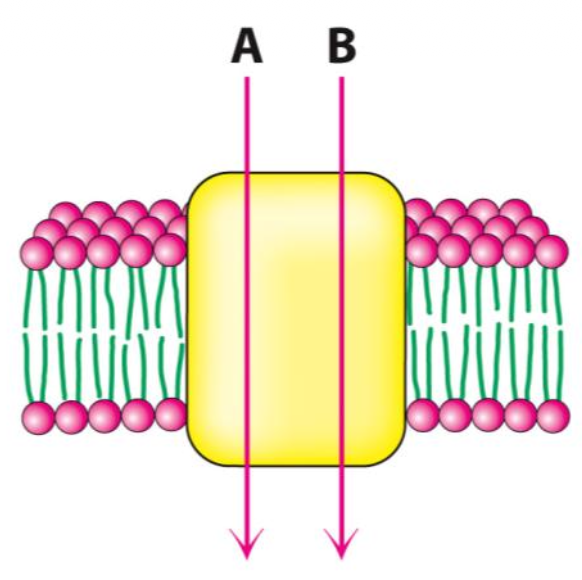
What membrane protein powers the transport of a molecule against its concentration gradient by coupling the movement with another molecule in the same direction?
symporters

What membrane protein powers the transport of a molecule against its concentration gradient by coupling the movement with another molecule in opposite directions?
antiporters
How is glucose moved into some animal cells against its concentration gradient?
by a secondary transporter (the Na+-glucose symporter) that is powered by Na+ ions moving down a concentration gradient
The ion gradient set up by the Na+-K+ ATPase can be used to move materials into the cell. Is this an example of primary or secondary active transport?
secondary
Which type of channels are passive transport systems that allow specific and rapid transport of ions down their concentration gradients?
ion channels
Which type of channel can be activated by changes in the voltage across a membrane?
voltage-gated channels
Which type of channel can be activated by the binding of specific molecules to the channels?
ligand-gated channels
What happens in the first step of the insulin secretion by Beta cells?
glucose binds to the GLUT2 transporter; glucose raises ATP levels in cell.
What happens in the second step of the insulin secretion by Beta cells?
The increase in ATP turns off a ligand-gated K+ channel; K+ can’t leave, which depolarizes the membrane.
What happens in the third step of the insulin secretion by Beta cells?
The depolarization of the membrane initiates voltage-gated calcium channels to open; calcium enters the cell and acts as a secondary signal.
What happens in the fourth step of the insulin secretion by Beta cells?
calcium binds to a receptor on insulin vesicles; insulin is released into the blood.
In the secretion of insulin by Beta cells, what molecule acts as a primary signal/messenger?
glucose
In the secretion of insulin by Beta cells, what ion acts as a secondary signal/messenger?
calcium
If K+ is larger than Na+, how is K+ able to be transported through the K+ channel, but Na+ isn’t?
ions like sodium are too small to properly interact with the fixed distance of the carbonyl oxygens in the selectivity filter, making the energy cost of removing their water shell too high.
What are membranes composed of?
lipids and proteins, which can be decorated with carbohydrates
Membrane lipids are what type of molecules?
amphipathic
Membrane lipids form closed bimolecular sheets that prevent the movement of what type if molecules?
polar or charged molecules
What type of molecule serves to mitigate the impermeability of membranes and allow movement of molecules and information across the cell membrane?
proteins
Membranes are what type of assemblies?
noncovalent