Bimm 122 Midterm 2_Alistair B. Russell
 Call Kai
 Learn
 Practice Test
 Spaced Repetition
 Match
 Flashcards
 Knowt Play
1/66

There's no tags or description
Looks like no tags are added yet.
67 Terms
Phylogenetic Trees:
Describes evolutionary relationships between organisms OR within a single gene family. Built using aligned DNA, RNA, or protein sequences.
Components of a phylogenetic tree:
-Leaf: Existing species, genes, or proteins.
-Node: Most recent common ancestor of the branches below it.
-Root: Common ancestor of everything in the tree.
-Branch: Evolutionary path connecting nodes (ancestor) and leaves (descendants)

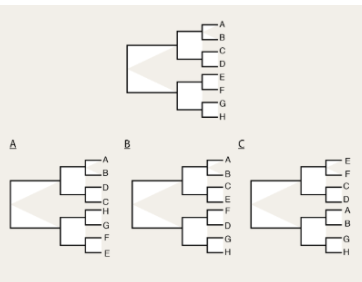
Reading Phylogenetic Trees example: Which of the following trees, A, B, or C, displays an identical relationship between leaves as the top tree?
Group of answer choices
A
B
C
Answer: A b/c it preserves the same sister groups and common ancestors as the original tree, even though the branches are rotated.
Maximum Parsimony:
Chooses the tree with the fewest evolutionary changes.
Maximum Likelihood:
Chooses the tree most likely to have produced the observed sequence based on a model of evolution.
Outgroup:
A species, gene, or protein more distantly related than the others in the tree.
Types of Phylogenetic Trees:
-Cladogram: Shows evolutionary relationships, but branches do NOT represent evolutionary distance.
-Phylogram: Shows evolutionary relationships and branch lengths represent number of DNA/amino acid changes.
-Chronogram: Shows evolutionary relationships and branch lengths represent time since divergence.
Molecular clock:
Estimates divergence time using genetic changes and their rate → Changes in mutation/substitution rates (ex: entering new host) can make estimates inaccurate if the old rate is used.
Subfunctionalization vs. Neofunctionalization
-Subfunctionalization: Duplicated genes specialize in different parts of the original function.
(a) Ex: Original gene does A and B → one copy does A, the other does B.
-Neofunctionalization: One duplicated gene develops a new function.
(a) Ex: Original gene does A and B → one retains A and B, the other develops C.
Homologs
Genes or proteins that share a common evolutionary ancestor.
BLAST (Basic Local Alignment Search Tool):
NCBI tool that compares nucleotide or protein sequences against databases to find similar sequences.
Amino Acid vs. Nucleotide Efficiency in Trees
-Amino acids: Easier to align because important amino acids are conserved.
-Nucleotides: Provide better resolution because DNA can change without changing amino acids.
-Best method: Align amino acids → Convert to nucleotides → Build tree using nucleotide differences.
Gene vs Species Tree:
-Gene tree: Shows evolutionary relationships of a gene
-Species tree: Shows evolutionary relationships between species
How can phylogenetic trees provide evidence of HGT?
-Gene tree differs from species tree, homologs appear in distantly related organisms (e.g., toxin genes in soil bacteria and pathogens), or virulence genes are associated with bacteriophages.
Why is HGT important for species trees?
Allows organisms to acquire new functions, including antibiotic resistance and virulence factors.
16S vs. 18S rRNA:
-16S rRNA: Archaea and Bacteria.
-18S rRNA: Eukaryotes.
-Both used to identify organisms and study evolutionary relationships
Advantage and Disadvantage of 16S rRNA:
-Highly conserved for studying evolution but evolves slowly, making closely related species hard to distinguish.
OTU (Operational Taxonomic Unit):
Group of organisms classified together when their exact species cannot be distinguished.
MLST (Multi-Locus Sequence Typing) Tree:
-Compares sequences from multiple conserved core genes to provide better phylogenetic resolution (identification).
PCR (Polymerase Chain Reaction)
Amplifies specific DNA sequences using primers.
Metagenomics:
Analysis of genetic material from an entire environment instead of a single species.
Biomarkers:
Indicators of health or environmental conditions (ex: Ratio of two bacterial phyla).
Why does bacterial identity matter if genes determine function?
Genes function together within a genome, so bacterial identity influences their activity.
Why is soil a “training ground” for pathogens?
Soil bacteria evolve defenses against amoebae that also help them survive human immune cells.
How are phylogenetic trees useful during epidemics?
Identify pathogen origins, track transmission, and estimate divergence times.
Operon:
-Group of genes controlled by a shared promoter and transcribed into one RNA molecule.
Polycistronic:
One RNA transcript containing multiple genes that can produce separate proteins.
Advantage of operons:
Allow related genes to be expressed and regulated together, saving energy.
RNA Polymerase (RNAP):
Enzyme that synthesizes RNA 5′ → 3′ from DNA without a primer.
Sigma factor (σ):
Protein that directs RNAP to specific promoters for transcription initiation
RNAP holoenzyme:
Core RNA polymerase + sigma factor, allowing promoter recognition and transcription initiation.
Sigma70 (σ70):
Most common sigma factor in E. coli that recognizes housekeeping gene promoters.
Housekeeping genes:
Genes essential for basic cell functions and survival.
Consensus sequence:
Most common nucleotides at each position, allowing stronger σ70 recognition and increased transcription.
What determines promoter strength?
a. Similarity to consensus sequences:
b. Spacing between -35 and -10 regions:
Template vs Coding Strand:
-Template strand: DNA strand read 3′ → 5′ by RNAP to synthesize complementary RNA.
-Coding strand: DNA strand matching the RNA sequence, except T replaces U.
Shine-Dalgarno (SD) sequence:
Ribosome-binding site upstream of the start codon that base-pairs with 16S rRNA to position the ribosome for translation.
Finding Shine-Dalgarno (SD) sequence. Ex: 16S rRNA is 5′-AGGACCU-3′
-Find the reverse complement of the 16S rRNA anti-SD sequence using A↔U and G↔C.
-Answer: 3’ UCCUGGA 5’ → 5′-AGGUCCU-3′
Formyl-Methionine (fMet):
First amino acid in bacterial translation, even when initiation uses AUG, UUG, or GUG; enters the ribosome's P site.
Release factors:
Proteins that recognize stop codons and terminate translation without tRNA. Include RF1, RF2, RF3
Ribosome stalling:
Ribosomes pause when rare codons or amino acid shortages limit available tRNAs.
tmRNA (Transfer Messenger RNA):
Rescues stalled ribosomes and tags incomplete proteins for degradation
Why must transcription terminate?
Prevents RNAP from continuously transcribing DNA and allows control of gene expression.
Two types of transcription termination:
1. Intrinsic (Rho-independent) termination:
-GC-rich hairpin followed by a U-rich sequence causes RNAP to stop transcription.
2. Factor (Rho)-dependent termination:
-Rho binds the rut site and moves along RNA until it catches paused RNAP and terminates transcription.
Polar mutation:
Mutation in an upstream operon gene that reduces expression of downstream genes.
Rho-dependent polarity:
-A premature stop codon causes the ribosome to detach, exposing the rut site so Rho can terminate transcription early and prevent downstream gene expression.
-Example: C → B → A; mutation in B → C remains expressed, but A is not.
Constitutive vs. Inducible Genes:
-Constitutive: Genes expressed continuously for basic cellular functions.
-Inducible: Genes expression increases in response to a stimulus.
Three levels of gene regulation:
1. Transcriptional: Controls how much RNA is produced, saving energy.
2. Translational: Controls protein production from existing mRNA.
3. Post-translational (FASTEST): Controls existing protein activity without making new RNA or protein.
Lac operon:
-Encodes proteins needed to import and metabolize lactose into glucose and galactose; regulated to avoid wasting energy. Include LacZ, LacY, and LacI
Beta-galactosidase:
Enzyme that breaks lactose into glucose and galactose and can isomerize lactose into allolactose.
What are the three lac operators?
-O1: Required/main operator.
-O2 and O3: Additional operators that help strengthen repression.
How does LacI repress transcription?
-LacI binds O1 with O2 or O3, forming a DNA loop that inhibits RNAP initiation
Why is lac repression leaky?
Small amounts of LacZ and LacY are produced even when repressed, allowing bacteria to detect and respond to lactose.
Which sugar does E. coli prefer and why?
Glucose because it can enter glycolysis directly after phosphorylation, allowing faster growth than lactose.
Diauxic (Die-oxic) growth:
-Two growth phases when bacteria consume glucose first, then lactose after a lag phase.

CAP (Catabolite Activator Protein) & cAMP:
-CAP is a positive regulator that binds DNA and helps recruit RNAP to increase transcription when activated by cAMP.
Second messenger:
Molecule that relays signals from an upstream stimulus to downstream responses.
PTS (Phosphotransferase System):
-System that transports glucose into bacteria while phosphorylating it.
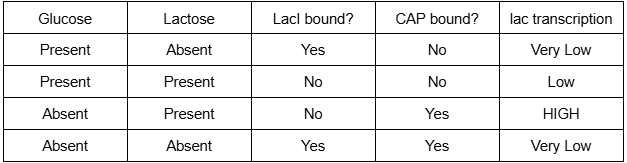
Combined Regulation of the lac Operon (Assuming Normal LacZ, LacY, and LacI)
Arabinose operon:
-Operon involved in arabinose metabolism, regulated by CAP and AraC.
Global regulator:
Protein that controls transcription of many genes or operons (ex: CAP, NOT LacI).
Alternative sigma factors:
Replace σ70 in RNAP holoenzyme to recognize different promoters and regulate genes in response to environmental changes.
Protein chaperones:
Proteins that assist other proteins in proper folding.
Transcriptome:
Total collection of RNA transcripts produced by a cell under particular conditions.
SOS response:
Bacterial response to extensive DNA damage that activates DNA repair pathways.
Translesion Polymerase (UmuCD):
-Error-prone DNA polymerase activated later during severe/persistent DNA damage to bypass DNA lesions.
-Requires UmuD cleavage and activated RecA for function
Why combine transcriptional and post-translational regulation during SOS?
Transcription produces repair proteins, while post-translational regulation activates them when needed, minimizing unnecessary mutations.