Cavities of the body

0.0(0)
Studied by 0 people
call kaiCall Kai
learnLearn
examPractice Test
spaced repetitionSpaced Repetition
heart puzzleMatch
flashcardsFlashcards
GameKnowt Play
Card Sorting

1/5

encourage image

There's no tags or description

Looks like no tags are added yet.

6 Terms

1
New cards
<p>Ventral cavity </p>

Ventral cavity

Located on the anterior aspect of the trunk, comprises the thoracic and the abdominopelvic cavities, separated by the diaphragm. The organs within the cavities are the viscera

<p>Located on the anterior aspect of the trunk,<u> comprises the thoracic and the abdominopelvic cavities</u>, separated by the diaphragm. The organs within the cavities are the viscera </p>
2
New cards
<p>Thoracic cavity (one of two from ventral cavity)</p><p>Where is it?</p>

Thoracic cavity (one of two from ventral cavity)

Where is it?

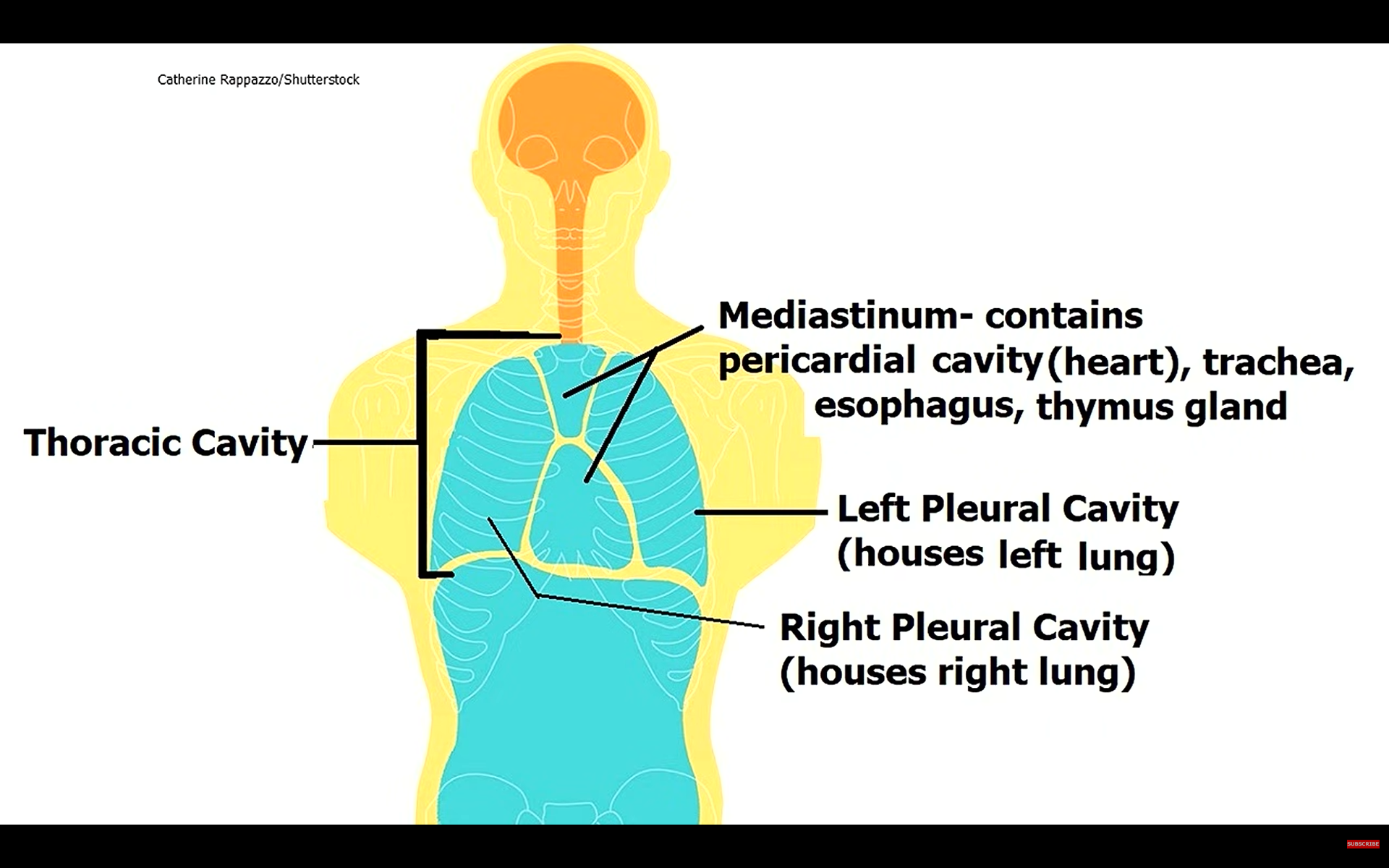
It is above the diaphragm (which separates the chest and abdominal cavity) and contains the lungs and the mediastinum, which separates the cavity into a right and left compartment.

The heart, esophagus, trachea, and thymus gland lie within the mediastinum (central compartment of the thoracic cavity)
<p>It is above the diaphragm (which separates the chest and abdominal cavity) and contains the lungs and the mediastinum, which separates the cavity into a right and left compartment.</p><p>The heart, esophagus, trachea, and thymus gland lie within the mediastinum (central compartment of the thoracic cavity)</p>
3
New cards
<p>Abdominopelvic cavity (one of two from ventral cavity)</p><p>Where is it?</p>

Abdominopelvic cavity (one of two from ventral cavity)

Where is it?

Located below the diaphragm to the pelvic floor, contains the upper abdominal cavity and the lower pelvic cavity ( not physically separated). The organs found within this cavity are:

Stomach, liver, gallbladder, spleen, kidneys, pancreas, large and small intestines.


<p>Located below the diaphragm to the pelvic floor, contains the upper abdominal cavity and the lower pelvic cavity ( not physically separated). The organs found within this cavity are:</p><p>Stomach, liver, gallbladder, spleen, kidneys, pancreas, large and small intestines. </p><p> </p><p></p>
4
New cards
<p>Dorsal cavity</p><p>Where is it and what is included?</p>

Dorsal cavity

Where is it and what is included?

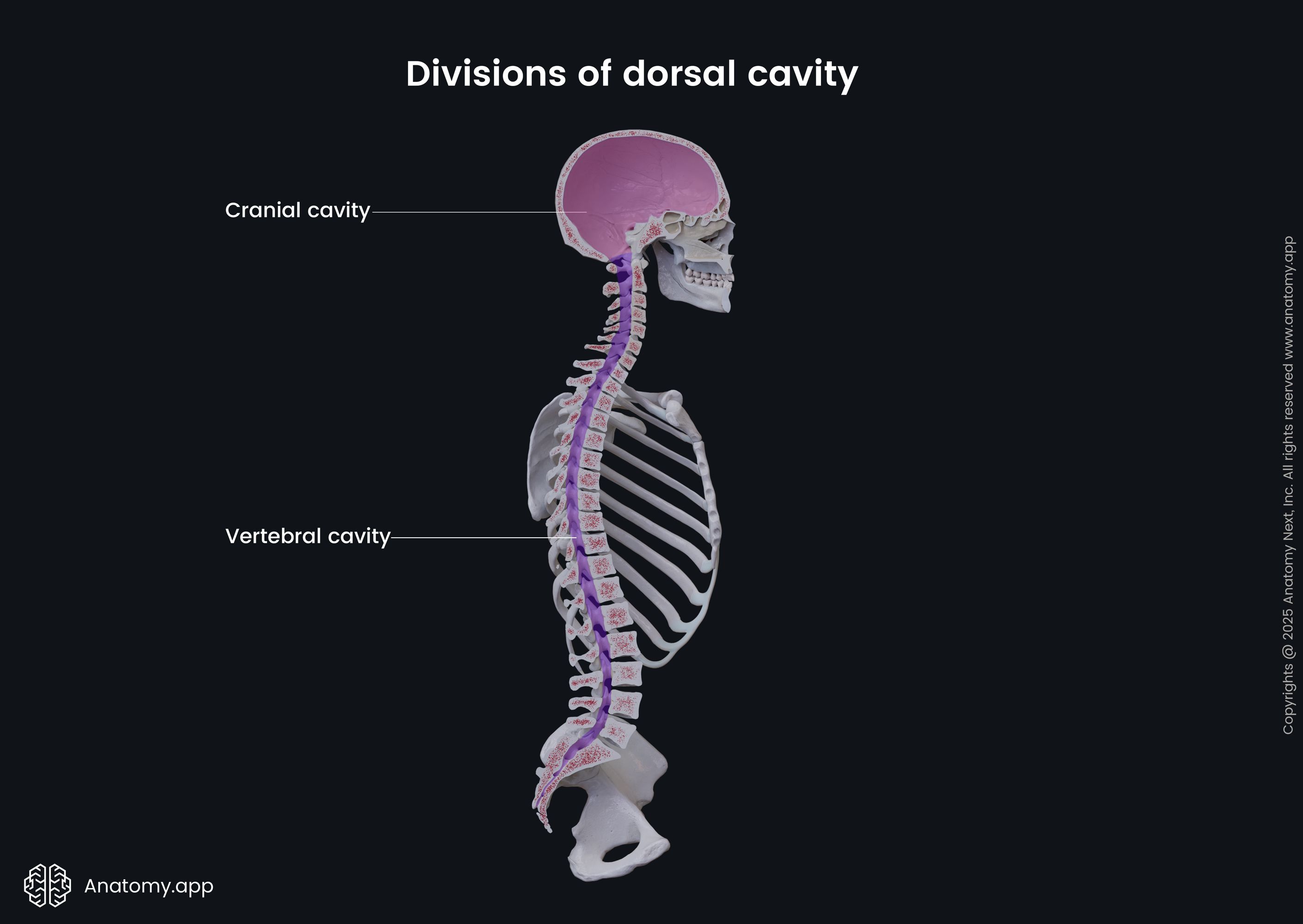
Dorsal = posterior (the back)

The cranial cavity (brain) and the vertebral cavity(spinal cord) are what make up the dorsal cavity.
<p>Dorsal = posterior (the back)</p><p>The <u><mark data-color="yellow" style="background-color: yellow; color: inherit;">cranial cavity</mark></u> (brain)  and the <u><mark data-color="yellow" style="background-color: yellow; color: inherit;">vertebral cavity</mark></u>(spinal cord) are what make up the dorsal cavity.  </p>
5
New cards

Cranial cavity

what is it?

It is encased by skull bones; it contains the brain, 12 cranial nerves, and the pituitary gland ( also known as the “master gland” which releases hormones that regulate other endocrine glands.

The dorsal cavity has 3 membranes called the meninges

(dura mater, arachnoid mater, and pia mater) They line the cavity and surround the brain and spinal cord and contain cerebrospinal fluid between the arachnoid mater and pia mater. (They both protect the dorsal cavity)

The vascularized pia mater ( innermost layer, containing many blood vessels and supplies oxygen and nutrients to spinal cord and brain) is adhered to the surface of the brain and spinal cord

The arachnoid mater (middle layer) contains connective tissue but not blood

The enervated (with nerves) vascularized ( with blood vessels) dura mater is the outer layer that lies next to the bones and folds inwards in places to then separate the brain into different compartments.

The dura mater has two layers

1.Endosteal layer, lines the cranial bones

  1. Menigeal layer, which lines the endosteal layer, lines the vertebral cavity


<p>It is encased by skull bones; <strong><u>it contains the brain, 12 cranial nerves, and the pituitary gland</u></strong> ( also known as the “master gland” which releases hormones that regulate other endocrine glands.</p><p>The <strong>dorsal cavity has 3 membranes</strong> called the <u>meninges</u></p><p>(<strong>dura mater, arachnoid mater, and pia mater</strong>) They line the cavity and surround the brain and spinal cord and contain cerebrospinal fluid between the arachnoid mater and pia mater. (They both protect the dorsal cavity)</p><p><strong>The vascularized pia mater</strong> ( innermost layer, containing many blood vessels and supplies oxygen and nutrients to spinal cord and brain) is adhered to the surface of the brain and spinal cord</p><p><strong>The arachnoid mater</strong> (middle layer) contains connective tissue but not blood</p><p><strong><u>The enervated</u></strong> (with nerves) <u>vascularized </u>( with blood vessels) <strong><u>dura mater</u></strong><u> is the outer layer </u>that lies next to the bones and folds inwards in places to then separate the brain into different compartments.</p><p>The dura mater has <strong>two </strong>layers </p><p>1.Endosteal layer, lines the cranial bones</p><ol start="2"><li><p>Menigeal layer, which lines the endosteal layer, lines the vertebral cavity </p></li></ol><p></p><p></p><p></p>
6
New cards

Vertebral cavity

The vertebral cavity contains the vertebrae and the spinal cord. The meninges extend from the cranial cavity to enclose the vertebral cavity.

<p>The vertebral cavity contains the vertebrae and the spinal cord. The meninges extend from the cranial cavity to enclose the vertebral cavity. </p>



