NEW limbic system
 Call Kai
 Learn
 Practice Test
 Spaced Repetition
 Match
 Flashcards
 Knowt Play
1/58

There's no tags or description
Looks like no tags are added yet.
59 Terms
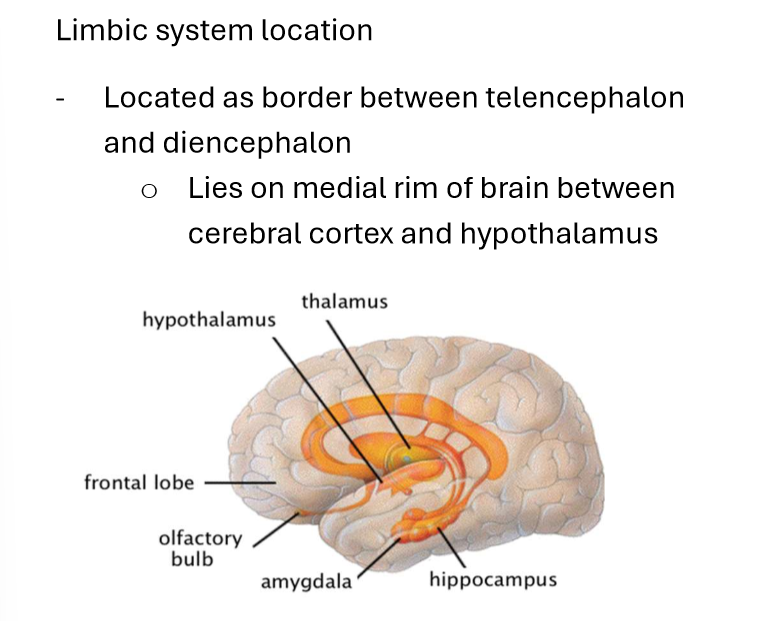
Limbic system is
located as a border between?
Lies on medial rim of brain between?
Telencephalon and diencephalon
Cerebral cortex & hypothalamus
Basic jobs of the limbic system
__ behaviors
__
__
Expression of __
Expression of __
- Feeding behaviors
- Fight or flight
- Aggression
- Expression of emotion
- Expression of autonomic, behavioral, and endocrine aspects of the sexual response
“feeling & reacting brain”
limbic system
Limbic system
Associated with control of functions necessary for?
Regulate what functions in response to emotional stimuli?
Set level of?
Involved in what behaviors?
- Associated with control of functions necessary for self preservation and species preservation
- Regulate autonomic and endocrine function in response to emotional stimuli
- Set level of arousal
- Involved in motivation and reinforcing behaviors

Limbic system has a large role in?
Creates two-way connection between thoughts/memories and emotions via?
memory
fornix
Fornix is an arched structure whose neurons communicates between
hippocampus & hypothalamus
Limbic system - HOME
- H: Homeostasis (Hypothalamus)
- O: Olfaction (Olfactory cortex)
- M: Memory (Hippocampal formation)
- E: Emotion (Amygdala)
Function of what is?
Emotion laden responses and behaviors
Bridge between autonomic and voluntary responses
Limbic system
Primary output node for limbic system
Hypothalamus
Hypothalamus is connected with what structures via the medial forebrain?
Frontal lobes
Septal nuclei
BS
Hypothalamus receives input from?
Hippocampus via fornix
Amygdala
Hypothalamus receives sensory inputs from?
most of body
Olfaction
Viscera
Retina
Hypothalamus has internal sensors for? receptors for?
Internal sensors - temp, glucose & sodium conc., osmolarity
Receptors - hormone signals
Hypothalamus has
output centers involved in?
Strongly influences many functions including?
output - sexual, endocrine, autonomic, behavioral function
autonomics, endocrine function, behavior
What functions are intrinsic to the hypothalamus?
temperature
osmolarity
appetite
sexual response
Amygdala location?
- Located in anterior temporal lobe within uncus (parahippocampal gyrus)
- End of caudate nucleus near putamen (not part of BG)
Amygdala
Sensory input?
Projects efferent fibers to?
- Receives a great deal of sensory input (afferent): somatosensory, visual, visceral, auditory, olfactory
- Projects efferent fibers to hypothalamus and cerebral cortex
What part of the limbic system?
Critical center for coordinating behavioral, autonomic and endocrine responses to environmental stimuli, especially those with emotional content
Amygdala
What part of the limbic system?
Integrates many behavioral reactions involved in the survival of the species, particularly to stress, fear, and anxiety
Amygdala
What lesion reduces response to stress?
amygdala
Stimulation of what causes directed rage reactions?
amygdala
Olfaction location
Is located near the medial anterior tip of the temporal lobe
Primary olfactory cortex receives direct input from __ without passing through __
CN I
thalamus
Olfaction makes strong connections with?
anterior portions of the temporal lobe and amygdala
Hippocampus location
- Part of limbic system located in medial aspect of temporal lobe
What part of the limbic system
Has significant contribution to understanding spatial relations within the environment
Hippocampus
What part of the limbic system?
Critically involved in many declarative memory functions
Hippocampus
Hippocampus 4 functions
Declarative memory
Converting short term to long term memory
Active in encoding and retrieval of memories
Understanding spatial relations within environment
Cingulate gyrus location
- Located next to corpus callosum
What part of the limbic system
Links smells and sights with pleasant memories of previous emotions
Cingulate gyrus
What part of the limbic system
Emotional response to pain
Cingulate gyrus
What part of the limbic system
Regulation of aggressive behavior
Cingulate gyrus
Papez Circuit
Links cortex to?
2 functions
- “Emotion System” linking the cortex to the hypothalamus
- Plays role in storing memories and cortical control of emotion
Prefrontal cortex location
- Sits anterior to premotor cortex
Prefrontal cortex (PFC)
Critical to?
- Critical to judgement, insight, motivation, and mood
Prefrontal cortex (PFC)
Important for?
- Important for conditioned emotional reactions
The PFC receives input from?
Other areas of the limbic cortex
Amygdala
Septal nuclei
Lesion location
Difficulty with abstract reasoning, judgement, moods and puzzle solving.
PFC
What part of the cortex is strongly affected by alcohol & abnormal in mood disorders
PFC
PTSD
__ disorder
Persistent __
Anxiety disorder that occurs after seeing or living through a dangerous event
- Persistent fight-or-flight response
- Results in psychological trauma that significantly disrupts daily life
PTSD
Often associated with?
Most people adapt to a traumatic event in initial?
Gender
Mild TBI
weeks - 3 months
Females 2x likely
responsible for executive function
Dorsolateral PFC
regulates emotion
Ventrolateral PFC
Fear center, activated when something is frightening in environment
Amygdala
spatial info and translation to LTM
Hippocampus - back part
memory and context
Hippocampus - front part
Stores and recalls memories
draws inferences about environmental context (ie safety)
Hippocampus
Normal function - what helps you shut down amygdala and cope?
- Normal function: PFC helps you to shut down amygdala and cope
Stress induces histological/structural changes
PFC
Amygdala
Hippocampus
PFC
altered blood flow to PFC
Amygdala
Decreased regulation by PFC = increased activity of amygdala
Increased formation of fear related memories
Hippocampus
Atrophy - increased vulnerability to PTSD
Could be genetic abnormality
HPA
What releases CRF?
What releases ACTH
What releases cortisol?
Hypothalamus signals pituitary gland (CRF)
Pituitary gland signals adrenal gland (releases ACTH)
Adrenal gland releases cortisol
Alterations in HPA in those who suffer in PTSD
Alterations in?
Cortisol and CRF levels?
Results in maladaptive response to?
Alterations in the HPA axis
Low cortisol levels and high CRF levels
Results in a maladaptive response to fear stimulus
Why low cortisol=PTSD
- Cortisol helps bring down the high levels of adrenaline that are released during fight or flight
- Adrenaline and norepinephrine are responsible for memory formation and arousal
- Not having enough cortisol to completely bring down the sympathetic nervous system when a person needs to calm down may partially explain the formation of traumatic memory or triggers
Clinical Signs/Symptoms of PTSD & diagnosing PTSD
Must have all of the following for at least 1 month post-trauma
- One re-experiencing symptoms
- Three avoidance symptoms
- Two hyperarousal symptoms
The combination of these symptoms interfere with ability to go to work, school, be with friends or family, take care of important tasks
PTSD
Risk factor?
Resilience factors?
Small hippocampus?
Support group or positive support system
Feeling good about one’s own actions in the face of danger
Positive coping behavior
o Teaches coping strategies and aims to change thinking patterns.
o Teaches problem solving skills and builds confidence
o Involves efforts to change behavioral patterns.
Cognitive behavioral therapy
Therapist moves fingers back and forth in front of face while pt visually tracks. At the same time, therapist will have pt recall a disturbing event including associated emotions and body sensations
Gradually, therapist guides thoughts to more pleasant ones.
EDMR
Pharmacology for PTSD
- No clear drug treatment for PTSD
- SSRI’s- considered first-line drug treatment (Zoloft, Paxil)
- Tricyclic antidepressants also recommended but have more side-effects Anticonvulsants, mood stabilizers and anti-aggression agents
- Benzodiazepines and antipsychotics are not useful and may be harmful
Single most effective strategy for optimizing functional outcomes in PTSD/TBI population
Enriched environment
Promotes repair, regeneration, reorganization of neuronal connections in the injured nervous system
Includes:
Indv. and group therapy
Rest
Education for patient & family
General Treatment Guidelines in PTSD for DPTs
- Speak clearly – give simple directions
- Avoid overstimulation
- Model calmness
- Redirection is effective – especially when agitated or upset
- Include the family or significant other often