Topic 2B materials (stress, young modulus, Hooke's law)
 Call Kai
 Learn
 Practice Test
 Spaced Repetition
 Match
 Flashcards
 Knowt Play
1/11

There's no tags or description
Looks like no tags are added yet.
12 Terms
Manufacturers recommend leaving concrete blocks to dry at least 28days before compared to 2 days. Discuss why
(given young modulus of concrete dried 28days > 2days)
- the breaking stress is greater for the concrete
- concrete is stiffer
- there is little change in the toughness
(greater young modulus means greater stiffness)
The length of a wire increases by 0.50%(strain). The stress = 2.3 x 10^9 Pa.
What is the Young modulus of the metal wire?
Young modulus = E = stress / strain
= 2.3 x 10^9 Pa/ 0.005
= 4.6 x 10^11Pa
(strain is often expressed in percentage like this
So strain of 4% means that, strain = 0.04)
To make concrete suitable for use under large forces steel rods are embedded in concrete.
A tensile force is applied to the rods while the concrete sets. When the force is removed, the concrete is placed in compression.
Explain how this process increases the maximum tensile force that the concrete can withstand before fracture.
[4 marks]
- concrete is stronger under compression but weak under tension
- steel is stronger under tension
- So when steel rods are embedded, they take some the tensile force instead of concrete
- And any tensile force first have to overcome the compression since concrete is still under compression (from steel rods wanting to return to original shape),
(concrete is stronger under compression, like it can hold your body weight as you compress it by standing on it.
But weaker under tension, so if you hang from concrete it instantly breaks)

-in series, the same force acts through both springs
- so both springs have the same extension
- so in this (series) combination, the extension is doubled
thus spring constant k must halve
(2x, if there were three springs it would be extension would be 3x and so on..)
- because F = k∆x, here k is proportional to 1 / ∆x so k is halved


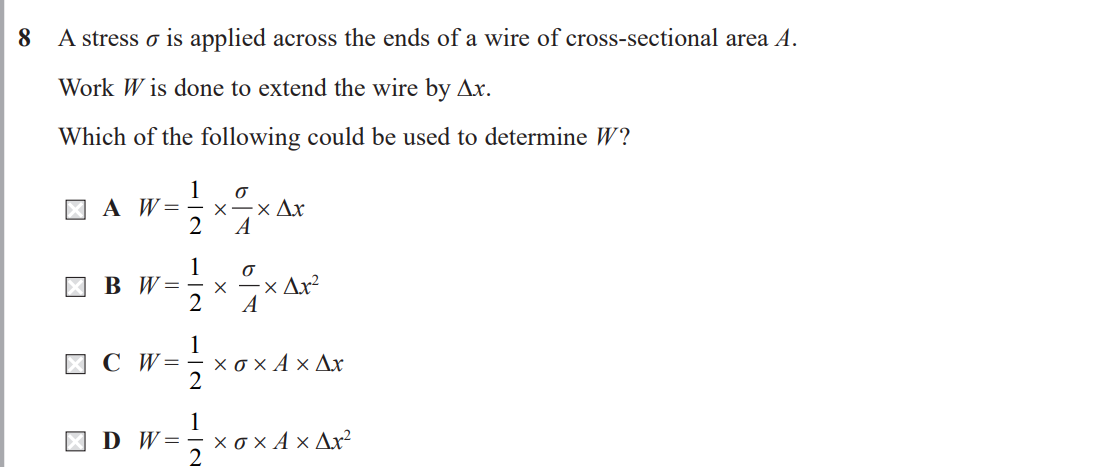
Take Tension as stress is the force transmitted through the rope's cross-sectional area.
The tension is the force stretching the rope i.e.
do not take Fweight


(a) State the significance of point K
[1marks]
(b) Explain the significance of point L
[2 marks]
(a) limit of proportionality
(b) - L is elastic limit, so beyond point L the spring will behave plastically
- spring will no longer return to its original length (once the deforming force is removed)

Suggest why the unloading graph has a different gradient to the loading graph
(1mark)
the spring constant/stiffness (which is the gradient) has changed
NOTE:
Spring constant, k from Hooke’s law is a measure of the stiffness of a particular object
It indicates the force required to produce a unit of deformation & depends on the object’s material, size and shape (UNLIKE YOUNG MODULUS which is a stiffness constant of object)
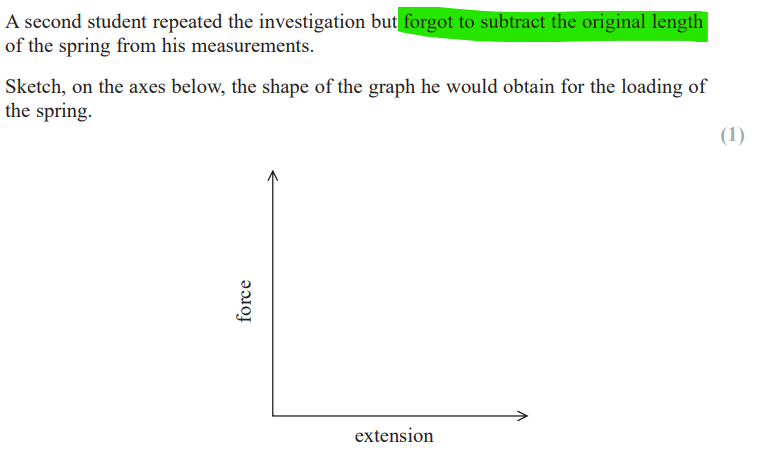
since student forgot to substract OG length, at F = 0 what would normally be
extension 0( e = x - xOG) the extension is equal to the unstretched OG length

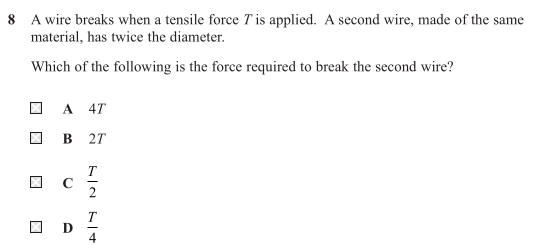
same material means same stress