intro to cell membrane
 Call Kai
 Learn
 Practice Test
 Spaced Repetition
 Match
 Flashcards
 Knowt Play
1/86

There's no tags or description
Looks like no tags are added yet.
87 Terms
What are the two major components of the cell membrane?
Phospholipids and proteins.
What does the cell membrane do?
It separates the inside of the cell from its external environment and selectively controls which substances enter and leave.
What does amphipathic mean?
Having both a hydrophilic region and a hydrophobic region.
What does hydrophilic mean?
Attracted to water; interacts favorably with water.
What does hydrophobic mean?
Repelled by water; interacts poorly with water.
What are the two main parts of a phospholipid?
A hydrophilic phosphate head and hydrophobic fatty acid tails.
What is a lipid bilayer?
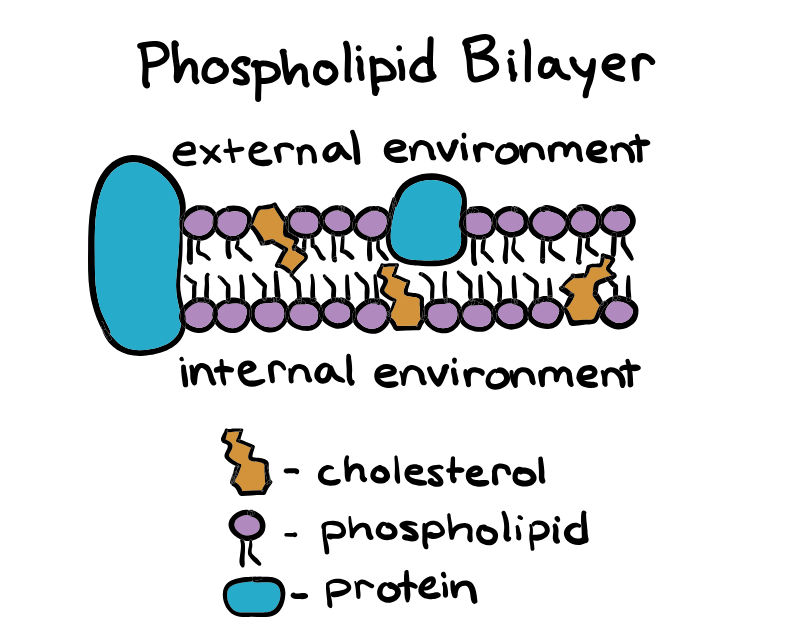
Two layers of phospholipids arranged with their heads facing the watery environments and their tails facing inward.

Why do phospholipids form a bilayer in water?
Their hydrophilic heads interact with water while their hydrophobic tails avoid water and face one another.
Which direction do phospholipid heads face in the membrane?
Toward the watery environments outside and inside the cell.
Which direction do phospholipid tails face in the membrane?
Toward the interior of the bilayer, away from water.
Why would hydrophobic tails facing the watery environment be unfavorable?
The tails interact poorly with water, so their exposure to water is energetically unfavorable.
What does selectively permeable mean?
Allowing some substances to cross more easily than others.
Why can oxygen and carbon dioxide cross the lipid bilayer relatively easily?
They are small, nonpolar molecules that can pass through the hydrophobic interior.
Why do ions such as Na+ and H+ have difficulty crossing the bilayer?
They are charged, and the hydrophobic interior of the membrane resists their passage.
How do ions usually cross the cell membrane?
Through specialized membrane proteins such as ion channels or transporters.
Why does glucose cross the lipid bilayer poorly on its own?
Glucose is relatively large and polar, so it does not pass readily through the hydrophobic interior.
How does glucose usually cross the cell membrane?
With the help of specific glucose transport proteins.
How does water cross the cell membrane?
Some water crosses directly through the bilayer, while aquaporin channel proteins allow faster passage.
What are aquaporins?
Membrane channel proteins that facilitate water movement across the membrane.
Why does membrane permeability depend on more than molecular size?
Polarity and electrical charge also affect how easily a substance crosses the hydrophobic interior.
What is the fluid mosaic model?
A model describing the membrane as a fluid, dynamic phospholipid bilayer containing a mixture of proteins and other components.

What does fluid mean in the fluid mosaic model?
Many membrane components can move sideways within the membrane.
What does mosaic mean in the fluid mosaic model?
The membrane contains a mixture of different components, including phospholipids, proteins, cholesterol, and carbohydrates attached to lipids or proteins.
What are integral membrane proteins?
Proteins embedded in the phospholipid bilayer; some span the entire membrane.
What are peripheral membrane proteins?
Proteins associated with the inner or outer membrane surface rather than extending through the hydrophobic core.
How can you distinguish a transmembrane protein from a peripheral protein in a diagram?
A transmembrane protein crosses the bilayer; a peripheral protein is associated with one surface.
What is cholesterol's role in an animal cell membrane?
It helps regulate membrane fluidity by influencing phospholipid movement and packing.
What are glycoproteins?
Proteins with carbohydrate chains attached.
What are glycolipids?
Lipids with carbohydrate chains attached.
What are cytoskeleton microfilaments in relation to the membrane?
Internal structural elements that help support cell shape and anchor some membrane proteins.
What is the extracellular matrix?
A network of material outside cells that provides support and helps connect cells to their surroundings.
What is membrane fluidity?
The ability of membrane components, especially phospholipids, to move within the membrane.
What is lateral movement of a phospholipid?
Sideways movement within the same layer of the bilayer.
What is flip-flopping of a phospholipid?
Movement of a phospholipid from one layer of the bilayer to the other.
Which phospholipid movement is more common: lateral movement or flip-flopping?
Lateral movement is much more common than flip-flopping.
Why is flip-flopping rare?
The hydrophilic head would have to pass through the hydrophobic interior of the bilayer.
What did the Frye and Edidin experiment demonstrate?
Membrane proteins can move laterally, supporting the fluid mosaic model.
What happened to the proteins in the Frye and Edidin hybrid-cell experiment?
Initially separated mouse and human membrane proteins became mixed after the cells were combined and allowed time to interact.
How do unsaturated fatty acid tails affect membrane fluidity?
Their double bonds create kinks that prevent tight packing and generally increase fluidity.
Why do unsaturated fatty acid tails have kinks?
One or more carbon-carbon double bonds create bends in the tails.
How do saturated fatty acid tails affect membrane fluidity?
Their relatively straight tails pack closely together and generally decrease fluidity.
What structural feature distinguishes saturated from unsaturated fatty acid tails?
Saturated tails lack carbon-carbon double bonds; unsaturated tails have one or more double bonds.
What happens to cholesterol's effect on membrane fluidity at higher temperatures?
It restrains phospholipid movement and helps prevent the membrane from becoming too fluid.
What happens to cholesterol's effect on membrane fluidity at lower temperatures?
It interferes with tight phospholipid packing and helps prevent the membrane from becoming too rigid.
Why is cholesterol described as a fluidity buffer?
It helps stabilize membrane fluidity, limiting excessive fluidity at high temperatures and excessive rigidity at low temperatures.
What happens to membrane fluidity when the proportion of unsaturated tails increases?
Fluidity generally increases because the tails cannot pack as tightly.
What happens to membrane fluidity when the proportion of saturated tails increases?
Fluidity generally decreases because the straight tails pack more closely.
What are six major functions of membrane proteins?
Transport, enzymatic activity, attachment, cell-cell recognition, intercellular joining, and signal transduction.
How do membrane proteins perform transport?
Channels and transporters facilitate the movement of substances across the membrane.
How can a membrane protein act as an enzyme?
It catalyzes a chemical reaction, increasing the reaction rate.
How do membrane proteins help attach a cell to its surroundings?
They can connect the membrane to the cytoskeleton inside the cell or the extracellular matrix outside it.
How do membrane proteins contribute to cell-cell recognition?
Surface proteins, often with carbohydrate chains, help cells identify one another.
How do membrane proteins contribute to intercellular joining?
Some proteins connect neighboring cells.
What is signal transduction?
The process by which a cell detects an external signal and triggers a response inside the cell.
What is a receptor protein?
A protein that recognizes and binds a specific signaling molecule or other compatible molecule.
How does a receptor help a cell respond to an external signal?
Binding of the signal to the receptor initiates a process that produces a response inside the cell.
What is the difference between transport and signal transduction?
Transport moves substances across a membrane; signal transduction converts an external signal into an intracellular response.
What is the difference between cell-cell recognition and intercellular joining?
Recognition helps cells identify one another; joining physically connects neighboring cells.
What is the difference between glycoproteins and glycolipids?
Glycoproteins are proteins with attached carbohydrates; glycolipids are lipids with attached carbohydrates.
Where are membrane carbohydrate chains involved in cell recognition generally found?
On the extracellular surface of the cell membrane.
How can glycoproteins act like identification tags?
Their carbohydrate chains provide surface markers that other cells can recognize.
How are membrane carbohydrates relevant to blood types?
Differences in cell-surface carbohydrate antigens help distinguish blood groups such as A, B, and O.
What is a cell surface receptor?
A membrane-associated protein or other receptor molecule that recognizes a compatible molecule outside the cell.
How can a virus use cell surface receptors?
Some viruses bind specific host-cell surface molecules to attach to and enter cells.
Why can a virus infect certain cell types but not others?
Infection can depend on whether cells have the compatible surface molecules and other cellular conditions required for entry and infection.
What is the general sequence of viral entry using a receptor?
Viral proteins bind compatible host-cell surface molecules, and that interaction can enable the virus to enter the cell.
What are CD4 and CCR5 in the HIV example?
CD4 is a cell-surface receptor, and CCR5 can act as a co-receptor that certain HIV strains use for entry.
Why is CCR5 important for some HIV strains?
Those strains can use CCR5, along with CD4, to enter susceptible cells.
What happens to CCR5-dependent HIV entry if CCR5 is absent from the cell surface?
Those HIV strains cannot use the CCR5-dependent entry pathway in that cell.
What tells a cell how to make the CCR5 protein?
The CCR5 gene in the cell's DNA contains the instructions for making the protein.
What is transcription?
The process of making RNA from a DNA template.
What is translation?
The process in which ribosomes use mRNA instructions to build a protein.
How does DNA lead to the production of the CCR5 protein?
The CCR5 gene is transcribed into mRNA, which is translated by ribosomes; the protein is then processed and transported to the cell surface.
Does having a gene guarantee that a cell always makes its protein?
No. Gene expression is regulated, and genetic variations can affect whether a functional protein is produced.
What is the relationship between membrane structure and membrane function?
The phospholipid bilayer provides the basic selective barrier, while proteins, cholesterol, and carbohydrates contribute to transport, fluidity, signaling, recognition, and interactions.
Why are phospholipids and proteins both important to the cell membrane?
Phospholipids create the bilayer barrier, while proteins carry out specialized functions such as transport and signal reception.
A small nonpolar molecule needs to cross a cell membrane. Will it generally cross easily, and why?
Yes. Small nonpolar molecules can pass through the hydrophobic interior of the phospholipid bilayer.
A charged sodium ion needs to cross a cell membrane. What feature makes this difficult, and what helps it cross?
Its charge makes the hydrophobic interior unfavorable; an appropriate ion channel or transporter can facilitate crossing.
Two membranes differ in fatty acid composition. Which is generally more fluid: one with more unsaturated tails or more saturated tails?
The membrane with more unsaturated tails is generally more fluid because the kinks prevent tight packing.
A membrane becomes too fluid at high temperature. How can cholesterol help?
Cholesterol restrains phospholipid movement and helps keep the membrane from becoming excessively fluid.
A membrane risks becoming too rigid at low temperature. How can cholesterol help?
Cholesterol disrupts tight packing and helps maintain fluidity.
A diagram shows a protein spanning the entire phospholipid bilayer. What type of protein is it?
An integral membrane protein, specifically a transmembrane protein.
A diagram shows a protein attached to the outer surface without crossing the bilayer. What type of protein is it?
A peripheral membrane protein in the simplified classification used in the slides.
A carbohydrate chain is attached to a membrane protein. What is the molecule called, and what can it do?
A glycoprotein; it can help with cell recognition.
A carbohydrate chain is attached to a membrane lipid. What is the molecule called?
A glycolipid.
Why does the phospholipid bilayer act as a selective barrier?
Its hydrophobic interior permits some substances, especially small nonpolar molecules, to pass more readily than charged or large polar substances.
What is the main takeaway of the cell membrane unit?
The membrane is a selectively permeable, fluid phospholipid bilayer whose proteins, cholesterol, and carbohydrate-containing molecules work together to maintain cell function.