Bio Lecture 16
 Call Kai
 Learn
 Practice Test
 Spaced Repetition
 Match
 Flashcards
 Knowt Play
1/30

There's no tags or description
Looks like no tags are added yet.
31 Terms
What is the cell cycle?
An orderly sequence of events where the cell duplicates its contents and then it divides into two

What are the 3 stages of interphase
G1, S phase, and G2. G phase is the gap phase where cell pauses division in order to grow. Interphase is when the chromosomes and centrosomes are duplicated
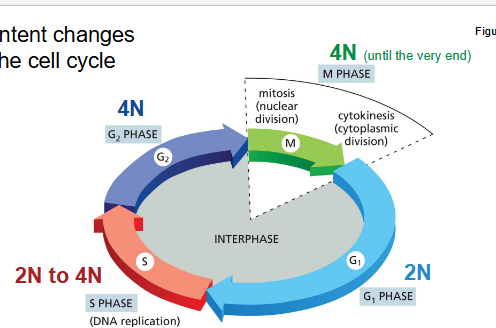
How does the DNA content of the cell change during the cell cycle?
During G1, the cell has 2N copies of each chromosome. During the S phase, each of the sister chromosomes double and there is now 4N copies in the cell. The cell will have 4N copies until it divides at the end of the phase back into 2N.
What is flow cytometry?
A technique that is used to measure the DNA content of the cells. They are labeled with a florescent dye and measured.
How can we analyze a flow cytometry chard?
Population of cells that are at different stages of the cell cycle. Some will be in the 2N stage (left peak) (G1 and end of mitosis) and some in the 4N stage (right peak) (S phase). The dip in between the peaks represent the S phase. The height of the peak represents how many cells in the population were at theat specific cell cycle stage.

What do these flow cytometry results tell us?
The 2N peak (G1) is the longest in the cell cycle. This is because at a given time, most cells in the population are at this stage in the cell cycle.
Is G1 phase is the longest cell cycle for all cells?
No
What are the 3 main properties of the cell cycle?
Recursive- Daughter cells go through the same cycle over and over. In order for this to work long term, cells must match up and keep their size and division the same across generations.
Ordered- The steps of the cell cycle must happen in a fixed order because each one depends on the one before it. (ex: DNA must be replicated before chromosomes are split or else daughter cells will have uncomplete deperation)
Linked cycles: The cell runs in more than one process at a time, specifically the chromosomes cycle and the growth cycle and they have to be in cync
What controls the cell cycle?
Cdks
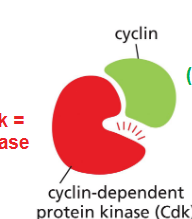
What are CDKs and how are they activated?
Cyclin-dependent kinases. These are proteins that phosphorylate other proteins via a covalent bond to drive the events of the cell cycle. They must be bound to a cyclin to be active via CDK-cyclin complexes.
Are cdks always active?
They are always present throughout the cell cycle but they are only activated when they need to be.
Is the concentration of regulating cyclin always the same throughout the cell cycle?
No unlike cdks, the concentration can be high or low depending on the stage of the cell cycles
What is the cdk cyclin kinase complex?
The complex that drives the cells entry into mitosis
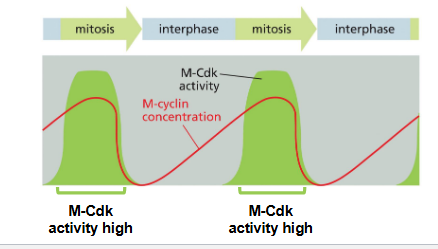
Describe the relationship between M-cyclin and cdks and how that changes throughout the cell cycle
When m cyclin is synthesized and levels rise, more m cdks are activates and the complex is formed which drives the cell into mitosis. When cyclin levels drop, more m-cdks are inactivated, and the cell are driven to interphase because the complex does not form

How is the rate at which mcdks and mcyclin are activated different?
M-cyclin rises gradually following growth throughout interphase, but M-CDK is activated very quickly. If the activity of M-CDK is tracked with cyclin levels, it would also rise slowly. Instead, it jumps on almost like a switch. This means there are extra regulators of M-CDK that prevent it from forming the complex until a certain point.
What are additional regulators of M-cdk?
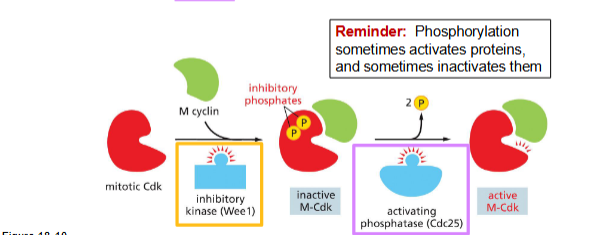
Wee-1 and Cdc25
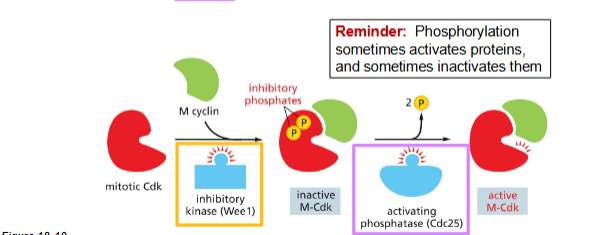
What is wee-1?
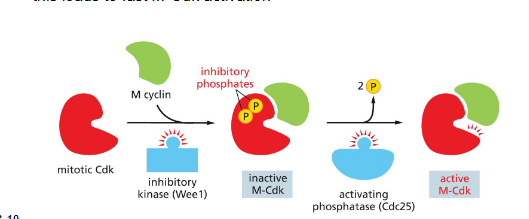
This is a kinase that phosphorylates M-CDK to inhibit its activity.
What is cdc-25?
This is a phosphatase that removed the phosphate that wee-1 adds, to activate the m cdk.
What are the 2 things that must happen to activate the m-cdk?
Binding of M-Cdk to M-cyclin (these complexes accumulate gradually during interphase) and Removal of inhibitory phosphates by Cdc25 (only happens at the end of G2)
What is another regulatory factor that accelerates Mcdk activation?
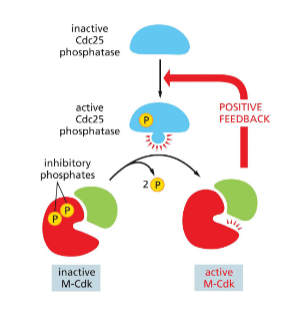
A positive feedback loop.
Describe the positive feedback loop that leads to Mcdk activation
When some M-cdk is activated, it phosphorylates cdc-25. When more cdc25 is active, more m-cdks get their complexes removed. this lead to rapid m-cdk activation.
Why is there a positive feedback loop in the cell cycle?
Allows for systems to be activated quickly and become “locked” in the activated state. This ensure the cyle only goes forward
How are m-cdk inactivated?
Near the end of M-phase, M cyclin levels fall quickly and bc m cdks need them to be active, they inactivate. this drives entry into interphase.

How does cyclin get detroyed?
A chain of ubiquitin proteins (polyubiquitin) is covalently bound to cyclin which targets it for degradation

What is a proteosome?
A multi-subunit complex. It contains a top region that recognizes the ubiquitin chains. It also contains a middle region called the central pole, when preoteolysis occurs.

How does the proteosome degrade proteins in cells?
The proteosome contains a polyubiquitin binding site, and once bound the target proteins are unfolded and woven through the pore where they are degraded. the ubiquitins are recycled.

What is the APC?
A protein complex that attaches ubiqutin the the M-cyclin (ubiquitin ligase). It is specific to cyclin.
How does regulation of Cdk activity by degradation also helps make the cell cycle irreversible
Adding a phosphate can be undone by removing it. But once the cell destroys a protein, it’s gone for good. At the end of mitosis, the cell destroys M-cyclin, and with no cyclin, M-Cdk shuts off, and the cell can’t just flip back into mitosis. It has to rebuild all the cyclins from scratch, which takes the whole next interphase.
What does m-cdk do once it is actually active?
Mcdk is a kinase and alters the activaty of many types of mitosis proteins
What is one example of a protein that m-CDK phosphorylates?
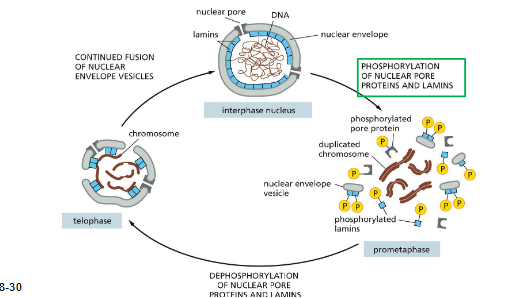
Nuclear lamins. These are IFs that form a meshwork under the nuclear envelope. They must disassemble in order for the envelope to breakdown and the spindles to attach to the chromosomes. To do this, lamins and pore proteins are phosphorylated by m-cdk at the start of mitosis and leads to this disassembly.

What happens to the nuclear envelope when M-cdk is deactivated
Lamins and nuclear pore proteins are dephosphorylated and reform the envelope in telophase. This dephos of the M-cdks happens during the metaphase to anaphase transitions.