Week 3: Innate Immunity
 Call Kai
 Learn
Learn Practice Test
 Spaced Repetition
 Match
Match Flashcards
 Knowt Play
1/34

There's no tags or description
Looks like no tags are added yet.
Name | Mastery | Learn | Test | Matching | Spaced | Call with Kai | Chat |
|---|
No analytics yet
Send a link to your students to track their progress
35 Terms
2 Soluble mediators of innate immunity
cytokines
Complement
Pathogen breakers barrier, what occurs next
four steps
Releases PAMPs (pathogen-associated molecular patterns)
Detected by PRR (pattern recognition receptor)
Activates signal transduction
Activates NFκB
Controls the production of soluble mediators of innate immunity (among other things!)
What are cytokines?
what are they a category of
What does it behave (2 things)
What type of molecule are they? - + an additional role
category of signalling molecules used in cellular communication
helps enhance the cell’s ability to rid of pathogens and promote healing
A soluble protein that moderate cell behaviour at small concentrations
Acts locally and systematically to the same producing cells or other cells
Biological activities

Cytokines: pro vs anti-inflammatory
pro-inflammatory cytokines
Things that induce sickness
IL-1B, IL-6, tumour necrosis factor (TNF)
Anti-inflammatory cytokines
IL-10, IL-4, transforming growth factor b (TGFb)
What are complements?
what is it made out of
What does it operate similarity to?
What is a zymogens
What are triggers for activating it?
a complex network of plasma and cell surface proteins
Operates similarly to a blood clotting casade
Known as a zymogens
A pro-enzyme that requires a biochemical change to become active - amplification Of an active factor activating the next, then the next, then the next
Triggers for activating the first factor
Microbial patterns (PAMPS)
Immune complexes (between antibody and non-self proteins)
Different complement effector mechanisms
just list them
The membrane attack complex (MAC)
Opsonization
Enhance inflammation
The membrane attack complex
What does the MAC consist of?
Why doesn’t this form on human cells?
MAC is located on the cell surface (appears like tubes)
Components C5-C9 creates the complex that perforates (creates opening in) the cell membrane
On a separate cell, the human cell, has a specific component CD59 that binds on to a complex (C5b,6,7,8) and prevents the recruitment of C9 to form the pore
Therefore only can form pores in the microbes to kill them, rather than the human cell due to having CD59 to prevent forming the MAC

Opsonization
what are opsonins? What proteins are opsonins (2)?
What are they recognized by
opsonin: coat bacteria - very important, making microbes more palatable/digestible
C3b, and iC3b - both gets bind index to the complement receptors CR3 and CR1
Recognized by complement receptors expressed on phagocytes

Enhance Inflammation
explain the process
Four main steps
the complement’s C3b receptor binds to the microbe
Release of both C3b and C5a
C5 needs to under proteolytic first in order for C5a to be released
Leukocytes are recruits and activation by C3a and C5a binding to the corresponding C3a and C5a receptors on the cells
Leukocytes then destroy the microbes

Three important mechanisms that inhibit complement
C1 INH
Factor H
Protectin (CD59)
Main roles of each (only one sentence)
C1 INH: shuts down the classical and lectin pathways
Factor H: binds to C3b and targets factor I to cleave the protein
Protectin (CD59): integers with the assembly of the complement attack complex by binding to C7 and C8
C1-inhibitor deficiency
what type of disease
What is the cause of the disease (What encodes for it)
Prevalence ratio
Symptom (main name + definition)
Also explain when it happens and that are some links with family human life
Common affected areas (4)
an autosomal dominant disease
Lack of the C1-inhibitor
Encoded by SERPING1
Not proper functioning of inhibitor protein
Likelihood 1:50,000
Characterized by recurrent episodes of swelling (angioedema)
Lasts 2-5days
Links with trauma, infection, stress
Infected organs: limbs, face, intestinal tract, airway
Three main types of phagocytes
monocytes/macrophages
Neutrophils
Dendritic cells
Monocytes/Macrophages
monocytes: when found in the blood
Macrophages: differentiated once travelled to the tissue
Structure: have many protrusions to seek pathogens
Main role: phagocytose (to eat) pathogens and kill,
Types of macrophages and their definitions
Resident macrophages
live in tissues
Have unique gene expression depending on their microenvironment
Liver - Kupffer cells
Brain - microglial cells
Lung: - alveolar macrophage
Bone - osteoclast
Neutrophils
a.k.a polymorphonuclear leukocytes (PMNs)
High number in the blood (50-70%)
Main role: get to the site of the infection, enter tissues, use PRR (pattern recognition receptors) to bind to PAMPs, and ingest and kill microorganisms
The cytoplasms: full of granules containing toxic products for killing
After ingesting, they release their granules from the cytoplasms, killing the pathogens
Cause collateral damage
NETs
full name
Why is it used in neutophils
used to trap pathogens
NET: neutrophil extracellular traps
Neutrophil will die, releasing it’s DNA
DNA sticky and traps bacteria
Macrophages come clean up the mess
Dendritic Cells
resident cells in mucosal tissues that look around for pathogens
Look like dendrites with huge extensions
Main roles: survey the mucosal sites, sample bacteria, chew them up to present to T cells
DC considered pro antigen presentation cells (presenting antigen to T cells)
Granulocytes
characteristics
Types
multi-lobular nuclei and cytoplasm filled with granules; names derived from the appearance of their granules in stain
Types
Eosinophils
Basophils
Neutrophils (already discussed)
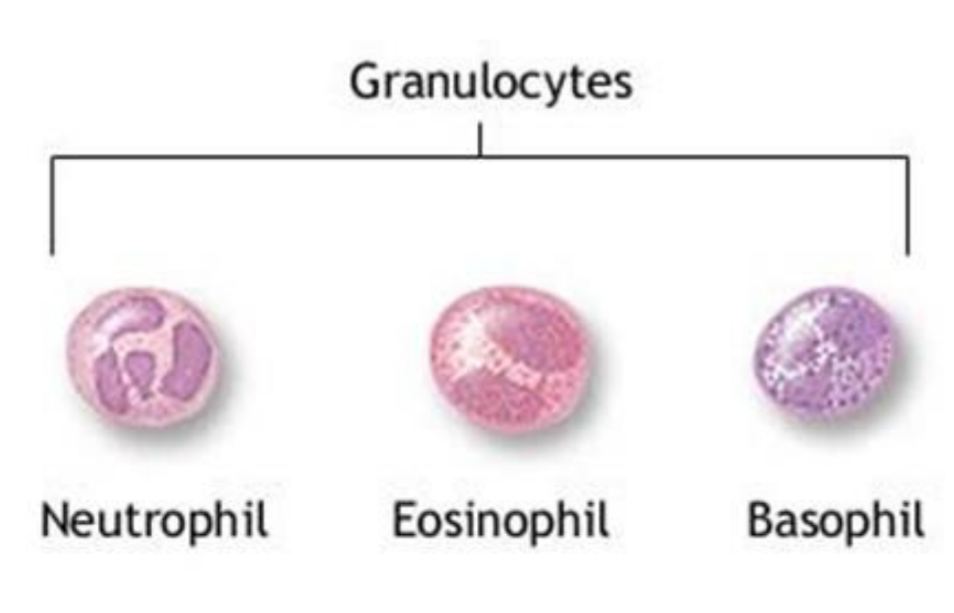
Eosinophils And Basophils
different characteristics
Same characteristics
Eosinophils are infrequent cells (1-6% of leukocytes) while basophils are the least common (0.01-0.3%)
Stains with Eosin for eosinophils and basic dyes for basophils
Similar (both…)
Degranulating cells
Often associated with parasite killing
Mediators of allergic reactions/asthma

Natural killer (NK) cells
classification
Part of which immune system
Main roles
Similar to
non-T, non-Blymphocytes
Part of the innate immune system
Recognizes and kills abnormal cells (e.g. tumor and virally-infected cells)
Similar cytolytic mechanisms to cytotoxic T lymphocytes (CTL)

Phagocytosis Process
Chemotaxic and adherence of microbe to phagocyte
Ingestion of microbe by phagocyte
Formation of a phagosome
Fusion of the phagosome with a lysosome to form a phagolysosome
Enzymes digest and kill through oxidative burst
Formation of a residual body containing indigestible material
Discharge of waste materials
Summary
Microbe → phagocyte → phagosome vesicle (phagocyte + microbe) → +lysosome = phagolysosome → enzyme digest → residual body with waste → dischargex$

Oxidative burst (respiratory burst)
What is produced (another name for it), mediate by what?
How is it produced?
the production of o2-based toxic molecules (reactive oxygen species (ROS)) mediated by the NADPH oxidase complex
ROS formed from o2 to form intermediate o2 products (like H2O2) that are indirectly toxic to bacteria

How does neutrophils kills microbes
several mechanisms
ROS: respiratory burst/oxidative burst
Lysozyme: an enzyme that breaks bacterial cell walls
Antimicrobial peptides
Formation of NETS, serving to trap, therefore killing bacteria
Defects in killing bacteria: Chronic granulomatous disease (CGD)
explain the case study
4 year-old boy is investigated because of repeated episodes of ear infections and pneumonia
Examination: underweight boi, fluid coming out of right ear, scars formed from healed abscesses (weird acne like thing). Other family members who are males has same symptoms
Observation: increase number of neutrophils in the blood - defect suspected
Reason: his neutrophils weren’t able to generate an oxidative burst = no toxic o2 molecules and phagocytes could not kill the ingested microbes
Final diagnosis: CGD
More details: a mutation affected the NADPH oxidase and prevent generation of ROS requires for oxidative burst and therefore no microbes gets killed through this process
Common symptoms with similar patients: patients have re-current infections and ‘granuloma’ a tumor like formation of immune cells surrounding in-digested microbes

CGD genetics
a deficiency in NADPH oxidase and its inability to make ROS
60% of these case: mutation in gp91^phox (encoded by the gene CYBB)
CYBB “x-linked”: affecting mainly males

Inflammatory response
general steps
Pathogens with PAMPs break through epithelium to get through the epithelium barrier
The epithelial cells are activated upon contact, PRRs are triggered by any tissue-resident phagocytes, NFkB is activated by those phagocytes
Soluble mediators (cytokines) of the innate immune defense produced by the activated cells
Cells of the innate system recruited to the site
Local inflammation
use the general steps (but instead be more specific to local inflammations)
Healthy skin gets infected
The epithelial and other resident effector cells gets recruited through PRRs to secret the cytokines
Vasodilation (widening of the blood vessels) and increased vascular permeability allow the movement of fluid, protein, inflammatory cells to leave the blood and enter the tissue
Infected tissue gets inflamed, causing redness, heat swelling and pain

Local inflammation - vascular changes
Explain how it changes
The purpose of the change
The cytokines and complement factors will act on the vascular endothelial cells, resulting in vasodilation and the slowing the blood cells (the separation of endothelial cells and breaking of tight junctions)
Cytokines help increase
Dilation of vessels
Permeability
Expression of adhesions molecules that trap white blood cells to the site
Result: the movement of WBC to migrate to the injured or infected site

Cell migration process
explain the extravisation process
tethering and rolling
The cytokines express more adhesion molecules that tethering and roll the white blood cells, mediated by SELECTINS
Extravisation process
selectin will grab onto passing WBC
The adhesion flattens the cell and allows for migration
Innate effect cells (WBC and other things) migrate towards the site of infection out of the vessel by following the gradient of cytokines produced by infected epithelial cell

which pathogen will go to the site of infection?
neutrophil

The effects of inflammation on other parts of the body
how do they affect the feelings of the person (what type of feeling)
How do they affect the other organs in the body (which ones and for all of them, how does it work)
Cytokines makes you feel bad
Cells from inflamed tissue will releases proinflammatory mediators into the blood
Brain = fever, malaise, loss of appetite
Liver: more synthesis of defense-related proteins like complement protein
Bone marrow: release of stored leukocytes and increase production in stem cells
Muscle and adipose tissue: increase catabolism to generate energy
Why is this important: increase by 1 degrees Celsius =33.8 Fahrenheit walking 35-40 km
Explain septic shock compared to local infection
explain the local infection first if it is easier
Local infection (Gram-negative bacteria)
LPS induces local macrophages to produce inflammatory mediators like these cytokines (TNFa, IL-1, IL-6)
Local vessels dilate to recruit the cellular and humoral mediators of innate immunity and healing)
Results
Phagocytosis
Tissue repair Through local clotting
Drainage of bacteria to local lymph nodes
Containment of infection
Systemic infection
a systematic infection in that presence of e.g. gram-negative bacteria
Cytokine storm: High levels of cytokines released by many immune cells (not just the local macrophages in the tissue)
All blood vessel dilate and Edna occurs (fluid buildup trapped in the tissues) as protein and cellular fluid escapes into the tissues during cytokines work
Result
Drop in blood volume (vasodilation) and pressure
Elevated heartbeat (like in fevers)
Disseminated intravascular coagulation (DIC): systemic clotting of small vessels
Blocks blood flow leading to organ failure and death
Why do people die
cytokine production leads of a massive production of endogenous vasodilators
a structural change in the endothelium might results in leakage of the fluid, causing tissue edema (inflammation)
Plugging of select microvascular beds with neutrophils and clotting factors will block blood flow to organs
Organ/lung-specific ‘ischemia’ restriction in blood supply
Organ failure
How to treat a septic shock?
cytokine storm dampening with steroid (anti-inflammatory effects)
Activate protein C to remove the clotting
Vasopressors to constrict blood vessel, stopping dilation
Mortality of septic shock
leaderboard in leading deaths in the US
mortality rate = 25-50%
13th leading cause of death in the US, most frequency case of deaths in intensive care units