MPDM 4 (Global Planning)
 Call Kai
 Learn
 Practice Test
 Spaced Repetition
 Match
 Flashcards
 Knowt Play
1/7

There's no tags or description
Looks like no tags are added yet.
8 Terms
Workspace W and Configuration Space C
Picture

Inputs & Outputs
1. User Information
(Destination, Requirements)
2. Localization
(Global Navigation Satellite System (GNSS), LiDAR-/Camera Localization, State: [𝒙, 𝒚, 𝒛, 𝒗, 𝜽])
3. Map
(2D (grid map, camera-based map), 3D (terrain map, LiDAR-based map))
4. Result: Global Plan from A to B
Objective
(1) Find a route from start to destination
(2) Route has to be feasible
(3) Route has to be effective
(4) Route has to be efficient
Discrete vs. Continuous Planning
Discrete states
Environment devided in states: grids or graphs
Advantage: A* can find the graph optimum
Disadvantage: Coarse grids can miss better paths
Map → Discretization → Planning
(Dijkstra‘s Algorithm, A*-Algorithm)
Continuous states
Planning in continuous space
Advantage: Flexible paths without a fixed grid
Disadvantage: No automatic smoothness or optimality

Graph-based Planning. Basic elements
Picture

A*-Algorithm
Extends Dijkstra's algorithm with a heuristic that directs the search toward the goal.
Complete; optimal if h(n) never overestimates the true cost (admissible)
Informed Heuristic Search Algorithm: A* uses a heuristic to guide its search, making it more directed towards the goal
Differences to Dijkstra’s algorithm:
- Informed Heuristic Search Algorithm: A* uses a heuristic to guide its search, making it more directed towards the goal.
- Estimation Function to Accelerate Search: The heuristic function estimates the cost from the current node to the destination, enabling A* to prioritize paths that are more likely to reach the target efficiently.
- Node Cost Calculation: A* evaluates the cost of each node as the sum of the distance from the start node to the current node (actual cost) and the estimated distance from the current node to the goal (heuristic cost). The node with the lowest combined cost is prioritized for exploration.

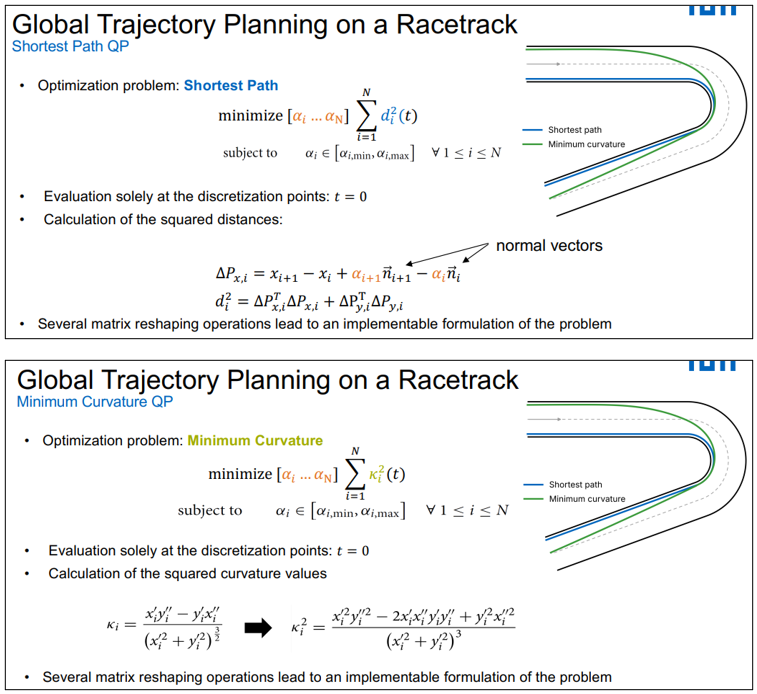
Global Trajectory: Optimization
Path Planning (Geometric QP) + Velocity Planning
Possible objectives:
(1) Shortest distance: We travel the shortest distance
(2) Minimum curvature: We reduce the steering of the wheel
+ Picture
General comment
Hard to make flashcard from this lecture
Mb just study the slides?