sedimentary rocks and processes pt. 1 (mod #9.1)
 Call Kai
 Learn
 Practice Test
 Spaced Repetition
 Match
 Flashcards
 Knowt Play
1/88

Earn XP
Description and Tags
🍂
89 Terms
sedimentary processes
all processes that shape a sedimentary rock — from the sediment source to its formation and modification
source area
weathering
erosion
transportation
deposition
diagenesis
sedimentary rock
list the sedimentary cycle
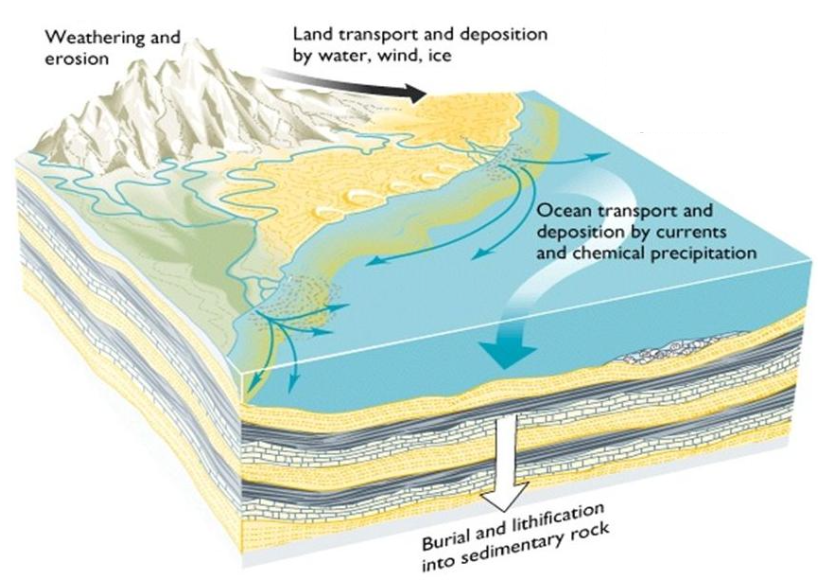
weathering
involves the in-situ (on site) physical, chemical and organic breakdown of rock material into smaller mineral and rock fragments and into dissolved components
physical (disintegration), chemical (decomposition), differential
differential weathering
TYPES OF WEATHERING
different rock materials weather at different rates wherein less resistant rocks are weathered and eroded more easily
physical weathering
TYPES OF WEATHERING:
dominant in dry and cold environments;
involves disintegration
disintegration/physical weathering
UNDER WEATHERING:
breakdown of larger, more coherent rock bodies of the same composition that may involve mechanical and biological processes;
unloading, frost action, crystal growth, abrasion, slaking, insolation, root growth, animal acts
unloading
PHYSICAL WEATHERING TYPES:
removal of overlying rock and sediment (overburden) via erosion or tectonic uplift causes buried rocks to expand upward and outward, forming parallel fractures known as sheet joints
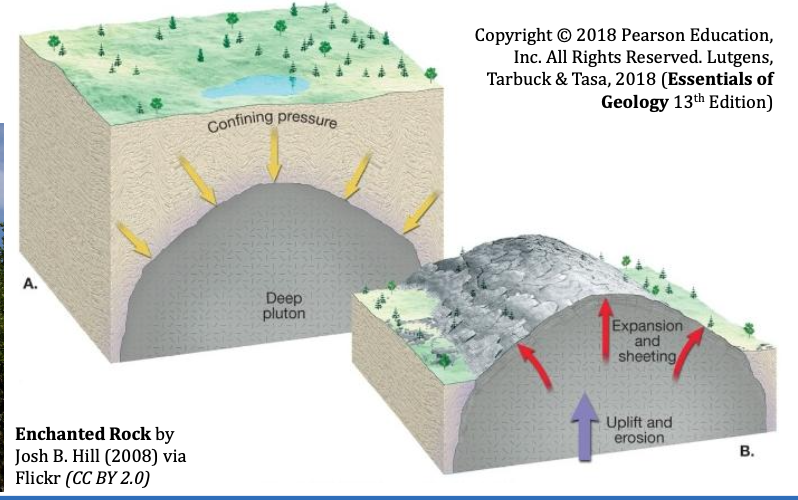
sheet joints
UNDER PHYSICAL WEATHERING (UNLOADING):
fractures oriented subparallel to the earth’s surface
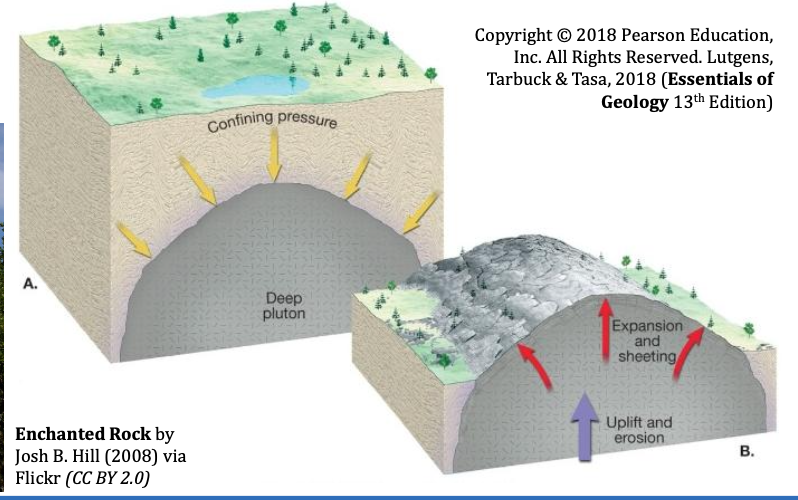
Frost Action / Shattering
PHYSICAL WEATHERING TYPES:
pre-existing fractures and weak surfaces are enlarged by the expansion of water;
includes frost wedging & frost heaving

Frost Wedging
PHYSICAL WEATHERING TYPES (FROST ACTION):
occurs along fractures oriented steeply

Frost Heaving
PHYSICAL WEATHERING TYPES (FROST ACTION):
develops along surfaces parallel to the surface often in soil

Crystal Growth
PHYSICAL WEATHERING TYPES:
expansive force from the growth of other crystals (particularly in evaporites) that weakening the rocks and enlarging the cracks
Abrasion
PHYSICAL WEATHERING TYPES:
mechanical wearing down, scraping, or grinding away of a rock surface by friction, resulting from the action of running water or waves, wind, and ice

Sandblasting
PHYSICAL WEATHERING TYPES:
occurs when winds blow sand or silt against other rocks enhancing abrasion
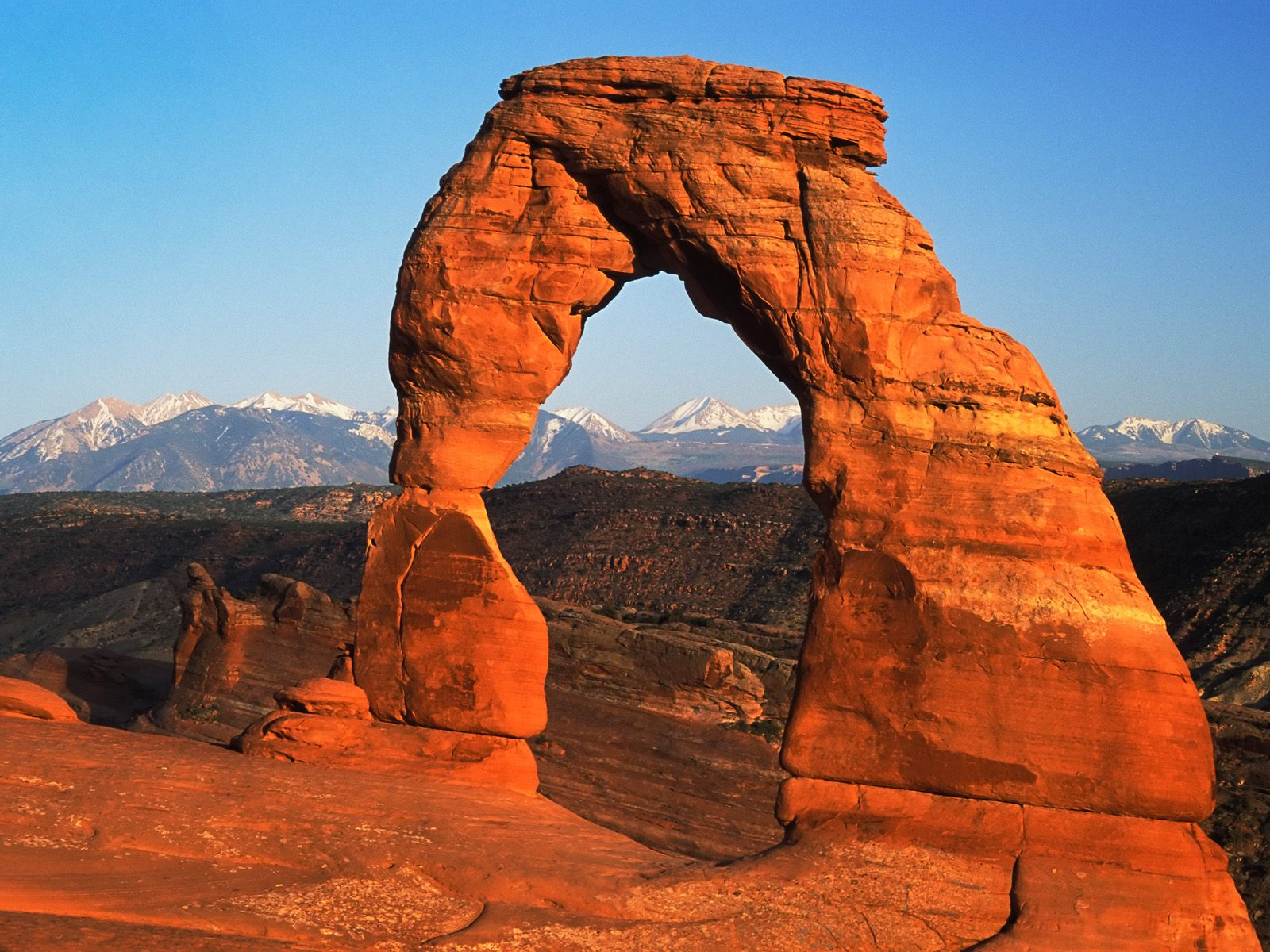
Slaking
PHYSICAL WEATHERING TYPES:
wetting and drying of rocks that contain micas and clays that expand when wetted generating stress to adjacent minerals

Insolation
PHYSICAL WEATHERING TYPES:
volume changes from temperature change (heating-thermal expansion and cooling-thermal contraction) that induce stresses spalling small particles from the rock body

Evorsion
PHYSICAL WEATHERING TYPES:
erosion from the impact of flowing water in the stream bed
due to vortices of water

Cavitation
PHYSICAL WEATHERING TYPES:
breaking of rocks by ocean waves from bubble implosion
rapid formation and violent collapse of vapor-filled bubbles in a liquid
Biological Activity
PHYSICAL WEATHERING TYPES:
interaction of organisms with rocks and sediments
ex. stone bored through by piddocks

Chemical Weathering; wet & hot
TYPES OF WEATHERING:
Dominant in ____ and ____ environments;
dissolution, carbonation, ion exchange, hydrolysis, hydration/dehydration, oxidation, organic decomposition
Decomposition
CHEMICAL WEATHERING TYPES:
breakdown of rock materials that involves changes in chemical composition;
Incomplete in steep slopes and complete in gentler slopes
Water needs time to sit on rock surfaces to react with them. On steep slopes, gravity pulls water and loose sediment down quickly, leaving the rock exposed for only a short time and resulting in incomplete weathering.
On gentler slopes, water pools and soaks into the ground, giving reactions plenty of time to finish and causing complete weathering
Goldich Stability Series
UNDER CHEMICAL WEATHERING:
method of predicting relative stability or weathering potential of various minerals on the surface;
opposite of Bowen's reaction series

least
GOLDICH STABILITY SERIES:
In the Series, minerals that crystallize at higher temperatures and pressures deep within the Earth are the ______ stable under cool, watery, low-pressure surface conditions and therefore weather the fastest.
longest
GOLDICH STABILITY SERIES:
Minerals that crystallize at lower temperatures are closer to surface conditions and resist weathering the _____.
Dissolution
CHEMICAL WEATHERING TYPES:
occurs when minerals are wholly or partly dissolved
Carbonation
CHEMICAL WEATHERING TYPES (DISSOLUTION):
carbonic acid reacts with calcite to produce Ca2+ and HCO3-
Ion Exchange
CHEMICAL WEATHERING TYPES:
occurs when ions are directly exchanged between a mineral and a solution

Hydrolysis
CHEMICAL WEATHERING TYPES:
chemical reaction between a mineral and water in which dissolved hydrogen ions and/or hydroxyl ions are added to form one or more new minerals, typically silicate to hydroxide/clay minerals
Hydration
CHEMICAL WEATHERING TYPES:
involves addition of water to a crystal structure during reaction between a mineral and aqueous solution converting it into another mineral
reverse is dehydration
oxidation
reduction
CHEMICAL WEATHERING TYPES:
chemical reaction in which one or more electrons are transferred from a cation to an anion, increasing the valence of the cation (LEORA)
involves loss of electron
True
TRUE OR FALSE:
Rocks that are red, orange, brown, and yellow are found in continental areas and are oxygen-rich.
Deep marine - black, dark gray, no oxygen
Shallow marine - green, light gray, low oxygen
Organic Decomposition
CHEMICAL WEATHERING TYPES:
organic activity can cause decomposition
Chelation
CHEMICAL WEATHERING TYPES (ORGANIC DECOMP):
highly soluble organic molecules bind with metallic elements in rocks that remove them from the mineral
effect of organic acids on rocks
Soil
CHEMICAL WEATHERING TYPES:
Unconsolidated surficial deposits produced by weathering processes and capable of supporting rooted plant life;
Composed of regolith, humus, water and air
Regolith
humus
CHEMICAL WEATHERING TYPES (SOIL!):
layer of sediments derived from the weathering of bedrock;
layer of loose, unconsolidated, weathered rock, dust,
and mineral fragments that covers solid, unweathered
bedrock
aka organic matter
True
TRUE OR FALSE:
The formation of soil, given time, produces a soil profile, divided into different soil horizons
sediment source, climate, topographic relief
3 factors controlling soil formation (SCT)
Sediment Source
FACTORS CONTROLLING SOIL FORMATION:
source rock composition determines how effective physical and chemical weathering processes
Precipitation
FACTORS CONTROLLING SOIL FORMATION (CLIMATE):
governs the extent of hydrolysis, hydration and dissolution
Temperature Fluctuations
FACTORS CONTROLLING SOIL FORMATION (CLIMATE):
________ fluctuations determine importance of ice-wedging and insolation
Topographic Relief
FACTORS CONTROLLING SOIL FORMATION:
controls the exposure of minerals to weathering agents
Erosion
SEDIMENTARY PROCESSES:
Action of surface processes that wear away and transport rock particles and dissolved ions from the source;
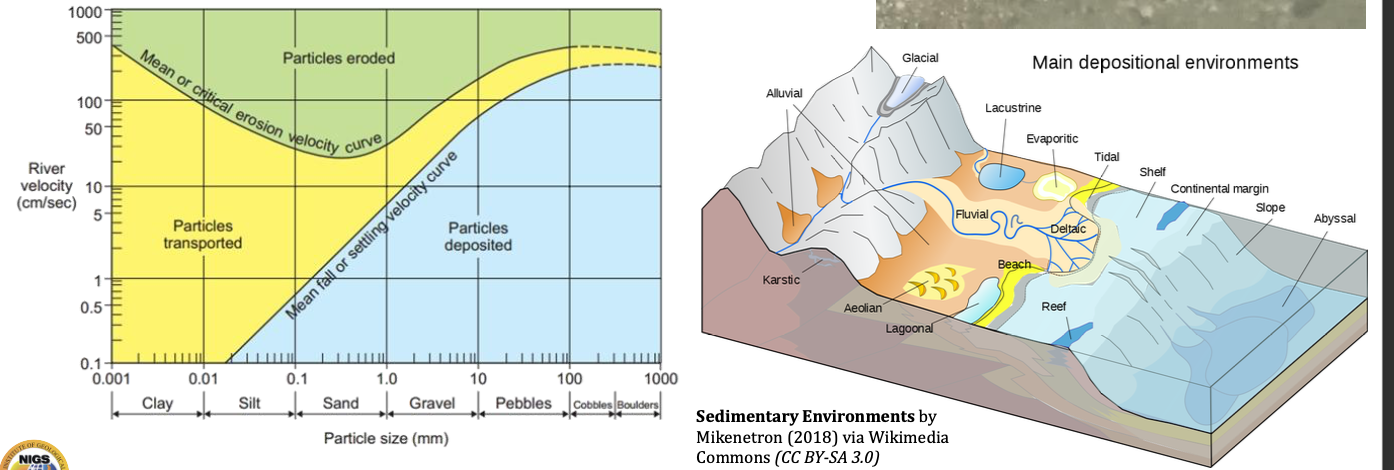
agents: gravity, wind, water, ice, biological activity
gravity, wind, water, ice, biological activity
5 agents of erosion and transportation (GWWIB)
transportation
SEDIMENTARY PROCESSES:
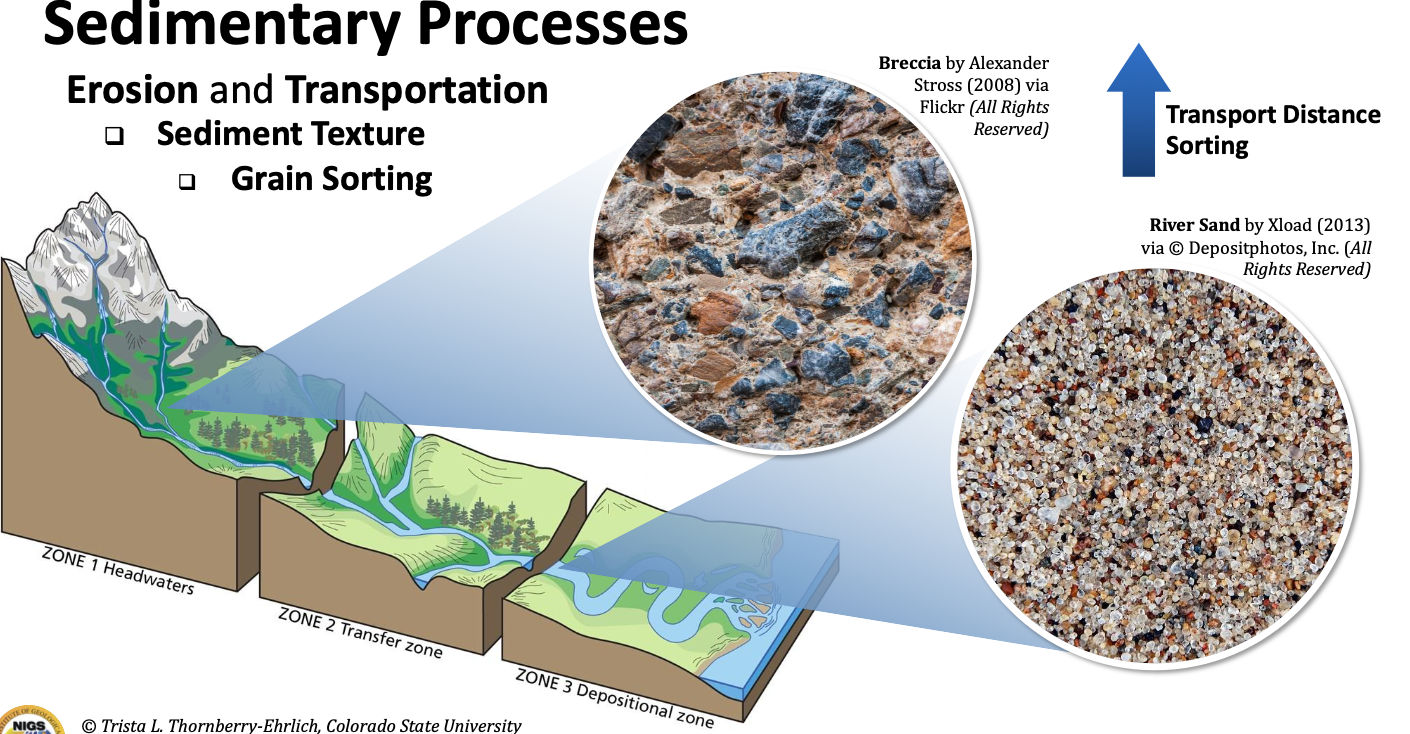
involves the mobilization & moving along of sediments
Mass Wasting
EROSION & TRANPO (GRAVITY):
downslope movement of rock particles driven by gravity;
slope failures transport rocks and sediments downslope

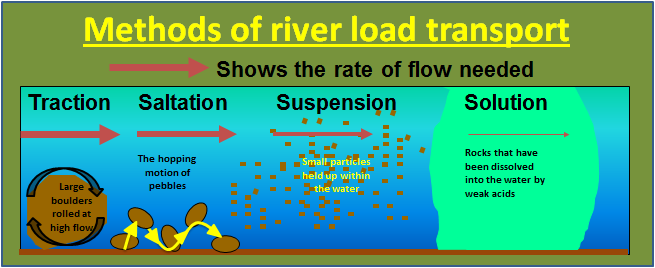
Solution
EROSION & TRANPO (WATER TYPES):
dissolved minerals and ions in the water;
Slightly acidic water chemically dissolves soluble rocks like limestone and chalk;
invisible minerals and ions travel completely dissolved within the water flow until the water evaporates or reaches the sea.
Suspension
EROSION & TRANPO (WATER TYPES):
fine sediments suspended by turbulence
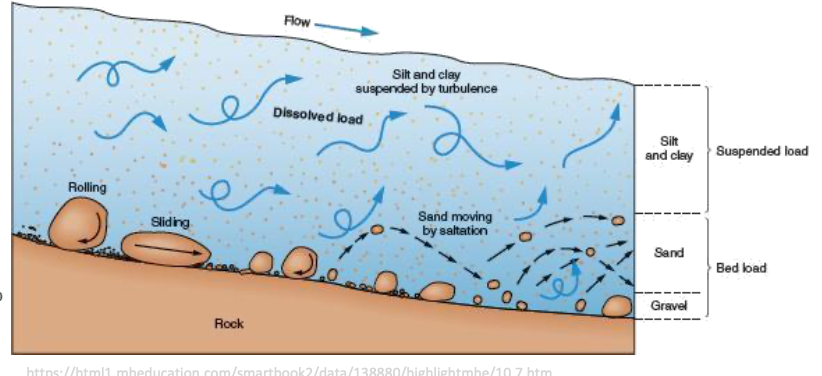
Saltation
EROSION & TRANPO (FLUVIAL PROCESSES):
small sediments that bounce along the streambed
Traction
EROSION & TRANPO (FLUVIAL PROCESSES):
large sediments that roll and slide along the streambed
Stream Capacity
EROSION & TRANPO (WATER TYPES):
measure of the total sediment a stream can carry;
higher sediment load capacity?

Stream Competence, higher
EROSION & TRANPO (WATER TYPES):
maximum size of particles a stream can transport;
_____ competence, larger grain size

Suspension
EROSION & TRANPO (WIND/AEOLIAN TYPES):
fine sediments suspended by turbulence
saltation
EROSION & TRANPO (WIND/AEOLIAN TYPES):
small sediments that bounce along the bottom
Traction
EROSION & TRANPO (WIND/AEOLIAN TYPES):
large sediments that roll and slide along the bottom
Glacial sediments (till)
EROSION & TRANPO (ICE):
these may be derived by plucking and abrasion along the rock-glacier interface, or by deposition from mass wasting and supraglacial streams
unsorted and unstratified sediment deposited directly by moving glacial ice without being reworked by meltwater

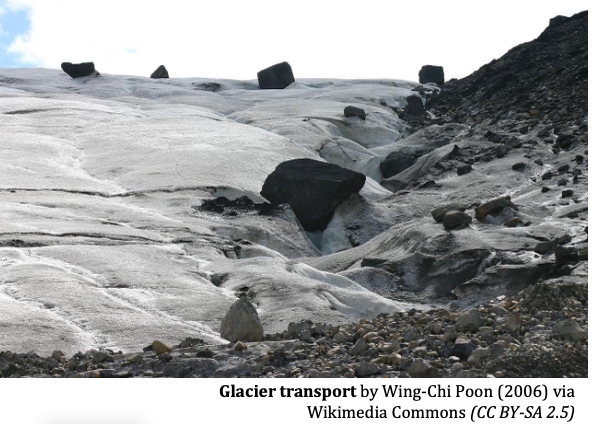
Glaciers
EROSION & TRANPO (ICE):
they may carry sediments as an internal load, or as a surface load
Sediments
EROSION & TRANPO:
unconsolidated earth materials broken down or produced by weathering that can be small grains of rocks, minerals and plant-animal remains
size, shape, arrangement
SEDIMENT TEXTURE:
sediment texture refers to ____, ____, & ____ of constituent particles & the void spaces in between;
used in classification and interpretation
grain size, sorting, roundness and angularity

very poorly sorted
SEDIMENT TEXTURE (SORTING):
this is the texture where there’s a wide range of different sizes
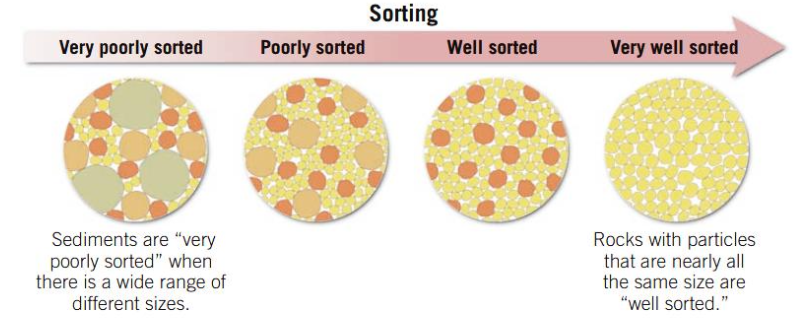
very well sorted
SEDIMENT TEXTURE (SORTING):
this is the texture of rocks with particles that are nearly all the same size
inversely proportional
SEDIMENT TEXTURE (GRAIN SIZE):
the relationship between transport distance & energy + grain size is _____ proportional

direct relationship, normal grading
SEDIMENT TEXTURE (GRAIN SIZE):
a ______ relationship is observed for turbidity currents, which loses energy as it proceeds downslopes (lower grain size, lower energy);
as such, turbidities exhibit _____ grading (fining upward).

direct
inverse
inverse
SEDIMENT TEXTURE RELATIONSHIPS:
transport distance & roundness
transport distance & angularity
angularity & roundness

directly proportional
SEDIMENT TEXTURE RELATIONSHIPS:
rs between transport distance & sorting
deposition
SEDIMENTARY PROCESSES:
Sediments settle and laid down into layers due to loss of kinetic energy
diagenesis
SEDIMENTARY PROCESSES:
Suite of low temperature processes that affect sediments after deposition, accumulation & burial below low-grade metamorphism conditions
includes lithification & modification
lithification
SEDIMENTARY PROCESSES (DIAGENESIS):
transformation of loose sediments to sedimentary rocks that involves porosity reduction via compaction and cementation
modification
SEDIMENTARY PROCESSES:
changes in texture & mineralogy of sediments
compaction
SEDIMENTARY PROCESSES (LITHIFICATION):
pressing of grains due to increasing pressure from overburden causing the expulsion of intergranular fluids & increase in attractive forces between grains
Cementation
SEDIMENTARY PROCESSES (LITHIFICATION):
precipitation of minerals in pore spaces that bind or cement grains from subsurface fluids
Recrystallization
SEDIMENTARY PROCESSES (DIAGENESIS):
unstable minerals undergo changes in their crystal structures to attain equilibrium (ex. aragonite to calcite)
Replacement
SEDIMENTARY PROCESSES (DIAGENESIS):
new minerals are formed by altering the composition of existing minerals, or completely fills voids left by dissolution
Dissolution
SEDIMENTARY PROCESSES (DIAGENESIS):
unstable minerals are broken down into ions, which are leached away by pore fluids
Bioturbation
SEDIMENTARY PROCESSES (DIAGENESIS):
the disturbance of sediments or rocks by burrowing organisms
Strata
SEDIMENTARY STRUCTURES:
layers of sediments
Beds, lamination
TYPES OF STRATA:
greater than 1 cm thick strata; represent longer-term or larger-scale depositional events, pulses of sediment supply, or major changes in current strength and climate over decades to thousands of years
less than 1 cm thick strata; low-energy environments (such as deep lake bottoms, quiet marine basins, or below wave base) where fine-grained particles like silt and clay settle slowly out of suspension

sedimentary rocks
these are composed of sediments that undergo lithification by compaction and cementation
chemical sedimentary rocks
composed of minerals that form in-situ (by precipitation from a solution) and accumulate and bind into a ____ sedimentary rock;
Described based on composition and texture
detrital, biochemical/bioclastic
TYPES OF SEDIM ROCKS:
rock & mineral fragments
shells & plant material

Composition
CLASSIFICATIONS OF SEDIM ROCKS:
sedimentary rocks may be made up of detrital grains (siliciclastic rock and mineral fragments), biochemical grains, and other common minerals
Grain Size
CLASSIFICATIONS OF SEDIM ROCKS:
used for sedimentary rocks composed of detrital or biochemical clasts

microcrystalline
macrocrystalline
TEXTURES (GRAIN SIZE):
refers to when crystals are not visible under 10x hand lens
crystals are visible under 10x hand lens

roundness
sphericity
TEXTURES (SHAPE):
absence of angular corners in a grain; opposite of angularity
refers to how close a grain’s shape is to a sphere

sorting
TEXTURES:
describes how uniform the grain sizes are in a sediment sample

sandstone, shale, siltstone, chert breccia, quartz pebble conglomerate
examples of detrital sedimentary rocks
coquina, limestone, chalk, coal, lignite, peat
examples of biochemical/bioclastic sedimentary rocks
limestone, stalactite, dolostone, flint, rock gypsum
examples of chemical sedimentary rocks
geologic history
SEDIMENTARY ROCK IMPORTANCE:
record of the Earth’s past life, environment, climate, tectonics and major events at the surface;
relative dating of rocks
hydrocarbons, building materials, industrial materials, food additives, groundwater
SEDIMENTARY ROCKS IMPORTANCE:
______ (oil, natural gas, coal and Uranium deposits)
______ materials (cement and aggregates)
______ materials (plaster, fertilizer and glass)
____ additives like salt
_______ in aquifers