Lab Practical

0.0(0)
Studied by 0 people
call kaiCall Kai
learnLearn
examPractice Test
spaced repetitionSpaced Repetition
heart puzzleMatch
flashcardsFlashcards
GameKnowt Play
Card Sorting

1/13

encourage image

There's no tags or description

Looks like no tags are added yet.

14 Terms

1
New cards

Limiting reactant

The limiting reactant is the reactant that runs out first.

It determines how much product can form.


How to find it:

  1. Balance the chemical equation.

  2. Convert each reactant's mass into moles.

  3. Use the mole ratio to calculate how much product each reactant could produce.

  4. The reactant producing the smaller amount of product is the limiting reactant.


<p>The limiting reactant is the reactant that runs out first.</p><p>It determines how much product can form.</p><p></p><p><strong>How to find it:</strong></p><ol><li><p>Balance the chemical equation.</p></li><li><p>Convert each reactant's mass into moles.</p></li><li><p>Use the mole ratio to calculate how much product each reactant could produce.</p></li><li><p>The reactant producing the smaller amount of product is the limiting reactant.</p></li></ol><p></p>
2
New cards

Theoretical yield

The maximum amount of product you could produce if the reaction were 100% efficient.

It is calculated using the limiting reactant

<p>The maximum amount of product you could produce if the reaction were 100% efficient.</p><p>It is calculated using the limiting reactant</p>
3
New cards

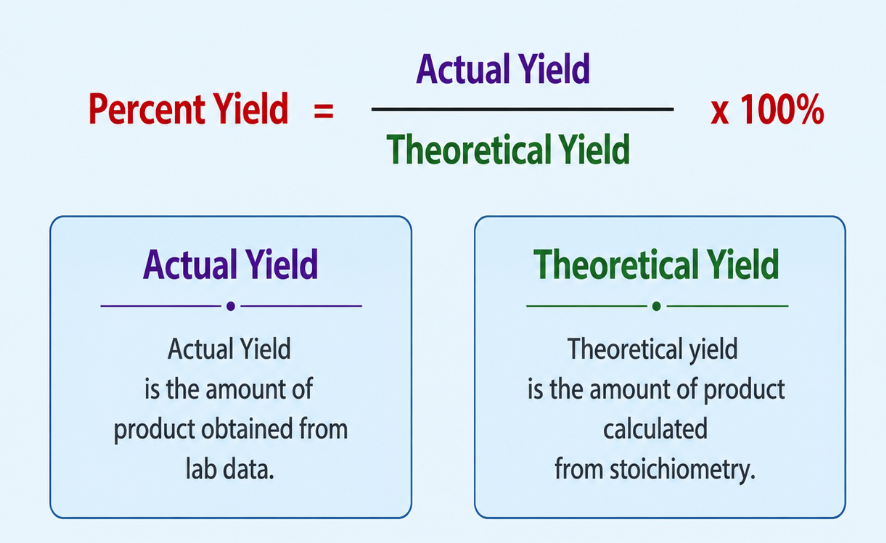
Actual yield

The amount of product you physically obtain in the laboratory
<p>The amount of product you physically obtain in the laboratory</p>
4
New cards

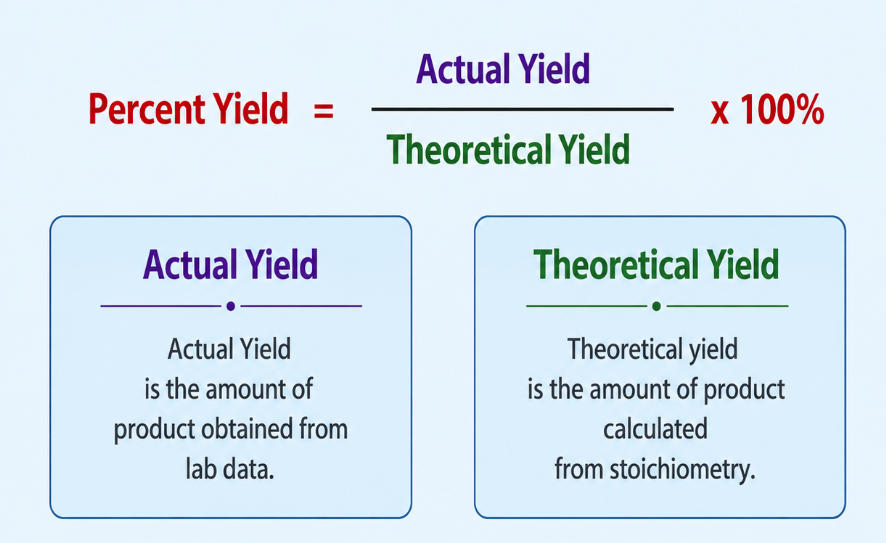
Percent Yield

Measures how efficiently a chemical reaction produces the desired product
<p>Measures how efficiently a chemical reaction produces the desired product</p>
5
New cards

What is melting point?

The temperature range over which a solid changes into a liquid
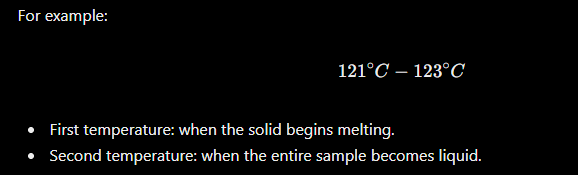
<p>The temperature range over which a solid changes into a liquid</p>
6
New cards

How do you determine melting point?

  1. Place a small amount of dry solid into a capillary tube.

  2. Pack the solid at the bottom of the tube.

  3. Place the capillary tube into the melting point apparatus.

  4. Heat the sample.

  5. Observe when melting begins.

  6. Record the temperature when the entire sample has melted.
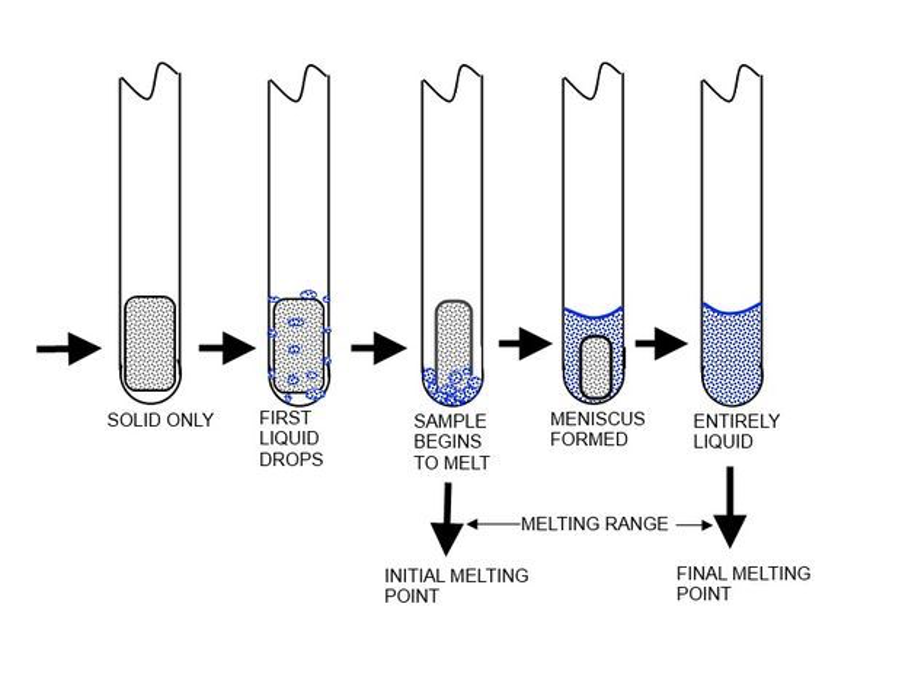

<ol><li><p>Place a small amount of dry solid into a capillary tube.</p></li><li><p>Pack the solid at the bottom of the tube.</p></li><li><p>Place the capillary tube into the melting point apparatus.</p></li><li><p>Heat the sample.</p></li><li><p>Observe when melting begins.</p></li><li><p>Record the temperature when the entire sample has melted.</p></li></ol><p></p>
7
New cards
8
New cards

What does purity have to do with melting point?

A pure compound generally has:

  • A narrow melting point range.

  • A melting point close to its literature value.


An impure compound generally has:

  • A lower melting point.

  • A broader melting point range.


<p>A pure compound generally has:</p><ul><li><p>A narrow melting point range.</p></li><li><p>A melting point close to its literature value.</p></li></ul><p></p><p>An impure compound generally has:</p><ul><li><p>A lower melting point.</p></li><li><p>A broader melting point range.</p></li></ul><p></p>
9
New cards

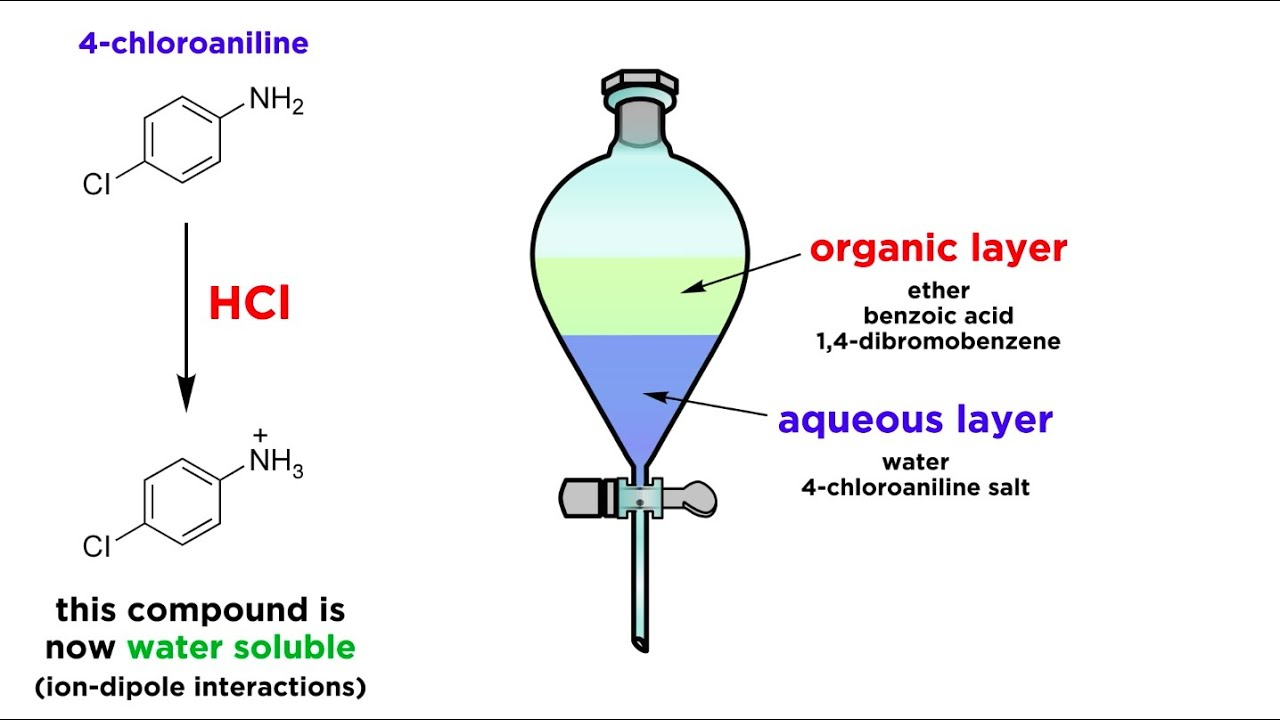
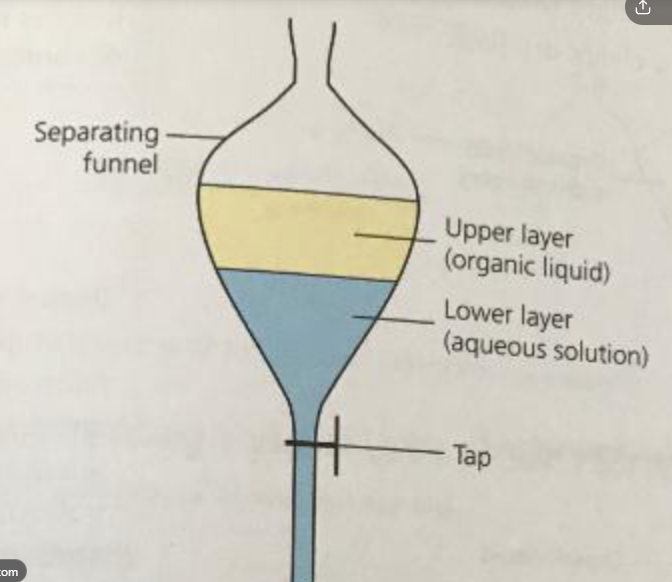
What is extraction?

Extraction is a technique used to separate compounds based on their different solubilities in two immiscible liquids with separatory funnel.


Usually, we use:

  • An aqueous layer (water-based).

  • An organic layer (organic solvent).


<p>Extraction is a technique used to separate compounds based on their different solubilities in two immiscible liquids with separatory funnel.</p><p></p><p>Usually, we use:</p><ul><li><p>An aqueous layer (water-based).</p></li><li><p>An organic layer (organic solvent).</p></li></ul><p></p>
10
New cards

What is miscibility?

Miscibility means the ability of two liquids to mix together and form one uniform solution.

<p>Miscibility means the ability of two liquids to mix together and form one uniform solution.</p>
11
New cards

How do you determine the aqueous layer in octane and water?

Water has a density of approximately 1.00 g/mL.

Octane has a density of approximately 0.70 g/mL.

Therefore:

  • Top layer = octane (organic layer).

  • Bottom layer = water (aqueous layer).


<p>Water has a density of approximately 1.00 g/mL.</p><p>Octane has a density of approximately 0.70 g/mL.</p><p>Therefore:</p><ul><li><p>Top layer = octane (organic layer).</p></li><li><p>Bottom layer = water (aqueous layer).</p></li></ul><p></p>
12
New cards

What is washing a layer?

Washing means adding another liquid to a layer to remove unwanted impurities.

<p>Washing means adding another liquid to a layer to remove unwanted impurities.</p>
13
New cards

What is anhydrous magnesium sulfate used for?

Anhydrous MgSO₄ = drying agent

It removes small amounts of leftover water from an organic layer.

It absorbs water to form hydrated magnesium sulfate.

Remember: It dries the organic layer. It does NOT remove the organic solvent

14
New cards

Why does the acid move into the aqueous layer?

Because NaOH converts it into an ionic, water-soluble salt
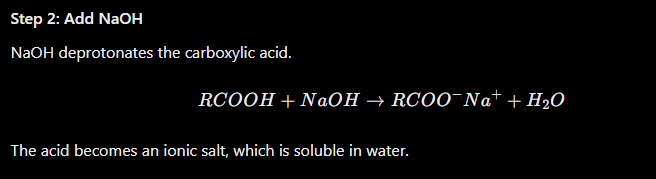
<p>Because NaOH converts it into an ionic, water-soluble salt</p>