Mutations
 Call Kai
 Learn
 Practice Test
 Spaced Repetition
 Match
 Flashcards
 Knowt Play
1/7

There's no tags or description
Looks like no tags are added yet.
8 Terms
Mutation
‣ A change to the base sequence of DNA.
Mutagenic agent
A factor that increases the mutation rate.
‣ Mutations are spontaneous, only the rate of mutation is affected by the environment.
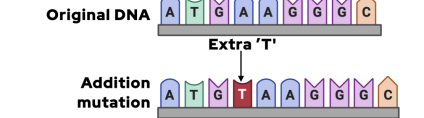
Addition mutation
When one or more bases are added to the DNA sequence.
‣ Causes a frameshift.
‣ Changes the entire amino acid sequence downstream of the mutation.
‣ More likely to be harmful (or beneficial) as opposed to neutral
because more likely to change the tertiary structure of the protein.
Deletion mutation
When one or more bases are deleted from the DNA sequence.
‣ Causes a frameshift.
‣ Changes the entire amino acid sequence downstream of the mutation.
‣ More likely to be harmful (or beneficial) as opposed to neutral
because more likely to change the tertiary structure of the protein.

Substitution mutation

When one or more bases are swapped for one another.
More likely to be a neutral mutation due to the degenerate nature of the genetic code.
Neutral / silent mutations
‣ No effect on the phenotype of the organism because the functioning protein is still produced.
‣ Most likely following a substitution mutation because only one triplet code is changed (i.e. there is no frameshift).
‣ Due to the degenerate nature of the genetic code, a substitution mutation may not change the amino acid coded for by the triplet.
‣ Even if the mutation does code for a different amino acid, the
amino acid may not be involved with the protein’s function & so
the protein is still functional.
Harmful/beneficial mutations
Mutations which cause a frameshift are more likely to result in harmful or beneficial mutations.
‣ Changes the amino acid sequence downstream of the mutation.
‣ So changes the sequence of R groups.
‣ So changes the type & position of bonds.
‣ So changes the tertiary structure of the protein.
‣ Can result in a protein which is non-functional (which generally has
a harmful effect on the organism) OR a protein which now
functions better (generally beneficial to the organism).
Why are errors in DNA replication more damaging than errors
in transcription?
‣ Errors in DNA replication can be passed onto daughter cells / offspring → so can have a permanent effect.
‣ Errors in transcription only affect a small number of mRNA molecules, so only affect a small number of proteins. Most mRNA’s produced will not have the error.