art exam 2
 Call Kai
 Learn
 Practice Test
 Spaced Repetition
 Match
 Flashcards
 Knowt Play
1/18

There's no tags or description
Looks like no tags are added yet.
19 Terms

Great Serpent Mound
300 BC
Ohio, United States
Ancient North America
Serpents held important spiritual significance in many Indigenous North American traditions.
Often associated with water, fertility, renewal, transformation, and the supernatural.
Could represent connections between the earthly world and the spiritual or underworld realm.
The Indigenous communities of the surrounding region, likely serving as a communal sacred site rather than a monument dedicated to one chief or ruler.
ohio river valley

Monk’s Mound
900 CE
Cahokia, Illinois
Ancient North America
comes from one of largest urban centers in Ancient NA
The largest earthen mound at Cahokia and the largest prehistoric earthen structure in the Americas.
Covers approximately 15 acres and originally stood over 100 feet tall.
Likely served as a major political and religious center.
Important leaders or religious authorities may have occupied the summit.
Elevating important buildings above the city physically demonstrated the power and status of those who occupied them.
The mound was surrounded by smaller mounds and large public plazas.
surrounded by a massive wooden palisade (a defensive wall made from upright logs). may have served defensive purposes, but also could have separated the central ceremonial and elite areas from surrounding spaces.
A large building or ceremonial structure stood on its summit.
surrounded by smaller auxiliary mounds

The Etowah Figures
1000 CE
Etowah, Georgia
Ancient North America
found in mound c, elite burial ground for high-status individuals
made of marble (luxurious) used to communicate status and importance
suggests both male and female hold important positions in Mississippian religious.political life
carved using stone tools, demonstrating advanced technique
originally painted

The Olmec
1000 BCE
La Venta, Villa La Venta, Tabasco, Mexico
Olmec
Likely portraits of historically sig. People
Detailed headgear
Made of basalt (volcanic stone) quarried way far away
Would have weighed several tons
Carved w/ stone tools
Naturalistic, curvilinear forms characteristic of olmec style

“Throne”
800 BCE
La Venta, Villa La Venta, Tabasco, Mexico
Olmec
Figure sitting cross legged holding rope
Where rituals took place
Face carved above
Caves had mysteriousness, sacred entrances to the underworld
Textiles were important (weaving), important cultural practice
Underworld is “knotted” - assoc. w. organization of the universe

Moon Pyramid
200 BCE
Central Mexico
Teotihuacan
Designed to visually interact with the mountain behind it (Cerro Gordo)
Its relationship with the mountain creates an illusion that changes as viewers approach.
Mountains assoc. with fertility, water, origins of life
nature + cosmology = arch
most likely used for religious ceremonies
Contained ceremonial offerings.
Part of a carefully planned urban and religious landscape centered around astronomical alignment

San Bartolo North Wall Mural
300 BCE
Las Pinturas Temple, San Bartolo, Guatemala
Maya
Earliest Mayan paintings discovered
Eye level, meant to be seen and present everyday life
Road matches road in topography
Images ground myths in everyday life, religion tied to every day life
Organic style, detail, more naturalistic and less angular than Teotihuacan, detailed anatomy, less rigid, vibrant pigments
Procession showing mythological scene assoc. with Maize God important deity
No battles, only religious scenes
Unique style more similar to Olmec/Teotihuacan

Tomb of Jasaw Chan K’awiil
734 CE
Tikal Temple I, Tikal, Guatemala
Maya
powerful Maya king of Tikal
burying rulers in monumental pyramids connected political authority with religions beliefs + landscape
9 levels, underworld understood to have nine levels, may connect king to spiritual universe and life after death
priests had to climb, separation of ordinary space and sacred
hieroglyphic inscriptions
religious temple for ceremonies

The Yaxchilan Lintel 24
723 CE
Structure 23, Yaxchilán, Chiapas, Mexico
Maya
Set above doorway, encountering as entering building
Was painted
Shows bloodletting ritual - idea of penance, rulers taking care of people, rejuvenation of universe and balance
Ruler and wife pulling thorned cord through tongue
Hieroglyphs saying exact events and date, took place 20 years earlier
Signature of artist in more faint glyph
Representation of textiles - huipil (elabortately patterned, worn by women)
Diamonds represent cosmic model
Textiles were important indicators of identity, status, and cultural traditions.
Rope could have symbolized, life, umbilical cord, underworld
life, birth, and the continuation of existence

Tenochitlan
1519
Tenochtitlan (present day Mexico City), Central Mexico
Aztec
Tenochtitlan means “Place among the prickly pear cacti.”
Built on an island in Lake Texcoco; became a wealthy, densely populated city.
Based on the founding myth: the Mexica were told to establish their city where they saw an eagle perched on a cactus.
Architecture recreated sacred natural landscapes and mythological places.
Temples were designed to bring mythological spaces into the physical world.
he Aztecs developed chinampas (artificial agricultural plots built in shallow lake areas) to grow crops and support their large population. and canals
Built causeways (raised roads) connecting the island city to the mainland, adapt city to lake environment
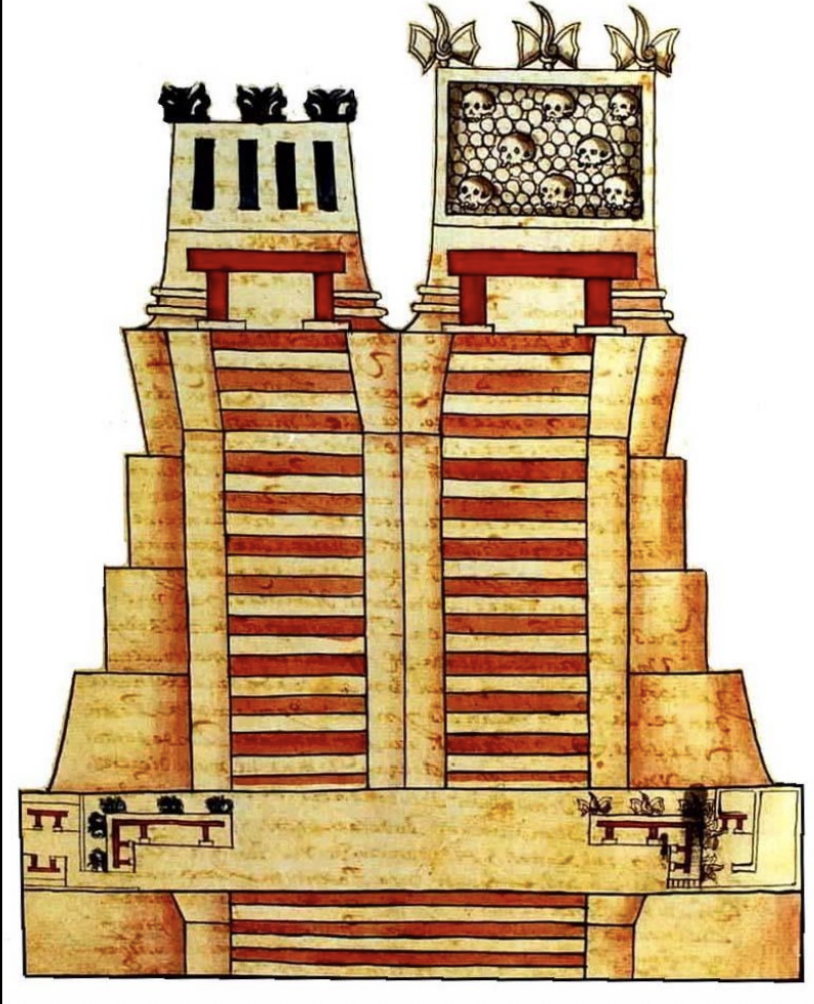
Templo Mayor
1300 CE
Tenochtitlan, Central Mexico
Aztec
It had two shrines at the top, representing two important gods:
Tlaloc: God of rain and agriculture; associated with water, fertility, and crops.
Huitzilopochtli: Patron god of the Mexica and god of war.
The temple was designed to recreate Coatepec, the sacred mountain from Huitzilopochtli's birth myth.
found offerings and sacrificial remains in deposits beneath and around
believed that the universe required offerings to sustain its existence and maintain cosmic equilibrium
Warfare could be understood as a reenactment of divine conflicts
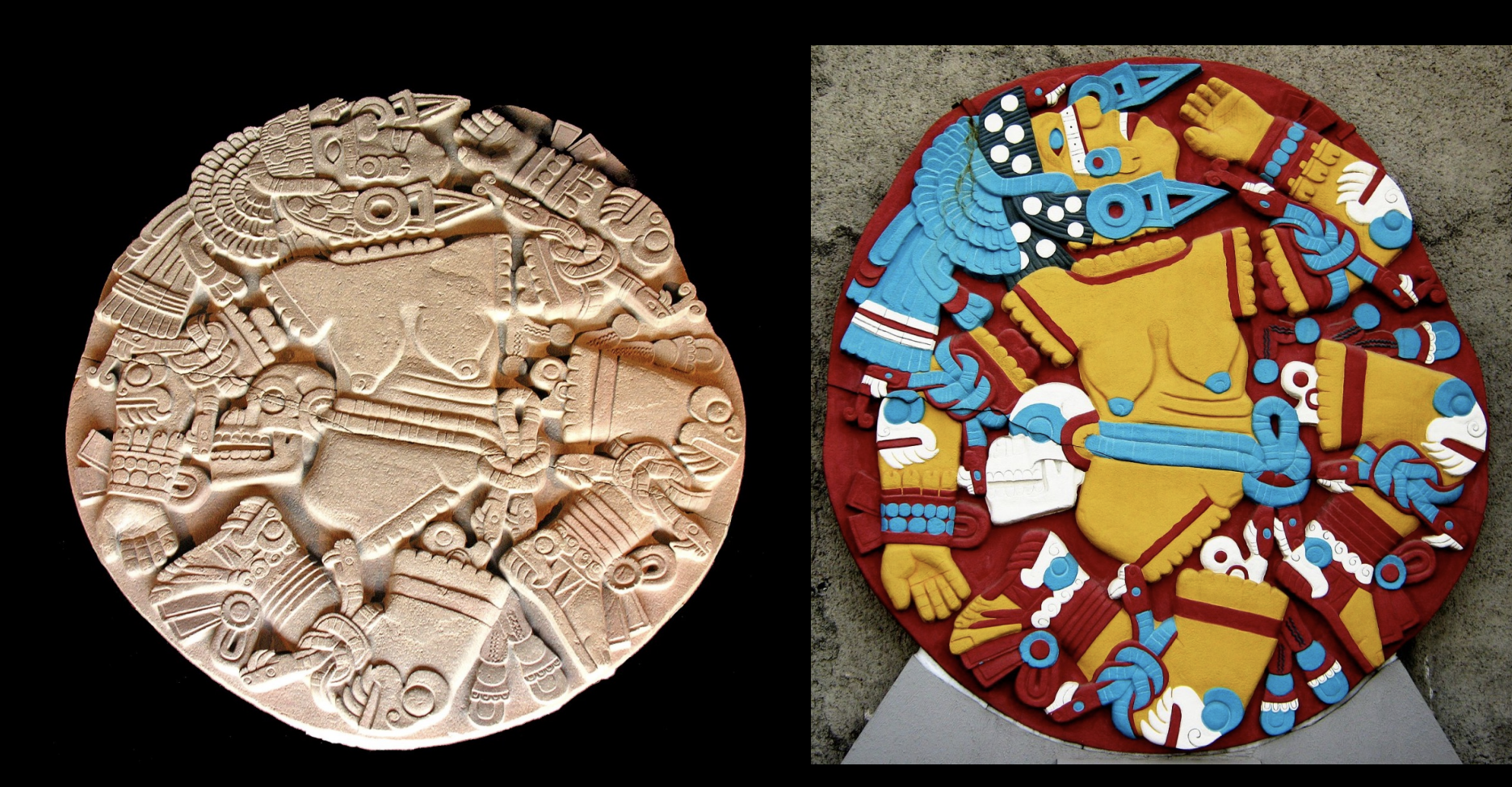
Coyolxāuhqui
1473 CE
Tenochtitlan, Central Mexico
According to the myth, she led her siblings in an attempt to kill their mother, Coatlicue, because she was pregnant with Huitzilopochtli.
Coyolxauhqui and throwing her body down the mountain Coatepec.
Sacrificial victims brought to the top of the temple could be associated with this mythological scene as they descended or were deposited at the base
cosmic order
mythology to reality

The “Calendar Stone”
1503 CE
possibly Palace of Moteuczoma II, Tenochtitlan, Central Mexico
Aztec
Central face traditionally interpreted as Tonatiuh (sun god).
Newer interpretation suggests it may represent Moctezuma II embodying Huitzilopochtli.
Hieroglyphs may identify both the ruler and the god.
Could communicate the ruler's divine authority and connection to cosmic power.
Possible placement near the palace would reinforce the palace as a center of political and religious authority.
maybe on platform

Pyramids at Meroë
337 BCE
Sudan, Africa
Nubian
Its location attracted merchants and encouraged cultural exchange, especially with Egypt.
Built as burial monuments for Nubian rulers.
Steeper and narrower than Egyptian pyramids.
Characteristic decorated entrance arrangements, including the H-shaped entrance noted in your lecture.
Brickwork is less smooth and polished than Egyptian pyramid construction.
More elaborate entrance decoration.
The entrance may represent a passage between the human world and the afterlife.
Their pyramid faces were often decorated with relief carvings showing religious scenes and funerary imagery.

Colossal statue of king Aspelta
593 BCE
Sudan, Egypt
Nubian
Twice life-size: The enormous scale emphasizes Aspelta's importance
Egyptian influence:
Uses the traditional upright, formal posture associated with Egyptian pharaohs.
Reflects the close historical and cultural relationship between Nubia and Egypt.
Nubian identity:
His clothing includes a distinctive draped cord across his shoulders.
This helps distinguish Nubian royal dress from traditional Egyptian royal clothing.

(Djenne Style) Equestrian Figurine
1300 CE
Smithsonian National Museum of African Art, Washington, DC
Mali Empire
Coiled-clay technique: Made by building the figure from coils of rolled clay, then carving details into the surface and firing it.
Stylized appearance:
Narrow, elongated oval head.
Distinctive pointed, oval-shaped eyes.
Elongated and somewhat exaggerated body proportions.
Detailed clothing: Clothing, armor, and accessories are carefully carved, showing the importance of dress and status.

Head
from Nok, Nigeria, now in National Museum Lagos, Nigeria
500 BCE
Nok region
One of the earliest known traditions of figurative sculpture in West Africa.
Triangular eyes: Distinctive feature of Nok sculpture; gives the face a stylized appearance.
Stylized features: Facial proportions are simplified or exaggerated rather than realistically represented.
Perforations (small holes): Carved into the sculpture to allow air to circulate during firing.
Without holes, trapped moisture and air could cause the clay to crack or explode in the kiln.
Intentional abstraction: The artist wasn't necessarily trying to create an exact, realistic human face. The distinctive proportions and shapes were an artistic choice.
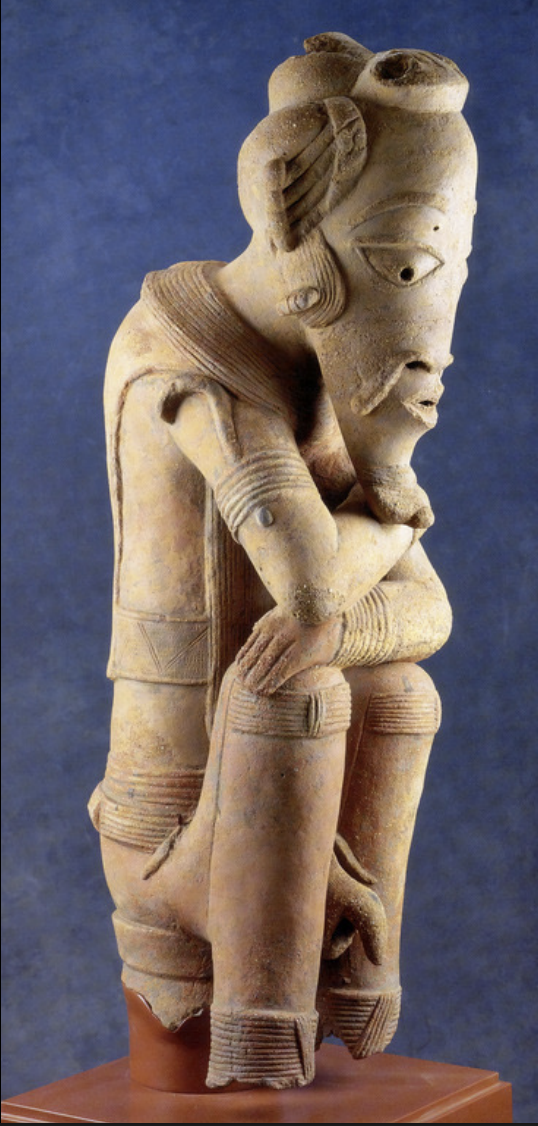
Seated Figure in Ceremonial Garb
600 BCE
Nok, Nigeria
Nok region
Stylized: Does not aim for realistic human proportions.
Elongated body: Has a lanky, narrow appearance with a long oval head.
Coiled appearance: Similar to other Nok and Djenné figures, with an emphasis on elongated forms.
Ceremonial clothing: Detailed garments suggest the figure may have held an important social or religious position.
Contemplative expression: Despite its abstract proportions, the figure has a recognizable human quality and appears thoughtfu
Shows that stylized art can still communicate human emotion and personality.
Similar to Hellenistic art in its interest in creating an emotional response in the viewer.
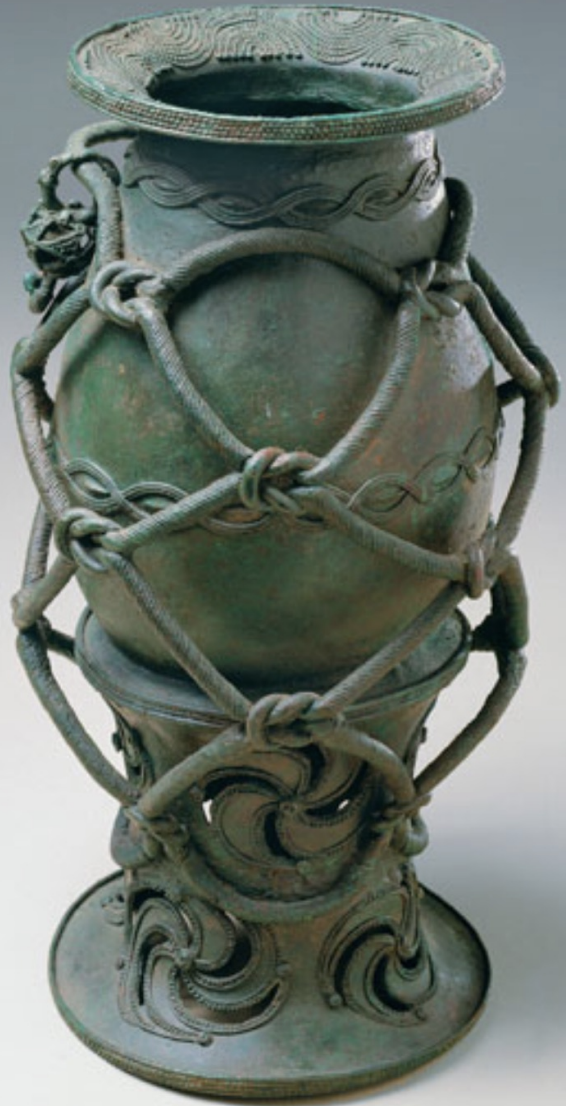
Roped Pot on A Stand
900 CE
Igbo-Ukwu, Nigeria
Demonstrates that West African societies had advanced metalworking traditions long before European colonial contact.
Lost-wax casting:
Artist creates a model out of wax.
Covers it with clay to create a mold.
Heats the mold, melting and removing the wax.
Pours molten metal into the empty space.
Breaks the mold to reveal the finished metal object.
This technique allows artists to create extremely intricate shapes and details.
Skeuomorph: An object made from a different material but designed to imitate the appearance of another material or object.
ceremonial/symbolic rather than functional like Narmer pallette