L27/28 - high yield
 Call Kai
 Learn
 Practice Test
 Spaced Repetition
 Match
 Flashcards
 Knowt Play
1/182

There's no tags or description
Looks like no tags are added yet.
183 Terms
Both gram positive and gram negative bacteria display
natural competence:
Bacillus subtilis - is this gram + or - ?
Would it display natural competence?
Gram-positive (+)
yes
Haemophilus influenzae - is this gram + or - ?
Would it display natural competence?
Gram-negative (−)
yes
Neisseria gonorrheae - is this gram + or - ?
Would it display natural competence?
Gram-negative (−)
yes
Streptococcus pneumoniae - is this gram + or - ?
Would it display natural competence?
Gram-positive (+)
yes
Synechococcus - is this gram + or - ?
Would it display natural competence?
Gram-negative (−)
yes
single, large, covalently closed molecule of double stranded DNA
some bacterial species have linear chromosomes
contains all essential genes
size varies
bacterial chromosome:
supercoiled, circular, and double strainded
replicate independently of chromosome
Plasmid DNA
functions of the plasmid DNA in bacterial cells?
Which one is required for adherence/colonization?
pathogenicity or survival under special conditions
production of toxins
synthesis of cell structure - required for adherence or colonization
What are the types of plasmids and thier associated functions
F plasmid - fertility factors or conjugative plasmids
R plasmid - drug resistance factors
Col plasmids - bacteriocins - proteins that kill bacteria
DNA that arises through infection with a template phage whos viral production is repressed
stable phage DNA
________: Uptake of extracellular DNA by bacteria from the environment
Transformation
_______: Transfer of DNA mediated by bacterial viruses (bacteriophages), no direct contact between bacteria
Transduction
types of transduction?
Generalized and specialized
________: Transfer of DNA by direct donor-recipient contact
Conjugation
________: Naturally transformable bacteria (gram positive and negative) that can take up DNA from the environment.
Natural Transformation
Q: What are the three purposes of natural competence?
A: Diversity, repair, and nutrition.
Q: What two factors characterize DNA uptake during natural transformation?
A: Efficiency and specificity.
what are the 4 determinints of natural transformation?
______ ______ factor
Specific ________
_________ polypeptides
_______ to increase cell permeability
Labile competence factor
Specific endonuclease
DNA-binding polypeptides
Autolysin to increase cell permeability
who was the research who worked on the transforming principle of DNA
Griffith
in Griffiths transforming principle (DNA):
What happened to the mouse when when the mouse was injected with living encapsulated bacteria?
What happened to the colonies?
mouse - died
colonies - isolated from dead mouse
in Griffiths transforming principle (DNA):
What happened to the mouse when living nonencapsulated bacteria was injected into the mouse?
What happened to the colonies?
mouse - healthy
colonies - isoloated from mouse; controlled prolifieration via phagocytes
in Griffiths transforming principle (DNA):
What happened to the mouse when heat-killed encapsulated bacteria was injected into the mouse?
What happened to the colonies?
Mouse - healthy
Colonies - no colonies were isolated
in Griffiths transforming principle (DNA):
What happened to the mouse when living nonencapsulated and heat-killed encapsulated bacteria injected into the mouse?
What happened to the colonies?
mouse - died
colonies - isolated from dead mouse
what is transforming principle (shown from mice)? Who was the scientist behind it?
Griffith - the initial idea that the poly sach capsule/protein was being transferred
What did avery and mcgardy show about the transforming principle?
DNA is the genetic material that is being transformed.
DNA carries the genes for coding the capsule.
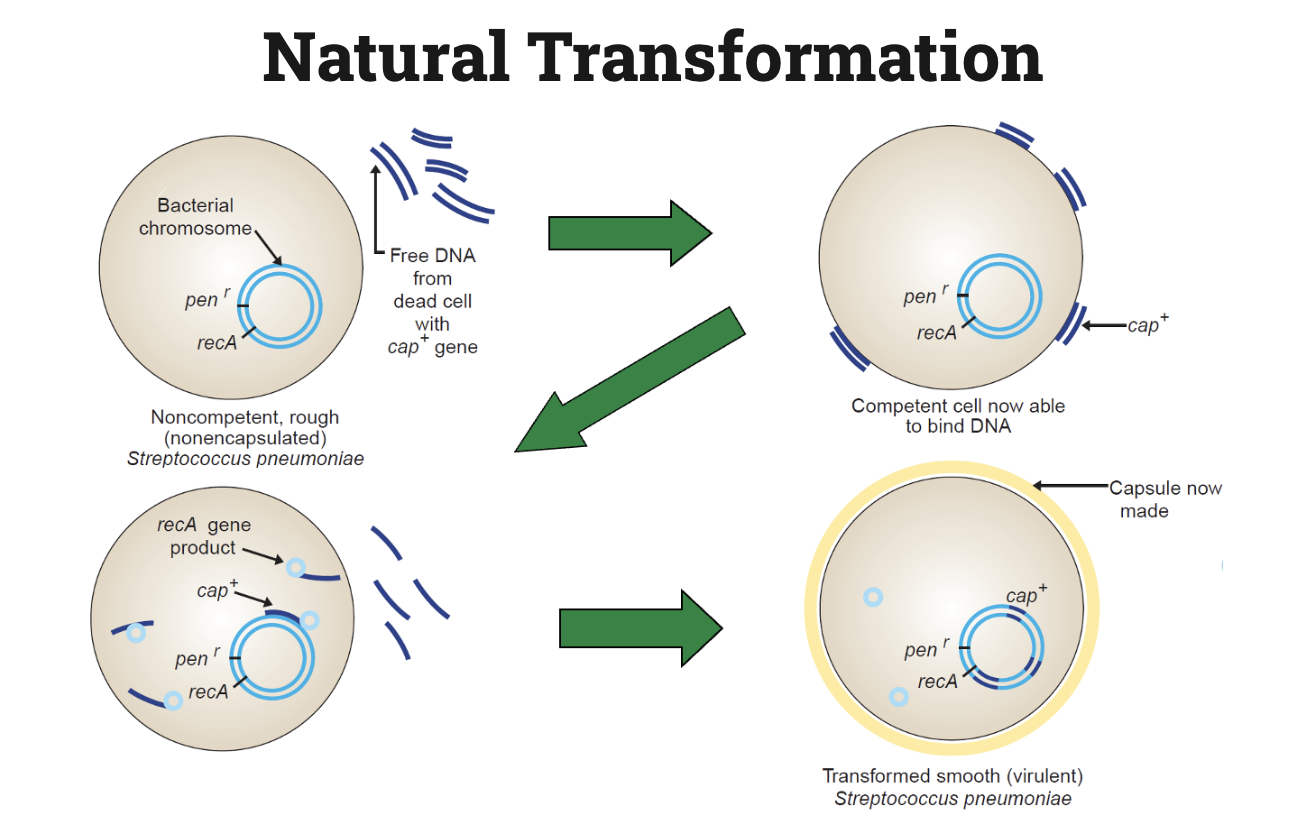
In natural transformation, when does the bacteria become competent?
How does the bacterial cell initially start

When there is free DNA available from dead cells with cap+ gene
(starts out rough and with no capsule)
In natureal transformation, the bacteria will eventually start to produce enzymes. What will cut the free DNA in the enviornment into smaller pieces?
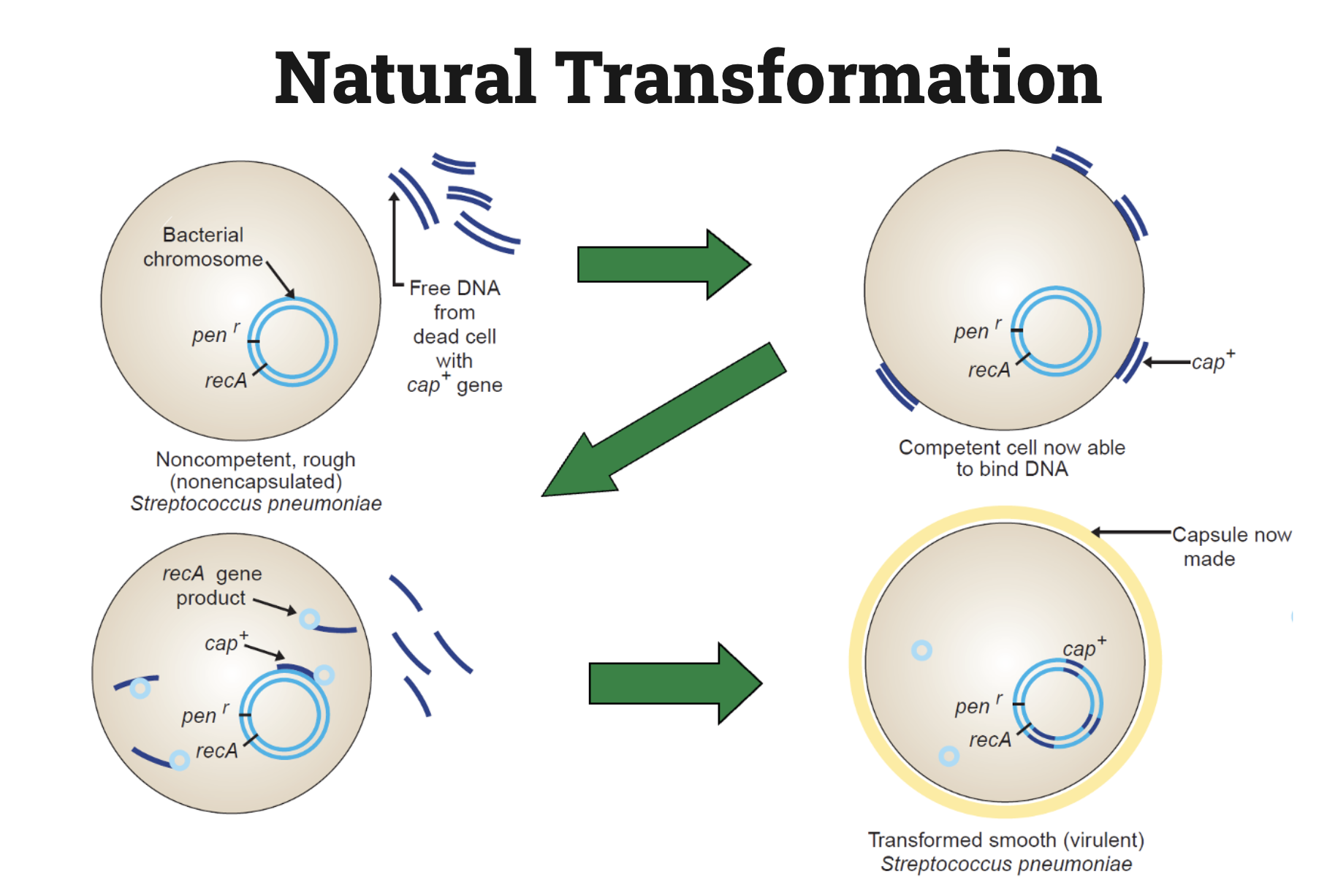
A specific endonuclease
What does exonuclease do in natural transformation?
Degrades one of the strands, causing a sungle strand to enter the bacterial cell
what increases cell permiability to protect incoming single stranded DNA from nucleases in natural transformation?
autolysin
The cap+ gene is transformed → ______ after autolysin
smooth (last step)
Q: How does natural transformation increase virulence in Streptococcus pneumoniae?
A: The bacteria take up the cap⁺ gene from free DNA, allowing them to produce a capsule and transform from rough (nonvirulent) to smooth (virulent) bacteria.
What are the 4 phases of the bacterial growth curve, in order?
A: Lag → Exponential (Log) → Stationary → Decline (Death)

What happens during the lag phase of the bacterial growth curve?
Lag Phase: Bacteria adapt to the environment; little to no cell division
What happens during the exponential (log) phase of the bacterial growth curve?
Exponential (Log) Phase: Bacteria rapidly divide, causing exponential growth
What happens during the stationary phase of the bacterial growth curve?
Stationary Phase: Bacterial growth equals bacterial death; population remains stable
What happens during the decline phase of the bacterial growth curve?
Decline (Death) Phase: Bacterial death exceeds growth; population decreases due to lack of nutrients/space or by its own waste.
_______: Naturally transformable bacteria become competent to take up DNA late in their growth cycle
Competence
________: Two-component regulatory system; Controls gene ______ in response to fluctuations in cell-population density
Quorum Sensing; expression
Q: What are competence pheromones?
Small peptides secreted by bacteria as they multiply.
Q: How does bacterial cell density affect quorum sensing?
Low cell density = ?
High cell density = ?
Low cell density: Low concentration of competence pheromones → Individual behaviors.
High cell density: High concentration of competence pheromones → Group behaviors.
Q: What is the ComX pheromone pathway that regulates competence in Bacillus subtilis?
ComX pheromone is released and recognized by ComP (histidine kinase sensor).
ComP becomes phosphorylated (ComP-P).
ComP-P phosphorylates ComA (response regulator).
ComA-P activates the srfA gene, which turns on competence genes.
Pathway: ComX → ComP → ComP-P → ComA-P → srfA → Competence genes

Q: What are the three components of the two-component regulatory system in Bacillus subtilis?
ComP: Histidine kinase sensor.
ComA: Response regulator that activates the srfA gene (competence genes).
ComX: Competence pheromone that initiates the signaling pathway.
Q: What is the relationship between CSF concentration, competence, and sporulation in Bacillus subtilis?
CSF: ?
Low CSF (2–8 µM): Promotes ______.
High CSF (>20 µM): Promotes ______.
CSF: Competence sporulation factor; enters through Spo0K permease and promotes ComA-P activation.
Low CSF (2–8 µM): Promotes competence.
High CSF (>20 µM): Promotes sporulation.
H. influenzae takes up double-stranded DNA in subcellular compartments called?
transformasomes
Q: What are transformasomes in Haemophilus influenzae?
A: Subcellular compartments that take up double-stranded DNA during natural transformation.
Q: What happens to DNA after it is taken up by transformasomes in Haemophilus influenzae?
Double-stranded DNA is taken up by transformasomes.
One DNA strand is degraded as it enters the cytoplasm.
The remaining strand invades the bacterial chromosome.
The incoming strand displaces one strand of the bacterial chromosome.
Plasmids must be ______-stranded to replicate and must ______.
double; recyclize
Q: How can multiple copies of plasmid DNA regenerate an intact plasmid during transformation?
A:
Multiple copies of the same plasmid DNA enter a single bacterial cell.
Overlapping single-stranded plasmid molecules hybridize to form a partially double-stranded plasmid.
The plasmid recircularizes and regenerates an intact, double-stranded plasmid.
Steps of artificially induced competence
Chemical Transformation:
Bacteria are exposed to a solution of calcium ions
Heat shock treatment
Cells are plated on selection media to select the transformants.
what is electroporation in artificially induced competence?
Electroporation: Electrocompetent bacterial cells are mixed with the DNA and are pulsed with an electric current (Best carried out at 0-4℃)
______: Transfer of DNA mediated by bacteria viruses (bacteriophages)
Transduction
Q: What is the difference between generalized and specialized transduction in terms of genes transferred?
A:
Generalized: Any gene from the donor bacterium can be transferred.
Specialized: Only genes close to the attachment site of the prophage can be transferred.
Q: What genes are carried by the transducing phage in generalized vs. specialized transduction?
Generalized: Carries ONLY bacterial genes.
Specialized: Carries BOTH bacterial and phage genes.
Q: What are transducing phages?
A: Phages capable of transferring bacterial DNA through transduction.
Q: What are the requirements for a phage to be capable of transduction?
Must NOT completely degrade host DNA after infection.
Phage packaging sites must NOT be too specific to prevent packaging of host DNA.
Non-transducing phages can be converted into transducing phages by special treatments.
Q: What is the donor strain in transduction?
A: The original bacterial strain in which the transducing phage multiplied.
Q: What is the recipient strain in transduction?
A: The bacterial strain infected by the transducing phage.
Q: What are transductants?
A: Bacterial cells that received DNA from another bacterium through transduction.
Q: What is generalized transduction?
A: A process in which essentially any region of bacterial DNA can be transferred by a transducing phage that carries only bacterial genes.
Q: What are the steps of generalized transduction?
A bacteriophage infects a donor bacterium and destroys its DNA.
Viral DNA and coat proteins are synthesized.
Phage particles assemble, with some accidentally packaging bacterial DNA.
The donor cell lyses, releasing phage particles.
A transducing phage infects a recipient bacterium and transfers donor bacterial DNA.
Q: What are the three possible outcomes of generalized transduction?
Stable gene transfer (rare): Donor DNA integrates into the recipient chromosome.
Unsuccessful gene transfer: Donor DNA is degraded.
Abortive transduction (70–90%): Donor DNA survives temporarily and is expressed for a few cell cycles before being eliminated.
________ = A process in which only bacterial genes close to the attachment site of a lysogenic phage can be transferred. The transducing phage carries both bacterial and phage genes.
Specialized Transduction
Q: What are the steps of specialized transduction?
A lysogenic bacterium contains a prophage integrated into its chromosome.
Induction causes the prophage to excise, sometimes incorrectly taking nearby bacterial genes.
The defective phage DNA, containing bacterial and viral genes, replicates.
Transducing phage particles assemble and are released.
The transducing phage infects a recipient bacterium and transfers the DNA.
Q: What are the two possible outcomes of specialized transduction?
Crossover: Donor bacterial DNA integrates into the recipient chromosome → Only donor bacterial DNA is incorporated.
Integration as prophage: Phage DNA integrates into the recipient chromosome → Both viral and donor bacterial DNA are incorporated.
_____ Infection: Virus takes over a host cell, makes copies of itself, and then kills the cell. This process is also known as a virulent infection.
Lytic
_______ infection: Virus inserts its DNA into a host cell's DNA and becomes part of the host's genetic material. The viral DNA is then replicated along with the host cell's DNA. This process is also known as a non-virulent infection.
Lysogenic
____ infection:
Phage infects the host cell (adsorption and penetration).
Phage DNA circularizes.
Phage DNA replicates (rolling circle).
Phage heads, tails, and DNA assemble into new phages.
Host cell lyses, releasing new phages that can reinfect other cells.
lytic
______ infection:
Phage infects the host cell and its DNA circularizes.
Phage DNA integrates into the host chromosome, forming a prophage.
Host cell divides, replicating the prophage along with its DNA.
UV light induction can activate the prophage, causing it to enter the lytic cycle.
Lysogenic
_______: Unidirectional transfer of DNA directly from one living bacterium to another
Conjugation
Q: How does conjugation differ from transformation?
Conjugation: Requires direct cell-to-cell contact between bacteria of opposite mating types.
Transformation: Involves uptake of free DNA from the environment without direct cell-to-cell contact
Q: What are the two types of naturally occurring plasmids involved in conjugation?
A: Self-transmissible and mobilizable plasmids. Bacteria containing self-transmissible plasmids are potential donors.
Q: What is the difference between F⁺, Hfr, and F⁻ cells?
F⁺ (Donor): Contains a free fertility factor (F plasmid).
Hfr (Donor): Contains an F factor integrated into the bacterial chromosome.
F⁻ (Recipient): Lacks the fertility factor but can receive it from donor cells.
Q: What is a transconjugant?
A: A recipient bacterial cell that receives the fertility factor (F plasmid) from a donor cell and becomes F⁺.
Q: What is the fertility factor (F plasmid)?
A: A large, self-mobilizable plasmid that controls its own replication and enables bacterial conjugation.
Q: What are the two origins of replication in the F plasmid?
oriV: Bidirectional replication.
oriS: Unidirectional replication.
Q: How is the F plasmid transferred during conjugation?
A: Transfer begins at the origin of transfer (oriT) and proceeds through a rolling circle mechanism.
Q: What are the major genes and regions involved in F plasmid conjugation?
tra operon: Contains genes for sex pili (proteins and assembly) and conjugative DNA metabolism.
oriT: Origin where DNA transfer begins.
Insertion sequences (IS1 and IS2): Sites involved in integration of the F plasmid into the bacterial chromosome, forming an Hfr cell.
_______ Mating: When a F factor (a plasmid) is transferred from a donor (F+) to a recipient (F-), the F- cell is converted into a F+ cell.
F+ x F-

Q: What are the steps of bacterial conjugation (F⁺ → F⁻)?
Endonuclease (encoded by tra genes) nicks one strand of plasmid DNA at the oriT site.
Helicase displaces the nicked strand, and tra gene products transfer it to the recipient (F⁻) cell.
The transferred DNA ends rejoin, forming a circular plasmid.
Complementary DNA strands are synthesized in both donor and recipient cells.
Q: What is the outcome of F⁺ → F⁻ conjugation?
Donor: Remains F⁺ (unchanged).
Recipient: Becomes F⁺ after receiving the F plasmid.
Bacterial chromosomal genes: Not transferred.
Q: What are the functions of transfer (tra) genes in bacterial conjugation?
A: Tra genes are required for plasmid transfer. Their products are trans-acting and can act on another plasmid within the same cell.
Q: How are tra genes regulated during bacterial conjugation?
Natural plasmids transfer with high efficiency for only a short time.
Tra gene repression prevents synthesis of pilin and other tra gene products, protecting against infection by some phages.
When plasmid-containing bacteria encounter bacteria without plasmids, tra genes are expressed, allowing plasmid transfer.
______: Appendage that serves to bring two cells together for mating
Sex Pilus
________: Product of tra genes that makes up the pilus
Pilin Protein
______ genes transport pilin through cell membrane and assembles pilus on the cell surface
Tra
Structure of _____ depends on type of self transmissible plasmid
sex pilus
Q: How are Hfr (high frequency of recombination) cells formed?
An F⁺ cell contains a free F factor (F plasmid).
Recombination occurs between specific sites on the F factor and bacterial chromosome.
The F factor integrates into the bacterial chromosome, converting the F⁺ cell into an Hfr cell.

Q: What are the steps of Hfr × F⁻ mating during bacterial conjugation?
An Hfr donor transfers a portion of its bacterial chromosome into an F⁻ recipient.
The transferred chromosomal DNA undergoes recombination with the recipient's chromosome.
The recipient becomes a recombinant F⁻ cell.

Q: What is the outcome of Hfr × F⁻ mating? (donor, recpient, F factor?
A:
Donor: Remains Hfr.
Recipient: Becomes a recombinant F⁻ cell with new bacterial genes.
F factor: The recipient remains F⁻ because the complete F factor is typically not transferred.
Q: What are the steps in the formation of recombinant F⁻ cells by an Hfr strain?
DNA transfer begins at oriT, with plasmid genes transferred first, followed by bacterial genes in linear order.
A single strand of DNA is transferred from the Hfr donor to the F⁻ recipient.
The transferred DNA is replicated in the donor, allowing it to maintain the same genotype.
The transferred bacterial genes can recombine with the recipient chromosome, producing a recombinant F⁻ cell.

Q: Why does the Hfr donor maintain the same genotype during conjugation?
A: Only one DNA strand is transferred, and the transferred region is replicated in the donor, preserving its original genotype.
Q: Why is DNA transfer usually incomplete during Hfr × F⁻ conjugation?
Complete DNA transfer takes approximately 2 hours.
The cytoplasmic bridge and DNA are fragile, so mating is usually interrupted before transfer is complete.
The recipient receives some new bacterial genes but does not become Hfr.
Q: What is the outcome of interrupted Hfr × F⁻ conjugation? (donor, recipient, unincorporated DNA)
Donor: Remains Hfr (unchanged).
Recipient: Remains F⁻ but gains new bacterial genes through recombination.
Unincorporated DNA: Is degraded.
Q: How are F′ (F-prime) factors formed?
The F plasmid integrates into the bacterial chromosome, forming an Hfr cell.
If the F plasmid excises precisely, it returns to a normal F plasmid.
If it excises incorrectly, it carries a small section of bacterial chromosomal DNA with it.
This produces a modified F′ plasmid containing bacterial genes.
Q: What are the characteristics of F′ (F-prime) factors?
F′ factors are fertile and capable of conjugation.
Contain both F plasmid DNA and bacterial chromosomal genes.
F′ × F⁻ mating: The F⁻ recipient receives the F′ plasmid and becomes F′.
_____ plasmids – digestion of unusual substances
Degradative
______ plasmids – pathogenic bacteria
Virulence
_______ DNA – Phage DNA arises through infection with a
temperate phage whose viral production is repressed
Stable phage
________ bacteria can take up DNA from the enviorment
Naturally transformable