Week 3 - Developmental - Prenatal + Infant Brain Development
 Call Kai
 Learn
 Practice Test
 Spaced Repetition
 Match
 Flashcards
 Knowt Play
1/20

Earn XP
Description and Tags
21 Terms
Prenatal Brain Development - Neural Tube
early brain forms as a hollow tube - neural tube
develops through a series of thickenings + constrictions
these changes eventually produce the different regions of the brain
brain development is initially guided by genetically programmed processes

Five Stages of Neural Network Development
1) Cell profileration
2) Cell migration
3) Cell differentiation
4) Programmed cell death
5) Synaptic rearrangement
NWD - Stage 1 - Cell Proliferation
large numbers of neural cells are produced
massive cell production occurs approx between 2-4 months of gestation (although development continues beyond this)
NWD - Stage 2 - Cell Migration
newly produced neurons travel to the correct locations in the developing brain
NWD - Stage 3 - Cell Differentiation
cells become specialised - for particular functions
NWD - Stage 4 - Programmed Cell Death (Apoptosis)
some neurons are deliberately eliminated - particularly those that fail to establish appropriate connections
the whole neuron dies
NWD - Stage 5 - Synaptic Rearrangement
the brain strengthens useful connections + eliminates less useful ones
this produces a more efficient neural network
a connection between neurons is removed (different apoptosis)
Nature VS Nurture in Brain Development
nature = genetic influences
nurture = environmental influences + experiences
brain development involves an interaction between the two
genes guide initial neural development (nature), while environmental experience modifies + refines neural connections
Activity-dependent Synaptic Rearrangement
early development involves approx 50% more synapses than in the adult brain - more produced than needed
Undergoes Synaptic Rearrangement:
connections regularly activated - more likely to survive
connections with little activity - may be eliminated
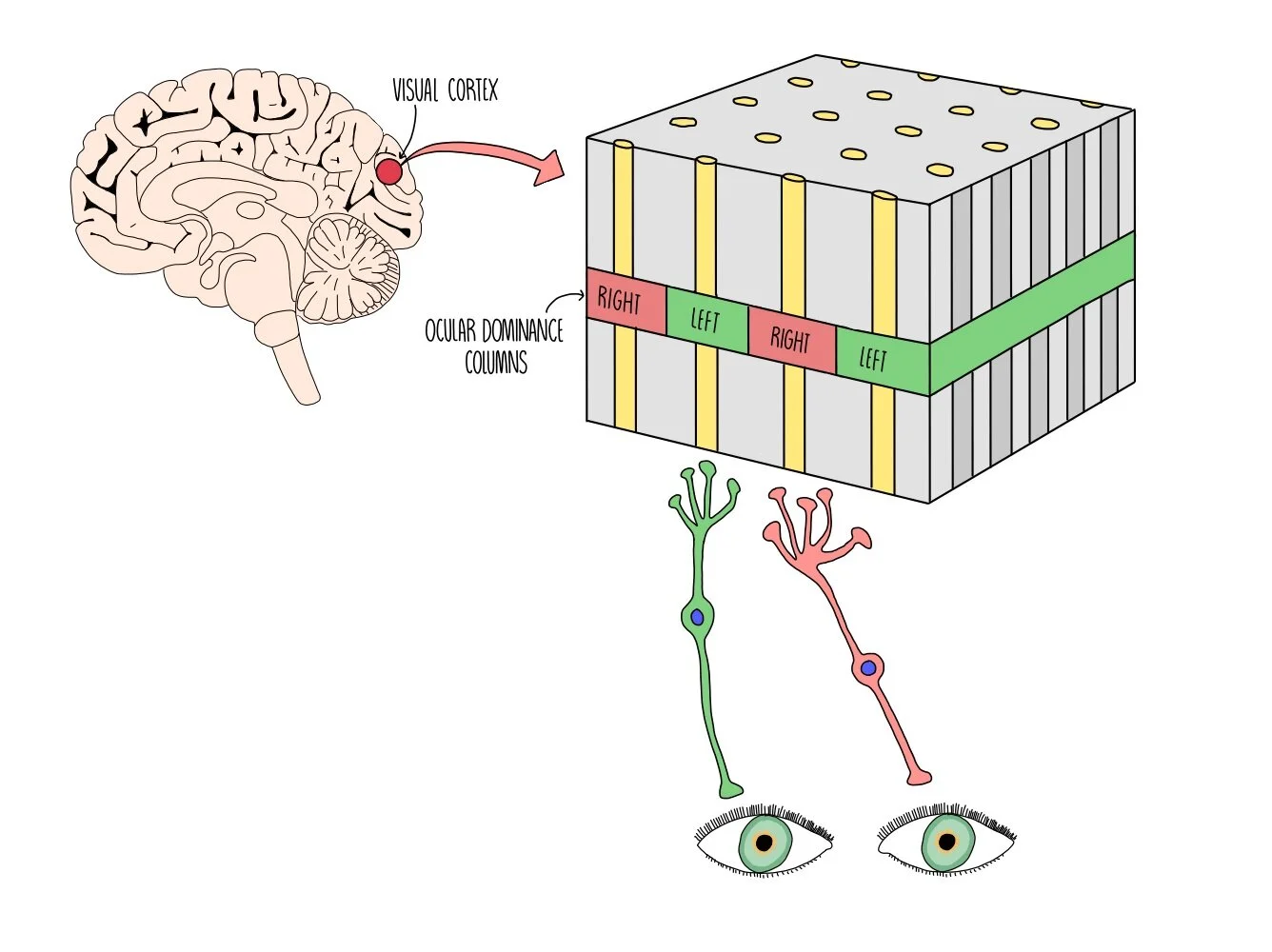
Ocular Dominance Columns + Visual Experience
ODC’s = the alternating regions of the primary visual cortex that respond preferentially to input from one eye to another
the brain initially develops connections from both eyes, but visual experience helps organise these connections into specialised patterns
if one eye receives less visual input = eye’s connections may become weaker, while other eye’s connections take up more cortical space
demonstrates that visual system organisation is not determined by genes alone - also shaped by sensory experience
Knudsen & Knudsen (1989) - Prism Goggles
Can visual experience change how the brain processes auditory spatial info?
studied barn owls wearing prism goggles that shifted their visual field - goggles created a mismatch between visual + auditory information
Findings:
owl’s auditory spatial processing adjusted in response to their altered visual experience
= means sensory experience can modify neural processing - brain is not completely hardwired

Brain Plasticity
= the brain’s ability to change or recognise its structure + function in response to experience
can involve changes to neural connections + brain organisation
not always beneficial - can be maladaptive (eg, following an illness..)
plasticity occurs through life - generally greater during infancy
Critical Period + Visual Deprivation
= a developmental window during which particular experiences have an especially important influence on the development of a brain system
eg = an infant has one eye covered during an important period of visual development
1) the covered eye receives reduced visual stimulation
2) its neural connections become less active
3) connections from the uncovered eye gain a greater proportion of cortical resources
4) this can produce lasting changes in a visual system organisation
Recovery from Early Brain Injury
normally - left hemisphere plays an important role in language processing
however - following early injury, language functions may reorganise into regions of the right hemisphere
= the developing brain has greater flexibility in how certain functions become organised
= does not mean that young children always recover completely from brain injury, but demonstrates the potential for functional reorganisation
MAOA Gene + Childhood Environment
MAOA gene is involved in regulating neurotransmitters and has been studied in relation to impulsive and antisocial behaviour
Caspi et al. (2002) study - MAOA Gene
examined whether the relationship between MAOA variation and later antisocial behaviour depended on childhood maltreatment
found that individuals with low-activity MAOA variant who experienced childhood maltreatment showed an increased risk of antisocial outcomes
conclusion - the influence of gene variation on behaviour can depend on environmental experiences
Infant Brain Function + Maturation - Immature Vision + Face Perception
infants are born with immature visual system
vision is relatively blurry during early infancy
depth perception is not fully developed at birth
face perception + discrimination improve during the first months of life
= visual system continues to mature after birth, including changes in neural connections + the efficiency of neural communication - brain matures and infants gain visual experience, so their ability to process visual info improves
EEG/ERP Evidence for Brain Maturation
infants display a visual electrical response similar in general pattern to adults, but their response occurs more slowly
= means that neural systems needed for visual processing are functioning, but they are still immature
Auditory Development & Prenatal Hearing
around 30 weeks of gestational age, the foetal auditory system can detect external sounds
sounds heard in the womb are filtered, newborns can hear mother’s voice
newborns may recognise familiar songs heard before birth
= shows that experience + learning can begin before birth, even though the auditory system is still maturing
Early Language Processing & Word Segmentation
Word Segmentation = the ability to identify individual words within a continuous stream of speech
newborns have early language-processing abilities despite their immature brains
= matters because some foundations of language processing are present very early, while more advanced language abilities develop through maturation + experience
Brain Maturation vs Experience : Preterm Infants
preterm infants are born earlier - at the same postnatal age, they may have had less gestational maturation
examining brain responses to rhythmic patterns in different languages:
different patterns of gamma-band responses across full-term and preterm groups, including responses to Spanish, Italian + Japanese
= development depends on the interaction between biological maturation and environmental exposure