Generative AI for Image Creation Vocabulary Flashcards
 Call Kai
 Learn
Learn Practice Test
 Spaced Repetition
 Match
Match Flashcards
1/20

Earn XP
Description and Tags
Vocabulary flashcards covering core generative AI architectures, processes, models, and technical terminology from the Visionary Studios case study.
Name | Mastery | Learn | Test | Matching | Spaced | Call with Kai | Chat |
|---|
No analytics yet
Send a link to your students to track their progress
21 Terms
Text-to-image generation models
Generative AI models, such as DALL·E and Stable Diffusion, that generate images from textual prompts, allowing detailed descriptions to be translated into visual outputs.
Conditional image generation models
Generative models that produce images based on specific predefined inputs, such as class labels, sketches, and segmentation maps.
Class-conditional models
A type of conditional image generation model designed to generate specific categories of images, such as animals or landscapes.
Image-to-image translation
A technique that transforms one image type into another, such as converting sketches into realistic renderings or black-and-white images into color.
Unconditional image generation
Generative models that create images without predefined inputs, relying solely on learned patterns from training data to produce novel or abstract visuals.
Diffusion models
Generative models that create images using an iterative denoising process, starting from noise injection and refining it over multiple steps into coherent outputs using a neural denoiser.
Noise injection
The technique of introducing random noise as the starting point for image generation in diffusion models.
Denoising diffusion probabilistic model (DDPM)
The mathematical framework underpinning modern diffusion models that formalizes the gradual addition and removal of noise during training and generation.

Iterative Denoising Process
The step-by-step reconstruction technique in diffusion models where a convolutional neural network (CNN) gradually eliminates noise to reveal visual features.
Generative adversarial networks (GANs)
A generative AI architecture that creates realistic images through a competitive adversarial process between two neural networks: a generator and a discriminator.
Generator network
The neural network in a GAN that creates synthetic candidate images by transforming a D-dimensional noise vector.
Discriminator network
The neural network in a GAN that evaluates candidate images by comparing generated fake outputs against real images from the training dataset.
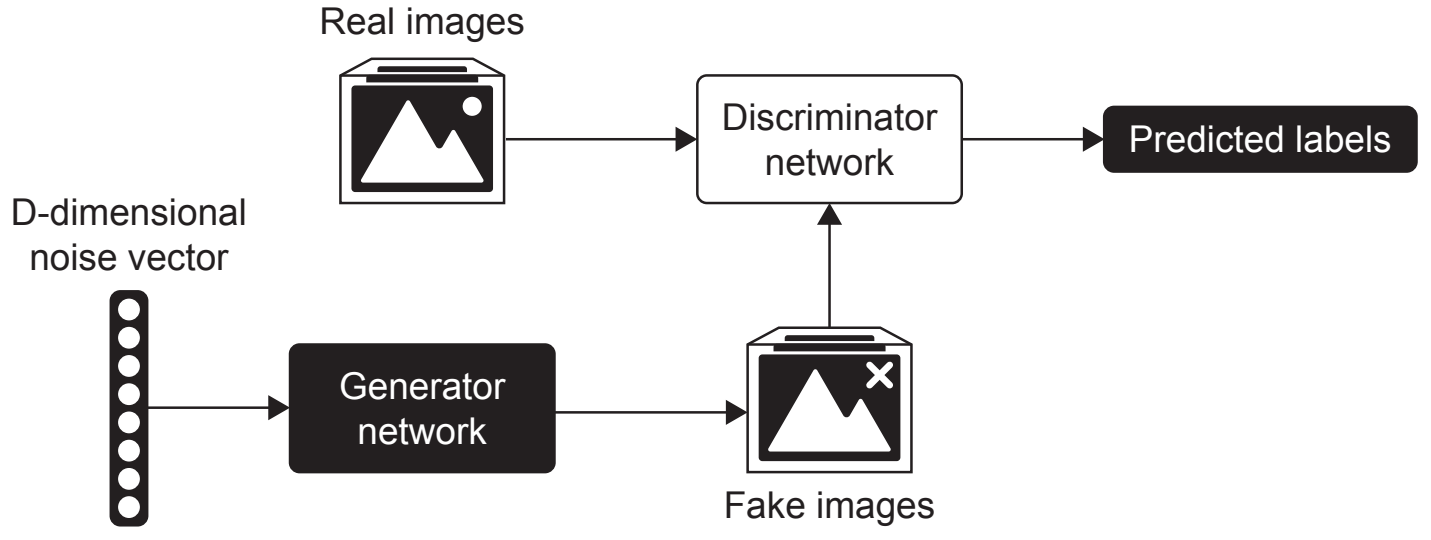
GAN Image Creation Process
An adversarial architecture where a generator transforms a D-dimensional noise vector into fake images, which are evaluated alongside real images by a discriminator to produce predicted labels.
Mode collapse
A failure mode in GAN training where the generator produces limited variations of outputs instead of capturing the full diversity of the dataset.
Hybrid models
Generative AI systems that combine multiple model architectures (such as VAEs, GANs, flow-based models, and diffusion models) to overcome individual limits and improve output quality.
Variational autoencoders (VAEs)
Generative models that represent images within a compressed, organized latent space where similar images are placed closer together, allowing flexible image modification.
Latent space
A compressed and organized version of original image data learned by models like VAEs, where similar images are positioned near one another.
Flow-based models
Generative models that learn an exact, reversible mapping between random noise and realistic images without loss, providing precision, reproducibility, and transparency.
Character consistency
The capability of a generative model to maintain uniform appearances for recurring characters or motifs across multiple images, often achieved using embedding-based approaches.
Style adherence
The requirement that generated images strictly match the intended artistic style or theme specified by input prompts.
Dataset curation
The process of selecting and managing training datasets to avoid copyrighted content, ensure compliance with intellectual property laws, and minimize bias.