Chemistry Unit 3 Review
 Call Kai
 Learn
Learn Practice Test
 Spaced Repetition
 Match
Match Flashcards
 Knowt Play
1/62

There's no tags or description
Looks like no tags are added yet.
Name | Mastery | Learn | Test | Matching | Spaced | Call with Kai | Chat |
|---|
No analytics yet
Send a link to your students to track their progress
63 Terms
Mendeleev
published his ideas first so he usually gets credit over Lothar Meyer, they arranged the periodic table by atomic mass horizontally rather than vertically and predict the existence of undiscovered elements based on blank spaces.
Henry Mosley
work with x-rays determined the actual nuclear charge of the elements, he rearranged them in order of increasing atomic number.
Periods
Horzontal row of elements

Similarity of periods
share the same primary electron energy level
Groups
vertical Columns of elements
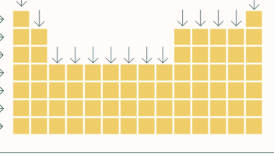
groups also called…
families because they are resemble each other chemically
similarity of groups
same number of valence electrons (valence electrons)
Properties of metals
solid, silver, luster (shiny), conductor, maliable, ductile, LOSE ELECTRONS
properties of metaliods
solid, luster(shiny), SEMI CONDUCTORS
properties of non metals
gas liquid or solid, many different colors, dull, insulator, brittle, GAIN ELECTRONS
Metals cation or anion
CATION
Non Metals cation or anion
ANIONS
Diatomic elements
two atoms of the same element that share electrons to fill each others’ valence shells, they are mostly gasses
example of diatomic element
oxgen’s element = o - diatomic element = o2
Main group (representative) elements
s and p groups

Transistion metals
d group

Inner transition metals
f group

Metals
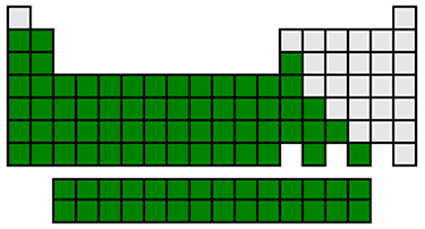
Are Noble Gasses metals, non metals, or metaliods?
None
non metlas

metaliods
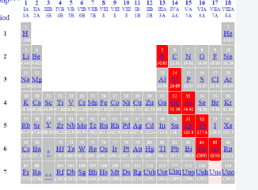
alkai earth metals on periodic table

Alkai Earth Metals properties
They have one valence electron, very easily lose it to non-metals in ionic bonding becoming a +1 charge, VERY chemically reactive, never found in their pure form in nature
Alkaline Earth Metals on periodic table

poperties of alkaline Earth metals
they have two valence electrons, easily lose them to non-metals in ionic bonding becoming a +2 charge, very chemically reactive but not as reactive as group 1, they can be found in the group unredacted, solid silvery metals at room tempurature
Halogens
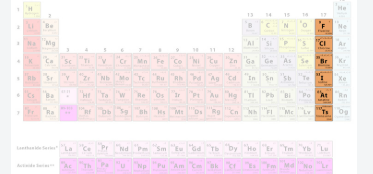
properties of halogens
they have 7 valence electrons, VERY chemically reactive, they are never found alone in nature, steal one valence electrons from metals to form ionic salts (NaCl), if they are not bonded them exist as diatomic elemetns
Noble Gases
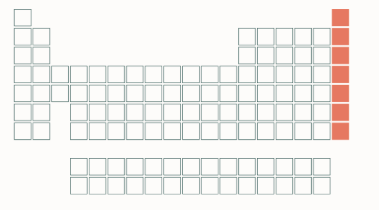
properties of noble gasses
valence level is completely full, they are unreactive and do not form bonds
how many valence electrons is helium stable with
2
all noble gasses besides helium are stable with how many valence electrons
8
Noble gasses at room temperature are..
monatomic
Group 1 common charge
+1
Group 2 common charge
+2
Group 13 common charge
+3
Group 14 common charge
-4 and +4
Group 15 common charge
-3
Group 16 common charge
-2
Group 17 common charge
-1
Group 18 common charge
0
Group 1 valence electrons
1
Group 2 valence electrons
2
Group 13 valence electrons
3
Group 14 valence electrons
4
Group 15 valence electrons
5
Group 16 valence electrons
6
Group 17 valence electrons
7
Group 18 valence electrons
8
Attomic raduis
half the distance between 2 bonded nuclei, typically measured in picometers
Attomic radius trends
Down a group- atomic radius increases because increase in number of energy levels of electrons
Across period- atoms tend to get smaller because of a increase in nuclear charge, electrons enter the same outer shell so screening effect stays mostly the same while nuclear charge grows, the stronger net pull shrinks the electron
Effective nuclear charge
the amount of attraction exerted on valence electrons by the nucleus
Effective nuclear charge trends
Across the period- a higher nuclear charge pulls the electrons closer to the nucleus which results in smaller atomic radius, It increases across a period but stays almost consistent down a group
Down the group-despite the slight change the atomic size increases significantly because brand new electron shell (energy level) is added with each row down the column pacing valence electrons much further from the nucleus.
Shielding effect
When inner core electrons push back and block outer electrons from feeling the full positive pull of the nucleus. Inner electrons repel the valence electrons and diminish the attraction of the nucleus.
Shielding effect trends
Decreases effective nuclear charge felt by outer electrons. An increased screening effect reduces the pull from the nucleus on outer electrons which allows the outer shell to expand and increased the atomic radius
Ionic Radius
similar to atomic radius but for charged particles/ions (atoms that have gained or lost electrons)
Ionic Radius trends
metals (group 1,2 etc.) not only lose their first few valence electrons but they also lose a whole level
This makes them smaller
A cation radius is SMALLER than the native element
Anions are BIGGER than the atom
example of cation < atom < anion

Ionization Energy
the amount of energy required to remove an electron from a gaseous atom
Ionization energy trends
Trend down a group- decreases as atomic radius grows larger and inner shells sheild outer electrons from the nucleus (electrons can be easily removed)
Trend across period- increases as the EFFECTIVE NUCLEAR CHARGE increases, holding electrons closer
successive ionization energy
energy to remove subsequent electrons. Each step takes more energy because the remaining electrons experience a higher net postive charge.
metals tend to have LOW ionization energy; they lose electrons easily and form positive ions.
electronegativity
the ability of an atom to attract electrons
electronegativity effects
helps gain octet stability
used to calculate the type of bond that will likely form between two elements
electronnegativity trends
Across a period- it increases (the closer to an octet the easier) it is to attract the one or two needed to fill the octet
Trend down a group- it decreases (due to increased distance from nucleus)