30. Head and Neck: Dog Skull Foramina-Cranial Nerves
 Call Kai
 Learn
 Practice Test
 Spaced Repetition
 Match
 Flashcards
 Knowt Play
1/134

There's no tags or description
Looks like no tags are added yet.
135 Terms
hole in a bone
foramen means
opening between 2 bones
fissure means
elongated passage w/ foramen at each end
canal means
air filled passageway
meatus means
1. Olfactory-CN I
2. Optic- CN II
3. Oculomotor- CN III
4. Trochlear- CN IV
5. Trigeminal- CN V
6. Abducens- CN VI
7. Facial- CN VII
8. Vestibulocochlear- CN VIII
9. Glossopharyngeal- CN IX
10. Vagus- CN X
11. Accessory- CN XI
12. Hypoglossal- CN XII
Match the cranial nerve to the correct roman numeral
1. CN I- smell
2. CN II- vision
3. CN III- eye movement and pupil dilation
4. CN IV- vertical eye movement
5. CN V- facial sensation and chewing
6. CN VI- lateral eye movement
7. CN VII- taste and facial expression
8. CN VIII- hearing and balance
9. CN IX- taste and swallowing
10. CN X- thirst, vocalization, peristalsis
11. CN XI- head and shoulder movement
12. CN XII- tongue movement
Match the cranial nerve roman numeral to its general action
Some Say Money Matters But Many Boys Say Big Boobs Matter More
what is a pneumonic to remember the sensory/motor/both functions of the cranial nerves
1. CN III (oculomotor)
2. CN VII (facial)
3. CN IX (glossopharyngeal)
4. CN X (vagus)
which cranial nerves have PSNS GVE innervation
1. CN III (oculomotor)
2. CN IV (trochlear)
3. CN VI (abducens)
4. CN VII (facial)
5. CN IX (glossopharyngeal)
6. CN XII (hypoglossal)
7. CN XI (accessory)
8. CN X (vagus)
9. CN V-->V3 (mandibular)
which cranial nerves have SNS GSE innervation
1. CN VII (facial)
2. CN IX (glossopharyngeal)
3. CN X (vagus)
4. CN V (trigeminal)
which cranial nerves have SNS GSA innervation
1. CN IX (glossopharyngeal)
2. CN X (vagus)
3. VIII vestibulocochlear
4. CN II (optic)
5. CN I (olfactory)
which cranial nerves have special afferent innervation
1. V1- ophthalmic n.
2. V2- maxillary n.
3. V3- mandibular n.
what are the three branches of the trigeminal n. (V)
review
review (choose matching word)

for n. blocks
why is it important to know the foramina in the skull

occipital bone
what bone is shown here

foramen magnum
1

spinal cord, meninges, vessels
what passes through 1 (foramen magnum)

basilar part
2

muscular tubercles
3

longus capitus m.
what is 3 the attachment point for

internal basilar part
what is shown here

hypoglossal canal
1

CN XII (hypoglossal)
what passes through 1

jugular process
2

tympano-occipital fissue
3

1. CN IX (glossopharyngeal)
2. CN X (vagus)
3. CN XI (acessory)
4. internal carotid a.
5. sympathetic n.
what all passes through 3 (tympano-occopital fissue)

tympanic bulla
4
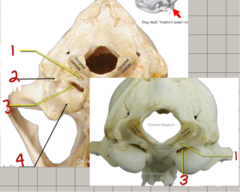
basilar part
1

foramen magnum
2

tentorial process
3
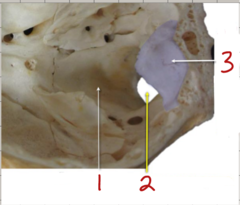
shelf like bone btwn hemispheres and cerebellum w/ laterally and ventrally extended dura matter
significance of 3

tentorial process
what aspect of the occipital bone is circled

1. squamous portion
2. petrosal portion
3. tympanic portion
what parts are included in the temporal bone
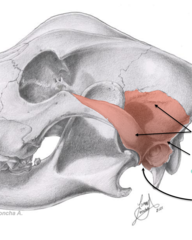
zygomatic arch
what is indicated here

zygomatic process of temporal bone
what aspect of the temporal bone is highlighted
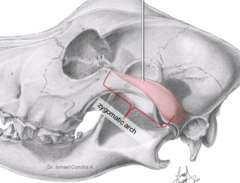
mandibular fossa
what aspect of the temporal bone is highlighted

canal for CN V (trigeminal)
1

internal acoustic meatus
2

1. CN VII (facial)
2. CN VIII (vestibulochochlear)
what cranial nerves pass through 2 (internal acoustic meatus)

jugular foramen
3

1. CN IX (glossopharyngeal)
2. CN X (vagus)
3. CN XI (accessory)
what cranial nerves pass through 3 (jugular foramen)

cerebellar fossa
4

auricular cartilage
1

anular cartilage
2

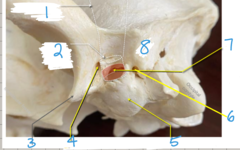
retroarticular process
3
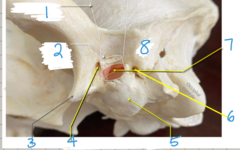
retroarticular foramen
4
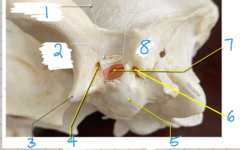
retroarticular v.
what passes through 4 (retroarticular foramen)

tympanic bulla
5

stylomastoid foramen
6

CN VII (facial)
what cranial nerve passes through 6 (stylomastoid foramen)

external acoustic meatus
7

osseous part of ear canal
what is indicated by the red highlighted portion of 7 (external acoustic meatus)

mastoid process
8
external acoustic meatus
what is indicated by the upper arrow of this x-ray

tympanic bulla
what is indicated by the lower arrow of the x-ray

tympanic membrane
what is attached in the external acoustic meatus to serve as the landmark between the middle and external ear

presphenoid bone
what bone is highlighted in orange and serves as the rostral floor

basisphenoid bone
what bone is highlighted in blue and serves as the "bat like" middle floor

orbital fissure
1
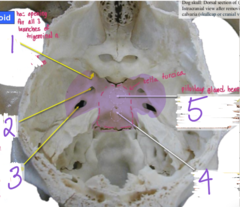
1. CN III (oculomotor)
2. CN IV (trochlear)
3. CN VI (abducens)
4. V-->V1 (opthalmic)
what runs through 1 (orbital fissure) to supply innervation to the eye
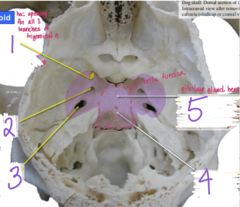
round foramen
2

V-2 (maxillary)
what runs through 2 (round foramen) and opens into the alar canal
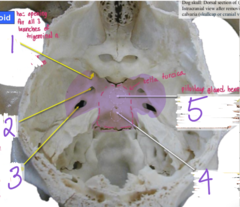
oval foramen
3

V-3 (mandibular)
what runs through 3 (oval foramen)
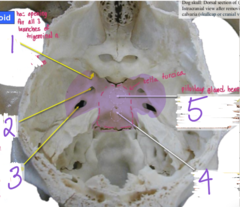
dorsum sella
4

hypophyseal fossa
5

pituitary gland
what is contained in 5 (hypophyseal fossa)

round foramen
2

V-2 (maxillary)
what runs through 2 (round foramen) and opens into the alar canal

oval foramen
3
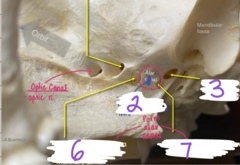
V-3 (mandibular)
what runs through 3 (oval foramen)

Rostral alar foramen
6
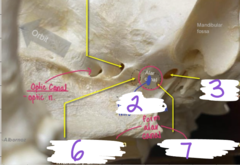
1. V-2 (maxillary)
2. maxillary a.
what runs through 6 (rostral alar foramen)
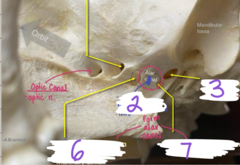
caudal alar foramen
7
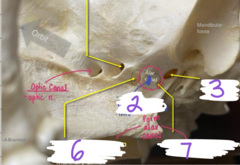
maxillary a.
what runs through 7 (caudal alar foramen)
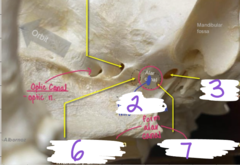
optic canal
1

CNII (optic)
what runs through 1 (optic canals)

chiasmatic groove
2

optic n. crossover
what occurs at 2 (chiasmatic groove)

review
review (select matching word)

frontal bone
what is being highlighted here
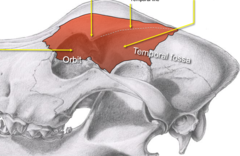
ecto turbinates aspect of ethmoidal bone
what is indicated by the top arrows

frontal sinus
what is indicated by the arrows on the right
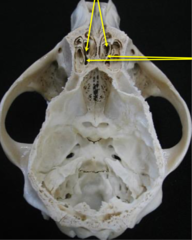
frontal sinus
what is being indicated
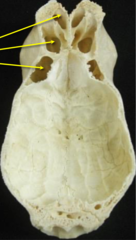
pneumatic bone
the frontal bone is considered a ______ (hint what kind of bone)
frontal sinus
what is being indicated by the upper arrows
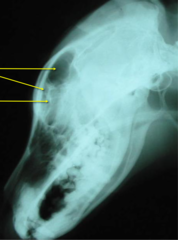
ectoturbunates
what is being indicated by the lower arrows

frontal sinus
what is being pointed to

perpendicular plate of ethmoid bone
what is the white arrow pointing to

vomer
what is the yellow arrow pointing to

perpendicular plate and nasal septum cartilage
what does the highlighted structure (vomer) articulate with

1. perpendicular plate
2. nasal septum cartilage
3. vomer
what parts make up the nasal septum
cribriform plate
what is being pointed to
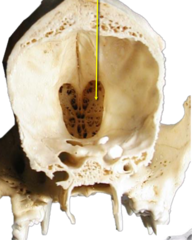
perpendicular plate
what is being pointed to

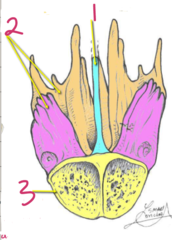
perpendicular plate
1

ethmoidal labyrinth
2

cribriform plate
3

1. CN I (olfactory)
2. vomernasal nn.
what passes through 3 (cribriform plate)
fossa for lacrimal sac within the lacrimal bone
what is being indicated here

maxilla
what bone is highlighted
