PNB 2264 EXAM 2
 Call Kai
 Learn
 Practice Test
 Spaced Repetition
 Match
 Flashcards
 Knowt Play
1/298

There's no tags or description
Looks like no tags are added yet.
299 Terms
Fluid, Mosaic
What are the two features of the Plasma Membrane’s structure?
Hydrophobic
Is the tail of a Phospholipid hydrophilic or hydrophobic?
Hydrophilic
Is the head of a phospholipid hydrophilic or hydrophobic?
Amphiphatic
Has both hydrophilic (water-attracting) and hydrophobic (water-repelling) regions within the same structure
Glycerol
What part of the phospholipid is this?

Phosphate
What part of the phospholipid is this?
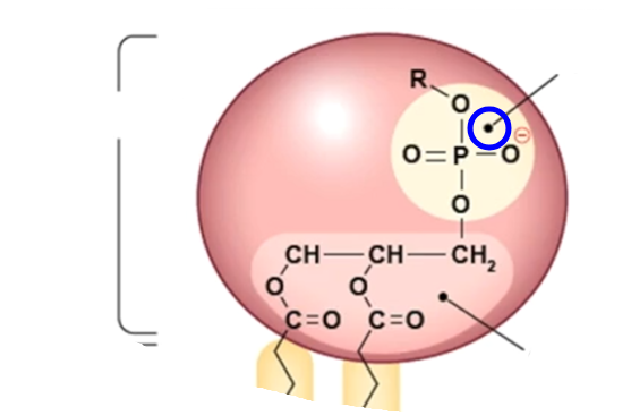

Hydrophilic head
What part of the phospholipid is this?
Hydrophobic tail
What part of the phospholipid is this?

Saturated fatty acid
What part of the phospholipid is this?

Unsaturated fatty acid
What part of the phospholipid is this?

Peripheral Proteins
Proteins that attach to either inner or outer face of membrane
Integral Proteins
Protrude partly or all the way across membrane
Include channel proteins and carrier proteins
Glycolipid
What part of the plasma membrane is this?

Peripheral protein
What part of the plasma membrane is this?

Channel protein
What part of the plasma membrane is this?
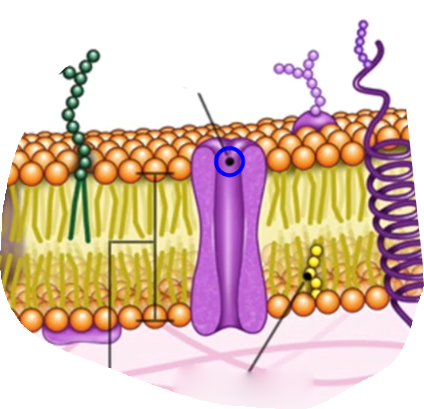
Phospholipid Bilayer
What part of the plasma membrane is this?

Cholesterol
What part of the plasma membrane is this?
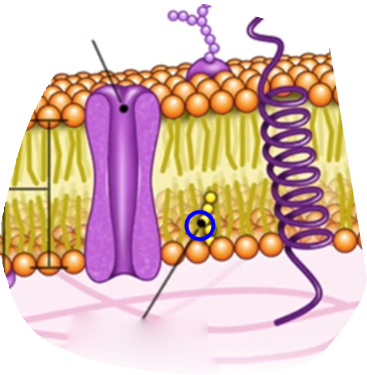
Glycoprotein
What part of the plasma membrane is this?

Transmembrane (integral) protein
What part of the plasma membrane is this?

Physical barrier, Exchange, Communication, Attachment
What are the 4 functions of the plasma membrane?
Selective Permeability
Controls which molecules can get into and out of the cell
Paracellular
Between Cells
Transcellular
Through Cells
Transcellular path
What path for transport is this?
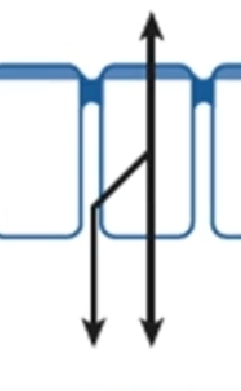
Paracellular Path
What path for transport is this?

Active Transport
Requires energy. Molecules are moved from lower concentration to higher concentration.
Passive transport
Does not require energy from the cell. Materials move from a region of higher concentration to a region of lower concentration.
Simple Diffusion, Osmosis, Facilitated Diffusion, Bulk Filtration
What are the 4 types of Passive Transport?
No Energy Required
What is the unique capability of passive transport?
Channel Protein
What type of protein is this?
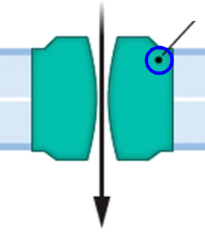
Carrier Protein
What type of protein is this?

Passive Transport
What does the channel Protein and Carrier-mediated protein have in common?

Active Transport
What is unique about the primary/secondary Carrier protein?

Simple Diffusion
What type of membrane transport is this?
Root Mean Squared (RMS)
What equation explains the non-linear relationship between distance and time of a molecule bouncing about?
Brownian Motion
random movement of microscopic particles suspended in a fluid, such as a liquid or gas
True
True or false: Diffusion is a inefficient way to move a molecule
Seven Properties of Simple Diffusion
Passive Process
Net Movement of High to Low Concentration
Requires a Concentration Gradient
Rapid over Short Distances
Directly Related to Temperature
Inversely related to molecular size
In open System or Across a parttiiton
Concentration Gradient
The absolute difference in solute concentration between two places
Ficks Law
What law defines diffusion as
Diffusive Flux of Solute = Diffusion Coefficient * Concentration Gradient
False
True or False: Diffusion constants are the same across every molecule
Osmosis
The diffusion of water molecules
Lower
Solutes ____ the concentration of water
Selectively Permeable
What type of permeability is this?

Freely Permeable
What type of permeability is this?

Cell volume
The movement of water is linked to changes in what?
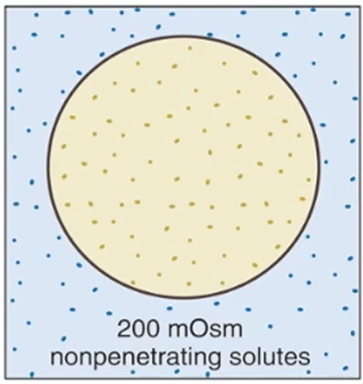
Hypertonic Solution
What solution causes the cell to shrink?

Isotonic Solution
What solution has no change in cell volume?

Hypotonic solution
What solution results in cell swelling?
Hydrostatic Force
Applied force of pressure required to block osmosis
Osmotic Force
Force created by diffusion of water
Facilitated Diffusion
A type of diffusion where the solute requires the help of an integral membrane protein such as a carrier protein
Bulk Filtration
Movement of solutes and/or water in the same direction. (NOT DUE TO BROWNIAN MOTION UNLIKE DIFFUSION)
Selective
Ion channels are ________
Voltage-gate
What type of ion channel is this?
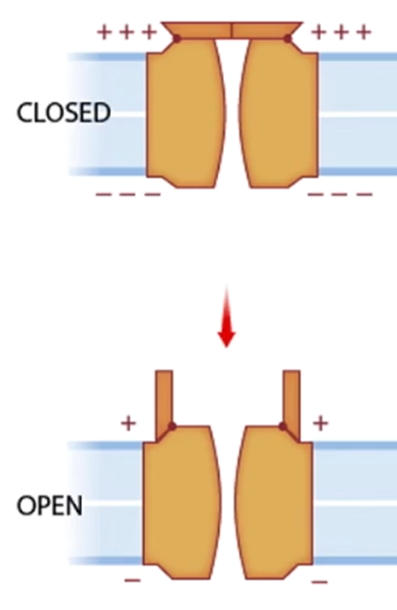
Extracellular Ligand-gate
What type of ion channel is this?

Intracellular ligand-gate
What type of ion channel is this?

Mchanosensitive gate
What type of ion channel is this?

False
True or False: Ion channels are active transport
Channelopathies
Diseases and disorders that are the result of ion channel dysfunction
tetrodotoxin
What toxin was prevalent in pufferfish that was 1000x stronger than cyanide?
Channel protein
A protein that forms a pore or continuous path through the membrane
Carrier protein
A protein that cycles between multiple conformations in which a solute binding site is accessible onto to one side of the membrane at any given time.
Never an open channel all the way through the membrane.
Occlusion state
A state that the solute is not accessible either inside or outside
True
True or False: A carrier transports one to three molecules per conformational cycle, whereas a single channel opening event allows flux of thousands of ions per second
Ion channel
What type of protein is this?

Transporter
What type of protein is this?
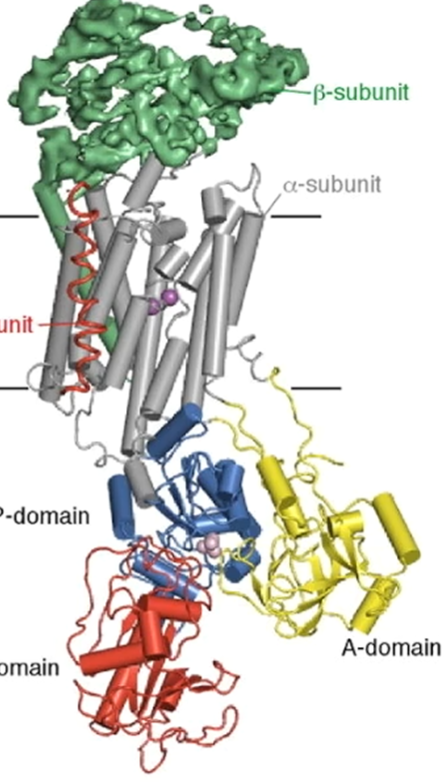
Uniport carrier
A carrier that only transports a single soluteS
Symport carrier
A carrier that transports solutes in the same direction
Antiport carrier
A carrier that transports solutes in the opposite direction
Facilitated Diffusion
Carriers that don’t use energy for transport operate by __________ _________
Primary/secondary active transporters
Carriers that use energy for transport operate by __________ _________
Primary
Active transporter that directly consumes ATP
Secondary
Active transporter that utilized energy stored in a pre-existing concentration gradient
Outside
Sodium is highly concentrated _______ the cell
Inside
Potassium is highly concentrated _______ the cell
False
True or False: Sodium Potassium pumps move 3 Na in, and 2 K out
Antiporter
What type of pump is the sodium potassium pump?
True
True or False: Most secondary active transporters are also symporters.
Secondary Active Transport
What type of transporter is Sodium Glucose?
Luigi Galvani
Who is the father of electrophysiology?
Membrane Potential
The uneven distribution of electrical charge across the membrane
False:
True or False: Vm is the voltaic potential outside the cell relative to the potential inside the cell
K, Na, Cl, Anions, Ca
What are the top 5 useful ions of the body
100
What is the intracellular mM for K+?
5
What is the extracellular mM for K+?
10
What is the intracellular mM for Na+?
100
What is the extracellular mM for Na+?
10
What is the intracellular mM for Cl-?
105
What is the extracellular mM for Cl-?
100
What is the intracellular mM for Anions?
0
What is the extracellular mM for Anions?
0.0001
What is the intracellular mM for Ca2+?
1.2
What is the extracellular mM for Ca2+?
True
True or False: Ions are not distributed equally across the cell membrane for a membrane potential.
False
True or False: Membrane are equally permeable to various ions for a membrane potential.
Concentration gradients
Pushes ion towards chemical equilibrium
Electrical potential
Pushes ions towards electrostatic equilibrium
Membrane potential
The potential energy to do work