KPE261: MODULE 4
 Call Kai
 Learn
 Practice Test
 Spaced Repetition
 Match
 Flashcards
 Knowt Play
1/95

There's no tags or description
Looks like no tags are added yet.
96 Terms
what is the motor program theory
refers to a theory proposing that movements are controlled through pre-structured sets of movement commands
what is a motor program (MP)
refers to a prestructured set of movement commands that defines + shapes a movement
specifies how muscles should be activates to produce an organized action
MP are described as being stored in long-term memory + retrieved when needed
what do motor programs (MP) do
determines which muscles contract
organizes the sequence of muscle activation
controls the timing + duration of muscle activity
coordinates multiple muscles + joints into one movement
importance of motor programs (MP)
allows movements to be planned BEFORE execution
reduce the need to consciously control every component of a movement
helps explain how rapid movement can occur w/o continuous sensory feedback
rationale for the existence of motor programs
some movements occur too quickly for sensory feedback to guide every component
muscle activation can occur in organized patterns even when movement is blocked
movements can be prepared before they begin
∴ the CNS must have some way of organizing movement commands in advance

what does the graph show (schmidt, zelaznik, hawkins, frank & quinn, 1979)
shows the positive relationship b/w 2 force measurements
x-axis → force (kg)
y-axis → standard deviation of force (kg) → representing variability in force production

what was the main takeaway (schmidt, zelaznik, hawkins, frank & quinn, 1979)
as force increases, the variability in force production also increases
∴ producing greater force is associated w/ greater absolute variability in force output

how does this graph relate to motor programs (MP) (schmidt, zelaznik, hawkins, frank & quinn, 1979)
shows that force production follows a systematic, predictable pattern rather than being completely random
supports the idea that motor output can be organized + structured which is consistent w/ the concept of motor programs
what is open-loop control
refers to a movement control system where commands are organized BEFORE movement begins and executed without using feedback to modify the ongoing action
what does the open-loop control do
allows rapid + organized movements
they’re particularly useful when the environment is stable + predictable
components of open-loop control
instructions are executed w/o ongoing feedback correction
input - the desired movement goal is provided to the executive
executive
determines what action needs to occur
organizes movement instructions
effector
carries out the instructions
activates muscles to produce movement
characteristics of open-loop control
ex. traffic lights → accident occurs → system doesn’t modify its actions based on changing conditions
instructions are prepared in advance (specify movement sequence +timing)
once initiated, instructions are executed essentially without modification
feedback is not used to detect + correct errors during execution
most effective in stable, predictable environments
when are motor programs used as open-loop systems
most useful for rapid, brief + forceful movements
movements occur too quickly for feed-based corrections to be made during execution
∴ movement is planned before it begins + executed w/ little direct conscious control
what is the role of the executive level in motor programs
plans the movement before the MP is initiated
determines
whether to act
movement speed
direction/trajectory
timing
ex. deciding when, where + how hard to kick a soccer ball
what is the role of a motor program in movement execution
organizes + sends movement commands to the spinal cord + muscles
specifies:
which muscles contract
order of muscle activation
when muscles activate
how long they remain active
ex. organizing the sequence + timing of leg muscle contractions needed to kick a soccer ball
what is the role of the effector level in motor programs
it executes the selected MP
muscles carry out the commands to produce the movement
ex. leg muscles
how do motor programs function as open-loop systems
executive level → plans the movement
makes decisions before movement begins:
whether to act
movement speed
direction/trajectory
timing
motor programs → organizes movement commands
what is the effect of practice on MP
it builds + improves MP
makes movement patterns more stable + precise
how does a MP change with practice
initially - MP may control shorter sequences of actions
w/ practice
can control longer + more complex movement sequences
movements become more organized
what is reaction time (RT)
refers to the time between stimulus presentation + initiation of movement

what does the table show (klapp & erwin, 1976)
response duration (ms) - targeted vs. actual time taken to complete the movement
reaction time (ms) - time b/w stimulus presentation + movement initiation
experiments 3A-3D - participants performed movements of increasingly complexity

what was the main takeaway (klapp & erwin, 1976)
found that greater movement complexity = longer RT
supports the idea that the CNS requires time to organize movement commands BEFORE execution
ex. experiment 3A:
150 ms target → RT = 329 ms
300 ms target → RT = 388 ms
how does the reaction-time evidence support MPs
suggests that movements are prepared in advance
more complex movement patterns will require additional preparation time
movements must be prepared + organized before execution (important of MPs)
limitations of reaction-time evidence
longer RT does not directly prove MP exist
↑ RT could result from other planning or decision-making processes (rather than MP preparation)
∴RT-evidence supports MP existence but does not prove it
what is a startle reaction
refers to an automatic reaction to an unexpected, intense stimulus
ex. loud noise
what was the startle reaction experiment
examined whether a prepared movement could be triggered earlier by an unexpected stimulus
participants prepared a rapid movement
an unexpected loud sound was presented
researchers measured how quickly the movement begins
what was the main takeaway of the start reaction experiment
prepared movement occurred w/ a RT approx. 100ms shorter
movement pattern remained unchanged
how does the startle reaction experiment support MPs
suggests that the MPs are prepared in advance
b/c the movement pattern is unchanged.. it suggests that the movement commands were already organized before execution
∴ supports the idea that MPs can be prepared before movement initiation
limitations of the startle reaction experiment
the exact mechanism responsible for the faster movement remains uncertain
∴ startle reactions support but do not directly prove the existence of MPs
what is deafferentation
refers to the removal or interruption of sensory nerve pathways carrying information from the body to the CNS
motor pathways remain in tact
studied to examine whether movement can still occur w/o normal sensory feedback
what is sensory neuropathy
refers to damage to sensory nerves that can cause loss of sensory information
individuals may lose proprioception
motor nerves may still function
∴ movement can still be produced despite sensory loss
what was the polit & bizzi (1979) experiment
examined whether movements could be organized w/o visual feedback about limb position (monkeys w/ deafferented upper limbs)
monkeys reached toward visual targets w/o seeing their arm
researchers measured biceps + triceps activity using EMG
external forces distributed some movements
must point to target light (w/ forearm) for a reward

what does this figure show (polit & bizzi, 1979)
top trace - biceps muscle activity (EMG)
middle trace - arm movement
bottom trace - triceps muscle activity (EMG)
3 conditions:
A = normal movement
B = arm displaced away from target
C = arm initially displaced toward target region

what was the main takeaway (polit & bizzi, 1979)
∴ despite different initial arm movements, monkeys could still reach intended final position
conditions:
A - normal movement.. monkey reached toward the target w/o disturbance
B - arm displaced away from target.. monkey still reached the correct final position
C - arm initially displaced toward target region.. monkey still reached the correct final position
could still perform gross motor skills (fine skills were impaired)
how does deafferentation evidence support MPs
movements could be organized w/o visual feedback about the limb
suggests that the CNS has internally organized movement commands
∴ supports the idea that MPs can guide movement w/o continuous visual feedback
what were findings of human deafferentation experiments
individuals w/ sensory feedback loss could still produce movements
visual feedback helped compensate for missing proprioceptive information
∴ movement can occur w/o normal proprioceptive feedback
what was the main takeaway of deafferentation evidence
sensory feedback is not always essential for movement production
some movements can be organized by the CNS
sensory information remains important for precision + adjustments (fine motor skills)
limitations of deafferentation evidence
not seeing ≠ all sensory feedback was absent
successful movements could involve remaining sensory info or other control mechanisms
∴ does not prove that movements are entirely independent of sensory feedback
what is the central pattern generator (CPG)
refers to a genetically organized neural network that produces rhythmic movement patterns
located in the brainstem or spinal cord
what does the central pattern generator (CPG) do
produces coordinated rhythmic movements
can operate without continuous sensory feedback
activated by triggering signals from the brain
ex. chewing, breathing
what is the difference b/w CPGs and MPs
CPGs - are associated w/ genetically organized, rhythmic movements
ex. breathing → body automatically produces repeated breathing rhythm w/o consciously planning each breath
MPs - are used to explain learned movement skills
ex. serve → CNS organizes the sequence + timing of muscle contracts needed to serve
how do CPGs support the existence of MPs
demonstrates that the CNS can generate coordinate movement patterns internally
rhythmic movements can occur w/o continuous sensory feedback
∴ supports the idea that movements can be organized in the CNS, rather than entirely controlled by incoming sensory information
what was the wadman et al. (1979) experiment
examined whether muscle activation patterns depend on actual movement + sensory feedback
participants performed a normal movement
the same movement was physically blocked
researchers compared agonist + antagonist muscle activity using EG
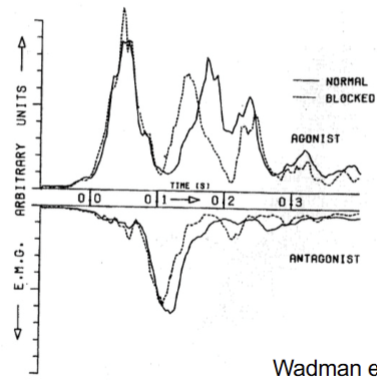
what does the graph show (wadman et al., 1979)
x-axis = time (seconds)
y-axis = EMG activity
top graph = agonist muscle activity
bottom graph = antagonist muscle activity
2 conditions:
normal (solid line) - movement performed normally
blocked (dotted line) - movement physically prevented

what was the main takeaway (wadman et al., 1979)
at the beginning:
the solid + dotted lines are almost identical
∴ muscles initially activate in a similar pattern (regardless of whether movement occurs)
later:
lines begin to separate
∴ muscle activity changes b/c the normal + blocked movement produce different sensory feedback
how does blocked movement evidence support MPs
muscles showed an activation sequence even when movement was blocked
suggests that the initial muscle commands were prepared before movement execution
∴ supports the idea that MPs can organize muscle activity w/o relying on sensory feedback
limitations of blocked movement evidence
later muscle activity differed b/w conditions
suggests sensory feedback + movement conditions can still influence motor output
∴ does not prove that movement is completely independent of feedback
what is movement inhibition
refers to the stopping or preventing a movement that has been prepared or initiated
what is the point-of-no-return
refers to the point when movement can no longer be stopped before it begins
what is the stop-signal paradigm
refers to a method used to determine when a prepared movement can no longer be inhibited
how does the stop-signa paradigm work
participant prepares an action
an occasional stop signal tells them to cancel it
researchers measure whether movement can still be stopped
what was the slater-hammel experiment
examined when a prepared movement reaches the point-of-no-return
participants prepared to life a finger at a target time on a clock
on unexpected trials, the clock stopped early
participants had to prevent their finger from moving
what were the findings of the slater-hammel experiment
>210ms before movement = successful inhibition
150-170ms before movement = ~50% successful inhibitiob
100ms before movement = nearly impossible inhibition
what was the main takeaway of the slater-hammel experiment
the closer the participants were to movement initiation the harder to stop the movement
an internal movement-initiation signals was inferred around 150-170 ms before movement
∴ suggests that movements are prepared before execution
how does movement inhibition evidence support MPs
suggests that the CNS prepares movement commands before execution
once movement preparation reaches a certain stage, stopping the action becomes increasingly difficult
∴ supports the idea that MPs are organized + initiated in advance (rather than being controlled entirely during movement)
what is the reflex-reversal phenomenon
refers to when the same sensory stimulus produces different or opposite reflex responses
depending on the movement phase or context
example of a reflex-reversal phenomenon
imagine a cat walking + something touches the top of its foot (stimulus)
swing phase = foot in air
cat is moving forward
stimulus (something touches top of its foot)
that bends its legs to lift its food higher to avoid the obstacle (step over it)
stance phase = foot on ground
cat’s foot is supporting weight
stimulus (something touches the top of its foot)
that straightens its legs to keep supporting the body
stimulus is the same, but reaction changes
findings of the reflex-reversal phenomenon
CPGs regulate when certain reflex responses can occur depending on the movement phase
sensory stimuli trigger reflex responses, but the CPG influences which response is produced
∴ the same stimulus can produce different responses depending on the ongoing movement
how does the reflex-reversal phenomenon support existence of MPs
it indirectly supports MPs by supporting open-loop control
CPGs centrally organize movement patterns = MP support
supports open-loop mechanisms
∴ supports the idea that central motor commands influence movement rather than movement being controlled by sensory feedback
challenges to MP theory
sensory feedback
movement flexibility
storage problem
novelty problem
knowledge of results (KR)
how does sensory feedback challenge MP theory
challenges the assumption that movements can be controlled through pre-programmed commands w/o on-going sensory feedback
movement precision + corrections depend on sensory information
fine motor skills req. adjustments from sensory feedback
∴ MPs alone cannot fully control movements w/o feedback
how does movement flexibility challenge MP theory
challenges the assumption that an MP specifies a fixed sequence of motor commands
movements can be modified in response to unexpected disturbances
∴ movement execution is not always fixed or predetermined
what is the storage problem
refers to the problem of how the CNS could store a separate motor program for every possible movement
how does the storage problem challenge MP theory
challenges the assumption that each movement variation requires its own stored MP
storing every variation would require enormous long-term memory
∴ separate MPs for every movement variation are unrealistic + inefficient
what is the novelty problem
refers to the problem of explaining how people perform movements they have never executed before
how does the novelty problem challenge MP theory
challenges the assumption that a movement requires a previously stored MP to be performed
people can produce new movements without having an exact stored program
∴ MPs cannot fully explain the ability to generate novel movements
how does knowledge of results (KR) challenge MP theory
challenges the assumption that stored movement commands alone are sufficient to explain motor learning + performance
KR helps people identify errors + improve future movements
∴ MPs alone cannot fully explain how movements are learned and improved through feedback
what is a generalized motor program (GMP)
refers to a stored movement pattern that controls a class of similar actions while allowing variations in execution
what does a generalized motor program (GMP) do
provides a basic movement structure
allows adjustments in speed, force, size + effectors
helps maintain important characteristics of the movement
how do generalized motor program (GMP) solve the storage problem
one generalized movement pattern can produce many variations
different parameters modify movement without requiring a new MP
∴ it ↓ the # of separate programs requires
how do generalized motor program (GMP) solve the novelty problem
an existing GMP can be adjusted to meet new movement demands
different parameters allow new variations w/o requiring a completely new MP
∴ explains how people can perform unfamiliar variations of existing movements
limitations of GMPs in solving the novelty problem
GMPs can explain new variations of existing movement patterns
but it doesn’t fully explain how the new movement patterns are created when no suitable GMP exists
benefits of generalized motor programs (GMP)
efficient storage - ↓ movement patterns need to be stored
movement variability - one GMP can produce multiple variations
novel movement variations - familiar movement patterns can be adapted to new situations
flexibility - movement parameters can change without altering the underlying structure
what is the motor schema theory
refers to a theory explaining how a generalized movement pattern can be selected + adjusted based on the situation and desired outcome
what is a schema
refers to a visual representation of movement
an adaptable “mental template” for how a movement should be performed
it’s the rules that help you adjust the GMP for different situations
what does the motor schema theory explain
how the CNS can use the same GMP to produce different movement variations
how movement parameters are selected
how sensory feedback + outcomes contribute to movement control
how does the motor schema theory work
initial conditions + desired outcome - determine the situation + movement goal
GMP + adjust parameters - choose the movement pattern + specify force, direction, etc
execute MP - send movement commands to muscles
limb movement - muscles produce movement + proprioceptive feedback
how your arm is moving, what position your arm is in, how the movement feels
environmental response - movement produces external sensory feedback
where the ball is travelling, whether it’s moving to the teammate
outcome measurements - evaluate the actual movement outcomes
how does the motor schema theory measure outcome
must evaluate whether the actual outcome matches the desired outcome
desired outcome ≠ actual outcome = error
∴ this info helps refine schema to select more appropriate parameters next time
what is parameterization
refers to the process of adjusting movement parameters to change how a GMP is executed
allows 1 GMP to produce movements w/ different: speed, durations, amplitudes, sizes, effectors

what was the muscle activation experiment (schmidt, 1988)
examined whether the same GMP could produce movements w/ different overall durations
compared movement 1 (M1) → shorter duration
compared movement 2 (M2) → longer duration
examined the timing + duration of activation in muscle 1, 2, 3

what does the muscle activation figure show (schmidt, 1988)
MT1 + MT2 = total movement duration
MT1 = shorter
MT2 = longer
muscles 1, 2 + 3 = order + timing of muscle activation
a, b, c = duration each muscle is activated
wavy lines = periods of muscle activation
what were the findings of the muscle activation experiment
overall movement duration changes (M2 > M1)
absolute timing changed (muscles remained active for longer in M2)
relative timing remained constant (muscle activation durations maintained the same proportions)
muscle activation sequence remained the same (muscles activated in the same order)
how does the muscle activation experiment support GMPs
supports the idea that GMPs have features that stay the same (relative timing + muscle activation order)
parameterization allows movement speed to change while keeping these features the same
∴ the CNS can use the same GMP for faster/slower movements (instead of storing a diff MP for each speed)
what is the connection b/w GMPs, parameters + motor schema theory
GMP - provides the basic movement pattern (what movement to perform)
parameters - adjust how the movement is performed (force, speed, direction)
motor schema theory - explains how the CNS selects + adjusts movement patterns based on the situation → helps select appropriate parameters to reach target
stable characteristics of a GMP
invariant features
relative timing
relative force
sequencing
surface features
parameters
movement time
movement amplitude
effector selection
what are invariant features
refers to characteristics of a GMP that remain stable across variations of the same movement
they define the movement’s basic structure
allow the same movement pattern to be recognized across different executions
AKA the movement’s deep structure
types of invariant feature
relative duration (timing)
relative amplitude (force)
relative sequencing
what is relative duration (timing)
refers to the proportion of total movement time devoted to each movement component
maintains the movement’s underlying rhythm
total duration can change while relative timing stays similar
ex. 10s to 20s.. but it still amounts to 5% of the time
what is the difference b/w relative and absolute timing
relative timing = proportion of total time spent on each movement component
absolute = actual amount of time taken by a movement component
what is relative amplitude (force)
refers to the proportional distribution of force between movement components
which maintains the movement’s overall force pattenr
what is relative sequencing
refers to the order in which movement components or muscles are activated
which maintains the same basic activation order across movement variations
least debatable, stays constant
what is the phonograph analogy
when music is played, the speed + pitch can be changed but the song stays the same
explains the stable characteristics of a GMP
what are surface features
refers to characteristics of a movement that can change between performances without altering the underlying GMP
they determine how the movement is performed in a specific situation
ex. movement speed, movement size, movement force, muscles/limbs used
types of parameters
movement time - total duration required to complete an action
ex. writing quickly vs. slowly
movement amplitude - overall size or distance of a movement
ex. writing a signature on a small vs. large surface
effector selection - choosing which muscles or limbs perform a movement
ex. writing w/ dominant vs. non-dominant had

label the schimidt’s model (in rainbow order - boxes only)
initial conditions (red)
desired outcome (orange)
motor response schema (yellow)
motor program (green)
limbs (light blue)
environment (dark blue)
measured outcome (pink)
error labeling (purple)
expected proprioceptive feedback (brown)
expected exteroceptive feedback (gray/black)

label the schimdt’s model (arrow notes only)
response specification
proprioception
exteroception
knowledge of results
KR (knowledge of results again)
subjective reinforcement