the ageing population
 Call Kai
 Learn
 Practice Test
 Spaced Repetition
 Match
 Flashcards
 Knowt Play
1/16

There's no tags or description
Looks like no tags are added yet.
17 Terms
what is happening to the average age of the UK population? .
what was it in 1971?
what was it in 2020?
what is projected to reach by 203?
There are fewer y____ people and more o____ people. The number aged 65 or over equalled what? for the first time ever in 20___.
The average age of the UK population is rising.
In 1971, it was 34.1 years.
By 2020, it stood at 40.4.
By 2037, it is projected to reach 42.8.
There are fewer young people and more old people. The number aged 65 or over equalled the number of under-15s for the first time ever in 2014.
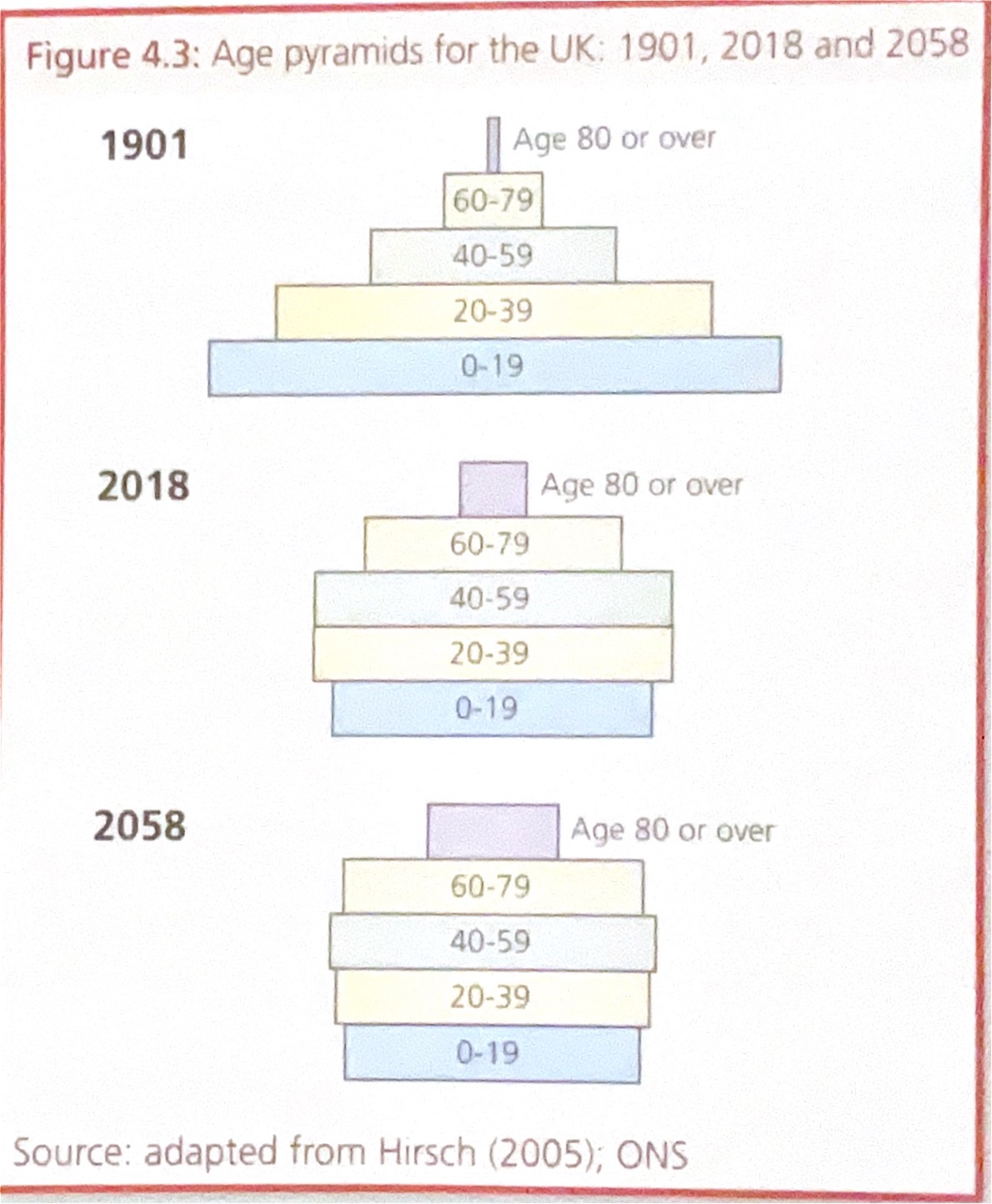
what do 'age pyramids' such as the ones in Figure 4.3 demonstrate
In fact, as D_____ H____ (2005) notes, the t____ age 'pyramid' is d_____ and being replaced by why? representing the different age groups.
For example, by 2041 there will be as many 78 year olds as five year olds.
Another way of illustrating the changing age-profile of the population is by means of 'age pyramids' such as the ones in Figure 4.3.
These show how older age groups are growing as a proportion of the population, while younger groups are shrinking.
In fact, as Donald Hirsch (2005) notes, the traditional age 'pyramid' is disappearing and being replaced by more or less equal-sized 'blocks' representing the different age groups.
For example, by 2041 there will be as many 78 year olds as five year olds.
This ageing of the population is caused by three factors- what are these factors?
This ageing of the population is caused by three factors:
Increasing life expectancy - people are living longer into old age
Declining infant mortality, so that nowadays hardly anyone dies early in life
Declining fertility - fewer young people are being born in relation to the number of older people in the population.
what are 5 the effects and consequences of an ageing population ?
the effects and consequences of an ageing population
public services
one-pensioner households
the dependency ratio
ageism, modernity and postmodernity
policy implications
the effects and consequences of an ageing population ⟶ public services
Older people c_____ a larger proportion of services such as h____ and s____ c___ than other age groups.
this is particularly true of what age group? compared against what other age.
(However, we should beware of o____-g____, since many people remain in relatively g____ h____ well into old age)
in addition to increased e_____ on h_____ c____, an a_____ p____ may also mean changes to p____ and p____ of h___, t___ or other s___.
the effects and consequences of an ageing population ⟶ public services
Older people consume a larger proportion of services such as health and social care than other age groups.
this is particularly true of the 'old old' (usually defined as 75 or over) as against the 'young old' (65-74).
(However, we should beware of over-generalising, since many people remain in relatively good heath well into old age)
in addition to increased expenditure on health care, an ageing population may also mean changes to policies and provision of housing, transport or other services.
the effects and consequences of an ageing population ⟶ One-person pensioner households
The number of pensioners living alone has increased and one-person pensioner households now account for about how much of all households?
Most of these are female- what are two reasons for this?
Among the over-75s, there are t____ as many women as men.
This has been described as what?
the effects and consequences of an ageing population ⟶ One-person pensioner households
The number of pensioners living alone has increased and one-person pensioner households now account for about 15% or 1 in 7 of all households.
Most of these are female, both because women generally live longer than men, and because they are usually younger than their husbands.
Among the over-75s, there are twice as many women as men.
This has been described as the 'feminisation of later life'.
the effects and consequences of an ageing population ⟶The dependency ratio
Like non-working children, the non-working old are an e____ d____ group who need to be provided for by those of w___ age, for example through t____ to pay for p____ and h____ c___.
As the number of r____ p____ rises, this i____ the dependency ratio and the b____ on the working population.
In 20___, there were how many people of working age for every 1 pensioner? This ratio is predicted to fall to what to 1 by 20__?.
the effects and consequences of an ageing population ⟶The dependency ratio
Like non-working children, the non-working old are an economically dependent group who need to be provided for by those of working age, for example through taxation to pay for pensions and health care.
As the number of retired people rises, this increases the dependency ratio and the burden on the working population.
In 2022, there were 3.5 people of working age for every 1 pensioner. This ratio is predicted to fall to 2.7 to 1 by 2041.
the effects and consequences of an ageing population ⟶The dependency ratio
However, it would be wrong to assume what?
For example, in 20___ the age at which men and women could d___ their s___ p____ rose from 65 to 66, and it will rise further to 67 in 20__ and 68 in 20__.
Also, while an increase in the number of old people raises the dependency ratio, in an ageing population this is offset by what?
the effects and consequences of an ageing population ⟶The dependency ratio
However, it would be wrong to assume that 'old' necessarily equals 'economically dependent'.
For example, in 2020 the age at which men and women could draw their state pension rose from 65 to 66, and it will rise further to 67 in 2026 and 68 in 2037.
Also, while an increase in the number of old people raises the dependency ratio, in an ageing population this is offset by a declining number of dependent children.
the effects and consequences of an ageing population ⟶ageism, modernity and postmodernity
One consequence of the ageing population in modern society is the growth of ageism - what is ageism?
Ageism towards older people shows itself in many ways- give an example
. Similarly, much of the discourse about old age and ageing has been constructed in what way? + an example
the effects and consequences of an ageing population ⟶ageism, modernity and postmodernity
One consequence of the ageing population in modern society is the growth of ageism - the negative stereotyping and unequal treatment of people on the basis of their age.
Ageism towards older people shows itself in many ways, e.g discrimination in employment and unequal treatment in health care
. Similarly, much of the discourse about old age and ageing has been constructed as a 'problem' - for example in terms of the cost of pensions or health care for the old.
the effects and consequences of an ageing population ⟶ageism, modernity and postmodernity
Modern society and old age
Many sociologists argue that ageism is the result of ‘structured dependency'. - what is this?
in modern society, our identity and status are largely determined by what?
Those excluded from p_____ by c_____ r____ have a d____ status and a s____ identity.
similarly, from a M____ perspective, P_____ (1982) argues that the old are of no use to capitalism - why?
As a result, the s___ is unwilling to support them a____ and so the family, especially f_____ relatives, often has to take r____
the effects and consequences of an ageing population ⟶ageism, modernity and postmodernity
Modern society and old age
Many sociologists argue that ageism is the result of ‘structured dependency'. - The old are largely excluded from paid work, leaving them economically dependent on their families or the state.
in modern society, our identity and status are largely determined by our role in production.
Those excluded from production by compulsory retirement have a dependent status and a stigmatised identity.
similarly, from a Marxist perspective, Phillipson (1982) argues that the old are of no use to capitalism because they are no longer productive.
As a result, the state is unwilling to support them adequately and so the family, especially female relatives, often has to take responsibility
the effects and consequences of an ageing population ⟶ageism, modernity and postmodernity
Modern society and old age
In modern society, life is structured how?
Age becomes important in what? , creating f____ l___ s____ and age-related i____, such as worker or pensioner.
The old are thus e____ from a role in the l____ f____ and made d____ and p_____
the effects and consequences of an ageing population ⟶ageism, modernity and postmodernity
Modern society and old age
In modern society, life is structured into a fixed series of stages, such as childhood, youth and so on.
Age becomes important in role allocation, creating fixed life stages and age-related identities, such as worker or pensioner.
The old are thus excluded from a role in the labour force and made dependent and powerless
the effects and consequences of an ageing population ⟶ageism, modernity and postmodernity
Postmodern society and old age
Postmodernist sociologists argue that in today's postmodern society, what has broken down?
For example, trends such as c_____ dressing in a____ styles, later m____ and early r_____ b____ the b_____ between the l___ s___
This gives individuals a greater choice of l____, whatever their a____
Unlike in modern society, c_____, not p____, becomes the key to our i___.
We can now define ourselves how?
as H____ (2005) argues, this means we can choose a l___ and i___ regardless of age: our age no longer determines who we are or how we live.
the effects and consequences of an ageing population ⟶ageism, modernity and postmodernity
Postmodern society and old age
Postmodernist sociologists argue that in today's postmodern society, the fixed, orderly stages of the life course have broken down.
For example, trends such as children dressing in adult styles, later marriage and early retirement blur the boundaries between the life stages.
This gives individuals a greater choice of lifestyle, whatever their age.
Unlike in modern society, consumption, not production, becomes the key to our identities.
We can now define ourselves by what we consume.
as Hunt (2005) argues, this means we can choose a lifestyle and identity regardless of age: our age no longer determines who we are or how we live.
the effects and consequences of an ageing population ⟶ageism, modernity and postmodernity
Postmodern society and old age
As a result, the old become a m___ for a vast range of 'r____' goods and services through which they can create their i____.
These include what type of things ?
These trends begin to break down the a___ s___ found in modern society.
the effects and consequences of an ageing population ⟶ageism, modernity and postmodernity
Postmodern society and old age
As a result, the old become a market for a vast range of 'rejuvenation' goods and services through which they can create their identities.
These include cosmetic surgery, exercise equipment, gym memberships and anti-ageing products e.g ‘anti- wrinkle’
These trends begin to break down the ageist stereotypes found in modern society.
the effects and consequences of an ageing population ⟶ageism, modernity and postmodernity
Postmodern society and old age
Two other features of postmodern society also undermine old age as a s____ life stage:
The c____ of the m___ ⟶Media images now p___ p____ aspects of the l____ of the e__.
The emphasis on surface features ⟶ The body becomes a surface on which we can write identities. a____-a___ products enable the old to write different identities for themselves.
the effects and consequences of an ageing population ⟶ageism, modernity and postmodernity
Postmodern society and old age
Two other features of postmodern society also undermine old age as a stigmatised life stage:
The centrality of the media ⟶Media images now portray positive aspects of the lifestyles of the elderly.
The emphasis on surface features ⟶ The body becomes a surface on which we can write identities. Anti-ageing products enable the old to write different identities for themselves.
the effects and consequences of an ageing population ⟶ageism, modernity and postmodernity
Inequality among the old
However, while the orderly stages of the life course may have broken down somewhat, P___ (1995) argues what?
Many of these are related to what?
Class The middle class have better o____ p____ and greater s____ from h____ s___. Poorer old people have a s___ l___ e____ and suffer more i___ (making it more difficult to maintain a youthful self-identity).
Gender Women's l___ e____ and career breaks as carers mean l___ p___. They are also subject to s___ as well as a____ stereotyping, for example being described as 'o___ h___'.
the effects and consequences of an ageing population ⟶ageism, modernity and postmodernity
Inequality among the old
However, while the orderly stages of the life course may have broken down somewhat, Pilcher (1995) argues that inequalities such as class and gender remain important.
Many of these are related to the individual's previous occupational position.
Class The middle class have better occupationalc pensions and greater savings from higher salaries. Poorer old people have a shorter life expectancy and suffer more infirmity (making it more difficult to maintain a youthful self-identity).
Gender Women's lower earnings and career breaks as carers mean lower pensions. They are also subject to sexist as well as ageist stereotyping, for example being described as 'old hags'.
the effects and consequences of an ageing population ⟶ageism, modernity and postmodernity
the s____ of w___ s____ plays a major part in shaping the experience of old age, often restricting the f____ of the elderly to choose an i___ through their consumption. Older people also face d___ that limits their c___
A___ C___ (2004) found more people (___%) reported suffering age___ discrimination than any other form.
the effects and consequences of an ageing population ⟶ageism, modernity and postmodernity
the structure of wider society plays a major part in shaping the experience of old age, often restricting the freedom of the elderly to choose an identity through their consumption. Older people also face discrimination that limits their choices
Age Concern (2004) found more people (29%) reported suffering age discrimination than any other form.
the effects and consequences of an ageing population ⟶Policy implications
D____ H____ (2005) argues that a number of important s___ p___ will need to change to tackle the new problems posed by what?
The main problem will be how to f____ a longer period of old age. This can be done in what 2 ways?
Similarly, housing policy may need to change - why?
This would release w____ to improve their standard of living and free up housing for y____ p___.
As Hirsch recognises, these policy changes also require a what?
His view illustrates the notion that old age is a s___ c___ - not a fixed, purely b___ fact, but something shaped and defined by s___. For example, in an ageing society, what may change?
the effects and consequences of an ageing population ⟶Policy implications
Donald Hirsch (2005) argues that a number of important social policies will need to change to tackle the new problems posed by an ageing population.
The main problem will be how to finance a longer period of old age. This can be done by paying more from our savings and taxes while we are working, or by working for longer, or both.
Similarly, housing policy may need to change to encourage older people to 'trade down' into smaller accommodation.
This would release wealth to improve their standard of living and free up housing for younger people.
As Hirsch recognises, these policy changes also require a cultural change in our attitudes towards old age.
His view illustrates the notion that old age is a social construct - not a fixed, purely biological fact, but something shaped and defined by society. For example, in an ageing society, our idea of how old is old enough to retire may change.