BK5 2 Atomic Structure and Radadioactive Decay
 Call Kai
 Learn
 Practice Test
 Spaced Repetition
 Match
 Flashcards
 Knowt Play
1/30

There's no tags or description
Looks like no tags are added yet.
31 Terms
Structure of an atom
Mostly empty space with a tiny, positively charged core called the nucleus (containing protons and neutrons), and negatively charged electrons orbiting around it.
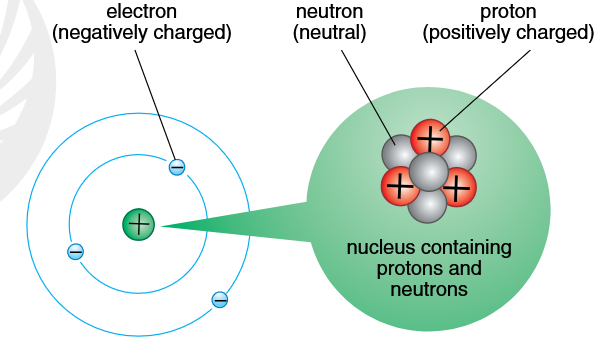
Mass comparison of subatomic particles
Protons and neutrons (nucleons) have roughly the same mass.
The mass of an electron is negligible (about 1/1800 of a nucleon).
Most of the mass of an atom is concentrated in the nucleus.
Atomic number (Z) vs Mass number (A)
Atomic number (Z) = number of protons in the nucleus. Mass number (A) = total number of protons and neutrons (nucleons). Number of neutrons = A - Z.

Isotopes
Atoms of the same element containing the same number of protons (same atomic number) but different numbers of neutrons (different mass numbers).

HKEAA Trap: Do isotopes of an element have the same properties?
They have identical CHEMICAL properties (because they have the same number of outermost electrons)
but different PHYSICAL properties (due to different masses and nuclear stability).
Radioactive decay
A spontaneous process where unstable nuclei (radionuclides) release excess energy by emitting nuclear radiation (alpha, beta, or gamma) to become more stable.
HKEAA Trap: Can radioactive decay be sped up or slowed down?
No. Radioactive decay is a spontaneous process that cannot be accelerated, decelerated, or affected by external physical means (e.g., temperature, pressure, or chemical state).
HKEAA Trap: Where does the beta particle come from during beta decay?
It comes from INSIDE the nucleus when a neutron transforms into a proton and an electron (n -> p + e^-).
It DOES NOT come from the orbiting electrons of the atom!
Alpha (α) decay equation & mass/atomic number changes
Parent nucleus emits a helium nucleus (α particle).
Mass number decreases by 4, atomic number decreases by 2.

Beta (β) decay equation & mass/atomic number changes
Parent nucleus emits an electron (β particle).
Mass number remains unchanged, atomic number increases by 1.

Gamma (γ) emission equation
An excited nucleus releases excess energy as electromagnetic waves.
NO change in mass number or atomic number.

Random nature of radioactive decay
It is impossible to predict exactly WHEN a particular nucleus will decay, or WHICH nucleus will decay next at a certain moment.
Activity (A) Definition and Formula
The rate of decay of a sample, measured in decays per second or becquerels (Bq). Formula: A = kN (where k is decay constant, N is number of undecayed nuclei).
[NOT IN DSE FORMULA SHEET - MUST MEMORIZE/DERIVE]

Decay constant (k)
The probability of decay per unit time per nucleus (or the fraction of undecayed nuclei that decay per unit time).
It is an identifying characteristic of the radionuclide and independent of external factors like temperature or pressure.
Half-life (t_1/2)
The time taken for the number of undecayed radioactive nuclei to decrease by half, or for the activity of the sample to fall by half.
Relationship between half-life and decay constant [IN DSE FORMULA SHEET]
[IN DSE FORMULA SHEET] just showing u

Exponential decay law for N and A
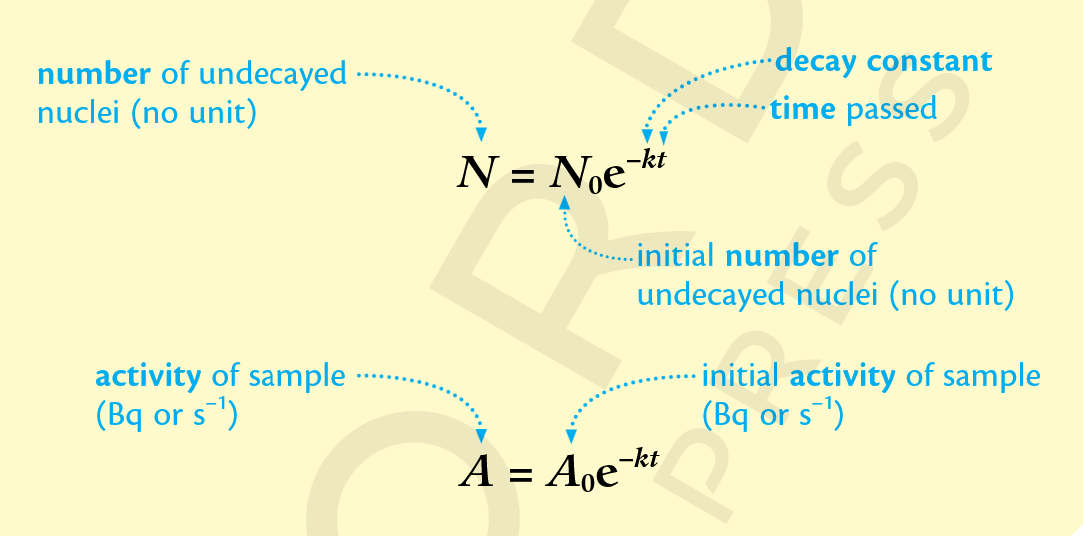
N = N0 * e^(-kt) and A = A0 * e^(-kt) [IN DSE FORMULA SHEET]
what the N mean?
The number of undecayed nuclei and activity decrease exponentially with time.
Radioactive decay curve
A graph of activity A (or N) against time t showing exponential decay. The time interval to halve the vertical value is constant and equals the half-life.

HKEAA Trap: How to handle background radiation in half-life experiments?
You MUST subtract the background count rate from the measured count rate to find the corrected count rate of the sample BEFORE applying the half-life halving logic. Measured count rate = Corrected count rate + Background count rate.

HKEAA Trap: Does the total mass of a radioactive sample halve after one half-life?
NO! Only the mass of the UNDECAYED parent nuclei halves.
The decayed nuclei do not disappear; they transmute into daughter nuclei, which remain in the sample. The total mass of the solid sample remains almost identical.
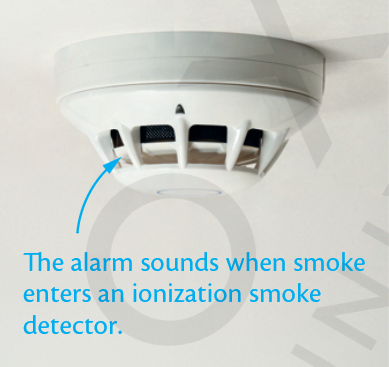
Use of radioisotopes: Smoke detectors
Uses an ALPHA source with a long half-life.
Alpha particles ionize air molecules to create moving ions, maintaining a constant current between metal plates.
When smoke enters, smoke particles absorb/block the ionized air molecules (ions), reducing the current and triggering the alarm.


Use of radioisotopes: Thickness gauge (paper/aluminum foil)
Uses a BETA source.
Beta has moderate penetrating power.
If the foil is too thick, less radiation passes through, dropping the count rate at the detector, triggering rollers to apply more pressure.

Use of radioisotopes: Radioactive tracers
Uses GAMMA sources with a short half-life (hours/days) to minimize long-term radiation exposure.
Gamma has strong penetrating power to be detected outside the body/ground (e.g., detecting underground pipe leaks or medical imaging).
Use of radioisotopes: Radiotherapy & Sterilization
Uses highly concentrated GAMMA sources (like Cobalt-60) to kill cancer cells or microorganisms in food and medical instruments.
In radiotherapy, the gamma source rotates around the tumor so that the tumor receives a high concentrated radiation dose while surrounding healthy cells receive a much lower average dose.
Carbon-14 dating principle
Living organisms maintain a constant C-14 to C-12 ratio by exchanging carbon with the atmosphere.
Upon death, C-14 intake stops, and the proportion of C-14 decreases via beta decay (half-life 5730 years).
Age is found by comparing current activity to a living sample.
HKEAA Trap: Limitations of Carbon-14 dating
It cannot be used for objects that were never alive (e.g., rocks, ceramic vases) or remains that are too old (e.g., millions of years old) because the C-14 activity would be practically zero and undetectable.
HKEAA Trap: U-238 to Pb-206 rock dating ratio (yap? idk)
If the ratio of remaining U-238 to formed Pb-206 is 4:1, it means 1 out of every 5 original U-238 nuclei has decayed.
The remaining U-238 (N) is (4/5) of the initial amount (N0).
Apply N = N0 * e^(-kt) as (4/5) = e^(-kt).
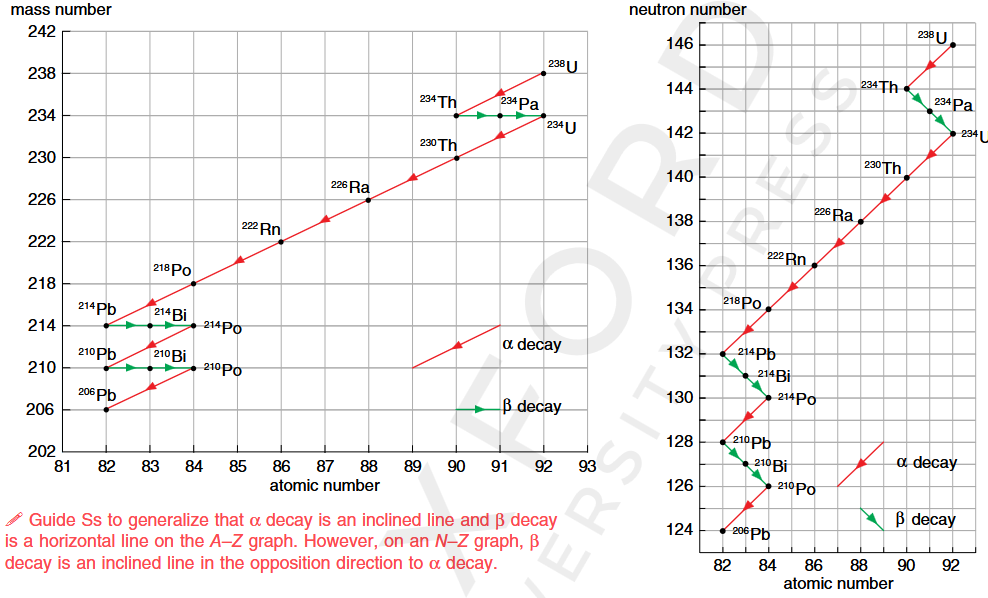
Graphical Representation of Decay Series (A-Z vs N-Z)
On an A-Z graph (Mass Number vs Atomic Number), α-decay is a diagonal line down-left (ΔA = -4, ΔZ = -2) and β-decay is a horizontal line to the right (ΔA = 0, ΔZ = +1).
On an N-Z graph (Neutron Number vs Atomic Number), α-decay is diagonal down-left (ΔN = -2, ΔZ = -2) and β-decay is diagonal down-right (ΔN = -1, ΔZ = +1). Gamma emission cannot be shown on either graph as A and Z do not change.
Why Gamma Rays are emitted after Alpha or Beta Decay
After emitting an α or β particle, the daughter nucleus is often left in an excited state with excess nuclear potential energy. It releases this extra energy by emitting a γ photon/ray to drop to a lower energy ground state without changing its proton or neutron count.
Spark Counter Mechanism & Irregular Sparking
Sparks occur at irregular intervals when an α source is brought near the metal gauze because radioactive decay is random in nature. We cannot predict when individual nuclei will decay, leading to sporadic emissions of α particles and irregular ionization/sparking.
HKEAA Trap: Detector Count Rate Fluctuation in Thickness Gauges
The recorded count rate fluctuates slightly even when measuring a metal sheet of perfectly uniform thickness due to the random nature of radioactive decay and small fluctuations in natural background radiation.