Chapter 7 Nerve Cells and Electrical Signaling
 Call Kai
 Learn
Learn Practice Test
 Spaced Repetition
 Match
Match Flashcards
 Knowt Play
1/14

There's no tags or description
Looks like no tags are added yet.
Name | Mastery | Learn | Test | Matching | Spaced | Call with Kai | Chat |
|---|
No analytics yet
Send a link to your students to track their progress
15 Terms
Peripheral nervous system
Consists of neurons that provide communication between the central nervous system and organs throughout the body.
Somatic senses
Skin, muscles, and joints
Special Senses
Vision, hearing, equilibrium, smell, and taste
Visceral senses
Internal environment (fullness of the stomach, blood pressure, and blood pH).
Table 7.1 be able to draw this out!

What does it mean that neurons are “excitable cells”
Cells that can produce large, rapid electrical signals called action potentials.
Figure 7.2 anatomy of a neuron
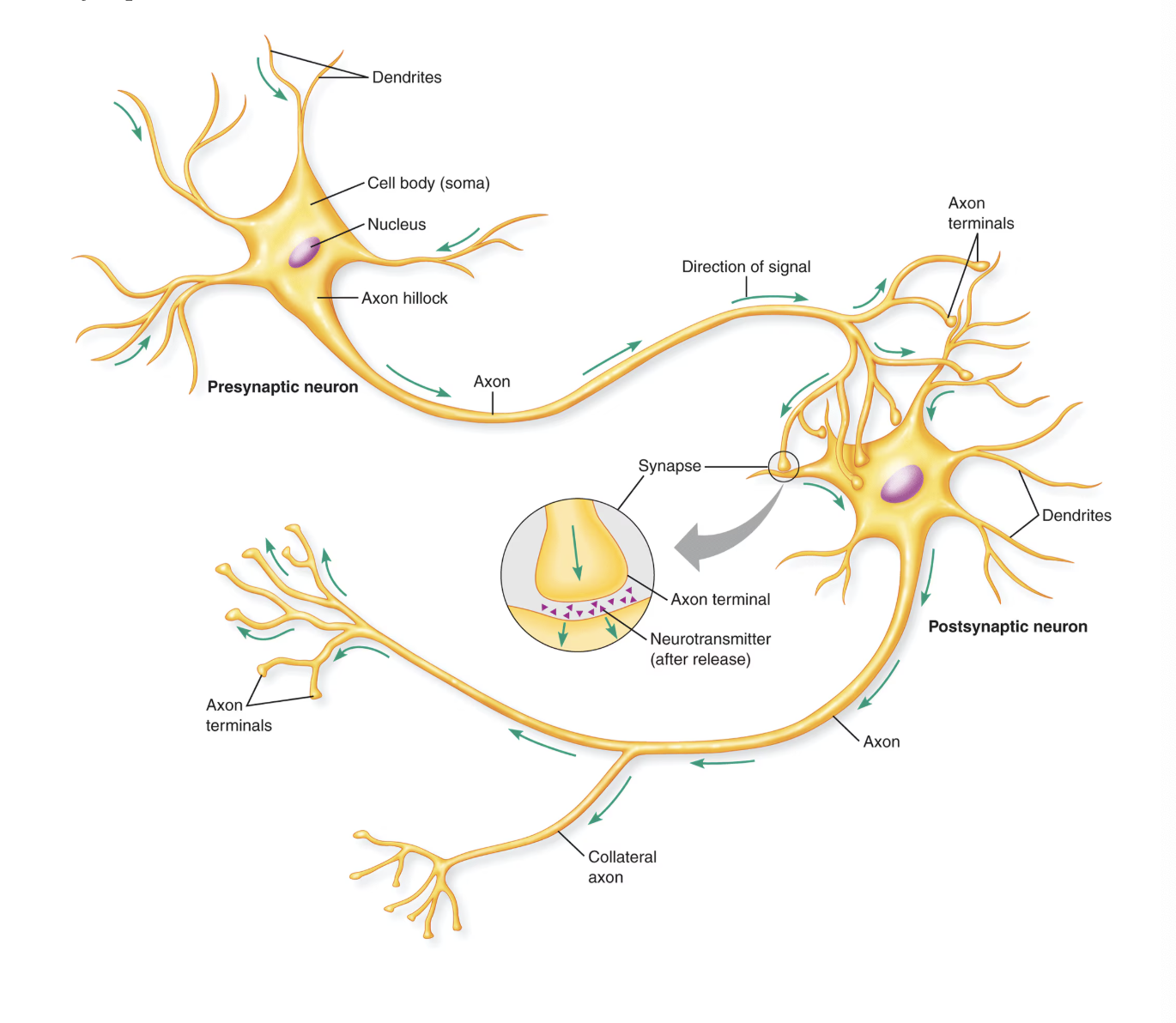
1) Cell body (soma)=contains the nucleus and most organelles
2) Dendrites=branch from the cell body and receive input from other neurons at synapses.
3) Axon=Transmits electrical pulses called action potentials
4) Axon hillock = where the axon originates, and action potentials are initiated.
5) Axon terminal=Releases neurotransmitter
Synapse
Site of communication between two neurons or between a neuron and an effector organ
Transport in neurons
1) Anterograde transport:From cell body/soma to axon terminal
2) Retrograde transport: From axon terminal to cell body/soma
Figure 7.4 fast axonal transport of vesicles

Role of ion channels
-They contribute to the resting membrane potential and facilitate signaling in Neurons
-The opening or closing of ion channels changes the permeability of the plasma membrane for a specific ion, resulting in a change in electrical properties or release of a neurotransmitter.
Leak channels
1) Always open
2) Throughout the neuron
3) Resting membrane potential
Ligand-gated channels
1) Open or close in response to ligand binding
2) Dendrites and cell body
3) Synaptic potentils
Voltage-gated channels open/close with changes in membrane potential
1) Sodium and Potassium channels: mostly in the axon; action potentials
2) Calcium channels: axon terminal; release of neurotransmitters.
Structural classes of neurons

1)