Chp 6 - Biology

0.0(0)
Studied by 0 people
call kaiCall Kai
learnLearn
examPractice Test
spaced repetitionSpaced Repetition
heart puzzleMatch
flashcardsFlashcards
GameKnowt Play
Card Sorting

1/83

encourage image

There's no tags or description

Looks like no tags are added yet.

84 Terms

1
New cards

Genome

  • A cell’s complete set of DNA

  • Found in the Nucleoid


2
New cards

Plasmids

there are EXTRA DNA molecules

3
New cards
  • LARGER

  • LINEAR (Long, Non-looped)

  • Nucleus

  • Chromatin

  • Chromosome


In the Eukaryotic Cells (Genome)

  • The Genome is ____

  • LINEAR (Long, Non-looped)

  • Found in the _____

  • ____-> Relaxed form 

  • ____-> Condensed Form


4
New cards

Chromosome

consists of a Long Strand of DNA containing many genes

5
New cards

Human Chromosome

this chromosome can have up to 500 million base pairs (Adenine-Thymine, Guanine-Cytosine) of DNA w/ Thousands of Genes

6
New cards

Nucleotide Monomer

Nucleic Acids

PO4 (phosphate group), Sugar, & a Nitrogenous Base

<p><span style="background-color: transparent;">PO4 (phosphate group), Sugar, &amp; a Nitrogenous Base</span></p>
7
New cards

Thymine (T)

Complementary Nitrogenous Base Pairing in DNA

Adenine (A) pairs with?
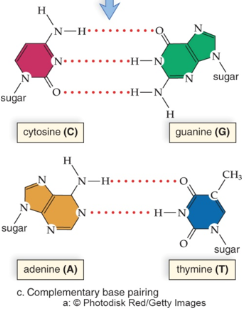
<p><strong>Complementary Nitrogenous Base Pairing in DNA</strong></p><p><span style="background-color: transparent;"><strong>Adenine (A) pairs with?</strong></span></p>
8
New cards

Cytosine (C)

Complementary Nitrogenous Base Pairing in DNA

Guanine (G) pairs with?
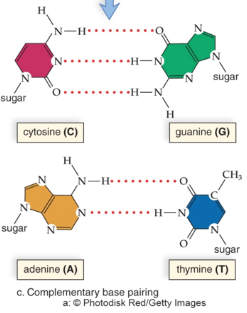
<p><strong>Complementary Nitrogenous Base Pairing in DNA</strong></p><p><span style="background-color: transparent;"><strong>Guanine (G) pairs with?</strong></span></p>
9
New cards

DNA Structure

  • Double Helix (like a twisted ladder)

  • uses Hydrogen Bonding (Weak bond but many of them it’s a strong bond)
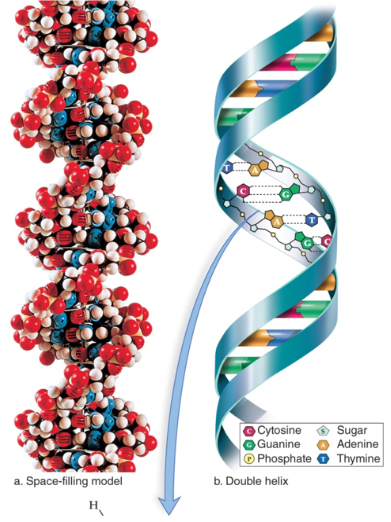

<ul><li><p><span style="background-color: transparent;">Double Helix (like a twisted ladder)</span></p></li><li><p><span style="background-color: transparent;">uses Hydrogen Bonding (Weak bond but many of them it’s a strong bond)</span></p></li></ul><p></p>
10
New cards

Genes

Sequences of DNA on a chromosome that CODE FOR A SPECIFIC PROTEINS, or RNA molecules (messenger RNA)

11
New cards

Genes

  • ___are the Functional Units of Heredity

  • ___is a REGION of DNA that codes for Proteins

  • ___consist of a Distinct Sequence of Nucleotides (= DNA monomers) forming part of a Chromosome, arranged in a certain order to code for Protein Molecules which a Cell SYNTHESIZES

  • ____code for Eye color, Hair color, Skin color, Sex, Body type, etc


12
New cards

Genes

  • ___is a short piece of DNA

  • ___tell the body how to build specific proteins

  • about 20,000 ___ in each cell of the human body

  • Together, they make up the blueprint for the human body & how it works


13
New cards

Genotype

A person’s genetic makeup is called a ____

14
New cards

Genome

this is the Entire Genetic Complement of an Organism (= all of the DNA)

15
New cards

46 chromosomes

Each Eukaryotic Species has a unique number of Chromosomes

how many chromosomes humans have?

16
New cards

an organism is more COMPLEX (smartness)

NUMBERS of Chromosomes DOES NOT mean

17
New cards
  • Somatic 

  • Gametes


Two Different Cell Types in a HUMAN

18
New cards

Somatic

(body cells) = Diploid = Full Complement of Chromosomes

19
New cards

Gametes

(sex cells) = Haploid = 1/2 the Number of Chromosomes

20
New cards
  1. Somatic

  2. 23 sets of Chromosomes

  3. 2 Chromosomes

  4. total of 46 Chromosomes


  1. ___Cells are Diploid -> Two Chromosomes / set = 2n

  2. Humans have ____

  3. Each set has ____

  4. Humans have a ____ in a Somatic (body) cell


21
New cards
  1. Gamete

  2. Two Haploid (n) ; Diploid (2n) State


  1. ___Cells are Haploid -> One Chromosome / Set = n

  2. When ____ cells meet (fertilization), the Organism is back to ____


22
New cards

23 Pairs of Homologous Chromosomes

There are ____ in a female Human Somatic Cell (2 X Chromosomes)

23
New cards

Karyotype

  • These Chromosomes are viewed w/in the Nucleus (top), Removed from a cell in Mitosis (right), & Arranged according to Length (left) in an arrangement called a ____

  • An individual’s complete set of chromosomes → organizes those chromosomes by Size, Shape, & Numbers


<ul><li><p><span style="background-color: transparent;">These Chromosomes are viewed w/in the Nucleus (top), Removed from a cell in Mitosis (right), &amp; Arranged according to Length (left) in an arrangement called a ____</span></p></li><li><p>An individual’s complete set of chromosomes → organizes those chromosomes by Size, Shape, &amp; Numbers</p></li></ul><p></p>
24
New cards

Homologous chromosomes

  • ____are MATCHED PAIRS of Chromosomes in a Diploid (2n) Organism

  • ____have the same genes but often have VARIATION among those genes

  • One Gene is from Mom, One gene is from Dad (in each set) so it’s unlikely that you get the same genes from both unless Mom & Dad are very CLOSELY RELATED


25
New cards
  • The SAME LENGTH

  • Have the SAME GENES in the SAME LOCATION

  • the centromere is in the same location, and genes are in the same locus but have variation


Each Chromosomes in a Pair are:

26
New cards

Locus (Loci plural)

The Location of a Gene is called a ___

27
New cards
term image

Duplicated Homologous Chromosomes

28
New cards

Homologous Chromosomes

  • You get One Chromosome from Mom & One from Dad in EACH SET

  • In the Cell Cycle, the Chromosomes DUPLICATE


<ul><li><p><span style="background-color: transparent;">You get One Chromosome from Mom &amp; One from Dad in EACH SET</span></p></li><li><p><span style="background-color: transparent;">In the <strong>Cell Cycle</strong>, the <strong>Chromosomes DUPLICATE</strong></span></p></li></ul><p></p>
29
New cards

Sister Chromatid

An Identical Copy of a Chromosome that is attached is called a ___

<p><span style="background-color: transparent;">An Identical Copy of a Chromosome that is attached is called a ___</span></p>
30
New cards

Homologous Chromosomes

members of a Pair of Chromosomes that are ALIKE w/ Small Variations in Genes they Hold

<p><span style="background-color: transparent;">members of a Pair of Chromosomes that are ALIKE w/ Small Variations in Genes they Hold</span></p>
31
New cards

(sister) Chromatids

Duplicated Chromosomes attached by a Centromere

<p><span style="background-color: transparent;">Duplicated Chromosomes attached by a <strong>Centromere</strong></span></p>
32
New cards

Cell Cycle

  • an Ordered Series of Steps that concludes w/ Two New Identical Daughter Cells

  • DNA is copied & Divided evenly


33
New cards

To allow an Organism to GROW & REPAIR itself

Cell Cycle Purpose

34
New cards

Two Identical Daughter Cells

Cell Cycle Outcome

35
New cards

Interphase & Mitotic Phase

Cell Cycle TWO MAJOR PHASES

36
New cards
<ol><li><p>Interphase &amp; Mitotic Phase</p></li><li><p>Interphase: G1, S, G2</p></li><li><p>Mitotic Phase: Mitosis + Cytokinesis</p></li><li><p>Mitosis 5 Stages: Prophase, Metaphase, Anaphase, Telophase (PMAT)</p></li></ol><p></p>
  1. Interphase & Mitotic Phase

  2. Interphase: G1, S, G2

  3. Mitotic Phase: Mitosis + Cytokinesis

  4. Mitosis 5 Stages: Prophase, Metaphase, Anaphase, Telophase (PMAT)


Cell Cycle

37
New cards
  • To make Identical Cells to Replace Old Cells

    • Get DNA into the Cells to make it Organized


Mitosis PURPOSE

38
New cards

CONTINUING ; WRONG

Checkpoints of the Cell Cycle

  • Checkpoints Prevent Cells from ____ the Cell Cycle when Something is _____

    • Ex: P53 will STOP the Cell Cycle at G1 if DNA is damaged


39
New cards

G1 Checkpoint (primary checkpoint)

  • Assess DNA damage & nutrient availability

  • the check point in which a cell checks if DNA was damaged during mitosis and if there is enough nutrients available to move forward with the cell cycle. The molecule p53 is used here to correct DNA damage or cause apoptosis.


40
New cards

G2 Checkpoint

  • Check for Completion of DNA replication

  • occurs to check if chromosomes lined up correctly during mitosis before being split to opposite side of the cell


41
New cards

M Checkpoint

  • Assess Chromosome alignment & spindle connection

  • occurs to check that DNA was replicated correctly in the previous phase


42
New cards
  • G1 phase

  • S phase

  • G2 phase


Interphase (functions) consists of phases:

43
New cards

Interphase

  • It takes up 90% of the Cell Cycle

  • Most of the Cell Cycle is spent in ____

  • Cell performs its usual functions

  • Time spent in ____ varies by Cell type


44
New cards

First Gap Phase (G1 Phase)

The Cell Cycle - Interphase - G1

  • Cell is in RECOVERY from Previous Division

  • Cell DOUBLES its Organelles

  • Cell GROWS in Size

  • Cell ACCUMULATES Raw Materials for DNA synthesis

  • Cell recovering from division, growing in size, doubling organelles


<ul><li><p><span style="background-color: transparent;">Cell is in <strong>RECOVERY </strong>from <strong>Previous Division</strong></span></p></li><li><p><span style="background-color: transparent;">Cell <strong>DOUBLES </strong>its <strong>Organelles</strong></span></p></li><li><p><span style="background-color: transparent;">Cell <strong>GROWS </strong>in <strong>Size</strong></span></p></li><li><p><span style="background-color: transparent;">Cell <strong>ACCUMULATES Raw Materials for DNA synthesis</strong></span></p></li><li><p><span>Cell recovering from division, growing in size, doubling organelles</span></p></li></ul><p></p>
45
New cards

S Phase in The Cell Cycle

  • S stands for SYNTHESIS 

    • Proteins associated with DNA are also DUPLICATED

    • Chromosomes enter _____ with 1 Chromatid EACH

    • Chromosomes leave _____ with 2 Identical Chromatids (Sister Chromatids) EACH

    • Sister Chromatids remain attached until they are SEPARATED during Mitosis

    • DNA is replicated


<ul><li><p><span style="background-color: transparent;">S stands for <strong>SYNTHESIS&nbsp;</strong></span></p><ul><li><p><span style="background-color: transparent;"><strong>Proteins </strong>associated with DNA are also <strong>DUPLICATED</strong></span></p></li><li><p><span style="background-color: transparent;"><strong>Chromosomes <u>enter </u>_____ </strong>with <strong>1 Chromatid EACH</strong></span></p></li><li><p><span style="background-color: transparent;"><strong>Chromosomes <u>leave _____</u></strong> with <strong>2 Identical Chromatids (Sister Chromatids) EACH</strong></span></p></li><li><p><span style="background-color: transparent;"><strong>Sister Chromatids remain attached</strong> until they are <strong>SEPARATED </strong>during <strong><u>Mitosis</u></strong></span></p></li><li><p><span>DNA is replicated</span></p></li></ul></li></ul><p></p>
46
New cards

Interphase - S Phase

Which phase

  • Each DNA molecule is attached by a CENTROMERE

  • Sister Chromatids attached by Centromere

  • DONT SEPARATE UNTIL MITOSIS


<p>Which phase</p><ul><li><p><span style="background-color: transparent;">Each<strong> DNA molecule</strong> is attached by a <strong>CENTROMERE</strong></span></p></li><li><p><span style="background-color: transparent;"><strong>Sister Chromatids</strong> attached by <strong>Centromere</strong></span></p></li><li><p><span style="background-color: transparent;"><strong>DONT SEPARATE UNTIL MITOSIS</strong></span></p></li></ul><p></p>
47
New cards

G2 Phase in The Cell Cycle

  • ____is located b/t DNA Replication & Mitosis

  • Cell Synthesizes Proteins, including Microtubules, necessary for Division

  • The Cell “Double Checks” the Duplicated Chromosomes for error, making any NEEDED REPAIRS

  • Cell continues to grow, forms microtubules in preparation for division


<ul><li><p><span style="background-color: transparent;"><strong>____</strong>is located b/t <strong>DNA Replication &amp; Mitosis</strong></span></p></li><li><p><span style="background-color: transparent;"><strong><u>Cell Synthesizes Protein</u>s, including Microtubules, <u>necessary for Division</u></strong></span></p></li><li><p><span style="background-color: transparent;">The Cell <strong>“Double Checks”</strong> the Duplicated Chromosomes for error, making any<strong> NEEDED REPAIRS</strong></span></p></li><li><p><span>Cell continues to grow, forms microtubules in preparation for division</span></p></li></ul><p></p>
48
New cards

Interphase - G2

Second Gap Phase -> G2

  • Replenishes Energy Spent in S Phase

  • Synthesize Protein (microtubules) used to break apart the Sister Chromosomes


<ul><li><p><span style="background-color: transparent;"><strong>Replenishes Energy</strong> Spent in S Phase</span></p></li><li><p><span style="background-color: transparent;"><strong>Synthesize Protein</strong> (microtubules) used to break apart the<strong> Sister Chromosomes</strong></span></p></li></ul><p></p>
49
New cards

G0 (G Naught)

  • This is the RESTING PHASE

  • Some Cells ENTER & NEVER Duplicate

    • Cardiac Muscle Cells

    • Nerve Cells

  • Some Cells STAY HERE until SIGNALED to Replicate


<ul><li><p><span style="background-color: transparent;">This is the </span><span><strong>RESTING PHASE</strong></span></p></li><li><p><span style="background-color: transparent;"><strong>Some Cells <u>ENTER &amp; NEVER Duplicate</u></strong></span></p><ul><li><p><span style="background-color: transparent;">Cardiac Muscle Cells</span></p></li><li><p><span style="background-color: transparent;">Nerve Cells</span></p></li></ul></li><li><p><span style="background-color: transparent;"><strong>Some Cells <u>STAY HERE </u>until <u>SIGNALED </u>to <u>Replicate</u></strong></span></p></li></ul><p></p>
50
New cards
  • Mitosis 

  • Cytokinesis


Mitotic Phase Includes:

51
New cards

Mitosis

5 Stages where Chromosomes are Divided

52
New cards

Cytokinesis

  • The Physical Separation of Cytoplasm into Two New Daughter Cells

    • Results in 2 Genetically Identical Daughter Cells


53
New cards
<p><span style="background-color: transparent;"><strong>Prophase - Metaphase - Anaphase - Telophase</strong></span></p>

Prophase - Metaphase - Anaphase - Telophase

Phases of Mitosis (PMAT)

54
New cards
  • 1) Mitosis 

    • Nuclear Division

    • Daughter Chromosomes distributed by the Mitotic Spindle to Two Daughter Nuclei

  • 2) Cytokinesis

    • Division of the Cytoplasm

  • Results in Two Genetically Identical Daughter Cells


M (Mitotic) Stage (PMAT + C)

<p><strong>M (Mitotic) Stage (PMAT + C)</strong></p>
55
New cards

S Phase

Chromosomes are being Synthesized & Replicated

56
New cards

G2

Check to make sure the Chromosomes are replicated properly & if they arent they are repaired -> if not the cell dies

57
New cards

Prophase

Phases of Mitosis

  • Chromatin condenses into Chromosomes

  • Nucleolus DISAPPEAR

  • Centrosomes (2 Microtubule Rings called Centrioles / Mitotic Spindle Fiber Creators) move to Opposite Sides of the Cell

  • Spindle Fibers form Microtubules

  • Chromatin condenses, nucleus and nucleolus breakdown, mitotic spindle fibers form


<p><strong>Phases of Mitosis</strong></p><ul><li><p><span style="background-color: transparent;"><strong>Chromatin </strong>condenses into Chromosomes</span></p></li><li><p><span style="background-color: transparent;"><strong>Nucleolus DISAPPEAR</strong></span></p></li><li><p><span style="background-color: transparent;"><strong>Centrosomes </strong>(2 Microtubule Rings called </span><span><strong>Centrioles / Mitotic Spindle Fiber Creators</strong></span><span style="background-color: transparent;">) <strong>move </strong>to<strong> Opposite Sides </strong>of the <strong>Cell</strong></span></p></li><li><p><span style="background-color: transparent;"><strong>Spindle Fibers form Microtubules</strong></span></p></li><li><p><span>Chromatin condenses, nucleus and nucleolus breakdown, mitotic spindle fibers form</span></p></li></ul><p></p>
58
New cards

Metaphase

Phases of Mitosis

  • Chromosomes ALIGN on the Metaphase Plate in the Center of the Cell

  • Chromosomes line up down the center


<p><strong>Phases of Mitosis</strong></p><ul><li><p><span style="background-color: transparent;">Chromosomes <strong>ALIGN </strong>on the <strong>Metaphase Plate</strong> in the<strong> Center </strong>of the Cell</span></p></li><li><p><span>Chromosomes line up down the center</span></p></li></ul><p></p>
59
New cards

Anaphase

Phases of Mitosis

  • Sister Chromatids are Pulled Apart by the Spindle Fibers

  • Now called Daughter Chromosomes

  • Sister chromatids separate forming daughter chromosomes.


<p><strong>Phases of Mitosis</strong></p><ul><li><p><span style="background-color: transparent;"><strong>Sister Chromatids </strong>are<strong> Pulled Apart </strong>by the <strong>Spindle Fibers</strong></span></p></li><li><p><span style="background-color: transparent;">Now called <strong>Daughter Chromosomes</strong></span></p></li><li><p><span>Sister chromatids separate forming daughter chromosomes.</span></p></li></ul><p></p>
60
New cards

Telophase

Phases of Mitosis

  • OPPOSITE of Prophase

  • Daughter Chromosomes reach the Opposite Side of Cell

  • Chromosomes RELAX (Decondense)

  • Nucleus & Nucleolus REFORM

  • Spindle Fibers BREAK DOWN

  • Chromosomes relax, nucleus and nucleolus reform, mitotic spindle fibers breakdown


<p><strong>Phases of Mitosis</strong></p><ul><li><p><strong>OPPOSITE of Prophase</strong></p></li><li><p><span style="background-color: transparent;"><strong>Daughter Chromosomes</strong> <strong>reach the Opposite Side</strong> of Cell</span></p></li><li><p><span style="background-color: transparent;"><strong>Chromosomes RELAX (Decondense)</strong></span></p></li><li><p><span style="background-color: transparent;"><strong>Nucleus &amp; Nucleolus</strong> <strong>REFORM</strong></span></p></li><li><p><span style="background-color: transparent;"><strong>Spindle Fibers</strong> <strong>BREAK DOWN</strong></span></p></li><li><p><span>Chromosomes relax, nucleus and nucleolus reform, mitotic spindle fibers breakdown</span></p></li></ul><p></p>
61
New cards

Cytokinesis

  • Second Phase of the Mitotic Phase

  • Physical Separation of the Cell into Two Identical Daughter Cells

  • Often begins in Anaphase

  • This Process is DIFFERENT for Animal Cells Compared to Plant Cells

  • Animals – actin creates a cleavage furrow. Plants – cell plate forms. Both – cells split


<ul><li><p><span style="background-color: transparent;">Second Phase of the Mitotic Phase</span></p></li><li><p><span style="background-color: transparent;"><strong>Physical Separation</strong> of the Cell into <u>Two Identical Daughter Cells</u></span></p></li><li><p><span style="background-color: transparent;">Often begins in <strong>Anaphase</strong></span></p></li><li><p><span style="background-color: transparent;">This Process is <strong>DIFFERENT</strong> for <u>Animal Cells Compared to Plant Cells</u></span></p></li><li><p><span>Animals – actin creates a cleavage furrow. Plants – cell plate forms. Both – cells split</span></p></li></ul><p></p>
62
New cards
  • CONTRACTILE RING of Actin Filaments forms at Metaphase Plate

  • Contracts & Creates Cleavage Furrow

  • This is where the Cells SPLIT


Cytokinesis In Animal Cells

63
New cards
  • Rigid Cells Wall DONT Allow the Plant Cell to have a Contractile Ring

  • Form a Cell Plate made of Vesicles & Cellulose (Cell Wall Material)


Cytokinesis In Plant Cells

64
New cards
term image

Kinetochore, Kinetochore Microtubules, Centromere, Chromatids

65
New cards

Kinetochore

A Disc-Shaped Protein Structure associated w/ Duplicated Chromatids in Eukaryotic Cells where the Spindle Fibers attach during Cell Division to PULL Sister Chromatids APART
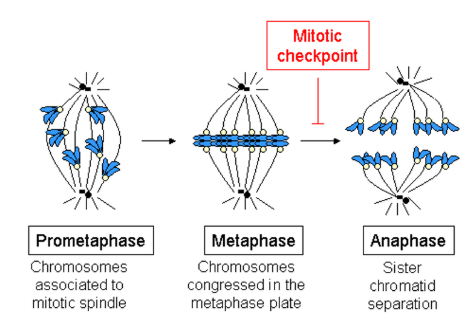
<p><span style="background-color: transparent;">A <strong>Disc-Shaped Protein Structure</strong> associated w/ <strong>Duplicated Chromatids </strong>in <strong>Eukaryotic Cells </strong>where the <strong>Spindle Fibers attach during Cell Division </strong>to<strong> PULL Sister Chromatids APART</strong></span></p>
66
New cards
  1. Metaphase

  2. Prophase

  3. Beginning of Cytokinesis

  4. Interphase

  5. Plant cell already divided

  6. Plant cell already divided 

  7. Anaphase

  8. Interphase

  9. Same as 3 

  10. Metaphase


Pick out the Phase

<p><span><strong>Pick out the Phase</strong></span></p>
67
New cards
  • 1 -> Cytokinesis (late Telophase)

  • 2 -> Anaphase

  • 3 -> Interphase

  • 4 -> Interphase after Cytokinesis (cell walls form in b/t)

  • 5 -> Metaphase


Pick out the Phase

<p><span><strong>Pick out the Phase</strong></span></p>
68
New cards

Cancer

  • A Collective Name for Different Diseases

    • Caused by Uncontrolled Cell Division


69
New cards

Cell Cycle Checkpoints

  • are VITAL to Maintain Cell Health

    • If Broken -> Leads to Cancer


70
New cards

Mutations

___occurring during S Phase lead to Cancer

71
New cards

Protein Malfunctioning

All Cancers ________ due to Mutations

72
New cards

Tumors

____result when Cells Divided UNCONTROLLABLY

73
New cards

Proto-Oncogenes

  • GOOD Genes that Code for POSITIVE Cell Cycle Regulators (proteins)

    • They PUSH the Cell Cycle FORWARD (keep dividing)

    • BUT, when they Mutate ______ become Oncogenes (causes cancer)

    • We need these!


74
New cards

Oncogenes

  • BAD Genes that Cause a Cell to Develop Cancer

    • If a Proto-Oncogene is Mutated, it may become an _____


75
New cards

Tumor Suppressor Genes

  • Genes that control the NEGATIVE Cell Cycle Regulator Proteins

    • They STOP the Cell Cycle when it SHOULDNT GO ON (stop dividing)

  • We need these too!

  • Ex: p53


76
New cards

All Cancers

Mutated P53 Genes lead to HALF of _____ Identified so far

<p><span style="background-color: transparent;"><strong><u>Mutated P53 Genes</u> lead to <u>HALF </u>of _____ <u>Identified</u> so far</strong></span></p>
77
New cards
  1. MONITOR DNA

  2. Repair Mechanisms

  3. Apoptosis


  1. The Role of P53 is to ____

  2. If Damage is Detected, P53 TRIGGERS ______

  3. If Repairs are UNSUCCESSFUL, P53 signals _____


78
New cards
  • DNA ; Apoptosis

  • Cancerous


  • A Cell w/ an Abnormal P53 Protein CANNOT Repair ___ & CANNOT signal _____

  • Cells w/ Abnormal P53 can become _____


79
New cards
  • MONITORED

  • MUTATED

  • arrest cell growth ; repair

  • Apoptosis


  • p53 gene codes for the p53 protein that _____ the cell cycle

  • Over 50% of cancers are caused by _____ p53 proteins

  • P53 will _____ & begin to ____ damaged DNA

  • If can’t fix the damage in the cell, it will lead to ____ (programmed cell death)

  • = Tumor suppressor protein


80
New cards

Tumor Suppressing Protein p53

  • The p53 Gene provides Instructions for making a Protein called ____

  • Protein ACTS as a Tumor Suppressor → Regulates Cell Division by Keeping Cells FROM Growing & Dividing (proliferating) TOO FAST or in an UNCONTROLLED Way


81
New cards

Apoptosis

  • Programmed Cell Death

    • It involves a Sequence of Cellular Events that bring about the Destruction of the Cell


82
New cards
  • INCREASES

  • DECREASES


Mitosis & Apoptosis are Opposing Forces

  • Mitosis ____ Cell Number

  • Apoptosis ____ Cell Number


<p><span style="background-color: transparent;"><strong>Mitosis &amp; Apoptosis are Opposing Forces</strong></span></p><ul><li><p><span><strong>Mitosis </strong></span><span style="background-color: transparent;"><strong>____ </strong>Cell Number</span></p></li><li><p><span><strong>Apoptosis </strong></span><span style="background-color: transparent;"><strong>____ </strong>Cell Number</span></p></li></ul><p></p>
83
New cards

Binary Fission

  • Asexual (w/out sex) Reproduction in which Cells Divide into 2 Identical Daughter Cells w/out going through Eukaryotic Cell Division (Interphase & Mitotic Phase)

  • QUICKER & LESS Complicated than Sexual Reproduction (don’t need a partner)

  • Prokaryote Asexual Reproduction

    • Results in Genetically Identical Cells

  • THIS IS NOT MITOSIS


84
New cards
  • Circular Chromosome BINDS to the Plasma Membrane at a Special Site

  • DNA begins Replication at the Origin in BOTH DIRECTIONS

  • Each origin moves TOWARD OPPOSITE ENDS of the Cell

  • Cell ELONGATES

  • A Septum (Cleavage Furrow) forms & Cell Walls Form


Binary Fission Steps

<p><span><strong>Binary Fission Steps</strong></span></p>



