Rad Onc Physics: Nuclear Decay
 Call Kai
 Learn
 Practice Test
 Spaced Repetition
 Match
 Flashcards
 Knowt Play
1/87

There's no tags or description
Looks like no tags are added yet.
88 Terms
Nucleus
Protons + Neutrons
Atomic Number (Z)
Number of protons (uniquely determines the chemical identity of the element)
Atomic Mass (A)
# protons + # neutrons
Neutron Number (N)
A - Z
Nomenclature

Isotopes
nuclides with the same number of protons

Isotones
nuclides with the same number of neutrons

Isobars
nuclides with the same atomic mass (A)

Isomers
nuclides in different excited/metastable states

Radioactive decay results in the production of what 2 types of radiation?
Particulate (protons, electrons) and Electromagnetic (X-rays, 𝛄-rays)
Radioactive Decay
A process by which an unstable nucleus transforms into a more stable one by emitting particles and/or photons and energy
Unstable Nucleus
Parent
"more" Stable Nucleus
Daughter
Energy Released
Transition Energy (Q)
Decay equation for Beta- emission
- Neutron converted into Proton + Electron
- Z+1 results in isobar formation

Isomeric Transition (IT)
Decay of metastable (isomeric) state to ground state with the emission of a 𝛄-ray
Internal Conversion (IC)
Transition energy transferred to an orbiting electron (usually in k-shell)
Conversion electron emitted with energy equal to
[𝛄-ray energy - binding energy of the k-shell]
Decay Equation for Isomeric Transition (IT)
Nucleus goes from higher energy state to ground state

Decay Equation for Internal Conversion (IC)
Nucleus interacts with orbital electron
X-Rays and possible Auger electrons accompany

Decay Equation for Electron Capture (EC) and (EC, 𝛄)
Orbital electron captured by the nucleus
Z-1 results in Isobar formation
For (EC): Only radiation emitted is neutrino (v)

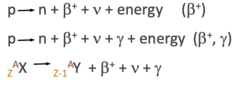
Decay Equation for Positron Emission (β+) and (β+, 𝛄)
Proton converted into neutron and positron
Z-1 results in Isobar formation
ALWAYS 1.02 MeV from annihilation interaction
A pair of _______ MeV photons are emitted at _______ degrees to each other
0.511; 180
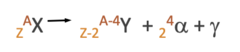
Decay Equation for Alpha Emission (⍺) and (⍺, 𝛄)
Atomic Number (Z) must be greater than or equal to 140
Alpha Particle is a Helium nucleus
May or may not be accompanied by gamma
Nuclear Fission Equation

The Decay Constant (ƛ)
Fraction of the atoms undergoing radioactive decay per unit time (during a time period that is so short only a small fraction decay during the time interval)
For a sample of N radioactive atoms, the average decay rate (decays per time), dN/dT is given by:

Law of Decay
N(t) = number of atoms at time t
N(0) = number of atoms at time 0
𝜆 = decay constant
****can sub N with A (activity)
A(t) = activity at time t
A(0) = activity at time 0
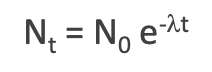
True or False: Decay is an exponential function of time
True
True or False: Activity is an exponential function of time
True
Half Life (T^1/2)
The time required for the activity to decay to 50% of its initial value

Average Life or Mean Life
Important concept in permanent brachy implants

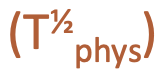
Physical Half Life
Biological Half Life
Disappearance with time of a radioactive biochemical substance in a biological system, can be described as ƛ(biol) similar to radioactive decay
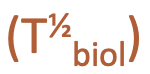
Effective Half Life
Disappearance with time of a radioactive biochemical substance in a biological system, both by radioactive decay and biological elimination
ƛ(eff) = ƛ(phys) + ƛ(biol)

Curie (Ci)
1 Ci = 3.7 x 10^10
Disintegrations per second
Originally defined as:
1 Ci = 1gram(226)Ra
Becquerel (Bq)
1 Bq = 1 disintegration per second = 27 x 10^-12 Ci
Conversion Factors
1mCi = 37 megaBq (MBq)
1MBq = 27 μCi
Equilibrium
A roughly constant relationship between the activity of the Parent (which is radioactive) and the activity of the Daughter (which is also radioactive)
What does the type of equilibrium depend on?
The ratio of the parent and daughter half-lives
Secular Equilibrium
T(1/2) parent >>> T(1/2) daughter (seems ∞)
ƛ daughter >>> ƛ parent
Transient Equilibrium
T(1/2) parent > T(1/2) daughter (5, 10, 20)
ƛ daughter > ƛ parent
No Equilibrium
T(1/2) daughter > T(1/2) parent
ƛ daughter < ƛ parent
Commonly used brachytherapy sources
Radium, Radon, Cobalt, Cesium, Iridium, Gold, Iodine, Palladium
When was Radium (226Ra) discovered?
1898, first source utilized
What is the half life of Radium 226?
≈ 1600 years
What is the average 𝛾-ray energy of Radium 226?
0.83 MeV (830keV)
Original Rx regimens of Radium 226
Only specified Radium, Interstitial and Intracavitary treatments
Construction of Radium 226
Radium Sulfate or Chloride, mixed with inert filler, sealed in Gold foil and then sealed in Platinum needle to prevent leakage of Radon Gas
Radium Prescription
mg-hrs to give the desired dose
Leakage of Radon Gas is a significant hazard if what is broken?
Source (needle)
Radium Exposure rate constant equation
𝚃 (exposure rate constant) = 8.25 R-㎠/mCi-hr for a platinum needle 0.5mm thick
Cesium (137Cs)
Byproduct material from reactors
Cesium 137 half life
30 years, most correct activity 2%/year
Cesium 137 𝛾-ray energy
0.622 MeV (662keV)
Cesium 137 Rx regimens
Replacement for radium, Interstitial and Intracavitary treatments
Cesium 137 construction
Insoluable powders or microspheres labeled with 137Cs and double encapsulated in stainless-steel needles or tubes
Cesium 137 prescription
mg-hrs Radium equivalent to give the desired dose.
Grew out of original Radium data.
Later changed to rad (cGy) and mCi
Cobalt (60Co)
Manufactured in reactors, rarely used now
Cobalt 60 half life
5.26 years, must correct activity ≈1%/month
Cobalt 60 𝛾-ray energies
1.17 MeV and 1.33 MeV
Cobalt 60 Rx regimens
Replacement for Radium, Intracavitary treatments
Cobalt 60 Construction
usually fabricated in a wire that is encapsulated in a sheath of platinum iridium or stainless steel
Iridium (192Ir)
Lower energy: less personnel shielding
Iridium 192 half life
73.8 days
Iridium 192 average 𝛾-ray energy
0.38 MeV (380keV)
Iridium 192 Rx regimens
Replacement for Radium, Interstitial (ribbons, LDR, HDR), Intracavitary (HDR)
Iridium 192 Construction
Usually fabricated in the form of thin flexible wires than can be cut to desired lengths
Gold (198Au)
Lower energy: Less personnel shielding
Gold 198 half life
2.7 days
Gold 198 𝛾-ray energy
0.412 MeV (412keV)
Gold 198 Rx regiments
Replacement for Radon seeds, permanent implants (brain, etc)
Iodine (125I)
Lower energy: less personnel shielding
Most commonly used LDR source
Iodine 125 Half Life
59.4 days (TG 43)
Iodine 125 Average energy
0.028 MeV (28 keV)
Iodine 125 Rx regimens
Permanent Implants (i.e prostate), Temporary (i.e Eye Plaques)
Iodine 125 Construction
0.05mm titanium tube welded at both ends to form a cylindrical capsule; differing vendor designs of the active portion
Iodine 125 Lower Energy
Less personnel shielding
Palladium (103Pd)
Lower energy: less personnel shielding
Palladium 103 Half Life
17 days (Decays faster than iodine, delivers dose faster)
Palladium 103 average energy
0.021 MeV (21keV)
Palladium 103 Rx regimens
Permanent Implants (i.e prostate), Interstitial (ribbons), Permanent
Palladium 103 Construction
Laser welded titanium tube containing 2 graphite pellets plated with 103Pd
Radioactive Decay Source Strength Specification
1. Activity (Curie, Bq)
2. Exposure Rate (R/time, or X)
3. Equivalent Mass of Radium (mg-Ra equivalents)
4. Air Kerma Strength (μGy-㎡/hr)
Exposure Rate
Exposure Rate Constant (𝛤)
Unique to each radionuclide
Relates the activity of a nuclide's emitted photons to the Exposure Rate
Exposure Rate Constant Equation
𝛤 = (Ẋ * d^2)/A
Measured at a specified distance perpendicular to seed axis (std. is 1m)
Assumes the nuclide to be a point source
Units of 𝛤 = (R-㎠)/mCi-hr) or R-㎡)/Ci-hr)
Exposure Rate Constant (𝛤) depends upon?
1. Isotope (energy, # photons/decay)
2. Encapsulation (stainless steel, platinum, etc)
mg-Radium Equivalent Equation
A(Ra) = A x 𝛤/𝛤(Ra)
Can also use the equation pictures:
*****Cs may be substituted for other elements

Total dose equation
D = Ḋ x time