Lecture 6 + 7 - DOHAD and Epigenetic's
 Call Kai
 Learn
Learn Practice Test
 Spaced Repetition
 Match
Match Flashcards
 Knowt Play
1/82

There's no tags or description
Looks like no tags are added yet.
Name | Mastery | Learn | Test | Matching | Spaced | Call with Kai | Chat |
|---|
No analytics yet
Send a link to your students to track their progress
83 Terms
What was the Hunger Winter?
A famine in the western Netherlands in 1944–1945 caused by Nazi Germany blocking food supplies.
Official rations fell as low as 500 kcal/day, causing widespread starvation.
Following liberation in May 1945, food supplies were immediately restored
What did researchers examine in Hunger Winter studies?
Researchers studied how maternal undernutrition at specific points during gestation affected offspring
Researchers measured birth weights of children and tracked long-term outcomes as the children aged
The famine affected fertility, weight gain during pregnancy, maternal blood pressure, infant size at birth and central nervous system development
The birth weights of children who were exposed to the famine while in the womb.
What were the key findings of the Hunger Winter study?
Late-trimester malnutrition → smaller babies, while first-trimester malnutrition followed by adequate nutrition → normal birth weight.
How were researchers able to track the famine-exposed children for decades?
The Netherlands had excellent healthcare records, allowing researchers to follow them long-term.
What were the long-term findings of the Hunger Winter study?
Babies born small tended to remain small and had lower obesity rates. First-trimester exposure was linked to higher obesity and other health problems, with some effects seen in grandchildren.
What did the Hunger Winter study show about prenatal nutrition?
Conditions in the womb during different trimesters can affect health decades later in different ways. The molecular mechanism was initially unknown.
What is the Barker Hypothesis?
Developmental Origins of Adult Disease (DOAD) hypothesis.
Adverse conditions early in development, especially in the womb, can permanently alter physiology and metabolism → ↑ disease risk in adulthood.
What did researchers compare in the Barker study?
Infant mortality rates in different areas with heart disease mortality rates in those same areas decades later.
Areas with higher infant mortality tended to have higher heart disease mortality decades later.
Low birth weight was a common cause of infant mortality, suggesting babies who survived infancy despite low birth weight may have had higher risk of heart disease later in life.
Poor conditions in early life → poor fetal growth/low birth weight → permanent changes in physiology/metabolism → increased risk of heart disease in adulthood.

Why did Barker hypothesize that infant mortality could be a marker for poverty?
Higher infant mortality could reflect poorer living conditions and poverty.
Poverty can adversely affect maternal nutrition, which can affect fetal development.
What relationship did Barker find between infant mortality and heart disease?
Areas with higher infant mortality (related to poverty) tended to have higher heart disease mortality ~50 years later.
The positive correlation was consistent in both sexes and all age groups in the UK.
Early-life conditions can have impacts that appear much later in life.

How does the fetal stage of development affect the effects of nutritional perturbations?
Different tissues develop at different times, so undernutrition at different stages can cause different effects.
Intrauterine environment influences nutrient and O2 supply to fetus
What happens to fetal and placental hormones during undernutrition?
Fetal and placental hormones decrease, including insulin and IGFs. → They can affect pancreatic development.
can also influence how organs develop and function wiht possible conceqeucnes for health later in life
What can undernutrition at different stages of pregnancy cause?
Different phenotypes and metabolic abnormalities in the offspring.
What happens during Trimester 1?
Rapid cell division and major organ foundations are being established; undernutrition can slow embryonic growth.
Overnutrition can cause hyperglycemia (gestational diabetes)
What happens during Trimester 2?
Fetal growth and organ development continue. The placenta plays a central role in nutrient and O₂ transfer.
Undernutrition can affect placental function, altering the relationship between fetus, placenta, and mother
What happens during Trimester 3?
The fetus gains weight rapidly; undernutrition can slow fetal growth to maintain placental function.
Effects on fetus depends on duration of deficiency
What is the relationship between birth size and adult disease?
Large number of associations between birth size (both small and large) and adult disease
These associations do not apply when a child is born prematurely
• No “magic” cut-off value for birth size

What can further affect the relationship between birth size and adult disease?
Early childhood growth. Impaired growth during the first year can exacerbate later health effects.
What is the relationship between placental weight and birth weight?
e.g., small placentas (in relation to birthweight) are associated with babies who develop diabetes
• Another layer of developmental complexity!
What is undernutrition during pregnancy associated with?

What is overnutrition during pregnancy associated with?

What factors can cause undernutrition during pregnancy besides lack of food?
Maternal constraints→ maternal stature, age, how much the moms body and placenta can support it. So even if the mom eats enoguh the amount of nutrients available to the featus cna be limtied by factors such as maternal size or having more than one featus to support.
disease, placental function, and imprinted genes.
What can prenatal nutrition change in the fetus?
Metabolism, hormone production, and tissue sensitivity to hormones.
What are possible mechanisms linking prenatal environment to later life health outcomes?
Quantity and Quality of Maternal Nutrition
xposure to stress / high levels of glucocorticoid
Thrifty phenotype hypothesis
Genetic / Epigenetic influence
What is the Quantity and Quality of Maternal Nutrition hypothesis?
Consistent maternal undernutrition results in reduced birthweight, increased blood pressure, and impaired glucose homeostasis in offspring
• Consistent maternal overnutrition (high-fat diet or excess calories) causes high circulating glucose in offspring
• The effects of altered maternal nutrition on offspring will depend on various factors, such as the offspring’s sex, estrogen levels, diet composition, and exposure to postnatal factors
Not only how much food the mother eats (too much or too little), but also what kind of foods the mother eats (balanced diet or high-fat diet)
Study: Types of food?
Maternal junk food diet during pregnancy and lactation promotes and exercbatied taste for junk foods and greater propensity for obesity in rat offspring
What is the high stress
an occur with high glucocorticoid levels or a problem in the placental barrier
Glucocorticoids are potent regulators of fetal organ maturation → High cortisol (i.e., stress) during pregnancy can cause accelerated fetal organ maturation at the expense of fetal growth; therefore, offspring are born with a low body weight
What is the role of placental 11β-HSD2?
11β-HSD2 inactivates maternal cortisol in the placenta, acting as a chemical barrier that limits fetal cortisol exposure.

Why can dexamethasone (DEX) reach the fetus despite placental 11β-HSD2?
11β-HSD2 is poor at inactivating DEX, so it can cross the placenta and reach fetal circulation.
What does the thrifty phenotype hypothesis propose?
Poor early-life nutrition causes permanent changes in genes involved in glucose-insulin metabolism, increasing later metabolic disease risk.
Fetus adapts during nutrient restriction (reduces insulin secretion to increase blood glucose levels, making more available for the brain and heart)
These adaptations are reversible, but if the problem persists the fetus makes permanent changes → the fetus is preparing for a life with low food availability
When the fetal environment and the “real world environment” differ, this is when disease develops (e.g., undernutrition in utero followed by food abundance in life)
How can epigenetics influence fetal development?
Epigenetic mechanisms can alter genes regulating fetal and placental growth with genetic imprinting
Phenotypic effects related to epigenetic modifications may not be visible until later in life, depending on environmental factors / cues (e.g., high-fat diet)
• Changes in gene expression can extend across generations
How does maternal diet influence the epigenome?
Methyl donors such as folate and choline provide methyl groups that support DNA methylation pathways.
Changes in promoter methylation affects gene expression
How did Waddington define epigenetics?
Conrad Waddington in 1940.
The interaction of genes with their environment that brings the phenotype into being
What is the “epigenetic landscape”?
Waddington’s model describing how cells become increasingly specialized during development.
They have the same DNA but express different sets of genes, producing different cell types.
Chemical modifications of DNA are molecular mechanisms underlying Waddington’s epigenetic hypothesis.
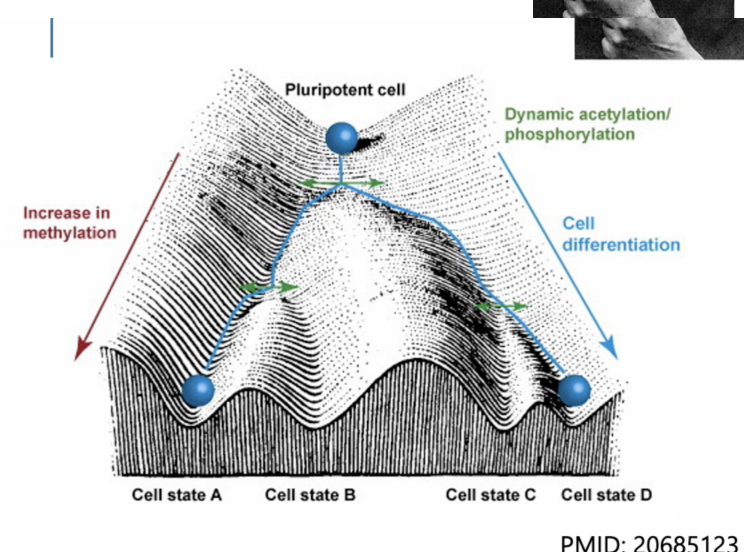
What is epigenetics?
Heritable changes in gene activity that do not alter the DNA sequence.
What are the two best-studied epigenetic changes?
DNA methylation and histone modifications.
What is the histone code?
The collection of chemical modifications on histones, including acetylation, methylation, phosphorylation, and ubiquitination.
these modifications cna be recognized but other proteins and influence how a region of DNA is used
Histones are proteins that DNA wraps around. Their chemical modifications can change DNA accessibility and gene expression.
What processes are affected by epigenetic events?
Cell differentiation, X-chromosome inactivation, and genomic imprinting.
What is the epigenome?
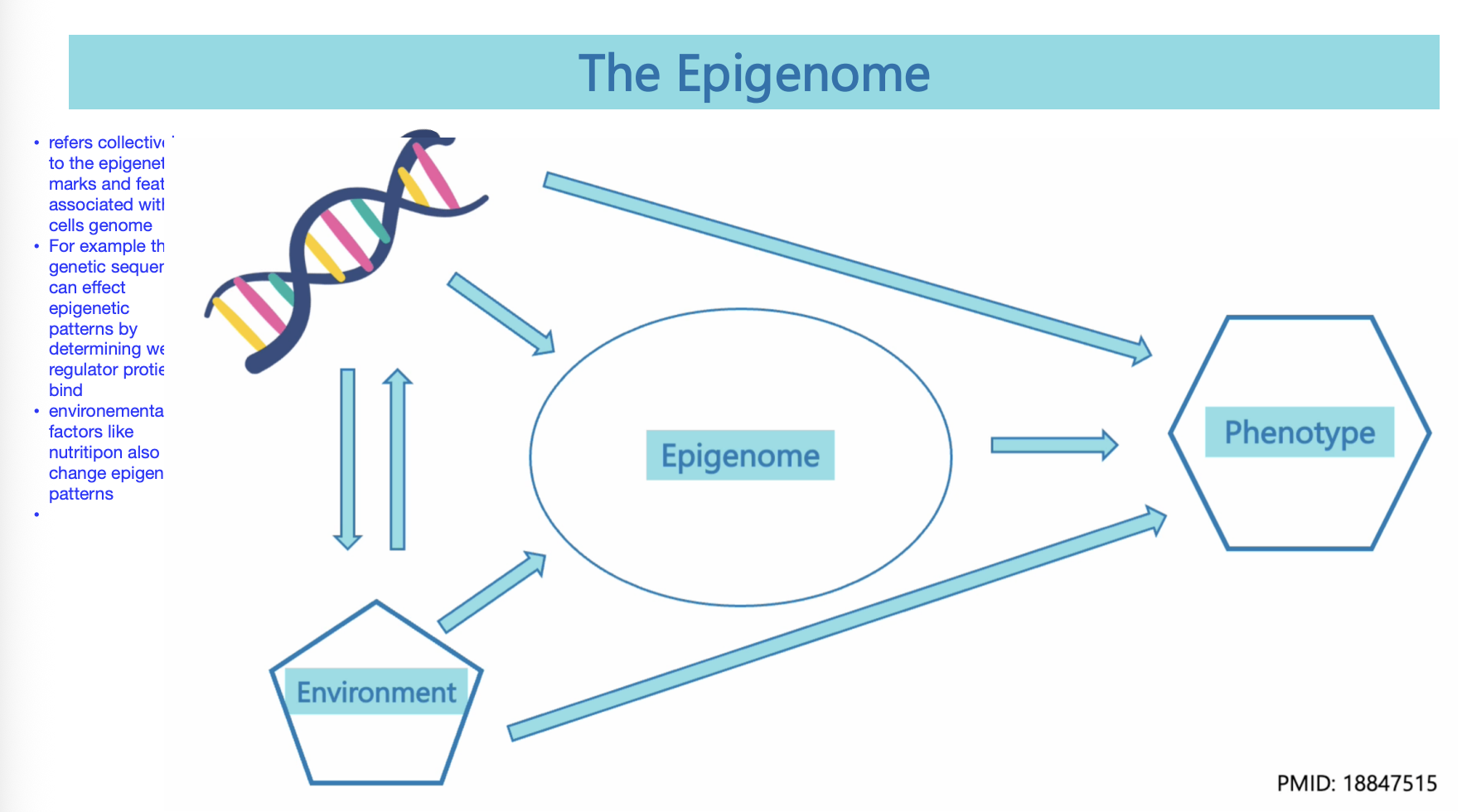
What are CpG islands?
CpG islands correspond to areas in the genome enriched in CG dinucleotides • CpG = cytosine – phosphate – guanine • CpG islands have 60-70% CG content
What are the biological properties of CpG islands?
Located near gene dense regions in the genome • Tend to be sites in DNA that favour DNA recombination -> recombination during meiosis
What happens when cytosine is deaminated, and how does this cause the most common SNP?
→ Unmethylated C → deaminates to uracil (U) → recognized and repaired.
→ Methylated C → deaminates to thymine (T) → often not recognized as an error → C → T is the most common SNPin the genome

What happens when the gene si switched on:
active (open) chromatin
Unmethylated cytosines
acetylated histones

What happens when the gene is switched off?
silent (condensed) chromatin
methylated cytosines
Deacylated histones
Where can epigenetic modifications occur?
Histone proteins or directly on DNA.
What DNA base is commonly methylated?
Cytosine, specifically at the 5-carbon position of the ring.
What enzyme adds methyl groups to DNA?
DNA methyltransferase (DNMT).
Where does the methyl group come from?
SAM (S-adenosylmethionine) donates the methyl group.
What are histone tails?
Histone tails are regions of histone proteins that can carry chemical modifications.
What enzymes add and remove acetyl groups from histones?
HAT adds acetyl groups; HDAC removes them.
What does HAT do?
Histone acetyltransferase (HAT) transfers an acetyl group from acetyl-CoA to a histone.
How does histone acetylation affect chromatin?
Acetylation neutralizes lysine’s positive charge, weakening its attraction to negatively charged DNA → chromatin loosens.
How can acetylation promote gene activity?
Looser chromatin increases DNA accessibility, and acetylation can attract proteins that support gene activity.
What does DNA methylation do?
Promotes binding of proteins that silence transcription → tightens DNA → ↓ gene expression

.
What does DNA demethylation do?
Favours transcription → relaxes DNA → ↑ gene expression.
Can diet alter the epigenome?
Diet can alter the epigenome, leading to significant “deprogramming” or “reprogramming” of large numbers of genes in metabolic pathways and physiological systems
• This can subsequently affect disease risk (e.g., cardiovascular disease, type 2 diabetes, neurodegenerative diseases, and cancer)
• Foods contain inhibitors and activators of chromatin remodelling enzymes (e.g., DNA methyltransferases, histone acetylases, histone deacetylases); therefore, foods can be used to “program” the epigenome
What is SAM and what is its role in DNA methylation?
→ SAM (S-adenosylmethionine) is the major methyl-group donor used for DNA methylation.
→ SAM becomes SAH (S-adenosylhomocysteine) after donating its methyl group.
How is homocysteine related to SAM?
→ SAH is converted to homocysteine, which can eventually be recycled back to methionine → SAM.
How do folate and B12 support DNA methylation?
→ Folate + B12 help recycle homocysteine → methionine, supporting SAM availability for methylation.

How can choline influence DNA methylation?
→ Choline → betaine, which donates a methyl group to homocysteine, helping regenerate methionine and support SAM.
How can maternal diet affect offspring epigenetics?
→ Maternal diet can influence methyl-group availability → DNA methylation patterns → gene expression and development.
→ No. More dietary methyl donors do not necessarily mean more methylation; methylation is tightly regulated and depends on many factors.
How can epigenetic changes be inherited?
→ Through mitosis and meiosis.
→ They can be maintained and passed to daughter cells, allowing epigenetic information to persist through mitosis.
What factors can influence the epigenome during early development?
→ Prenatal and early postnatal factors affect the epigenome→ Maternal nutrition, diet composition, xenobiotics, reproductive factors, radiation, and other environmental factors.
What are epigenetically sensitive regions?
→ Regions of the genome that are particularly responsive to epigenetic regulation and environmental influences.
→ includes promoter regions and metastable epialleles
What is a promoter region?
→ A DNA sequence near the beginning of a gene that helps regulate transcription.
What is an epiallele?
→ Genomic regions at which the epigenetic status varies amongst individuals in a population
→Can be one of many modifications → DNA methylation and acetylation of histone tails are the two most commonly studied
What is a metastable epiallele?
→ Regions of the genome that can be epigenetically modified in a variable and reversible manner
→ A genomic region whose epigenetic state can vary between individuals despite having the same DNA sequence.
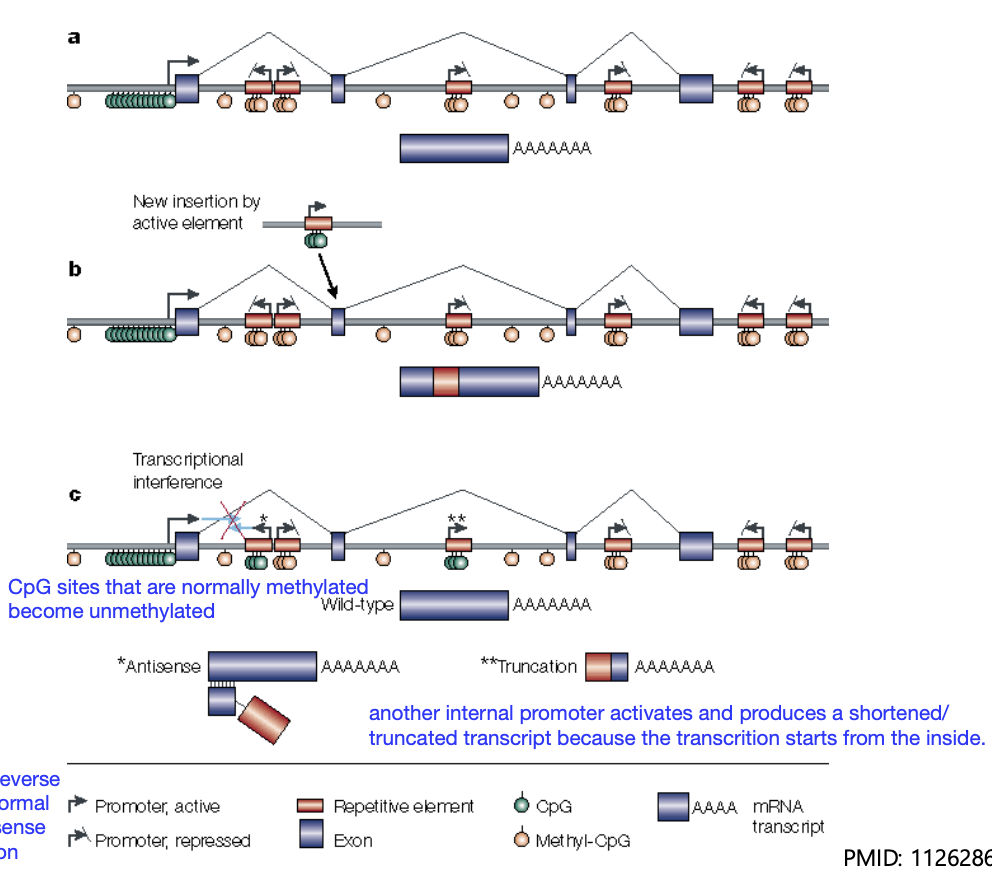
What is the general effect of promoter methylation on gene expression?
→ Methylated promoter → transcription OFF → less/no gene product.
How can methylation of a new DNA insertion affect gene expression?
→ Its methylation status determines whether the insertion is expressed/included in the final product or kept silent.
What happens when promotors that are normally silenced become active?
→ An promoter can become active, potentially disrupting normal transcription.
→ It can fire in the reverse orientation, producing an antisense transcript instead of the correct transcript.
→ It can activate transcription from inside the gene, causing transcription to start too late and producing a truncated gene product.
→ It can also cause an altered gene product
What are the three types of epialleles?
obligatory → Cis and trans
facilitated
pure
What is an obligatory epiallele?
An obligatory epiallele has an epigenetic state directly determined by a DNA sequence. Cis: mutation affects the same gene. Trans: mutation in one gene affects another gene.

What is a Facilitated Epiallele?
The “mutation” can experience an epigenetic change itself, but this will depend on the amount of the environmental factor present (e.g., low vs. high amounts of a methyl donor in the diet). • For example, the agouti mouse.

What is a pure epiallele?
Independent of a change in DNA. The DNA is already capable of being methylated. How much it’s methylated will depend on the amount of the environmental factor present. • For example, genomic imprinting. → Genomic imprinting is an example because certain genes are epigenetically marked depending on whether they came from the mother or father

How do epigenomes differ between tissues?
→ Total DNA methylation varies greatly between tissues, which can lead to differences in gene expression.

Study: how is epigenetic effected by aging?
Twin pairs had very similar methylation and acetylation patterns in lymphocytes at 3-yrs of age, but considerable differences are seen at 50-yrs of age.

Study: How does aging affect gene expression in identical twins?
At 3 years, twins have very similar methylation and gene expression. By 50 years, epigenetic differences increase, causing more differences in gene expression despite similar genetics.

Study:What is the AxinFu mouse, and how does IAP methylation affect its phenotype?
Axin gene → expressed in embryo + adult; regulates signalling pathways
IAP retrotransposon inserted into intron 6 → chronically activates a promoter
IAP methylation varies:
Hypermethylated → IAP silenced → normal promoter → straight tail
Hypomethylated → IAP active → altered gene expression → kinked tail
Facilitated epiallele → IAP insertion + stochastic factors determine methylation status
Key: ↑ methylation → straighter tail

Study: Agouti (Avy/a) Mouse
Murine agouti region (only one allele is functional)
• Agouti encodes a signalling molecule for development of the mouse
• Agouti expression affected by a transposable element upstream of the agouti gene
• IAP retrotransposon
• The IAP methylation status can range from hypomethylated to hyper-methylated
• Example of a facilitated allele
The IAP is silenced when hypermethylated, leading to normal weight, brown-fur mice

Study: Maternal diet and offspring
• Supplementing mothers with methyl-donor enriched diets (containing folate, Vit B12, choline, etc.) can alter the phenotype of offspring
• Mother’s diet during pregnancy affects the offspring phenotype via epigenetics • How: By altering methylation status at the IAP retrotransposon, thereby affecting development in the offspring

Study: Human relevance?
Compared siblings born before vs. after mothers had bariatric surgery • After surgery, offspring were less obese and had improved cardiometabolic parameters (fasting insulin & blood pressure) • 6000 genes were differentially methylated, related to glucose homeostasis and inflammation pathways