Final Distilling of Conditions from Unit 2
 Call Kai
 Learn
 Practice Test
 Spaced Repetition
 Match
 Flashcards
 Knowt Play
1/41

There's no tags or description
Looks like no tags are added yet.
42 Terms
Sickle Cell Disease
Pathophysiology, system affected : Sickled RBCs lead to impaired oxygen delivery function due to defective B hemoglobin
Symptoms: acute chest syndrome, vaso-occulsive crises pain, high WBC counts
Treatment: hydroxyurea, endari, crizanlizumab, transfusions, GT available but expensive
Genes: HBB
Clinical Criteria and testing : hemoglobin electrophoresis
Molecular testing strategy : targeted testing of point mutation in the 6th codon of the B globin gene
Other notes: other types of sickle cell possible like SC, SB+, SBo, along with SS

Beta-Thalassemia
Symptoms : variable presentation with overall fatigue, jaundice, ex. intolerance, skeletal abnormalities, hepato/splenomegaly
Treatment : chronic transfusions and iron chelation therapy w/
Genes : HBB : codon 26 missense mutation leading to loss of protein function
Clinical Criteria and testing : not mentioned
Molecular testing strategy : HBB gene sequencing
Other notes : also think of Hem E, hair on end appearance of skull on X-ray + facies

Alpha-Thalassemia
Symptoms :
trait and silent nothing typically (1-2 del)
Hemoglobin H disease (3 del) - anemia with fatigue, enlarged liver and spleen, jaundice, poor growth
Hb barts (4del) - perinatal lethal with hepatosplenomegaly and extreme anemia
Treatment : HbH disease is mostly focused on chronic transfusions, Hb barts is incompatible with life
Genes : HBA1 and HBA2
Clinical Criteria and testing :not really discussed
Molecular testing strategy : assess HBA1/2 for dels/constant spring mutations
Other notes : special considerations for inheritance given the digenic nature of the condition (cis or trans for silent carriers is consideration)

Hypohidrotic ED
Symptoms : lack of hair, sweat, dental abnormalities, prominent forehead, NORMAL Intellectual ability
Treatment : temperature regulation/sweat gland mgmt, dental and oral rehab, surgery if indicated
Genes : all XL AR AD - EDA, EDAR, EDARADD, WNT10A
Clinical Criteria and testing : not extensively discussed
Molecular testing strategy : sequence of genes above
Other notes : also consider SSPS with characteristic eyelid findings and OODD with characteristic complete tooth agenesis. Also WNT10A but HYPERHIDROSIS

Ectrodactyly-Ectodermal Dysplasia Cleft Syndrome (EEC)
Symptoms : missing fingers or toes, facial clefts, skin and hair diffs, pitted nails, abnormal tear ducts, normal intellectual ability
Treatment : temperature regulation/sweat gland mgmt, dental and oral rehab, surgery if indicated
Genes : AD, high de novo at 70%. TP63
Clinical Criteria and testing : not applicable
Molecular testing strategy : seq
Other notes :

Hidrotic Ectodermal Dysplasia
Symptoms : abnormalitiers of hair nails skin, thick skin over palms of hands and feet, join hyperpigmentation, NO SWEATING ISSUES
Treatment : temperature regulation/sweat gland mgmt, dental and oral rehab, surgery if indicated
Genes : GJB6 AD
Clinical Criteria and testing : not applicable
Molecular testing strategy : seq
Other notes :

Epidermolysis Bullosa Simplex
Pathophysiology, system affected : Keratins at the epidermal layer breaks down leading to symptoms
Onset : @ birth or before 18mo
Symptoms :nail dystrophy, blistering, natal teeth w/ no significant mortality
Treatment : minimize skin trauma, aluminum chloride to reduce sweating and blisters, moisturizing
Genes : KRT14, KRT5 (AD)
Clinical Criteria and testing : n/.a
Molecular testing strategy : testing the above genes seq
Other notes : least morbid of the EBs

Epidermolysis Bullosa Dystrophic
Pathophysiology, system affected : basement layer of skin collagen is affected leading to dystrohy, dermis and epidermis anchoring disruption
Onset : birth or infancy (rarely adol. or adulthood)
Symptoms : blisters, nail involvement, lingual papilae absence, pseudosyndac. INCREASED SQUAMOUS CELL CARC. risk
Treatment : minimize skin trauma, aluminum chloride to reduce sweating and blisters, moisturizing
Genes : COL7A1 AD
Clinical Criteria and testing : n/a
Molecular testing strategy : testing the above genes seq
Other notes : 2nd least morbid of the EBs

Epidermolysis Bullosa Junctional
Pathophysiology, system affected : junctional skin layer leading to a disruption of the connection between basement layer and epidermis
Onset : present at birth, sometimes localized in early childhood
Symptoms : blisters, nail involvement,significant oral membrane involvement, 73% infant mortality rate for generalized severe form
Treatment : minimize skin trauma, aluminum chloride to reduce sweating and blisters, moisturizing, avoidance of adhesive bandages
Genes : LAMB3 COL7A1 (AD)
Clinical Criteria and testing : n/a
Molecular testing strategy : testing the above genes seq
Other notes : most morbid of the EBs

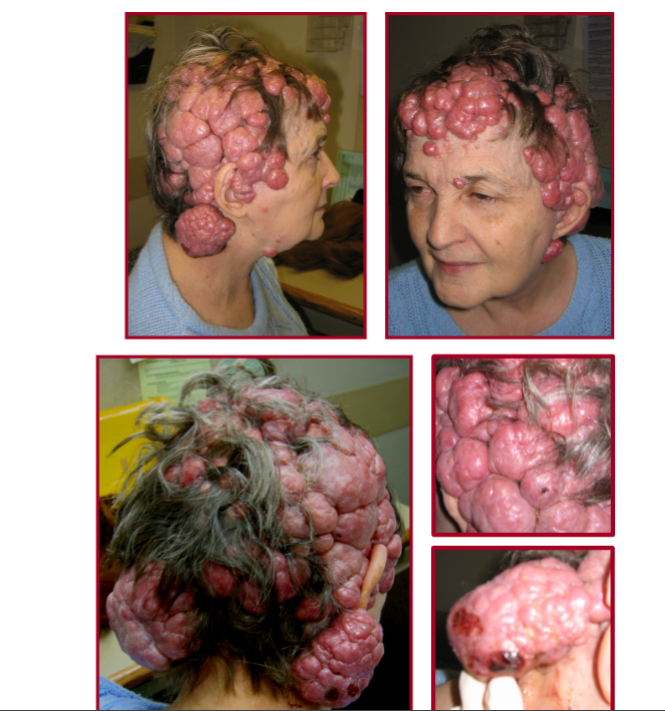
Cylindromatosis
Pathophysiology, system affected : TNFa and NF-kB paths disrupted leading to cell hyperproliferation and neoplasm
Onset : progressive over lifetime
Symptoms : neoplasm skin appendages
Treatment : not discussed
Genes : CYLD loss
Clinical Criteria and testing : not discussed
Molecular testing strategy : CYLD seq
Other notes : know as a “mimic” of NF1 and NFKB pathway but unlikely to appear
Hemophilia A
Pathophysiology, system affected : SECONDARY HEMOSTASIS Low Factor VIII - prevents proper clotting but platelet plug is ok
Onset : from birth
Symptoms : bleeding phenotype with variable severity depending on genetic change, occurs after trauma, surgical intervention, etc.
Treatment : prophylaxis and controlling acute bleeds : IV clotting factor, Emicizumab subcutaneous for F8 mimic, Despopressin to increase vW F8, GT avbailable but expensive
Genes : F8 XL
Clinical Criteria and testing : women w/ <40% factor levels are diagnosed with same severity classification as men.
Molecular testing strategy : F8 is very large, test cascade goes : Intron 22 inversion (most severe), intron 1 inversion, point mutations, del/dups
Other notes : nothing else
Hemophilia B
Pathophysiology, system affected : SECONDARY HEMOSTASIS Low Factor IX - prevents proper clotting but platelet plug is ok
Onset : progressive over lifetime
Symptoms : bleeding phenotype with variable severity depending on genetic change, VERY highly variable due to lots of different effects due to different point mutations
Treatment : prophylaxis and controlling acute bleeds : IV clotting factor, Emicizumab subcutaneous for F8 mimic, Despopressin to increase vW F8, GT avbailable but expensive
Genes : F9 XL
Clinical Criteria and testing : women w/ <40% factor levels are diagnosed with same severity classification as men.
Molecular testing strategy : not as big as F8, familial variant seq or just straight NGS of F9
Other notes :
Von Willebrand disease (VWD) T1
Pathophysiology, system affected : primary hemostasis defects, plug can’t form, quantitative
Onset : from birth
Symptoms : prolonged mucocutaneous bleeding, menstrual bleeding, oral mucosa, GI bleeding
Treatment : desmopressin, antifibrinolytics, vW factor concentrate, NSAID avoidance
Genes : AD variable genes
Clinical Criteria and testing : <30% vW factor w/30-50% bleeding symptoms
Molecular testing strategy : sequencing
Other notes : 1C : accelerated vWF clearance
Von Willebrand disease (VWD) T2
Pathophysiology, system affected : primary hemostasis defects, plug can’t form, qualitative
Onset : from birth
Symptoms : prolonged mucocutaneous bleeding, menstrual bleeding, oral mucosa, GI bleeding, variability in presentation
Treatment : desmopressin (NOT IN 2B), antifibrinolytics, vW factor concentrate, NSAID avoidance
Genes : AD variable genes, AR (2N only)
Clinical Criteria and testing : <30% vW factor w/30-50% bleeding symptoms
Molecular testing strategy : sequencing
Other notes : descending severity
2A - defect in VWF no platelet plug
2B - VWF binds to platelets in bloodstream but not injury site
2M - no platelet binding at all
2N - rapid FVIII clearance due to no vWF, secondary hemo
Von Willebrand disease (VWD) T3
Pathophysiology, system affected : primary hemostasis defects, plug can’t form, quantitative
Onset : from birth
Symptoms : prolonged mucocutaneous bleeding, menstrual bleeding, oral mucosa, GI bleeding, variability in presentation
Treatment : desmopressin, antifibrinolytics, vW factor concentrate, NSAID avoidance
Genes : AD variable genes, AR (2N only)
Clinical Criteria and testing : <30% vW factor w/30-50% bleeding symptoms
Molecular testing strategy : sequencing
Other notes : descending severity
T3 very rare very severe with almost no FVIII presence hem A phenocopy
Thrombophilia
Pathophysiology, system affected : inherited predisposition to clotting (VTEs) like PEs, DVTs
Onset : from birth
Symptoms : excess clotting leading to VTEs
Treatment : blood thinning and clot clearance
Genes : Protein C, antithrombin, Protein S genes
Clinical Criteria and testing : prothrombin, thrombin time (TT), fibrinogen activity
Molecular testing strategy : sequencing
Other notes :
Factor V Leiden
Pathophysiology, system affected : protein C resistance leading to slightly decreased efficacy for factor V
Onset : from birth
Symptoms : excess clotting leading to VTEs
Treatment : none really
Genes : FV DNA analysis for the c.1601G>A change
Clinical Criteria and testing : prothrombin, thrombin time (TT), fibrinogen activity
Molecular testing strategy : sequencing for above var
Other notes : generally very mild with no need for anticoagulant treatment. Most common inherited thrombophilia with 3-15% in european pops
Pendred
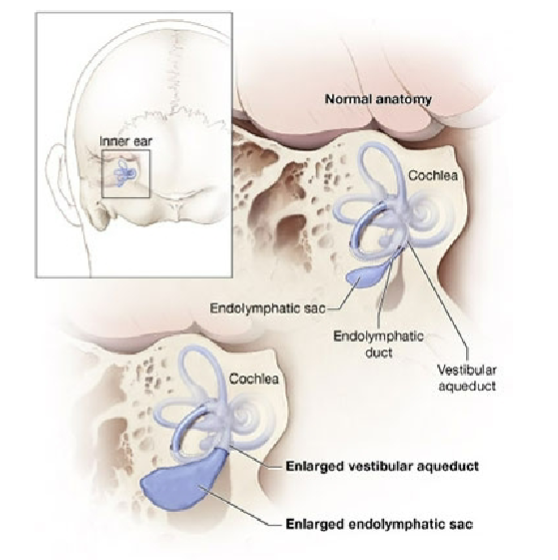
Pathophysiology, system affected : SNHL hearing, unilateral or bilateral
Onset : childhood/adol
Symptoms : enalrged vestibular aqueducts, sensorineural, euthyroid goiter
Treatment:
Genes : SLC26A4, FOXI1, KCNJ10 (AR)
Clinical Criteria and testing : hearing testing, growths visible on mri
Molecular testing strategy : gene seq
Other notes :
Waardenburg
Pathophysiology, system affected : neural crest malformation and SNHL
Onset : from birth
Symptoms : white forelock, blue iris, 60% experience SNHL, abnormalities of the iris, hirchsprung disease
Treatment :
Genes : PAX3, EDN3, EDNRB (AD, AR)
Clinical Criteria and testing :
Molecular testing strategy :
Other notes :
Connexin related hearing loss
Pathophysiology, system affected : NSHL due to loss of connexins
Onset : prelingual to postlingual, variable severity
Symptoms : severe to profound, bilat congenital SNHL
Treatment :
Genes : GLB2/GJB6 (AR)
Clinical Criteria and testing :
Molecular testing strategy :
Other notes
DFNX2 (X linked non-syndromic)
Pathophysiology, system affected :
Onset :
Symptoms : nonsyndromic sensorineural hearing loss
Treatment :
Genes : POU3FA, X-linked nonsyndromic
Clinical Criteria and testing :
Molecular testing strategy :
Other notes :
DFN16 (moderate autosomal recessive hearing loss)
Pathophysiology, system affected : stereociliary effects leading to SNHL
Onset :
Symptoms : nonsyndromic sensorineural mild to moderate hearing loss
Treatment :
Genes : STRC (AR)
Clinical Criteria and testing :
Molecular testing strategy :
Other notes :
Alport
Pathophysiology, system affected : degraded collagen tIV leading to SNHL
Onset :
Symptoms : syndromic sensorineural mild to moderate hearing loss with very high variability. Kidney diagnosis
Treatment :
Genes : XL, AD, AR, many genes. COL4A3, COL4A5 (maj 80%), etc.
Clinical Criteria and testing :
Molecular testing strategy : sequence the gene
Other notes :
Stickler
Pathophysiology, system affected :
Onset :
Symptoms: AD with many allelic disorders, HL might be SNHL or mixed/conductive
Treatment :
Genes :
Clinical Criteria and testing :
Molecular testing strategy :
Other notes :
Usher Type 1
Pathophysiology, system affected : combination of SNHL and Retinitis Pigmentosa
Onset : birth, extremely profound congenital
Symptoms: vestibular hypofunction leading to significant motor delay, infants dont walk before 18mo. RP
Treatment:
Genes : MY07A, USH1C (AR)
Clinical Criteria and testing :
Molecular testing strategy : seq the genes
Other notes :

Usher Type 2
Pathophysiology, system affected : combination of SNHL and Retinitis Pigmentosa
Onset : congenital, moderate to severe
Symptoms: normal vestibular function. onset of RP in the 2nd decade on average
Treatment:
Genes : USH2A (AR)
Clinical Criteria and testing :
Molecular testing strategy : seq the genes
Other notes :
Usher Type 3
Pathophysiology, system affected : combination of SNHL and Retinitis Pigmentosa, ciliary
Onset : postlingual, variable
Symptoms: variable RP and vestibular defects
Treatment:
Genes : CLRN1 (AR)
Clinical Criteria and testing :
Molecular testing strategy : seq the genes
Other notes :
STRC
Pathophysiology, system affected :
Onset : birth, congenital and profound
Symptoms : nonsyndromic sensorineural hearing loss
Treatment :
Genes : CATSPER2-STRC
Clinical Criteria and testing :
Molecular testing strategy :
Other notes :
HHT T1
Pathophysiology, system affected : endoglin affected
Onset : lifetime
Symptoms : pulmonary and vascular AVMs
Treatment :
Genes : ENG
Clinical Criteria and testing : curacao criteria - Recurrent epistaxis (nosebleeds)
• Multiple mucocutaneous telangiectasis in characteristic locations (lip, oral cavity, fingers, nose)
• Visceral arteriovenous malformations (AVMs). Typically pulmonary, cerebral, hepatic, spinal, gastrointestinal
• First-degree relative with HHT diagnosed according to the Curaçao criteria
Molecular testing strategy :
Other notes :

HHT T2
Pathophysiology, system affected : ALK1 affected
Onset : lifetime
Symptoms : Liver AVMs
Treatment :
Genes : ALK1
Clinical Criteria and testing :curacao criteria - Recurrent epistaxis (nosebleeds)
• Multiple mucocutaneous telangiectasis in characteristic locations (lip, oral cavity, fingers, nose)
• Visceral arteriovenous malformations (AVMs). Typically pulmonary, cerebral, hepatic, spinal, gastrointestinal
• First-degree relative with HHT diagnosed according to the Curaçao criteria
Molecular testing strategy :
Other notes :
PTEN
Pathophysiology, system affected :
Onset : lifetime
Symptoms : macrocephaly, cancer risk
Treatment :
Genes : PTEN AD
Clinical Criteria and testing :curacao criteria - Recurrent epistaxis (nosebleeds)
• Multiple mucocutaneous telangiectasis in characteristic locations (lip, oral cavity, fingers, nose)
• Visceral arteriovenous malformations (AVMs). Typically pulmonary, cerebral, hepatic, spinal, gastrointestinal
• First-degree relative with HHT diagnosed according to the Curaçao criteria
Molecular testing strategy :
Other notes :
Bannayan-Riley-Ruvalcabe
Pathophysiology, system affected :
Onset : Pediatric / Childhood
Symptoms : LOW TO MODERATE cancer risk, Macrocephaly (striking/universal, ~90%+), glans penis pigmentation High prevalence of juvenile hamartomatous polyps
Treatment :
Genes : PTEN AD
Clinical Criteria and testing : ngs panel
Molecular testing strategy :
Other notes :
PIK3CA
honestly just know this gene as related to overgrowth
cloves is congenital lipomatous asym., vasc. malformations, skeletal anomalies
MCAP (macroceph and broad over)
PRoteus asymmetirc vascular anomalies
CM-AVM
RASA1 related mostly visceral?
retinitis pigmentosa
rod cone disease w/ AR/XL/AD
wes approach
Leber congenital amaurosis
Severe retinal dystrophy, often
noticed at birth or early childhood.
• Symptoms include:
• Signs of low vision/ not
tracking objects
• Franschetti oculo-digital sign
• Keratoconus
• Nystagmus
• Photophobia
AR : RPE65 (luxturna treatable), CEP290
AD : CRX
PAX6-Related Disorders
WAGR
PAX6 related. Wilms, aniridia, genitourinary signs, ID
45,X/46,XY Mixed Gonadal Dysgenesis
Pathophysiology: Mosaic loss of Y chromosome; Reproductive/Endocrine.
Onset: Congenital / Infancy.
Symptoms: Ambiguous genitalia, asymmetric streak/dysplastic gonads, short stature, elevated gonadoblastoma risk.
Treatment: Prophylactic gonadectomy, HRT, growth hormone, surgical repair.
Genes: Mosaicism (45,X/46,XY).
Clinical Criteria & Testing: Karyotype, pelvic imaging, serum AMH and testosterone.
Molecular Strategy: G-banded karyotype, FISH, or Chromosomal Microarray (CMA).
Other Notes: Presence of Y material in dysplastic gonads drives high tumor risk.
Complete 46,XY DSD (SRY Knockout / Swyer Syndrome)
Pathophysiology: Inability to initiate testicular differentiation; Reproductive/Endocrine.
Onset: Adolescence (primary amenorrhea).
Symptoms: Phenotypic female, bilateral streak gonads, presence of uterus/tubes, elevated gonadoblastoma risk.
Treatment: Bilateral gonadectomy, estrogen/progesterone HRT.
Genes: SRY loss-of-function mutation or deletion (also NR5A1, MAP3K1).
Clinical Criteria & Testing: 46,XY karyotype, hypergonadotropic hypogonadism, pelvic ultrasound (uterus present).
Molecular Strategy: SRY sequencing or DSD NGS panel, reflex MLPA/CMA.
Other Notes: Uterus is functional; pregnancy is possible via donor egg IVF.
Partial 46,XY DSD (Partial Gonadal Dysgenesis)
Pathophysiology: Partial impairment of testis determination/androgen production; Reproductive/Endocrine.
Onset: Congenital / Neonatal.
Symptoms: Ambiguous genitalia, dysplastic/streak gonads, partial Müllerian retention, variable puberty.
Treatment: Multidisciplinary DSD care, HRT, elective genitoplasty, gonadal surveillance/removal.
Genes: NR5A1, WT1, MAP3K1, SOX9, GATA4.
Clinical Criteria & Testing: Ambiguous genitalia, low hCG-stimulated testosterone, low AMH, 46,XY karyotype.
Molecular Strategy: DSD NGS panel, reflex MLPA/CMA or Whole Exome Sequencing (WES).
Partial 46,XY AIS (Partial Androgen Insensitivity Syndrome)
Pathophysiology: Partial androgen receptor resistance despite normal testosterone production; Endocrine/Reproductive.
Onset: Congenital or Adolescence.
Symptoms: Ambiguous genitalia, micropenis, hypospadias, gynecomastia; functional testes present (no streak gonads).
Treatment: High-dose androgen therapy, hypospadias repair, gynecomastia management.
Genes: AR gene (X-linked).
Clinical Criteria & Testing: Elevated testosterone + elevated LH, normal AMH, testes on ultrasound, 46,XY karyotype.
Molecular Strategy: AR gene sequencing (NGS/Sanger) and MLPA.
Other Notes: Normal gonadal histology (testes, not streak); undescended testes carry post-pubertal tumor risk.
46,XX / 46,XY CAH (Congenital Adrenal Hyperplasia)
Pathophysiology: Adrenal enzyme defect altering steroidogenesis; Endocrine/Metabolic/Reproductive.
Onset: Neonatal / Early Childhood.
Symptoms:
46,XX: Virilized ambiguous genitalia, normal ovaries/uterus (no streak gonads).
46,XY: Normal or undervirilized genitalia, normal testes (no streak gonads).
Both: Risk of fatal salt-wasting adrenal crisis.
Treatment: Hydrocortisone, fludrocortisone, stress-dosing, reconstructive surgery if needed.
Genes: CYP21A2 (~95%), CYP11B1, HSD3B2 (Autosomal Recessive).
Clinical Criteria & Testing: Elevated 17-OHP on newborn screen, electrolyte imbalance, normal gonads on ultrasound.
Molecular Strategy: Targeted CYP21A2 analysis (NGS + MLPA) or adrenal NGS panel.
Other Notes: Enzyme deficiency, not a chimerism condition; gonads develop normally.