Microbiology - Lab Exam 3
 Call Kai
 Learn
 Practice Test
 Spaced Repetition
 Match
 Flashcards
 Knowt Play
1/53

There's no tags or description
Looks like no tags are added yet.
54 Terms
nitrogen fixation
microbes convert nitrogen gas into ammonia, N2 → NH3
ammonification
ammonia is produced by microbes when amine groups are cleaved from amino acids
nitrification
nitrites are produced when microbes oxidize ammonium ions, NH4+ → NO2- → NO3-
denitrification
nitrates undergo a series of reactions that release nitrogen gas to the atmosphere, NO3- → NO2- → NO → N2O → N2
_____ outnumber other soil microbes
bacteria
to detect denitrifying microbes in soil, we added a loopful of soil to nitrate broth. A Durham tube was included in the nitrate broth. Following incubation, what did a positive result for denitrification look like
bubble at top of Durham tube
to detect denitrifying microbes in soil, we added a loopful of soil to nitrate broth. A Durham tube was included in the nitrate broth. Following incubation, what did a negative result for denitrification look like
no bubble in durham tube
to detect ammonifying (ammonia-producing) bacteria, we used _____________ broth as our source of amino acids. As the name suggests, this medium contains partially digested proteins
peptone
during the soil microbe experiments, you viewed a simple stain of nitrogen-fixing bacteria under oil immersion. What was the source of these nitrogen fixers
root nodule from a clover plant
bacteriophage
virus that infects the bacteria
plaque
clear zone where viruses infected and lysed bacterial cells
agar overlay method
add designated volume of culture(s) to tube of liquid agar medium, gently rotate tube in palms to mix contents, work quickly to prevent premature solidification of liquid agar, pour liquid on top of plate medium, tilt to evenly spread
make 10^-2 dilution
add 1 mL of sample to 99 mL blank of sterile water
make 10^-2, pour plate from 10^-2 dilution bottle
pipette 1 mL of 10^-2 dilution bottle into plate
make 10^-3, pour plate from 10^-2 dilution bottle
pipette 1 mL of 10^-2 dilution bottle into plate
make 10^-3, pour plate from 10^-2 dilution bottle
pipette 0.1 mL of 10^-2 dilution into plate

as shown below, clear zones called __________________ are produced when viruses infect and lyse bacterial cells
plaques
how do you make a 10^-2 (1:100) dilution of a sample
add 1 mL of sample to 99 mL of sterile water
how do you make 10^-2 (1:100) pour plate
pipette 1 mL of the 10^-2 dilution into the petri plate
how do you make 10^-3 (1:1000) pour plate
pipette 0.1 mL of the 10^-2 dilution into the petri plate
which plating method is described as it follows, a tube of liquid agar is seeded with the culture of interest. the seeded liquid agar is evenly distributed across the surface of an agar plate
agar overlay method
what is the largest source of pathogens in water
animal feces
fecal coliforms
gram-negative facultative bacilli that ferment lactose
potable water
safe to drink, virtually no coliforms present
strains of E. coli
are non-pathogenic, serves as an indicator of the relative level of fecal contamination in water samples, consumption of fecal pathogens may lead to enteric (intestinal) diseases
which test/assay screened for colonies growing on top of nitrocellulose membranes
water quality testing
t/f, all strains of E. coli are pathogenic in nature
false
making a 10^-1 dilution of milk for coliform assay
add 1 mL of milk to 9 mL blank of sterile water = 1 mL milk in 10 mL total
which type of milk contains the most coliforms
raw milk
how did you make a 10^-1 (1:10) dilution of milk during the food micro lab
add 1 mL of milk to 9 mL of sterile water
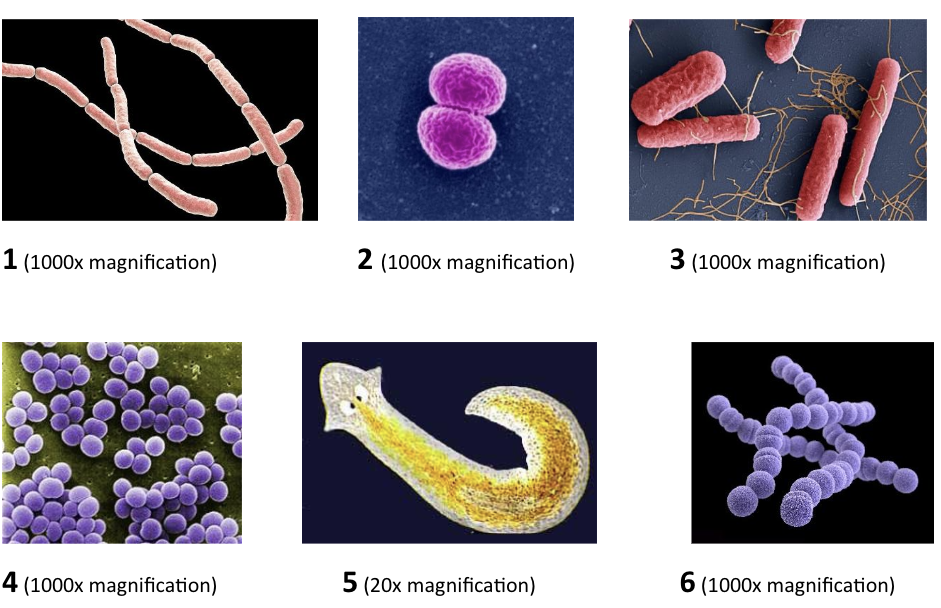
which shows streptococci bacteria
6

which shows streptobacilli bacteria
1
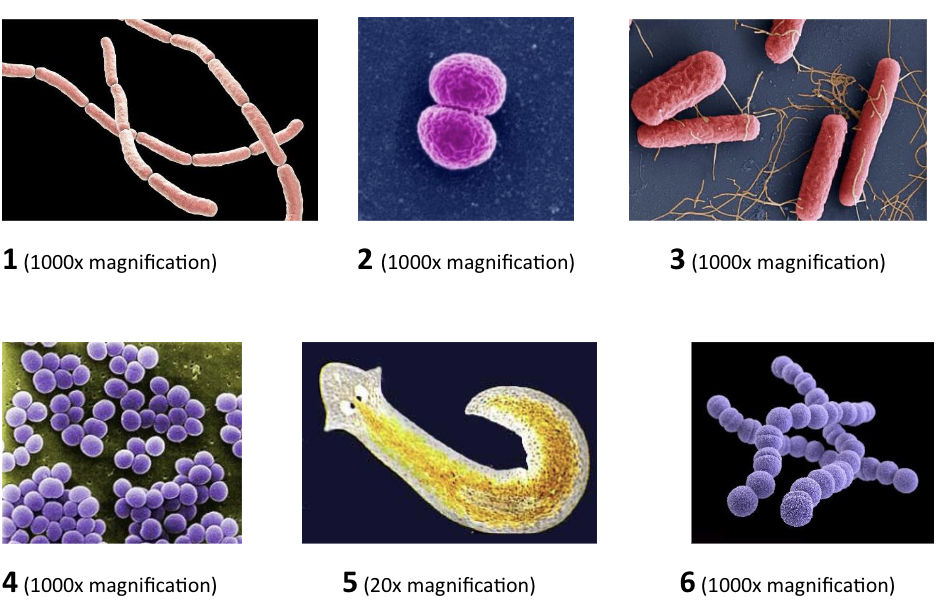
which shows monobacilli
3

which shows staphylococci
4
all staphylococcus species
all of the above (halotolerant, grow in clusters, produce catalase)
We used _____________________ to test Staphylococcus species for halotolerance
mannitol salt agar (MSA)
all staphylococcus species
are gram-positive
We used ____________________ to test Staphylococcus species for catalase production.
hydrogen peroxide
All Staphylococcus species _______________________.
are halotolerant
hemolysis results
medium = blood agar, and coagulase test (plasma = medium) differentiate S. aureus/S. epidermidis
S aureus
primary pathogen in genus, complete hemolysis on blood agar & produces coagulase (this enzyme clots/solidifies plasma)
S. epidermidis
normal skin flora, no hemolysis on blood agar & doesn’t produce coagulase
which staphylococcus species is part of everyone’s normal skin flora
staphylococcus epidermis
Staphylococcus ________________ is considered the primary pathogen of the genus
aureus
which test differentiated staphylococcus aureus from staphylococcus epidermis
hemolysis results on blood agar (complete vs. none)
which test differentiated staphylococcus aureus from staphylococcus epidermis
coagulase test
_______________ was used to test Staphylococcus species for coagulase production
plasma medium
agglutination
clumping that results from antibody/antigen binding
enteric
intestinal
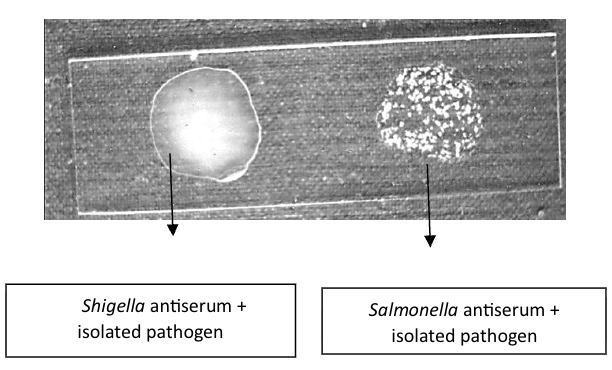
An enteric pathogen was isolated from a patient and subsequently mixed with antisera for Shigella and Salmonella. Based on the agglutination results shown below, the pathogen is a species of
salmonella
The results of a rapid agglutination test are shown below. Agglutination occurs between antigens and
antibodies (ex: antiserum with antibodies attached to colored latex beads)

Based on the agglutination results shown below, which organism (A or B) was identified as S. aureus
organism A
______________________ is/are Gram-positive. Assuming antibiotic resistance hasn’t developed, this means penicillin is a viable treatment option against pathogenic species/ strains
both A/B (staphylococcus species, streptococcus species)
Which method is most reliable for detecting Group A Strep (S. pyogenes) on a patient swab? Strep throat is caused by this organism.
used a rapid Group A strep test, which detects antigens exclusively found on Group A Strep