Physics 1: Key Concepts in Mechanics
 Call Kai
 Learn
Learn Practice Test
 Spaced Repetition
 Match
Match Flashcards
 Knowt Play
1/46

There's no tags or description
Looks like no tags are added yet.
Name | Mastery | Learn | Test | Matching | Spaced | Call with Kai | Chat |
|---|
No analytics yet
Send a link to your students to track their progress
47 Terms
Mass - Definition
The amount of matter in an object.
Mass - Units
Kilograms (Kg)
Position - Definition
An object's location relative to a reference point.
Position - Units
Meters (m)
Path Length
The total distance traveled along the path of motion.
Does not include direction.
Displacement
The change in an object's position from its initial starting point to its final resting point.
Includes distance and direction.
Time - Definition
A measurement of how long an event or motion lasts.
Time - Units
Seconds (s)
Speed - Definition
How fast something is moving. Speed is the distance traveled per unit time. Does not include direction.
Velocity - Definition
The rate of change of displacement.
Velocity describes how fast and in what direction something moves.
Speed and Velocity - Units
Meters per second (m/s)
Acceleration - Definition
The rate of change of velocity.
"Anything that will spill your coffee while driving."
Acceleration - Units
Meters per second per second OR Meters per second squared (m/s^2)
Force - Definition
A push or pull that can change an object's motion.
Force - Units
Newtons (N)
Equivalent to a kilogram meter per second squared ( kg m/ s^2 )
Net Force
The total force acting on an object after adding all forces together.
Work - Definition
Energy transferred when a force moves an object through a distance.
Occurs when force causes displacement.
Work - Units
Joules (J)
Equivalent to a Newton meter (N m)
Energy - Definition
The ability to do work.
Energy - Units
Joules (J)
Equivalent to a Newton meter (N m)
Power - Definition
The rate at which work is done or energy is transferred.
Power - Units
Watts (W)
Equivalent to Joules per second (J/s)
Kinetic Energy (KE)
Energy an object has because of its motion.
Potential Energy (PE)
Stored energy due to an object's position or configuration.
Potential Energy due to Gravity (PEg)
Energy an object has because of its height above the ground (or another reference level).
Potential Energy due to Spring force (PEs)
Energy stored in a spring when it is stretched or compressed.
Mechanical Energy (ME)
The total energy of motion and position in a system.
Conservative Force
A force that converts energy between forms but does not alter the total mechanical energy.
Nonconservative Force
A force that adds or removes mechanical energy from the system.
Newton's Second Law Equation
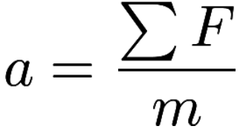
Newton's Second Law Equation in Equilibrium
Sigma F = 0
Work Equation

Kinetic Energy Equation

Gravitational Potential Energy Equation

Spring Potential Energy Equation

Work-Energy Theorem

Nonconservative Work Equation
Wnc = MEf - MEi
Momentum - Definition
the amount of motion an object has and its resistance to changing that motion
Momentum - Units
Newton seconds (Ns)
OR
Kilogram meters per second (kgm/s)
Impulse - Definition
A force applied over time that changes an object's momentum.
A change in momentum.
Impulse - Units
Newton seconds (Ns)
OR
Kilogram meters per second (kgm/s)
Angular Displacement (Δθ) - Definition
The change in an object's angular position as it rotates.
It measures how far something has rotated.
Angular Displacement (Δθ) - Units
Radians (rad), revolutions (rev), or degrees
Angular Velocity (ω) - Definition
The rate at which angular displacement changes.
How fast something rotates.
Angular Velocity (ω) - Units
Radians per second (rad/s) or Revolutions per minute (rpm)
Angular Acceleration (α) - Definition
The rate at which angular velocity changes.
How quickly rotation is speeding up, slowing down, or changing directions.
Angular Acceleration (α) - Units
Radians per second per second or radians per second squared (rad/s^2)