Quiz 5 : Chordata and Mammalian Anatomy
 Call Kai
 Learn
 Practice Test
 Spaced Repetition
 Match
 Flashcards
 Knowt Play
1/53

There's no tags or description
Looks like no tags are added yet.
54 Terms
deuterostomes
blastopore becomes anus
genes
these control developmental pathways
chordata
having a chord
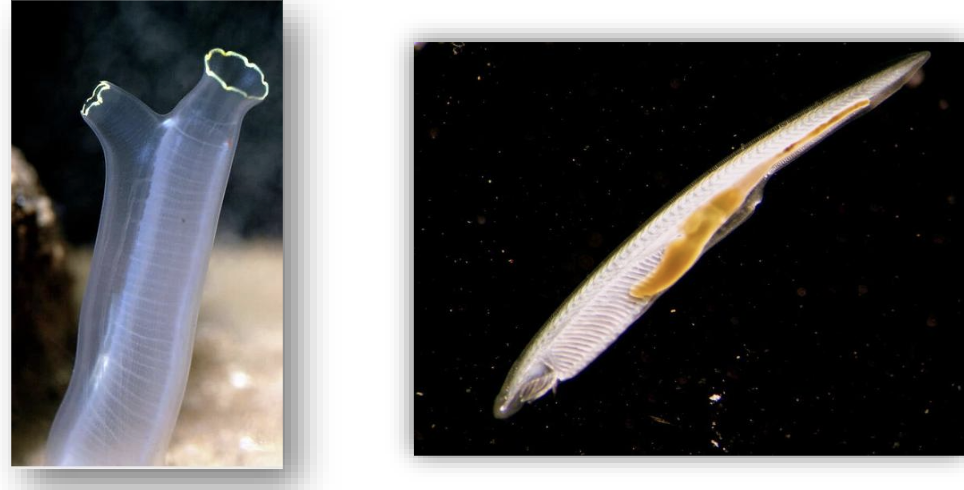
urochordatae
tunicate or sea squirt
distant “cousins”, more closely related to us than echinoderms
Vertebrata
Chordate well-known clade including: hagfish, lampreys, fishes, amphibians, reptiles, birds, mammals and others
Invertebrate
Chordate, less-familiar clade
Chordate hallmarks
four characteristics which all chordates have at some point in their development
Notochord
Hallmark - flexible rod supporting the bodies of chordate embryos and is retained in the adult Cephalochordates and in Vertebrate chordates
in humans it persists as part of the discs between the vertebrae in our backbone
Developmental role - positioned centrally and it secretes factors that signal surrounding tissues that instruct them to acquire particular differentiated fates
dorsal hollow nerve cord
Hallmark - during embryological development is is first laid down as a broad band of nervous tissue running along the dorsal side of the embryo. folds lengthwise into a tube, eventually becomes the “spinal cord”
dorsal to the notochord
retained in adult cephalochordates and vertebrates
lost by urochordates during development
develops into central nervous system
pharyngeal slits
Hallmark - opening that connect the pharynx/throat to the outside of the neck
retained by adult cephalochordates and urochordates and function in filter feeding
Some vertebrates modified for gas exchange
in humans they develop into the jaw and inner ear bones
postanal tail
Hallmark - skeletal extension of the posterior end of the body beyond the anus
instead of tail being filled with digestive tract, it has skeleton and muscles used by some chordates for locomotion
Urochordata
Invertebrate subphylum - tunicates
tunicates come from outer covering “tunic” - protects the animal from predator
live as solitary individual and some form colonies
Sea squirts are the most common
Yes
Do baby urochordata possess all the hallmarks?
Notochord and postanal tail, reduced dorsal hollow
What hallmarks urochordata loose as sessile adults
Suspension feeding
Feeding strategy of tunicates
simple, sack with two siphons through which water enters and exits
water drawn in and food is trappe in the inside of the body
Cephalochordata
Invertebrate subphylum - lancelets
Retains all chordate features as adults
Most of the time are covered in sand with heads protruding
fish-like animals
Vertebrata
Subphylum of Chordata
all have a head and a rigid structure around the brain called a cranium
Hagfish have a cranium but do not have a vertebral column
Fewer pharyngeal gill slits (used for respiration instead of feeding) or modified into other strucutres
Notochord supplemented by or replaced with segmented vertebrae in most
Larger, more complex brain and sense organs
More complex visceral organs
Includes fished (jawless, cartilaginous, and bony), amphibians, reptiles, birds, and mammals
Cartilaginous or bony cranium
What the brain is enclosed by in vertebrata
segmented vertebrae
Notochord supplemented by or replaced with in Vertebrata
Agnathans
First vertebrates with a brain case and beginnings of vertebrae
fishlike creatures that lacked jaws
Gnathostomes
Vertebrata with jaws - bony rods stiffening the blocks of flesh between the pharyngeal slits
permitted fish and their descendants to utilized larger and harder food
Adapted to many new and diversified ways of living
Tetrapods
Vertabrata with four limbs evolved
includes: amphibians (frogs, toads, salamanders), reptiles (snakes, lizards, turtles, crocodilians, birds), and mammals
Amniotes
Verbrata - common ancestor of reptiles (including birds) and mammals evolved the amniotic egg
allows animals to reproduce on dry land
Monotremes
Vertebrata, Mammals: lay eggs, young hatch and are sheltered in pouch where they feed on milk secreted onto the skin
Marsupials
Vertebrata, Mammals: give birth to young that appear to be in an underdeveloped state, young crawl into a pouch where most of the development takes place and the young feed
Eutherian
Vertebrata, Mammals: very diverse and are the largest group of mammals, have placenta and give birth to live young that completed embryonic development in the uterus and were nourished by the placenta
Birds and mammals
Endothermic chordates
Endotherm
body temperature stays within a narrow range even as the environmental temperature changes
generate body heat internally
require more food and more constant supply of food than the other, since they generate their body heat from these processes
oxygen is needed, require an efficient gas exchange strategy
had to evolve a way to maintain heat (feathers and hair)
Ectotherm
body temperature mirrors the temperature in their surroundings
regulate body temperature via moving into shade to cool or into the sun to warm
Two Chambered heart
One atrium, one ventricle
deoxygenated blood from the body goes to the atrium and then the ventricle of the heart
ventricle pumps deoxygenated blood to the gills and then oxygenated blood is pumped into the body
Deoxygenated blood returns to the heart
Closed
Three Chambered Heart
Two atria, one ventricle
deoxygenated blood from the body goes to the right atrium then to the ventricle then to the lungs
Oxygenated blood goes from lung to left atrium to ventricle which pumps it to the body then cycle repeats
Mixing of blood in the ventricles - body receives less oxygenated blood
Four Chambered Heart
Two atria, two ventricles
DO blood from body goes to the R atrium then the the R ventricle, then to the lungs
O blood goes from lungs to L atrium to L ventricle which pumps it to the body and the cycle repeats
NO mixing of DO and O blood with two ventricles
more highly oxygenated than the three-chambered heart
Higher metabolic rate is supported
Scavengers
Hagfish are eel-like with this feeding strategy
Hagfish
tooth-like rasps on the tongue to tear apart dead organisms
Sensory tentacles around their mouth to detect food
Tie themselves into a know which they use as leverage against the carcass to bite off pieces - adaption since they don’t have a jaw
Cartilage skeleton - no vertebrae but have a cranium
Scavengers
Pores that secrete a protein when the animal is disturbed - turn several gallons of water into thick slime, enables them to escape from predators and even suffocate their attacker
Lamprey
lack paired appendages, skeleton is made of cartilage
only fins are along the midline
Gas exchange by gills
Have a cranium and a partial vertebrae along the side of the notochord
Many are parasitic - attach to prey and rasp through the flesh and suck out the body fluids
Chondrichthyes
cartilaginous fish
fins: move animal forward ,stabilize, prevent rolling as they swim through water, lift as it swims
V-shaped scales, adapted to decrease drag and turbulence, can swim more quietly and faster
Shark, skates, rays, ratfish, and sawfish
Vertebrae and cranium with a skeleton composed of cartilage
development of the jaw - grasp and tear food
exploit food resources that were unavailable to jawless fishes
Two sets of paired fins, pactoral and pelvic, allowing the fishes to have stability and maneuver accurately
Osteichthyes
Bony fish, endoskeleton composed of bone
Ray-finned fish and lobe-finned fish clades
Ray finned Fish
fins are webs of skin supported by many thin bones arranged fan-like - bones are called rays
fin rays attach to the main skeleton by many bones at the base
the muscles controlling the movement of the fins are located in the body
Paired fins, gas exchange by drawing water over gills, two-chambered heart
lung evolved into swim bladder to provide fish with neutral buoyancy - use litter or no energy to stay at particular levels of water
adjust amount of gas in swim bladder (increase and rise, decrease and sink)
evolved only in ray-finned fish
Lobe finned fish
thinks are muscular, described as “fleshy”
fin attaches to the body by one bone called the humerus
muscles that control the movement of the fins are located within the fin
lungs were retained
every vertebrate on land is descended from this
Tetrapod limb homology
1 bone attached to body, 2 bones, many little bones, digits
transitional fossil
an animal that has intermediate characteristics between the ancestral form (fish and its descendants tetrapods)
Tiktaalik
Tetrapod characteristics: neck, wrists, flat head, expanded ribs
Fish characteristics: fins, scales, primitive jaws
Amphibians
Tetrapods, evolved only some of the