MOLARS
 Call Kai
 Learn
Learn Practice Test
 Spaced Repetition
 Match
Match Flashcards
 Knowt Play
1/138

There's no tags or description
Looks like no tags are added yet.
Name | Mastery | Learn | Test | Matching | Spaced | Call with Kai | Chat |
|---|
No analytics yet
Send a link to your students to track their progress
139 Terms
What tooth number is the maxillary right first molar?
3
What tooth number is the maxillary left first molar?
14
What tooth number is the mandibular left first molar?
19
What tooth number is the mandibular right first molar?
30
What tooth number is the maxillary right second molar?
2
What tooth number is the maxillary left second molar?
15
What tooth number is the right mandibular 2nd molar?
31
What tooth number is the left mandibular 2nd molar?
18
What tooth number is the right maxillary 3rd molar?
1
What tooth number is the maxillary left 3rd molar?
16
What tooth number is the mandibular left 3rd molar?
17
What tooth number is the mandibular right 3rd molar?
32
Permanent molars have no _________________ in the primary dentition
predecessors (A tooth that exsists in it's place before it errupts)
Permanent molars are not ________________ teeth
succudaneous teeth (they do not take the place of another tooth that was there before)
What are the functions of molars?
Mastication of food
Maintaining vertical dimension of face
Important in maintaining continuity within the dental arches
Have at least a minor role in esthetics (Because they are all the way in the back of the arch)
First molars are distal to second premolars when a child has completed the mixed dentition phase (Has complete dentition. True or false?
True.
When first molars FIRST erupt at about age 6-7, they errupt distal to the __________ __________ ___________.
Primary second molar.
This is because the permanent 1st molar erupts at age 6 and the permanent 2nd premolar doesn't erupt until age 11-12.
Molars are the __________ and___________ teeth in each arch.
largest and strongest
Second molars are _________ to the first molars.
distal
third molars are _______________ to the second molars.
distal
Which tooth is nicknamed the wisdom tooth and is given a bad reputation?
the 3rd molar (on either arch)
They are given a bad reputation but the assumptions about them are not true.
What is said:
soft enamel
serves no function
readily decays
causes crowding of anterior teeth
other dental issues
Mandibular molars make up ________ _________ of mesiodistal dimension of quadrant
Over half of the quadrant. (50%)
Maxillary molars make up________of the quadrant
44%
*Molar Class Traits*
They have ____-____ cusps on the occlusal surface.
3-5 cusps.
*Molar Class Traits*
Molar crowns are shorter _________ -___________
cervico-occlusally they are shorter than the crowns of any other teeth
Usually molar crowns get __________ from buccal to lingual.
narrower from the bucaal to lingual
(more narrow on the lingual)
*The exception*:
Maxillary first molars have a large distolingual cusp and an even larger mesio-lingual cusp and are usually wider on the LINGUAL.
*An exception to the rule that teeth are more narrow on the lingual*
_______________ _____ __________have large a distolingual cusp and an even larger mesio-lingual cusp and are usually wider on the LINGUAL.
Maxillary first molars

Molar crowns taper _________
distally
*Molar Traits*
Contact areas of all molars are at or near the ___________ of ___________ and __________ thirds MESIALLY.
Distal contacts: A little more apical, but still located in the ____________ of the tooth.
At or near the occlusal or middle third MESIALLY.
DISTAL CONTACT:
Located more apically but located in the middle third of the tooth.
If you view molars occlusally, you can seen their contacts ______________-___________. When you look at the tooth with this view... what are you able to observe?
bucco-lingually
When looking at the molar occlusally- you are able to see the contacts of the teeth. And you can also see that the contact is located more towards the FACIAL. This is what allows the deep lingual embrasure.
Explain why molars will have a deeper lingual embrasure.
When looking at the molar occlusally- you are able to see the contacts of the teeth. And you can also see that *the contact is located more towards the FACIAL*. This is what allows the *deep lingual embrasure*.
The ___________ embrasure is deeper on molars because the contact of the adjacent teeth is located more towards the ___________.
Deeper lingual embrasure
Due to contacts being located *facially*
The contact of molars is located ___________to the facio-lingual midline of the crown.
Facial
Crowns of mandibular molars are oblong or rectangular - much wider ______________than __________________
Crowns of maxillary molars have their greatest dimension ___________ __________. They have a square or parallelogram shape.
*Mandibular Molars:*
Wider Mesio-distally than faciolingually
*Maxillary Molars*
Wider Facio-lingually
(IMAGED: A Mandibular first molar)

Crowns of maxillary molars have their greatest dimension ___________ __________. They have a square or parallelogram shape.
Facio-lingually

Each cusp has a _______, a mesial cusp ridge (slope), distal cusp ridge (slope), and a ___________ ________
tip
triangular ridge.
Mandibular molars USUALLY have ____major cusps. ____ buccal and _____ lingual.
Name them.
What is the exception to that rule?
4 major cusps
2 buccal
2 lingual
Names of the cusps.
mesiobuccal, distobuccal, mesiolingual, and distolingual.
EXCEPTION:
The mandibular first molar usually also has a smaller 5th cusp- the distal cusp.
What tooth is the exception to the rule that mandibular molars have 4 cusps?
EXCEPTION:
The mandibular first molar usually also has a smaller 5th cusp- the distal cusp.
*All cusps of a mandibular first molar:*
mesiobuccal, distobuccal, mesiolingual, and distolingual and the smaller 5th cusp the distal.

Name the cusps of the Mandibular first molar.
mesiobuccal, distobuccal, mesiolingual, and distolingual and the smaller 5th cusp the distal.

Maxillary molars have _____larger cusps. Name them.
There is ALSO a 4th functional smaller cusp, the _________.
Which cusp is the largest?
3 larger cusps- The mesio-buccal, disto-buccal, and mesio-lingual.
The fourth FUNCTIONAL smaller cusp is the *disto-lingual*
The Mesio-lingual cusp is the LARGEST.
the ___________ __________ cusp on a maxillary molar is the largest.
Mesio-lingual
What is the fourth functional cusp called on a maxillary first molar?
the Disto-lingual cusp
what feature distinguishes a Maxillary molar?
An oblique ridge connecting the Mesiolingual and the Distobuccal cusp.
A maxillary molar contains a _________ __________ that connects the distobuccal cusp with the mesiolingual cusp.
Oblique ridge.
Maxillary 1st molars also contain a 5th NON functional cusp called _____________ _____ __________. AND where is it located?
The cusp of carabelli
on the lingual surface of the mesiolingual cusp
Where is the cusp of Carabelli located on the maxillary first molar?
the lingual surface of the mesiolingual cusp

Mandibular molars have a ___________ tilt and a _______tilt
lingual and distal tilt
Maxillary molars have a more _________ tilt
buccal
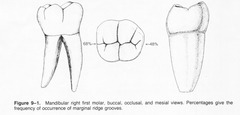
How many roots do Mandibular Molars have? Name them.
Which root is shorter?
Has 2 roots, mesial and distal.
Distal root is shorter. The Mesial root is longer.
Which root is longer on a mandibular molar?
the mesial root is longer and the distal root is shorter.
Where is the root furcation of mandibular molars located?
Close to the CEJ.
How many roots do maxillary molars have? Name them.
Tell which is the longest and which is the shortest.
Has 3 roots- mesiobuccal, distobuccal, and palatal (lingual).
*Palatal is longest*
Mesiobuccal is the middle
*distobuccal is shortest*
Maxillary molars have a longer root TRUNK than mandibular molars. True or false?
True. They converge into a broad root trunk.
(They have 3 roots)

What is the eruption date for maxillary first molars?
6 - 7 years
What is the eruption date for the maxillary second molars?
12-13
What is the eruption date for the maxillary 3rd molars?
17-21
What is the eruption date for the mandibular 1st molars?
6-7
What is the eruption date for the mandibular 2nd molars?
11-13
What is the eruption date for the mandibular 3rd molars?
17-21
What is the longest and strongest maxillary tooth?
The maxillary first molar
The tooth that shows least variation of any maxillary molar
The maxillary first molar
Usually has a fifth, nonfunctional cusp on the lingual of the mesiolingual cusp called cusp of Carabelli...
The maxillary first molar
Which tooth may have tubercles on mesial marginal ridge?
The maxillary first molar
*Maxillary first molar grooves*
There is a _____ ________ between mesiobuccal and distobuccal cusps.
buccal groove that extends onto the buccal surface. It also may have a pit at the end of the buccal groove.

*Maxillary first molar grooves*
Has a ________ ________ placed in central fossa
central groove

*Maxillary first molar grooves*
Possible ___________ __________ ____ _____ ____________ _________ if central groove continues distally. It crosses the oblique ridge if it exists.
Transverse groove of the oblique ridge

*Maxillary first molar grooves*
The___________ ________ _________ starts at distal triangular fossa lingually between distolingual and mesiolingual cusps.
And it continues onto lingual surface as lingual groove.
distal oblique groove

What groove on the maxillary first molar turns into the lingual groove once it reaches the lingual surface?
The distal oblique groove.

Although the oblique ridge usually is prominent, if it is NOT, the ___________ ____________ ___ ________ ________ ________may cross it.
Transverse groove of the oblique ridge

*Maxillary first molar, fossae*
what fossa is large, near center of occlusal center
Central fossa
The largest fossa

*Maxillary first molar, fossae*
what fossa is: second largest after central fossa. Extends between mesiolingual and distolingual cusps.
The distal fossa

*Maxillary first molar, fossae*
What is the third largest fossa?
Small mesial triangular fossa - third largest

*Maxillary first molar, fossae*
What is the smallest fossa?
The distal triangular fossa

*Maxillary first molar, fossae*
Name the fossa from largest to smallest
Central Fossa, Distal fossa, Mesial triangular fossa, then distal triangular fossa
*Maxillary first molar contacts*
Mesial contact?
Distal Contact?
*Mesial:* Junction of middle and occlusal thirds
*Distal:* In the middle of the middle third- more cervical than the mesial contact.
*Maxillary first molar contacts*
Just like all other molars-
Looking from an occlusal view, you can see the contact in a facio-lingual aspect. The contact is to the _________ of the facio-lingual midline of the crown.
To the facial
(giving it a larger lingual embrasure)
*Maxillary first molar view from occlusal*
Shaped like a ___________ (arch trait for maxillary molars)
parallelogram
*Maxillary first molar view from occlusal*
Wider ____________ than __________ (arch trait)
facio-lingually (wider)
Mesio-distally(less wide)
*Maxillary first molar view from occlusal*
Oblique ridge connects__________ cusp with _________cusp (arch trait).
Distobuccal with mesiolingual
*Maxillary first molar view from occlusal*
_______________cusp has 2 triangular ridges (arch trait) - this is the largest cusp
Mesiolingual
*Maxillary first molar view from occlusal*
The ________ surface of the tooth is more narrow. (Not like other molars!)
The buccal is more narrow.
The lingual is wider (due to the Mesiolingual and distolingual cusps)
The largest tooth facio-lingually.... is
The maxillary first molar
The maxillary first molar is ____________ than the maxillary second molar.
Larger
The maxillary second molar is ___________ than the maxillary first molar.
smaller
The Maxillary 2nd molar has ______ cusps.
Name them.
What cusp is absent?
3 cusps.
*1 Lingual*- The lingual cusp
*2 Buccal*- Mesiobuccal and Distobuccal
The cusp that is missing is the *disto-lingual*

*Maxillary 2nd molar*
There is no ___________ groove or _______fossa.
No lingual groove
OR
Distal fossa

*Maxillary 2nd molar roots*
The roots are spread __________ apart than the maxillary first molar.
LESS spread apart than the first maxillary molar.
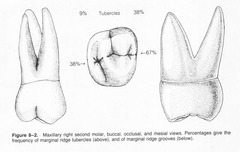
The maxillary 1st molar roots are ______ spread apart than the maxillary 2nd molar roots.
MORE spread apart

Maxillary 3rd molars occlude with:
Mandibular 3rd molars
Maxillary 3rd molars have ________ variance than any other tooth
Most morphologic variance of any tooth
Maxillary molars always have _____ roots.
Name them from largest to smallest.
3 roots
Palatal
Mesio-buccal
Disto-buccal
Name the *furcations* on maxillary molars.
They have 3 roots (Palatal, Mesiobuccal, and disto-buccal)
Mid-buccal, Mid-mesial, and Mid-distal
Mandibular crowns are are shorter _____________ -_______________than other mandibular teeth but larger in every other dimension.
Shorter Cervico-occlusally
The maxillary crowns tilt distally. True or false?
FALSE. Only mandibular molars have a distal tilt.
Mandibular crowns tip _________ like all other mandibular teeth.
LINGUALLY
What teeth do Mandibular molars occlude with?
The tooth right above it and the one anterior to that tooth. (this is because a normal "bite" is inched slightly forward in the mouth.
*Examples:*
What occludes with the mandibular 2nd molar?
The Maxillary 2nd molar and the Maxillary first molar.
What occludes with the mandibular 3rd molar?
The maxillary 3rd molar and the maxillar 2nd molar.
What teeth do the maxillary molars occlude with?
The tooth right below it and the tooth distal to it.
*Examples*
What teeth do the maxillary 2nd molars occlude with?
The Mandibular 2nd molar and part of the mandibular 3rd molar.
What teeth do the maxillary first molar occlude with?
The mandibular first molar and part of the mandibular second molar.
What is the main concern with mandibular molars?
The enamel may dip into the bifurcation.
And it could potentially cause periodontal problems.
*Most likely with MANDIBULAR FIRST MOLARS*
How many roots do mandibular molars have?
2 roots
1 mesial and 1 distal
What are the furcations on mandibular molars? (They have two roots- Mesial and distal)
Mid-facial and mid-lingual