A-Level Chemistry - 2.2 Electrons, bonding and structure
 Call Kai
 Learn
 Practice Test
 Spaced Repetition
 Match
 Flashcards
 Knowt Play
1/123

There's no tags or description
Looks like no tags are added yet.
124 Terms
How many electrons can fill the first four shells?
2, 8, 18, 32
What is a shell?
A group of atomic orbitals with the same principal quantum number, n
What is atomic orbital?
Region around the nucleus that can hold up to 2 electrons with opposite spins

What is a sub-shell?
A group of the same type of atomic orbitals within a shell
What is the principal quantum number, n?
Represents the relative overall energy of each orbital, which increases with distance from the nucleus (shell number)
What equation is used to determine the number of electrons that each shell can hold?
2n²
where n is the principal quantum number
What shape are s-orbitals?
spherical shape

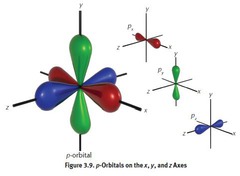
What shape are p-orbitals?
dumbbell shaped

How many orbitals make up s-sub-shells?
Each shell contains one s-orbital
How many orbitals make up p-sub-shells?
Each shell from n=2 onwards contains 3 p-orbitals
How many orbitals make up d-sub-shells?
Each shell from n=3 onwards contains 5 d-orbitals
How many electrons can fill an s-sub-shell?
2
How many electrons can fill a p-sub-shell?
6
How many electrons can fill a d-sub-shell?
10
What are the rules for filling orbitals?
In order of increasing energy for the first three shells and the 4s and 4p orbitals
For orbitals with the same energy, occupation singly before pairing
4s has a lower energy than 3d so it fills first

Describe what happened to the electron configuration when ions are formed
Positive ions: the electrons in the highest energy level are lost first
Negative ions: electrons fill the outer shell following the rules for filling orbitals
Give the electron configuration for a boron atom using sub-shell notation
Boron's atomic number is 5 so has 5 electrons
1s²2s²2p¹
Give the electron configuration for an O²⁻ ion
Oxygen's atomic number is 8 so ion would have 10 electrons
1s²2s²2p⁶
What is an ionic bond?
The electrostatic attraction between positive and negative ions

How does an ionic bond form?
Electrons are transferred from a metal atom to a non-metal atom
Metal atom loses electrons to form positive ions
Non-metal atom gains electrons to form negative ions
The oppositely charged ions are then held together by electrostatic attraction
How do you draw a dot and cross diagram for ionic bonding?
1) draw the outer shell electrons for the metal and non-metal with the element symbol inside the electron shell (dots and crosses are used to show the difference between the electrons of the metal and non-metal)
2) Draw an arrow to show the products formed during ionic bonding
3) Metal atoms lose electrons, forming an empty shell, and non-metals gain electrons to form a full outer shell
4) Draw the stable outer shell of the metal and non-metal in large square brackets
5) draw the charges of the ions in the top right hand corner outside the square brackets

Draw the dot and cross diagram for ionic bonding of sodium chloride

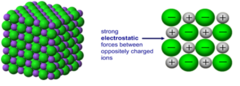
Describe the structure of a giant ionic lattice
Each ion is surrounded by oppositely charged ions
Ionic compounds are held together by oppositely charged ions strongly attracted in all directions

What is an ionic lattice?
a repeating pattern of positive and negative ions
Give three properties of ionic compounds
high melting and boiling points
soluble in polar solvents like water
conduct electricity when molten or in solution
Why do ionic compounds have high melting and boiling points?
There are very strong electrostatic forces of attraction between oppositely charged ions, which take a lot of energy to break
Can ionic compounds conduct electricity when solid? Why?
No, because ions are in held in fixed positions by the electrostatic forces of attraction and are not free to move

When can ionic compounds conduct electricity?
When molten or in solution
Why can ionic compounds conduct electricity when molten or in solution?
The solid lattice breaks down and the ions are free to move

Why are ionic compounds soluble in polar solvents like water?
A polar solvent contains polar molecules
Polar molecules surround the ions, which can overcome the electrostatic attraction between the ions

What happens to solubility as the charges on the ions in an ionic compound increase? Why?
It decreases, because the polar molecules cannot overcome the electrostatic forces of attraction
What is a polar solvent?
Polar solvents contain polar molecules which contain polar bonds caused by unequal sharing of electrons
Describe how water breaks down ionic lattices
The δ- charged oxygen atoms of the water molecule are attracted to the positive metal ions
The δ+ charged hydrogen atoms of the water molecule attracted to the negative non-metal ions
The polar water molecules overcome the electrostatic forces of attraction between oppositely charged ions, breaking down the ionic lattice
What is a covalent bond?
The strong electrostatic attraction between a shared pair of electrons and the nuclei of the bonded atoms
Describe how to draw a dot and cross diagram for covalent bonding
1) draw the outer shell of the two nonmetal atoms overlapping with the symbol of the element in the centre
2) determine how many pairs of electrons need to be shared between the atoms for each atom to have a stable outer shell of electrons
3) fill in the outer electrons for the atoms using dots and crosses for different elements. Draw the shared pair of electrons in the space where the outer shells overlap.
Draw the dot and cross diagram for H₂

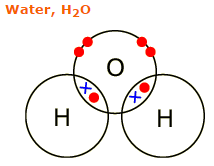
Draw the dot and cross diagram for water
Draw the dot and cross diagram for ammonia

Draw the dot and cross diagram for methane

What is a lone pair of electrons?
A pair of outer shell electrons that are not involved in chemical bonding

What property does a lone pair give an atom?
A concentrated region of negative charge around the atom, which can influence the chemistry of the molecule
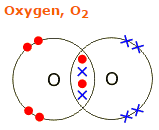
Draw the dot and cross diagram for oxygen
Draw the dot and cross diagram for nitrogen

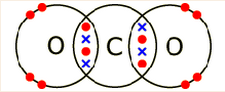
Draw the dot and cross diagram for carbon dioxide
What is average bond enthalpy?
A measure of the average energy of a bond, and therefore the energy needed to break it
Also a measure of covalent bond strength

What happens to the average bond enthalpy as the strength of the covalent bond increases?
It increases
What is dative (coordinate) covalent bonding?
One of the atoms supplies both the shared electrons to the covalent bond

What must an atom have in order for a dative covalent bond to form?
A lone pair of electrons
Draw the dative covalent bond diagram for the ammonium ion, NH₄⁺
The direction of the arrow indicates the direction in which the electron pair is being shared

Describe how the octet rule can be broken
During covalent bonding unpaired electrons pair up.
The maximum number of electrons that pair up is the number of electrons in the outer shell.
Some atoms in covalent bonding do not always reach a noble gas configuration as there may be too many or too few electrons

Name the elements in group 5 which can expand their octets during covalent bonding
Phosphorus, P
Arsenic, As
Name the elements in group 6 which can expand their octets during covalent bonding
Sulphur, S
Selenium, Se
Tellurium, Te
Name the elements in group 7 which can expand their octets during covalent bonding
Chlorine, Cl
Bromine, Br
Iodine, I
Astatine, At
Name the two types of covalent compounds
Simple molecular structure
giant covalent structure
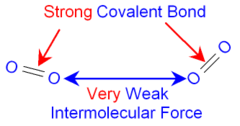
Describe the structure of simple molecular compounds
Atoms within the molecules held together by strong covalent bonds
Molecules held together by weak intermolecular forces
Give three properties of simple molecular structures
Low melting and boiling points
Do not conduct electricity when solid or liquid
Generally soluble in nonpolar solvents
Why do simple molecular structures have low melting and boiling points?
The intermolecular forces are weak so not much energy is needed to overcome them and separate the molecules
Why do simple molecular structures not conduct electricity when solid or liquid?
There are no charged particles that are free to move
Why are simple molecular structures generally soluble in nonpolar solvents?
Intermolecular forces can form between the covalent molecules and the solvent
Name the structure of solid bromine or chlorine
Simple molecular lattice
Give three properties of giant covalent structures
High melting and boiling points
Do not conduct electricity (apart from graphite and graphene)
Insoluble in polar and nonpolar solvents
Why do giant covalent structures have high melting and boiling points?
All atoms are linked to each other by strong covalent bonds, that take a lot of energy to overcome
Why do giant covalent structures not conduct electricity (apart from graphite and graphene)?
There are no charged particles free to move
In graphite and graphene, there are delocalised electrons that can freely move through the structure
Why are giant covalent structures insoluble in polar and nonpolar solvents?
Covalent bonds are too strong to be broken apart by the solvents
What is electron pair repulsion theory?
All electrons have a negative charge, so pairs of electrons around the central atom in a molecule all repel each other
The molecule will adopt a shape that allows each electron pair to be as far away from each other as possible

What does a singular line show about the direction of a bond?
The bond is in line with the plane of the paper
What does a shaded wedge show about the direction of a bond?
The bond is coming forward, out of the page
What does a dashed wedge show about the direction of a bond?
The bond is going backwards, into the page
What dictates the shape of a molecule?
The number of lone/bonded electron pairs around the central atom
What shape is a molecule with two bonded pairs around the central atom?
Linear

What is the bond angle for a linear molecule?
180°
Draw the 3D structure of a linear molecule

Give an example of a linear molecule
CO₂
What shape is a molecule with three bonded pairs around the central atom?
Trigonal planar

What is the bond angle for a trigonal planar molecule?
120°

Draw the 3D structure of a trigonal planar molecule

Give an example of a trigonal planar molecule
BF₃
What shape is a molecule with four bonded pairs around the central atom?
Tetrahedral
What is the bond angle in a tetrahedral molecule?
109.5°
Draw the 3D structure of a tetrahedral molecule

Give an example of a tetrahedral molecule
CH₄
What shape is a molecule with five bonded pairs around the central atom?
Trigonal bipyramid
What are the bond angles in a trigonal bipyramid molecule?
120°, 90°
Draw the 3D structure of a trigonal bipyramid molecule

Give an example of a trigonal bipyramid molecule
PCl₅
What shape is a molecule with six bonded pairs around the central atom?
Octahedral
What is the bond angle in an octahedral molecule?
90°
Draw the 3D structure of an octahedral molecule

Give an example of an octahedral molecule
SF₆
Give the three steps for drawing the 3D shape of molecules
1) draw the dot and cross diagram to figure out the number of bonded/lone electron pairs around the central atom
2) assign the shape depending on the number of bonded and lone pairs
3) predict the bond angles
Describe the relative strength of repulsion between lone pairs and bonded pairs of electrons
Lone pair to lone pair repulsion > lone pair to bonded pair repulsion > bonded pair to bonded pair repulsion
Which repel more: lone pairs or bonded pairs?
lone pairs
Describe and explain the shape and bond angles in a methane molecule
Shape: tetrahedral
Bond angles: 109.5°
Methane has four bonded pairs which all repel each other the same amount. The molecule adopts a tetrahedral shape which allows all the bonded pairs to be as far away from each other as possible.
Describe and explain the shape and bond angles in an ammonia molecule
Shape: pyramidal
Bond angles: 107°
Ammonia has three bonded pairs and one lone pair. The electron pairs repel, but the lone pair repels more than the bonded pairs, reducing the bond angle by 2.5°
Draw the 3D structure of an ammonia molecule

Describe and explain the shape and bond angles in a water molecule
Shape: non-linear
Bond angles: 104.5°
Water has two bonding pairs and two lone pairs. The electron pairs repel, but lone pairs repel more than the bonding pairs, reducing the bond angle by 5° (2.5° per lone pair)
Draw the 3D structure of a water molecule

What is electronegativity?
The ability of an atom to attract the bonding electrons in a covalent bond
Name the scale used to measure electronegativity
Pauling scale
Describe the pattern of electronegativity across the periodic table
Increases towards fluorine