Genetics Exam 3
 Call Kai
 Learn
 Practice Test
 Spaced Repetition
 Match
 Flashcards
 Knowt Play
1/83

There's no tags or description
Looks like no tags are added yet.
84 Terms
constitutive genes
products are essential to normal, growing cell
always active (transcription is always happening)
“housekeeping genes”
genes that these make are required for life
regulated genes
products are needed only at specific times
activity is controlled in response to needs of cell/organism
often expressed in specific environmental/developmental context
mechanisms:
repressor and activator proteins (lac operon)
attenuation
antisense RNA
riboswitch
operon
a cluster of genes coordinately regulated by one promoter
genes that are important for lactose metabolism in E.coli
present in PROKARYOTES ONLY
lac operon
single promoter upstream of several coding regions
generate a polycistronic mRNA
codes for many products
genes processes are necessary to metabolize lactose
need to be on at certain times
lactose must get converted into allolactose in order for this to be turned on
permease
necessary for importing lactose in cell
brings lactose into the cell
Lac Y
Beta-galactosidase
break down complex sugar lactose into its two simple sugar
galactose and glucose
lactose metabolism
Lac Z
lactose (converted to allolactose) induces expression of 3 genes
Beta-gal → lactose metabolism
permease → brings lactose into the cell
transacetylase → functional significance unclear
transacetylase
functional significance unclear
Lac A
polycistrontic mRNA
proteins are normally not always expressed because regulated genes
proteins only needed when lactose is present
only need these when lactose is present
protein expression was studies in several mutant bacterial strains
ask whether or not these strains will express these genes under certain condition
constitutive mutant
proteins are produced all the time, no longer regulated
Lac I
controller of inducibility
functions as a repressor
not linked to lac operon
I protein
I+>I-
encodes protein that negatively controls Beta-gal gene (encodes repressor)
transcription is blocked in the absence of inducer
allolactose binds I and prevents it from blocking transcription
merozygote
partial diploid cell
transacting factor
a molecule that can move around in the cell and exert its effect in several different places
Which is dominant over the other: I+ or I- in trans?
I+
negative control
repressor normally blocks transcription
presence of inducer overcomes block
IS
super-repressor
never allows for expression at the lac operon → always turned off
lac Z gene never induced (transcription always suppressed)
eliminates response to inducer
cannot bind allolactose
dominant to I+ and I-
no expression with beta-gal
Repressor Protein (I) sites
DNA bind site
if I-, then can’t bind DNA; transcription is always on
binds to lacO+
allolactose binding site
when bound to allolactose, 3D structure of I changes such that DNA binding becomes impossible
If IS, then can’t bind allolactose, so I never leaves DNA, transcription never happens
always blocking RNAP
the two binding sites are mutually sites
one binds, the other cannot bind
__ binds DNA at operator
DNA bind site
If I-, then can’t bind DNA; transcription is always on
repressor protein site
allolactose binding site
when bound to allolactose, 3D structure of I changes such that DNA binding becomes impossib;e
If IS, then can’t bind allolactose, so I never leaves DNA; transcription never happens
always blocking RNAP
I-
mutant allele of repressor gene that codes for a version of the protein that is unable to bind DNA
can never bind to DNA so always expressing
constitutive expression
OC
where mutations in DNA at operator are called
constitutive operator (never blocking RNAP)
prevent the repressor from binding so RNAP is never blocked so transcription happens
transcription is always on
cis-acting element
only affects genes it is attached to
prevent repressors from binding
transcription and translation happen
cis-acting element
will only exert its effect to the things it is directly attached to
examples
OC
lac operon promoter
lac operon promoter
place where RNA Polymerase binds
cis-acting element
flow chart for problem solving

wild-type
not made without lactose (non-induced: - lactose)
all are +
nonsense mutation
sense codon is changed to nonsense codon (stop codon)
causes ribosome to stop translation early
because sense codon is changed to stop codon, the full length protein is not getting made, protein synthesis stops once it hits that mutation
downstream products are not made
example
this is on Lac Y, Lac Z will get made, but Lac Y and Lac A will not get made
missense mutation
sense codon is changes to a different sense codon
cause change in only one amino acid sequence
incorrect placement of one amino acid, full length protein is still being made at one position
will not affect downstream products
example
mutation in Lac Z, it will lead to a nonfunctional protein but the full length protein will still get made and then the ribosome will carry one and translate permaease and trandsaceyltalse
positive control
lac operon has __ of gene expression
stimulate or upregulate gene expression
regulatory protein directly stimulates transcription
mechanism for cell to determine if glucose is present
glucose is easier to metabolize than lactose because it is a simple sugar
expression of lac operon is not need in the presence of glucose
if both lactose and glucose are present, lac operon will use glucose because it requires less energy because doesn’t need to turn on lac operon
CAP
inactive
CAP + cAMP
active
binds DNA at CAP site near beginning (5’ end) of promoter
help gene expression
adenylate cyclase
makes cAMP
inhibited by glucose
lots of glucose, no cAMP, no active cap, do not want lac operon to be on with glucose
high levels of glucose
cAMP
low
cAMP-CAP
low
binding at CAP site
no
RNAP binding
inefficient
beta-gal made?
no
low levels of glucose
cAMP
high
cAMP-CAP
high
binding at CAP site
yes
RNAP binding
efficient
beta-gal made?
yes
provided that lactose is also present in cell
tryptophan operon
contains one promoter and 5 genes that code for enzymes necessary to make trp
has two controls
negative control
attenuation
active trp operon conditions
a cell that has lots of tRNAtrp
uncharged, do not have enough of the amino acid to charge it → low levels of trp
a cell that has low levels of the amino acid tryptophan
low levels indicates it wants to synthesis more trp
negative control
part of the tryptophan operon
Trp R + repressor gene unlinked to trp operon
repressor protein + Trp binds to operator
this inhibits RNAP binding in the presence of trp

attenuation
part of tryptophan operon
only in prokaryotes because need transcription and translation to happen at the same time
5’ UnTranslated Region (5’ UTR) is important
contains short open reading frame within 2 trp codons
contains regions 1, 2, 3, 4 (2 can interact with 1 and 3; 3 can interact with 2 and 4)
con from different secondary structures (stem-loops)
signals for RNAP
2-3 → GO
3-4 → termination (rho-independent)
forms the stem-loop → termination
simultaneous transcription and translation in prokaryotes
when tryptophan levels are low
want to turn on system
RNAP is creating an even larger mRNA
enough of that mRNA made, our ribosome can jump on and begin translation
attenuation low level trp
RNAP is creating an even larger mRNA
enough of that mRNA made, our ribosome can jump on and begin translation
ribosome attaches to the mRNA
ribosome pauses once it reaches the Trp codon
waiting for Trp-tRNATrp and bind because right now, don’t have much charged tRNATrp
because ribosome is on the Trp codon, 1 and 2 cant form stem loop
RNAP continues on
when regions 2 and 3 are transcribed, they from stem-loop
tells RNAP to GO!!!!!
2-3 is anti-terminator because it prevents rho-independent termination from happening by preventing 3-4 stem loop from forming

attenuation high levels trp
RNAP is making mRNA longer
ribosome jumps on once mRNA is long enough
Ribosome does not stall at the trp codon
because there are lots of Trp-tRNAtrp
RNAP and ribosome both continue
Ribosome is on region 2 before region 3 is transcribed
Region 3 must make stem-loop with region 4 once RNAP is done with it
tells RNAP to terminate
rho-independent
need stem loop (causes RNAP to pause) but we need region of U’s in RNA and A’s in DNA
relatively unstable so can dissociate without rho-protein there
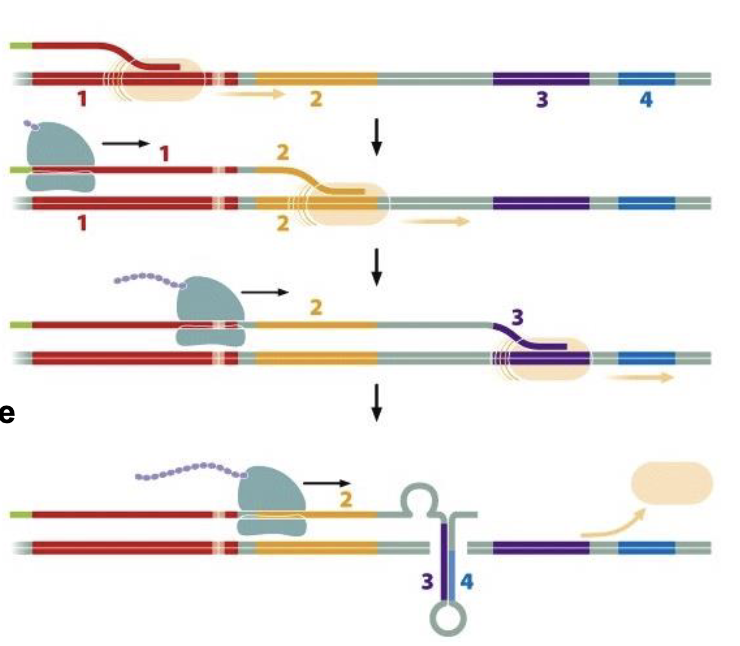
antisense RNA
small RNAs
inhibit translation by binding complementary sequence in mRNA
regulating gene expression at the level of translation
regulation of ompF
ompF encodes protein that works as an outer membrane channel for diffusion of water and ions
riboswitches
regulatory sequence in mRNA (usually 5’ UTR) where small molecules can bind
the small molecules can act as inducers or repressors
formation of secondary structure in mRNA affects translation
when this is in 5’UTR of mRNA, can affect gene expression
presence of regulatory protein stabilizes secondary structure
the secondary structure prevents ribosomes from binding
if there is not enough of the regulatory protein, this will fall apart, then the ribosome binding site is accessible and translation can happen
if there is enough of the regulatory protein, then translation will not occur because the ribosome binding site is not accessible
example
coenzyme B12
translation only occurs only if there is no active B12 present
lecture 18 part 2 second last slide has picture
can catalyze destruction of mRNA
ribozymes (RNAs with enzymatic activity)
it catalyzes cleavage of its own message
attaches to the switch (stem loops)
Glutamine-6-phosphate amidotransferase catalyzes synthesis of small sugar (GlcN6P)
GlcN6P is an active enzyme
results in cleavage
more enzyme production not needed when enough of sugar is made
ompF
encodes protein that works as an outer membrane channel for diffusion of water and ions
regulation of expression by antisense RNA
typically expressed under conditions of low osmolarity

pre-mRNA processing
5’ capping
3’ cleavage
Poly A tail addition
splicing
eukaryotic gene expression
mature mRNA must be transported into the cytoplasm
controlled by
DNA packing
transcription initiation
RNA processing
RNA stability
Translation initiation
DNA packing
metaphase chromosome (regular chromosome shape)
most tightly packed the chromatin is
more loosely packed and diffuse through nucleus in other steps
chromatin
DNA + protein (diffuse during most of the cell cycle)
less compact than metaphase chromosome
tightly packed areas → heterochromatin → inactive/few genes
genes in this are not being expressed
loosely packed areas → euchromatin → active/many genes
chromatin remodeling
DNA methylation
modification of histone proteins
eukaryotic gene expression
chromatin remodeling
proteins reposition nucleosome on DNA
the __ complex comes in and binds usually in linker histone, shifting things down, allowing for things like transcription factors and RNAP to come in and bind
DNA is more accessible to transcription factors
no chemical modifications of DNA
no chemical modifications of histones
part of DNA packing part of euk gene expression regu
DNA methylation
this is adding ME to a C base in a nucleotide
mainly happens at CpG islands
many repeats of CG
common in promoters
correlates with decreases transcription
ME of DNA correlates to deacetylation of histone proteins that are bound to the DNA
correlates with deacetylation of histone proteins
removal of acetyl groups from histone tails
allows for tighter DNA packing
is the binding site for histone deacetylases
enzyme that remove acetyl groups from histones
acetyl group on histone creates loosely packed DNA because the acetyl groups are buffering the positive charges on the histone tails from interacting with a negative charge in the phosphate backbone of the DNA
DNA less available for transcription
example
Fragile C syndrome
leading inherited cause of mental retardations
triplet repeat disease
non-disease chromosome have CGG repeat (29 copies) upstream of FMR-1 Gene
disease chromosome have 200-1300 copies of CGG repeat
coding region of gene is same in normal and diseased individual
many repeats → increased methylation → deacetylation → closed conformation → no FRM-1 expression
DNA in promoter will be more methylated which will lead to a closed conformation such that the FRM-1 gene is not expressed in these individuals
part of DNA packing part of euk gene expression regu

histone modification
happens to amino acids in “tail” of protein
adding chemical groups to amino acids in the carboxyterminous or tail portion of the protein
can include phosphorylation, ubiquitination, acetylation, methylation
often creates “epigenetic mark”
can increase or decrease transcription, depending upon which amino acids are modified
part of DNA packing part of euk gene expression regu
population genetics
study of genetic composition of a GROUP of individuals
frequencies of different alleles in a population
study of how genetic composition in population changes over time
change over time shows evolution
causes for change that we will consider include mutation, migration, natural selection and genetic drift
population
group of interbreeding, sexually reproducing individuals that share a common gene pool
total of all alleles carried in all members of a population
can be described by calculating:
genotypic frequency
proportion of a particular genotype in a population
how often different genotypes show up in a population
allelic frequency
proportion of a particular allele in a population
how often do we see different alleles in a population
genotypic frequency calculation
get the number for the question and then divide by the total number of population
(# of that given genotype)/total number of population
should add up to 1
allelic frequency calculation
p = f(dom genotype) + ½ f(het)
q = f(rec geno) + ½ f(het)
use the numbers that were found for the other one
should add up to 1
Hardy-Weinberg Equilibrum
if a population is in this, then allele frequencies will not change over time
population is NOT evolving
5 assumptions
very large population
random mating
no new mutations
no migratoin
no natural selection
2 conclusions
allele frequencies do not change from one generation to the next
genotype frequencies can be calculated from allele frequencies
p2, 2pq, q2
chi-square analysis
df = # of genotypes - # of alleles
p<0.05, we reject the hypothesis and conclude that population is NOT in this
HWE with more than 2 alleles
(p + q + r)2 = p2 + 2pq + 2pr + q2 + 2qr + r2 = 1
HWE X-linked
If q = 0.1 → 1/10 males affected
but # of females affected = q2= 0.01 → 1/100 females affected
for males, genotype frequency is allele frequency
no change in calculations for females
nonrandom mating
positive assortative mating → like mates with like
tall people mate with tall people
only affects genes associated with a particular trait
negative assortative mating → unlike individuals mate
only affects genes associated with a particular trait
inbreeding → mating between relating individuals
affects all genes
conditions that change allelic frequencies
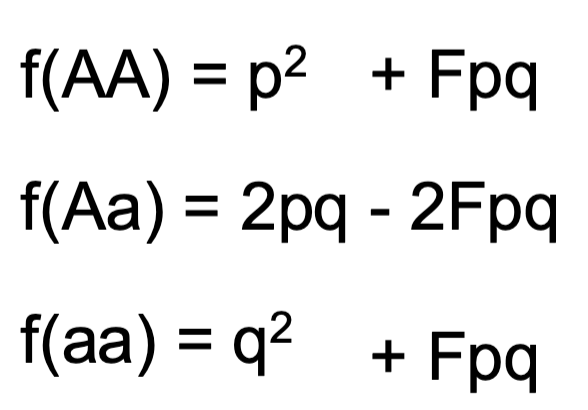
inbreeding
measured by the inbreeding coefficient (F) → probability that 2 alleles are identical by descent
if 0, then mating in large population is random
if 1, then all alleles are identical by descent
reduces proportion of heterozygotes
increases proportion of both homozygotes according to these equations (in picture)
eventually all genotypes will be homozygous
if neither homozygote has advantage over the other, both alleles will remain in population
if dom, dom will show up
inbreeding depression
increased appearance of recessive lethal and deleterious traits because of the increase number in homozygotes
example
imagine recessive allele (a) that causes genetic disease. frequency of allele a in a randomly mating population is 0.01
f(a) = q = 0.01
F = 0
f(aa) = q2 = 0.001 → 1/10,000 individuals affected
thus, population mates randomly so no inbreeding
now let F=0.25 (the equivalent of brother-sister mating)
f(aa) = q2 + Fpq = (0.01)2 + 0.25 (0.99)(0.01) = 0.0026 → 26/10,000 individuals affected
gene mutations
necessary for genetic variation that leads to evolution
condition that change allelic frequencies
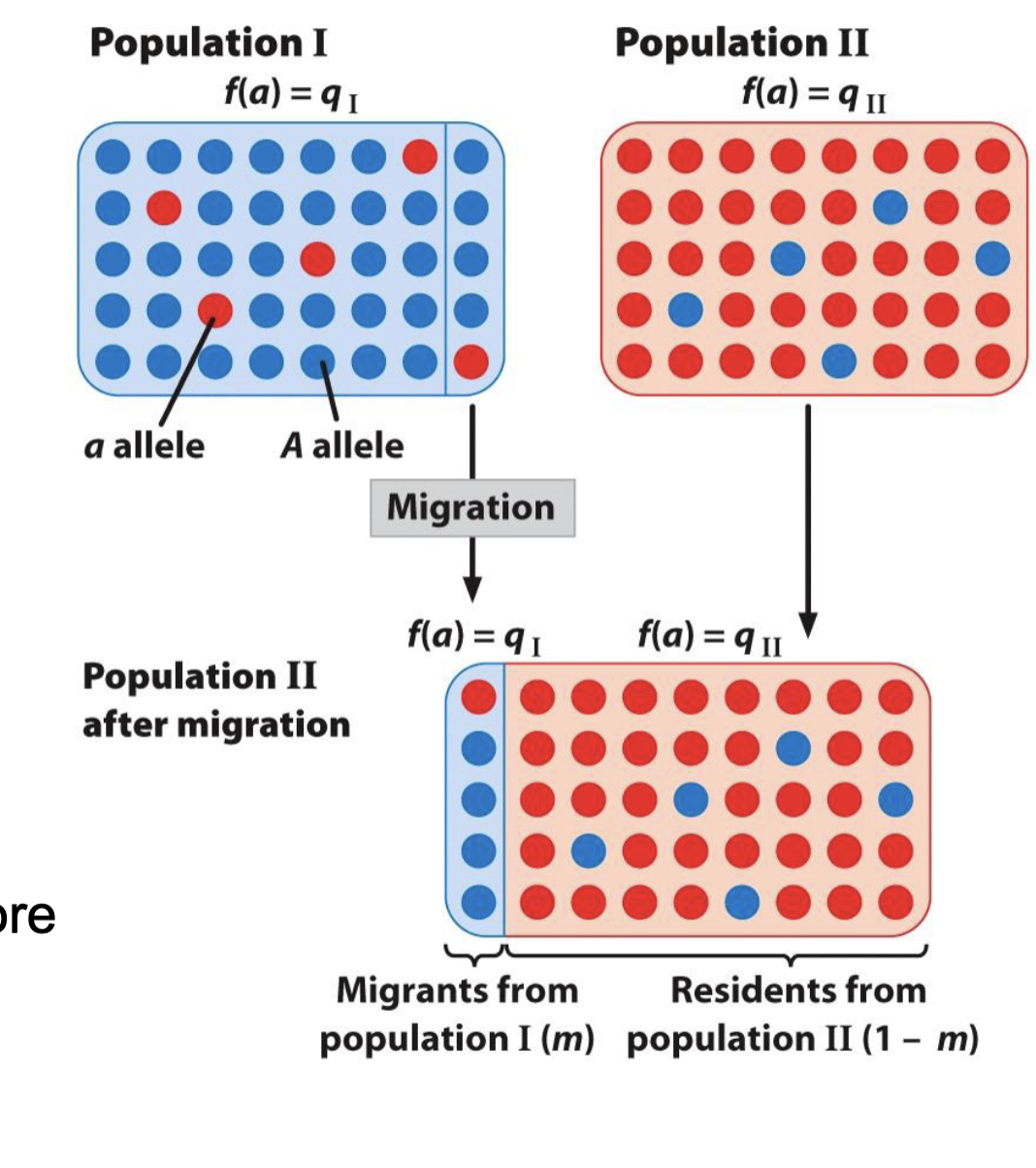
migration
causes gene flow between populations
causes gene pools of different populations to become more similar
because exchanging material
adds genetic variation to populations
example
a part of population 1 moves to population 2
population 2 slowly evolves and becomes more like population 1 so population 2 becomes more genetic diverse
just understand general concept
condition that change allelic frequencies
genetic drift
changes to allele frequencies over time that happen in a population because there is a chance involved in gamete selection
think of this as sampling error
happens in all populations
greatest effect on small populations
sampling error examples
resource limitations
founder effect
genetic bottleneck
effects
changed allele frequencies WITHIN a population
random changes so cannot be predicted
reduced genetic variation WITHIN a population
over time, one allele becomes “fixed” in population
reaches frequency of 1
population 1 fixes q, population 2 fixes p
genetic divergence BETWEEN populations
random changes so will be different for each population
resource limitations
not enough space, food, etc leads to reduced population size
affect which individuals are parents
part of genetic drift sampling error
founder effect
isolated population established by small # of individuals
allele frequencies change because founders carry only a fraction of alleles from original population
affect who is parents in generations
new population is going to change based on who are the founders of the population
it limits the available alleles in the gene pool to whatever the founders bring in
example
amish community
population ~14,000
established by 200 German immigrants
mating among these individuals
really similar to frequency to those in Germany orignially
overtime, frequency of alleles increases based on what is there
part of genetic drift sampling error
genetic bottleneck
population undergoes drastic size reduction
may be due to hunting or disease
example
northern elephant seals on CA coast
they were intensively hunted
allele frequencies are different from what they once where because limiting amount of individuals that are going to contribute to the gene pool
part of genetic drift sampling error
natural selection
differential reproduction of certain genotypes in a population
driven by interactions between PHENOTYPES and environment
genetically determined
phenotype is determined by genotype
eliminates individuals whose fitness is lower
individuals with higher fitness are more likely to parent next generation
change allele frequency
natural selection fitness
relative reproduction success of a genotype
reproductive success of 1 genotype compared to other genotypes
values between 0 and 1
high value → genetic variations help individual survive and reproduce
most fit is the one with the most offspring and it is set to 1
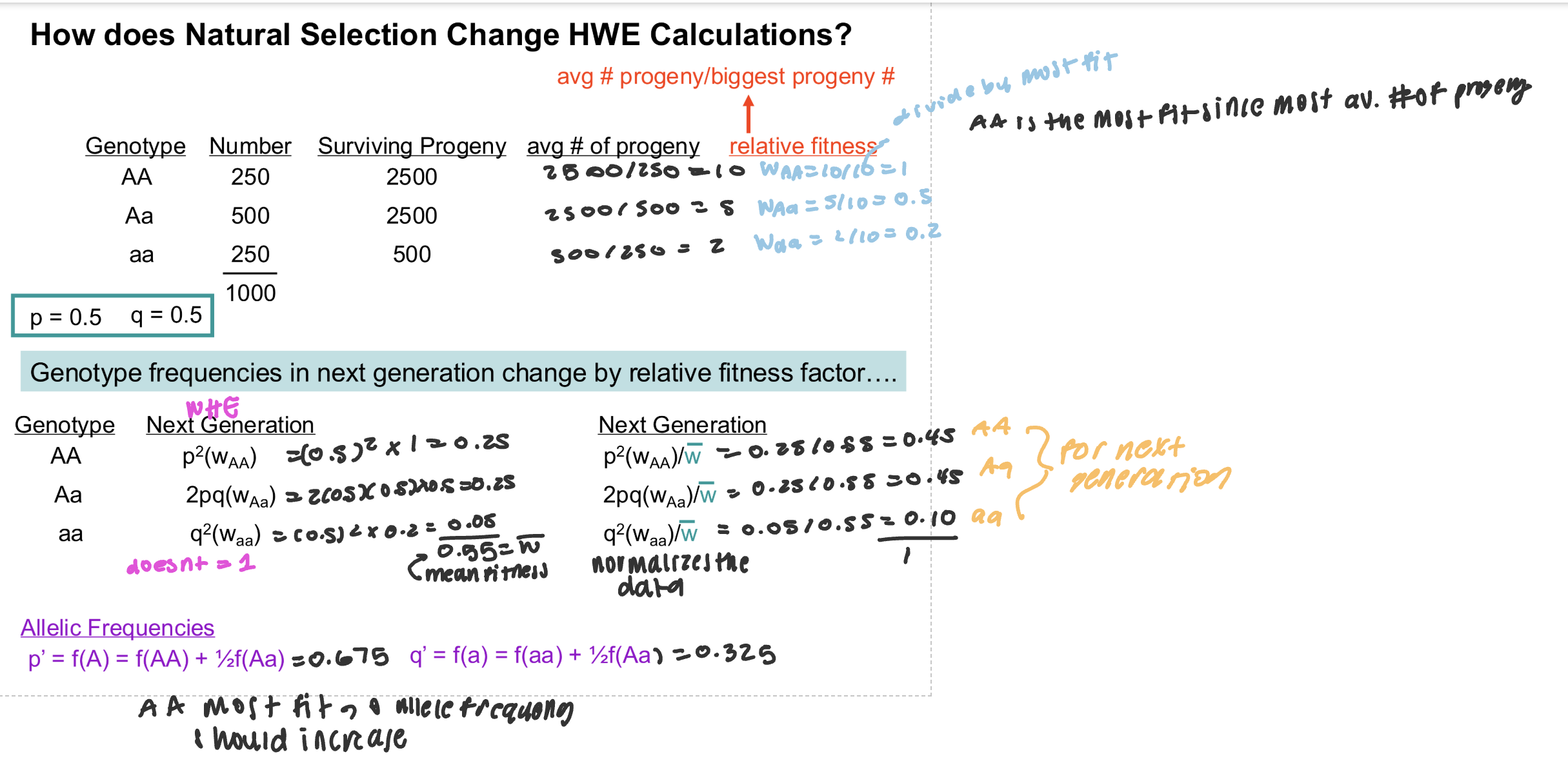
genotype frequencies in next generation change by relative fitness factor
first find mean fitness then divide that by that generations #
look at last slide from 21 part 2 for question example
average progeny
surviving progeny/number of genotype
relative fitness
average # of progeny / biggest avg progeny number