Chapter 24 Digestive System Review
 Call Kai
 Learn
 Practice Test
 Spaced Repetition
 Match
 Flashcards
 Knowt Play
1/55

There's no tags or description
Looks like no tags are added yet.
56 Terms
What are the major organs of the digestive system?
Oral Cavity - Ingestive with accessory organs (teeth, tongue)
Pharynx
Esophagus - Transport of material to stomach
Stomach - Chemical digestion of materials by acid and enzymes
Small intestine - Absorption of water, organic substrates, vitamins, ions
Large intestine - Dehydration and compaction of indigestible materials
What are the 6 intergrated processes of the digestive system?
Ingestion - Occurs when food enters body
Mechanical digestion and propulsion - Crushing & shearing food
Chemical digestion - breakdown of food into small organic fragments for absorption
Secretion - Release of water, acids, enzymes, buffers, salts
Absorption - Movement or of organic molecules, electrolytes, vitamins, minerals, and water
Defecation - Elimination of wastes from body

Define the Histology of the digestive tract, what are the major layers?
Mucosa
Submucosa
Muscular layer
Serosa
Where do the longitudinal folds in?
The empty stomach.
Where do the permanent transverse folds in?
The small intestine
What are the four functions of the Oral Cavity?
Sensory analysis
Mechanical Digestion (via teeth, tongue)
Lubrication (mixing with mucus and saliva)
Limited chemical digestion

What is the function of the Uvula?
Function of the Uvula is to prevent food from entering pharynx too soon
What is the tongue’s function (theres 4)
Mechanic digestion (compression, abrasion, distortion)
Manipulation to assist in chewing and to prepare food for swallowing
Sensory via touch, temperature, and taste
Secretion of mucins and lingual lipase

What is the function of Enamel in teeth?
Function of enamel is to cover the dentin.

What is the the cusp in teeth?
The cusp are the elevation.
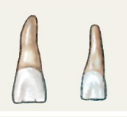
What type of tooth is this?
What is its function?
Incisors
Used for clipping or cutting
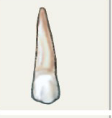
What type of tooth is this?
What is its function?
Canines
Used for tearing or slashing

What type of tooth is this?
What is its function?
Premolars
Used to crush, mash, grind

What type of tooth is this?
What is its function?
Molars (two - three roots )
Used for crushing and grinding
What is another word for Deciduous teeth?
How many of them does a person have?
Baby teeth.
20 temporary teeth.
In terms of permanent teeth, how do they replace deciduous teeth?
How many permanent teeth do you have?
Via Eruption
32 Permanent teeth.

What salivary gland is this?
What is the function?
Parotid gland
Function is to produce secretions

What salivary gland is this?
What is the function?
Sublingual gland
Function is to produce mucus (acts a buffer)

What salivary gland is this?
What is the function?
Submandibular gland
Function is to secrete buffers, mucins, and salivary amylase
What percentage of water is saliva?
What is the remaining percentage consist of?
Saliva is 99.4% water
Remaining is electrolytes, buffers, antibodies, waste
What does saliva keep pH of mouth near?
7
Define Mastication
Chewing
(True or false) Tongue compacts chewed food into a bolus (rounded ball)
True
Define Deglutition, and can it be initaited voluntarily?
Deglutition is swallowing, can be initiated voluntarily, but proceeds automatically.
What are the major functions of the stomach?
Storage of ingested food
Mechanical digestion with muscular contractions
Chemical digestion of food with acid or enzymes
Define Chyme
Partially digested food mixed with acidic secretions of stomach.
(True or false) Nutrients are NOT absorbed in stomach.
True

What is the function of rugae?
Allow for expansion of gastric limen
How many mL of gastric juice does the gastric glands secrete?
1500mL
What do parietal cells secrete?
Hydrochloric acid.
What type of epithelium lines the stomac?
Simple columnar
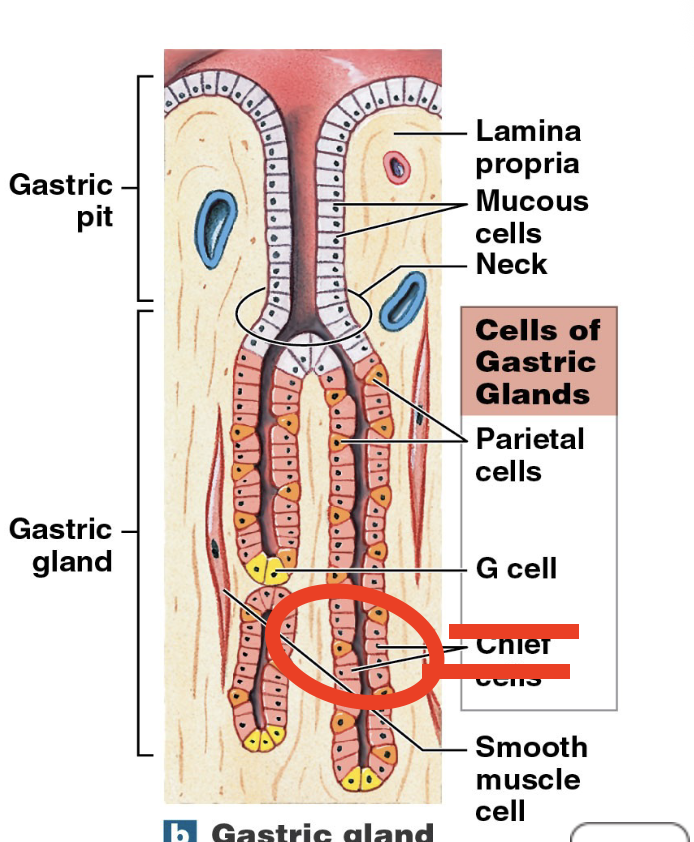
What do chief cells secrete?
Pepsinogen

What do G cells release?
Somatostatin
What does the pancreatic lipase do?
Breaks down certain complex lipids.
What does the Nucleases do?
Breakdown of RNA or DNA
What are the 3 Proenzymes secreted by pancreas?
Trypsinogen
Chymotrypsin
Procarboxypeptidase

What is the liver divided into?
What does the liver secrete?
Left and right lobes
Caudate lobe
Quadrate lobe
Liver secretes bile.
(True or false) All blood leaving absorptive surfaces of digestive tract enters hepatic portal system.
True
(True or false) Liver removes and stores excess nutrients
True
What do the activities of the liver affect?
Carb metabolism
Lipid metabolism
Amino acid metabolism
Waste removal
Vitamin storage
(True or false) Liver recevives about 25 percent of cardiac output
(True or false) Liver is the largest blood reservoir in the body
True
True
What are the hematological regulation by the liver involve?
- Synthesis of plasma proteins
- Removal of circulating hormones
- Removal of antibodies
- Removal or storage of toxins
(True or false) Bile salts in bile break lipid apart emulsification in duodenum
(True or false) Gallbladder stores and concentrates bile prior to secretion
True
True

What are the 3 segments of the small intestine
Duodenum
Jejunum
Illeum
(True or false) Lacteal transports chylmicrons that are too large to enter blood capillaries
True
What are the major hormones of duodenum
- Gastrin (contraction)
- Secretin (activates)
- GIP
- CCK
- VIP
- Enterocrinin

What is the function of the Ileocecal valve
The Ileocecal valve is the connecting point between small intestine and large, open and closes to allow food to go one way

What are the 3 parts of the large intestine
Cecum
Colon
Rectum

What is the haustra
little folds

What are the four regions of the colon?
Ascending colon
Transverse colon
Descending colon
Sigmoid colon
(True or false) Large intestine lacks villi, and is dominated by goblet cells
True
Functionals or large intestine
Absorption or reaction of water nutrients bile salts and organic wastes
Compaction of feces, storage of fecal material
Why produces the “rotton egg” odor
Hydrogen sulfide
What is a balanced diet
- Carbs
- Lipids
- Proteins
- Vitamins
- Minerals
- Water
What are the water - soluble vitamins?
B’s and C’a
What are the fat - soluble vitamins
A
D
E
K